
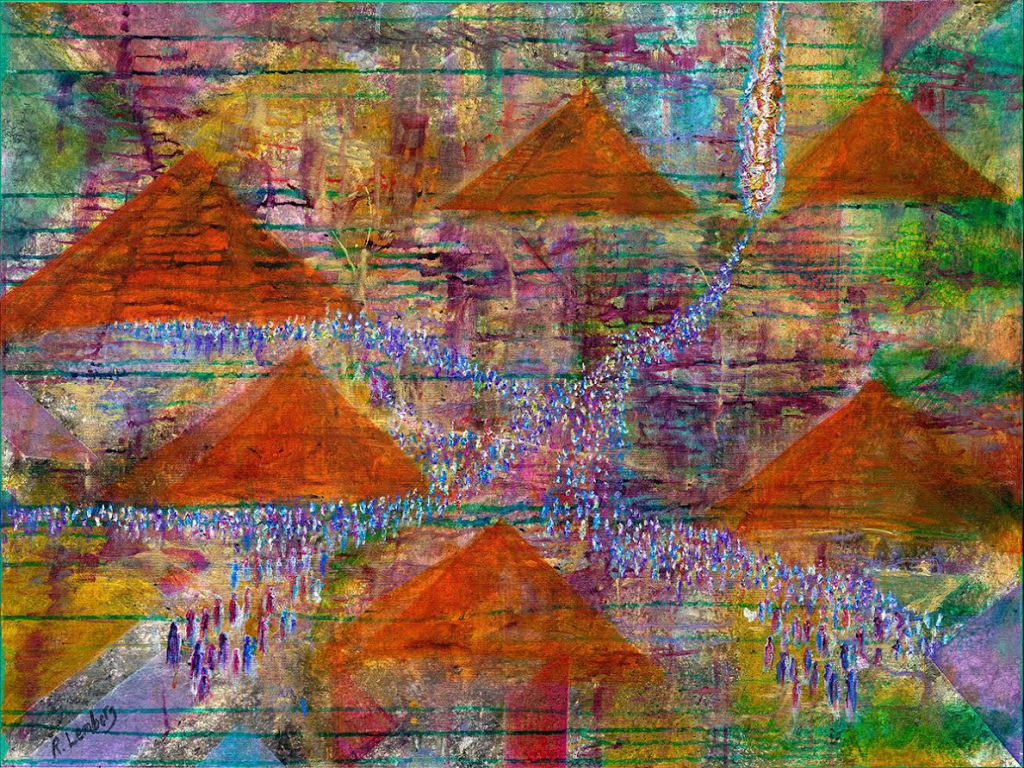
There Are Consequences to Injustice (Exodus 12:29-42)

Exodus Out of Egypt, by Rivka Lemberg

At midnight the Lord struck down all the firstborn in Egypt, from the firstborn of Pharaoh, who sat on the throne, to the firstborn of the prisoner, who was in the dungeon, and the firstborn of all the livestock as well. Pharaoh and all his officials and all the Egyptians got up during the night, and there was loud wailing in Egypt, for there was not a house without someone dead.

During the night Pharaoh summoned Moses and Aaron and said, “Up! Leave my people, you and the Israelites! Go, worship the Lord as you have requested. Take your flocks and herds, as you have said, and go. And also bless me.”

The Egyptians urged the people to hurry and leave the country. “For otherwise,” they said, “we will all die!” So the people took their dough before the yeast was added, and carried it on their shoulders in kneading troughs wrapped in clothing. The Israelites did as Moses instructed and asked the Egyptians for articles of silver and gold and for clothing. The Lord had made the Egyptians favorably disposed toward the people, and they gave them what they asked for; so they plundered the Egyptians.

The Israelites journeyed from Rameses to Sukkoth. There were about six hundred thousand men on foot, besides women and children. Many other people went up with them, and also large droves of livestock, both flocks and herds. With the dough the Israelites had brought from Egypt, they baked loaves of unleavened bread. The dough was without yeast because they had been driven out of Egypt and did not have time to prepare food for themselves.

Now the length of time the Israelite people lived in Egypt was 430 years. At the end of the 430 years, to the very day, all the Lord’s divisions left Egypt. Because the Lord kept vigil that night to bring them out of Egypt, on this night all the Israelites are to keep vigil to honor the Lord for the generations to come. (New International Version)

“A horse may run quickly but it cannot escape its tail.”

Russian proverb

The ancient Israelites were in bondage to the Egyptians for hundreds of years. Their oppression finally came to and end with the Lord’s dramatic deliverance of them in the tenth and final plague directed against Egypt.

The actions of the Egyptians eventually and finally caught up with them. Their making slaves of the Israelites was not going to last forever. Even though it took a while, Egypt was held accountable and experienced divine judgment. The empire’s internal moral emptiness would not be able to hold up under the justice of God.

“Empty sacks will never stand upright.”

Italian proverb

Pharaoh was a hard man. The more Moses talked to him the more stubborn Pharaoh got. Eventually, Pharaoh’s heart became like stone; he and his empire fell because they were bent toward the way of injustice. Oppression had been Pharaoh’s proclivity by instructing the Jewish midwifes to kill firstborn sons of Israelite mothers. Now the Egyptians would fall into the very trouble they created for others.

The death of so many on one night, all at once, was too much for Pharaoh and the Egyptians. In such a grief, Pharaoh’s dogged resolve in holding onto Israelite slavery and ostracizing Moses was loosened. He summoned Moses in the middle of the night and commanded the Israelite slaves to be gone – without any conditions or strings attached to it.

The Egyptians wanted them gone, and so, urged them to leave in a hurry – just as God had predicted. All sorts of articles – including silver and gold – were willingly given to the fleeing Israelites by the lamenting Egyptians. No matter how hard and stubborn any earthly ruler is, the plans and purposes of a sovereign God cannot be thwarted.

Finally, the deliverance out of Egyptian bondage happened. The Israelites were free. It was a hasty departure. It was as if the Hebrew people had become so upsetting to the great Egyptian empire, that they vomited them out of their land, projecting the former slaves as far away as they could.

Sometimes people get the notion that if they do something bad, they will be struck by lightning or have some sort of tragedy occur. And when it doesn’t happen, they might reason further in their misguided notions by believing they can get away with bad behavior. So, they keep doing it. But, eventually, this all has a terrible effect.

“Those who lie down with the dogs, rise with the fleas.” English proverb

Actions and inactions have consequences. Those consequences may not happen immediately. However, all of us shall someday harvest the fruit of decisions that were made months, even years or decades, ago.

Make no mistake, God is not mocked. A person will harvest what they plant. Those who plant only for their own benefit will harvest devastation from their selfishness, but those who plant for the benefit of the Spirit will harvest eternal life from the Spirit. Let’s not get tired of doing good, because in time we’ll have a harvest if we don’t give up. (Galatians 6:7-9, CEB)

Almighty God, Creator and Preserver of all humanity, we humbly ask that you make your ways known to people everywhere, and bring saving help to all nations. We pray for Christ’s Church, and all faith communities across the earth, that they be guided and governed by your good, gracious, and benevolent Spirit; and that all who profess and call themselves Christians may be led into truth, and hold the faith in unity, peace, and righteousness.

Blessed Lord, we pray for all who are afflicted or distressed in mind, body, or spirit. May your divine mercy bring them comfort and relief, according to their need. Give them patience through their sufferings, and a joyful outcome from their distress. This we pray through Jesus Christ our Savior and Lord. Amen.

Whoever Is Not with Me Is Against Me (Matthew 12:22-32)

Jesus casts out the devils, by Julius Schnorr von Carolsfeld (1794-1872)

Then they brought him a demon-possessed man who was blind and mute, and Jesus healed him, so that he could both talk and see. All the people were astonished and said, “Could this be the Son of David?”

But when the Pharisees heard this, they said, “It is only by Beelzebul, the prince of demons, that this fellow drives out demons.”

Jesus knew their thoughts and said to them, “Every kingdom divided against itself will be ruined, and every city or household divided against itself will not stand. If Satan drives out Satan, he is divided against himself. How then can his kingdom stand? And if I drive out demons by Beelzebul, by whom do your people drive them out? So then, they will be your judges. But if it is by the Spirit of God that I drive out demons, then the kingdom of God has come upon you.

“Or again, how can anyone enter a strong man’s house and carry off his possessions unless he first ties up the strong man? Then he can plunder his house.

“Whoever is not with me is against me, and whoever does not gather with me scatters. And so I tell you, every kind of sin and slander can be forgiven, but blasphemy against the Spirit will not be forgiven. Anyone who speaks a word against the Son of Man will be forgiven, but anyone who speaks against the Holy Spirit will not be forgiven, either in this age or in the age to come. (New International Version)

Binary thinking is rife in today’s world. It is a simplified mindset in which a person sees issues in one of two opposite and mutually separate ways. In other words, binary thinking reduces complex situations into a simplified either/or view that sees everything from a good versus bad, right versus wrong, and us versus them mentality.

Engaging in binary thinking elicits a tendency towards oversimplification where groups and sides are pitted against each other. And this is precisely what the religious leaders of Christ’s day wanted.

They engaged in a logical fallacy by attributing Christ’s ability to heal and drive out demons as itself demonic. Oversimplification is when someone does not look at a circumstance or situation with any understanding, but instead assigns it either a good or bad label. In this case, the religious leaders were simply saying Jesus was doing bad work because he himself is bad, and in league with the devil.

There is a big difference between the ability to take complex issues and explain them in terms that most people can understand, and refusing to know the complexity by immediately boiling it down to a right or wrong label. The religious leaders did not seek to know and understand Jesus; and in their ignorance, they simply called Christ’s work satanic.

It could be that the religious leaders wanted to create a polarization between Christ and the people. After all, their own authority, power, and hegemony were being threatened by this upstart healer. Jesus was gaining the affection of the people, and so, the leaders perhaps felt they were losing their influence. At the least, they certainly felt jealous.

I am always impressed by the way Jesus responded to people of all kinds. Christ generally entered the world of those in front of him and handled matters according to the way they thought and did things. In the case of the religious leaders, Jesus entered into their binary thinking world and took them on from that point of view.

Christ argued logically from the leaders’ own illogic. If black and white thinking is what they understood, then Jesus gave them that in a way they would grasp it. Jesus counters the accusations by simply stating that Satan undoing his own work is ridiculous. If Satan is wanting more and more control over people (like the religious leaders want!) then there is no way he is going to give Christ the power to set them free from that control.

Therefore, in binary terms the leaders could understand, Jesus declared that whoever is not with him is against him; whoever is not gathering with him is actually scattering. The tables are turned. Jesus is doing good work, of which the religious leaders are calling bad. Thus, they are bad.

And Jesus was not finished with them quite yet. He further stated a grim warning, aimed directly at the leaders. By seeing up close and personal the work of God’s Spirit, then declaring that work to be the devil’s doing, you cannot be forgiven.

What’s more, not only are such people not forgiven, but they also cannot be forgiven – because they have cut themselves off from the very power that could forgive them. Once a person declares in their binary thinking that the only remaining source of life is poisoned, then they just condemned themselves to death.

Cutting off oneself from God altogether cannot possibly bring forgiveness and grace to that same self. If we are mad at God and rage at him, we are still engaging and communicating with him – we are not cut off. Any sort of communication with God is still having some sort of connection with the divine. But if we sever the connection altogether, then there is not a way to receive any grace.

So, if we are concerned about committing the unpardonable sin, we most certainly have not – because we still are seeking connection with God. Hell is the place of separation from God – the very place where people who want nothing to do with God are. It isn’t that God put them there; they put themselves there.

Let us not, therefore, pit people against each other, but instead, foster relational connections, wholeness, integrity, and a just spirit of right relationships. We need not condemn others or assign to them demonic labels. If they truly are condemned, they have already done so to themselves.

O God and Father of our Lord Jesus Christ, we ask that you mercifully hear our prayers and spare all those who confess their sins to you; and may they be absolved by your gracious pardon of their guilty conscience and of any shameful deeds, through Jesus Christ your Son, our Lord, who with you and the Holy Spirit are one God, now and forever. Amen.

Against Apathy (Obadiah 15-21)

The day of the Lord is near
        against all the nations.
    As you have done, so it will be done to you;
        your actions will make you suffer!
Just as you have drunk on my holy mountain,
        so will all the nations around you drink;
    they will drink and swallow quickly,
        and they will be like they’ve never been before.

But on Mount Zion there will be those who escape,
        and it will be holy;
        and the house of Jacob will drive out those who drove them out.
The house of Jacob will be a fire,
        the house of Joseph a flame,
        and the house of Esau straw;
    they will burn them up completely,
        and there will be no one left of the house of Esau,
for the Lord has spoken.
Those of the arid southern plain will possess Mount Esau,
        and those of the western foothills, the land of the Philistines;
    they will possess the land of Ephraim and the land of Samaria,
        and Benjamin will possess Gilead.
Those who remain of the Israelites
            will possess the land of the Canaanites as far as Zarephath;
    and those left from Jerusalem and who are now living in Sepharad
        will possess the cities of the arid southern plain.
The deliverers will go up to Mount Zion
        to rule Mount Esau,
        and the kingdom will be the Lord’s. (Common English Bible)

The prophet Obadiah is a small book in the sea of the Old Testament prophets (a single chapter of twenty-one verses). It’s a prophecy dedicated to the singular focus of delivering a message of divine judgment against the nation of Edom.

Why judgment? Because when people remove themselves from or place themselves in opposition to God (and God’s people) they can expect divine retribution, rather than restoration.

“The day of the Lord” is a phrase used throughout Holy Scripture as a reference to God’s upcoming judgment of the world. Along the way, until that final day, there are many nations which come and go.

Actions

Edom was in an ideal position to help Judah when King Nebuchadnezzar and the Babylonians captured Jerusalem in 586 B.C.E. But they didn’t. They could have given military assistance; but the ancient animosity between Jacob (Israel) and Esau (Edom) prevented this.

They still could have sheltered the Jews fleeing Jerusalem and Judah in order to escape the Babylonian onslaught. Edom’s rocky strongholds would have been extremely difficult for Babylon to maneuver in pursuit of Judah. Yet, the Edomites refused to trouble themselves in offering Judah even the slightest assistance in the day of its great need.

In fact, the situation was worse than refusing to assist. Edom committed violence against Judah at the time of Jerusalem’s fall. The Edomites progressed from being aloof and disinterested observers of Judah’s fate, to gloating over Judah’s trouble, to participating as invaders of Jerusalem. Finally, Edom played the antagonistic enemy who plucked off desperate Jewish fugitives as they tried to escape certain death.

The Edomites were like a bunch buzzards, hovering overhead, waiting for Babylon to smash Judah so that they could swoop down and devour the leftovers.

Accountable

Historically, we don’t really know much Edom was actually involved in Jerusalem’s destruction. Yet, it’s notable that some later Jewish traditions indicate that Edom helped the Babylonians burn the temple in Jerusalem to the ground. Whatever really happened, the Edomites took advantage of Judah and profited from their destruction. What’s more, God held them accountable for their actions and/or inaction.

And that is the very nature of sin. A sinner is one who either acts in breaking God’s penultimate command of love by harming another, or fails to act lovingly with apathetic inaction, when it is in their power to act. Therefore, living rightly and justly is not only refraining from acts of evil; it’s also doing good whenever we see that love and good works are needed.

It is a sin when someone knows the right thing to do and doesn’t do it.

James 4:17, CEB

Edom knew that Judah needed help, but refused to give it. So, the Edomites were guilty before God for failing to offer hospitality, relief, and basic human kindness. As for us, we have a great deal to answer for as idle spectators, whenever we are capable of being active helpers.

Apathy

Today, it appears that society has lost its self-awareness. As a result, there is widespread apathy toward others. We have made a devil’s bargain of trading an interior life of developing spiritual discipline and actionable love for an exterior life of position, power, and prestige.

In our contemporary culture, there is no longer any intentional and systematic spiritual formation happening. Instead, we are regularly fed the unholy porridge that we can do and think whatever we like, as long we aren’t hurting anybody.

Therefore, we don’t see the connection between our current political and religious acrimony and our spiritual apathy. We have relegated practices such as centering and contemplative prayer as mere optional extras for the eccentric few. “Why struggle with all this scriptural, religious, and spiritual stuff?” we say. “Meh, it’s not worth the effort.” From such a stance, we are only a stone’s throw away from not caring about our neighbor.

This all makes me wonder if the ancient Edomites, over time, created a culture of spiritual carelessness that neglected the disciplined life of the soul. I’m curious if they ever said things like, “I don’t have time for all that God stuff.”

It is this sort of apathy which underlies so much of Western society. Even the word “apathy” barely gets used anymore – along with a lot of other words like “avarice.” They have become relics of another era. But they’re still among us. And they come out in a phrase such as, “Yeah, whatever. It is what it is.”

We are largely an unhappy people these days. And we cannot seem to put our finger on why that is. Maybe we need to rediscover the prophets – and the ones who never seem to get a hearing – like the prophet Obadiah. Or are we too indifferent to give him an honest reading?

All too often, Lord, we turn away from the world’s many problems, which seem too big, too complex, or too far away. Forgive us our indifference.

It is easier, Lord, to see only what is around us: our lives, our homes, our challenges. Forgive us our isolation.

Help us to see with your eyes: eyes which notice one another and help us understand.

Help us to dream your dream: of communities that reach out and dialogue and where diverse people creatively cooperate.

Help us to be people of solidarity and action, so moved by prayer, encounter, and understanding that peace can become a reality. Amen.

Hospitality Is a Matter of Life and Death (Jeremiah 49:7-11)

Concerning Edom, the Lord of heavenly forces proclaims:
Is wisdom no longer in Teman?
    Has good sense vanished from the perceptive?
        Are they no longer wise?
Turn, flee, and run for cover,
    you inhabitants of Dedan.
I’m bringing disaster on Esau:
    its day of reckoning.
If workers would come to you to pick grapes,
    they would at least leave a few on the vine.
If thieves would come in the night,
    they would take only what they needed.
But me? I will strip Esau bare.
    I will expose his hiding places,
        and he will find no place to take cover.
His offspring, family, and acquaintances will perish,
    and there will be no one left to say,
“Leave me your orphans,
    and I’ll look after them;
        trust your widows into my care.” (Common English Bible)

You might be saying to yourself, “What in tarnation is this crazy fool doing, having a Bible lesson on this here piece of Scripture that means nothing to you nor me?” Oh, really? To which I say, “What darned fool never gets into the backwoods of the prophets?”

Esau was the twin brother of Jacob, a real mountain man sort of guy. Being outdoors and hunting game was his thing. His descendants were the Edomites. They inhabited the southwest portion of what is now the country of Jordan, and the southeastern portion of Israel and Palestine in the middle east. It’s a territory made up of a network of clefts and caves in the rocks.

Edom tended to think of themselves as being invulnerable, the man’s man. They always had the high ground and knew how to handle themselves in the wilderness. For anyone interested in taking the Edomites down, it would be very difficult to dislodge them from their rocky fortress home. Yet, there is no place that is not vulnerable to the eye and purpose of Yahweh.

Site of an ancient Edomite stronghold in present day Jordan

Just as there was bad blood between Jacob and Esau, so also the Israelites and Edomites did not like each other throughout their history. Edom had no intention of helping their ancestral brother, and even participated with the Babylonians in the conquest of Jerusalem. What’s more, they rejoiced over the fall of the city – all of which raised the eyebrow of God.

Lord, remember what the Edomites did
        on Jerusalem’s dark day:
    “Rip it down, rip it down!
    All the way to its foundations!” they yelled. (Psalm 137:7, CEB)

Turns out that the Lord listened to the psalmist and remembered. The destruction of Edom came about because of two overlapping sins: the profound lack of hospitality; and the overt participation of doing harm. To refuse hospitality is to put someone or a group of people in harm’s way. It also betrays an attitude that works out in eventually becoming an agent of harm to those they could have helped.

In this vein, Edom is much more akin to Sodom and Gomorrah than to its brother Israel.

“Now this was the sin of your sister Sodom: She and her daughters were arrogant, overfed and unconcerned; they did not help the poor and needy.” (Ezekiel 16:49, NIV)

When the ancient Israelites, after having been delivered by God from Egyptian bondage, and traveling in the wilderness, came upon Edom, they made a request of their brother:

“Please let us cross through your land. We won’t pass through any field or vineyard, or drink water from any well. We will walk on the King’s Highway and not turn to the right or to the left until we have crossed your border.”

Edom said to him, “You won’t cross through, or I will come out against you with a sword.” (Numbers 20:17-18, CEB)

It does no one any good to refuse offering hospitality to others. Both the one in need, and the one being inhospitable, find themselves in dire straits. The reason the Lord cares so much about this is that God, at the core, is hospitable – loving the stranger and granting aid to the alien.

Jesus, upholding this long tradition of divine caring and prophetic utterance, had this to say to those who were indifferent:

“Depart from me, you who are cursed, into the eternal fire prepared for the devil and his angels. For I was hungry and you gave me nothing to eat, I was thirsty and you gave me nothing to drink, I was a stranger and you did not invite me in, I needed clothes and you did not clothe me, I was sick and in prison and you did not look after me.”

They also will answer, “Lord, when did we see you hungry or thirsty or a stranger or needing clothes or sick or in prison, and did not help you?”

He will reply, “Truly I tell you, whatever you did not do for one of the least of these, you did not do for me.”

Then they will go away to eternal punishment, but the righteous to eternal life. (Matthew 25:41-46, NIV)

It is high time that we, as a contemporary people, take the Old Testament prophets seriously, and adopt the divine heart for the alien, the stranger, the fatherless, the widow, and all who find themselves unable to meet their own basic needs.

And when a refusal of hospitality happens on a national scale, the people of that nation will discover themselves a bygone country – much like Edom and the Edomites of old.

Whenever the national zeitgeist translates into draconian tactics for keeping “those other people” at a distance and say to them, “get out of our country,” without any hospitality, that nation has come under the eye of a holy God who has a zero tolerance policy toward base unkindness and purposeful callousness.

So, we ought to have the fear of God when we believe we have a moral right to exclude immigrants because they may potentially harm citizens by taking away jobs, reducing wages, and draining social services. This line of reasoning is not consistent with the way of Christ.

I, for one, believe we have failed to live up to the moral universalism we pretend lies at the heart of the United States’ theories and political philosophies; and we have not been willing to accept the radical changes needed to accommodate even a modest notion of hospitality for those who have been the targets for hate crimes based upon their race, ethnicity, ancestry, religion, and gender.

The age old sin of this world is that the wealthy and the privileged, although giving out of their largess, have no intention of sharing power and would never think of following the example of the poor widow who gave everything she had.

So, God said of the Edomites, “I will ‘Edom’ up!” And like the wild game their ancestor Esau killed and ate, they were gone. Turns out that hospitality is really a matter of life and death.

Lord Jesus, you welcomed all who came into your presence. May we reflect that same spirit through the value of hospitality. May your light shine in our hearts this day and dispel the darkness of hate and bigotry. Remove from us anything that stands in the way of radiating your presence. Amen.