Return To the Lord (Amos 4:6-13)

I gave you cleanness of teeth in all your cities
    and lack of bread in all your places;
yet you did not return to me,
            says the Lord.

And I also withheld the rain from you
    when there were still three months to the harvest;
I would send rain on one city
    and send no rain on another city;
one field would be rained upon,
    and the field on which it did not rain withered;
so two or three towns wandered to one town
    to drink water and were not satisfied;
yet you did not return to me,
            says the Lord.

I struck you with blight and mildew;
    I laid waste your gardens and your vineyards;
    the locust devoured your fig trees and your olive trees;
yet you did not return to me,
            says the Lord.

I sent among you a pestilence after the manner of Egypt;
    I killed your young men with the sword;
I carried away your horses;
    and I made the stench of your camp go up into your nostrils;
yet you did not return to me,
            says the Lord.

I overthrew some of you
    as when God overthrew Sodom and Gomorrah,
    and you were like a brand snatched from the fire;
yet you did not return to me,
            says the Lord.

Therefore thus I will do to you, O Israel;
    because I will do this to you,
    prepare to meet your God, O Israel!

For the one who forms the mountains, creates the wind,
    reveals his thoughts to mortals,
makes the morning darkness,
    and treads on the heights of the earth—
    the Lord, the God of hosts, is his name! (New Revised Standard Version)

“Luxury often leads to forgetfulness. As for you, my beloved, if you sit at table, remember that from the table you must go to prayer. Fill your belly so moderately that you may not become too heavy to bend your knees and call upon your God.” St. John Chrysostom, On Wealth and Poverty 

Let us test and examine our ways and return to the Lord.

Lamentations 3:40, NRSV

Again and again, century after century, Israel’s God, Yahweh, sent prophets and calamities in order to shake God’s people from their wayward path.

It was expected that observance and faithfulness to God’s covenant would bring times of goodness and prosperity. Conversely, times of disobedience would elicit misfortune. It seems the people forgot that infidelity to the covenant leads to calamitous circumstances.

Through it all, Israel and Judah were unfaithful. All Yahweh ever wanted was for the people to return to their God, and enjoy all the blessings and benefits of being in a divine/human harmony. But the people weren’t having it.

Amos, throughout his prophecy, made it clear that personal transgressions, social injustice, religious infidelity, and national sins were at the heart of the trouble.

There was a tremendous wealth inequality which existed in ancient Israel. The people lost sight of the reality that everything belongs to God. Therefore, any resources they were blessed with should have been used to help the common good of all, especially the poor and needy.

It was from the prophets like Amos that the great early church preacher, St. John Chrysostom, developed his understanding of personal responsibility, church ministry, and national concern.

In sermon after sermon, Chrysostom argued and established that excessive wealth is dangerous to the soul. He continually warned his parishioners that those who accumulate exorbitant wealth are actually storing up a great retribution for themselves in the next life.

He insisted that the proper response to the extravagance of one’s possessions and money is to return to God and give liberally to others. One must understand, St. John argued, that all things belong to God. Thus, to acquire more and more is, in reality, a form of stealing from the poor.

Kindness and charity to the poor is imperative. Otherwise, a society cannot expect to realize ongoing blessing from God. Chrysostom constantly advocated for people to be generous in giving, not only to help the poor, but also to spur one’s spiritual growth and spiritual wealth. Building treasure in heaven, rather than on earth, was St. John’s basic orientation in life.

In today’s Old Testament lesson, after rehearsing seven different calamities which were meant as warnings, the eighth calamity would be to meet God face to face. We get the gist of the argument as a meeting that wouldn’t go so well for the filthy rich… that is, unless they willingly return to God and submit themselves and their stuff to the Lord of all.

Every one of us must ultimately come to grips with the fact that mercy and wrath are very real concepts that look one another in the eye. There is both hope and warning.

Will we return to the Lord, or will God effect a great visitation upon us?

Will God save us at the eleventh hour, or will the Lord bring devastation?

Either way, there is a meeting coming. Prepare to meet your God. It’s up to us how that meeting is going to shake out.

There is yet hope for those who are penitent, even and especially for those who finagled to obtain power and wealth for themselves. But if they are stubborn, they will find out what is the face opposite of mercy. This is the era of return, because it is still possible to change.

Yet even now, says the Lord,
    return to me with all your heart,
with fasting, with weeping, and with mourning;
    rend your hearts and not your clothing.
Return to the Lord your God,
    for he is gracious and merciful,
slow to anger, abounding in steadfast love,
    and relenting from punishment. (Joel 2:12-13, NRSV)

Most merciful God, we confess that we have sinned against you in thought, word, and deed, by what we have done, and by what we have left undone.

We have not loved you with our whole heart; we have not loved our neighbors as ourselves. We are truly sorry and we humbly repent.

For the sake of your Son Jesus Christ, have mercy on us and forgive us; that we may delight in your will, and walk in your ways, to the glory of your Name. Amen. (Book of Common Prayer)

Against Exorbitant Wealth (Amos 3:9-4:5)

Proclaim to the strongholds in Ashdod
    and to the strongholds in the land of Egypt,
and say, “Assemble yourselves on Mount Samaria,
    and see what great tumults are within it
    and what oppressions are in its midst.”
They do not know how to do right, says the Lord,
    those who store up violence and robbery in their strongholds.
Therefore thus says the Lord God:
An adversary shall surround the land
    and strip you of your defense,
    and your strongholds shall be plundered.

Thus says the Lord: As the shepherd rescues from the mouth of the lion two legs or a piece of an ear, so shall the people of Israel who live in Samaria be rescued, with the corner of a couch and part of a bed.

Hear and testify against the house of Jacob,
    says the Lord God, the God of hosts:
On the day I punish Israel for its transgressions,
    I will punish the altars of Bethel,
and the horns of the altar shall be cut off
    and fall to the ground.
I will tear down the winter house as well as the summer house,
    and the houses of ivory shall perish,
and the great houses shall come to an end,
            says the Lord.

Hear this word, you cows of Bashan
    who are on Mount Samaria,
who oppress the poor, who crush the needy,
    who say to their husbands, “Bring something to drink!”
The Lord God has sworn by his holiness:
    The time is surely coming upon you
when they shall take you away with hooks,
    even the last of you with fishhooks.
Through breaches in the wall you shall leave,
    each one straight ahead,
    and you shall be flung out into Harmon,
            says the Lord.
Come to Bethel—and transgress;
    to Gilgal—and multiply transgression;
bring your sacrifices every morning,
    your tithes every three days;
bring a thank offering of leavened bread
    and proclaim freewill offerings, publish them;
    for so you love to do, O people of Israel!
            says the Lord God. (New Revised Standard Version)

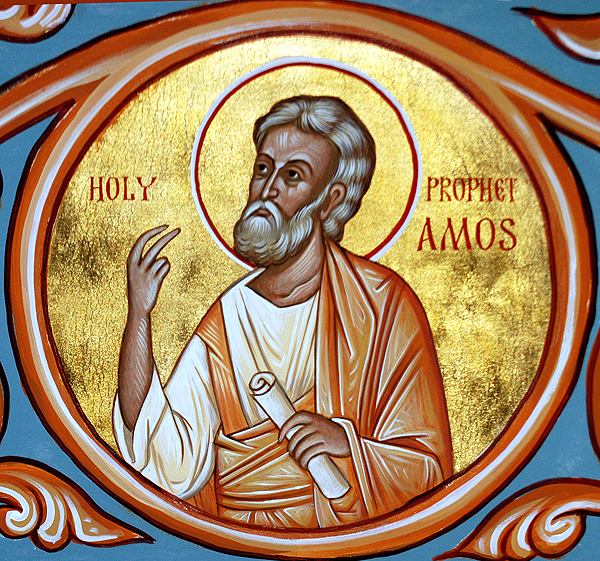
Orthodox icon of the prophet Amos

The prophet Amos sought to leave no stone unturned in exposing the transgressions of God’s wayward people. He went after social injustice; personal sins; religious idolatry; and all aspects of life in which the nation practiced self-indulgent hoarding of wealth and power.

Whenever people become focused on earthly power and control, they fall out of the realm of living in God’s power. If there is ever a personal or corporate sense of losing spiritual power, the problem is never with the Lord. The more one amasses worldly power and authority, the less effective they are with spiritual power.

It is possible for a nation or a church to have great political strength, yet in reality be powerless. Impressive constructed human strongholds are totally defenseless before the all-powerful God of the universe.

It’s always been curious to me why folks who claim the name of Christ, or who make grand confessions of faith, can then turn around and be enamored with obtaining wealth, real estate, resources of all sorts, and high-level positions. Such persons don’t deserve worldly power. It’s like putting a gold ring in a pig’s snout.

Persons with lots of worldly wealth and power will eventually find that their acquisitions fail them. And if their religion is powerless, everything in their life will lack power – no matter how it looks, or what spin they put on their situation.

Ignoring grace and mercy, compassion and kindness, to the poor and needy is a surefire way of experiencing divine condemnation. Treating one’s society and social relationships as mere pawns to get what I want is a prescription for alienation from God.

Whether someone believes in an almighty God, or not, oppressing and gaslighting others breaks down a society, and compromises basic law and order. Being concerned only with one’s constituents, and turning away from the common good of all, brings about injustice for the many.

But the ones in charge simply don’t care – which is why it raises the ire of a holy God. Any person who demeans meekness and gentleness, and clearly evidences a profound lack of humility, you can be sure that person is up to no good – despite any “good” words they might say.

Violence and robbery are the tools of those who care nothing for what their actions do to others. Justifying the rounding up of people into detention centers and robbing them of their lives and livelihood doesn’t fool God.

Those who go after unjust gain through any means possible will find that there is a boomerang effect to their actions. Their violent and unjust ways will turn back on them. They themselves shall be destroyed, and not the powerless and vulnerable.

In ancient Israel at the time of Amos, it was the Gentile nations who would rise up and be their judge. Pagan nations who thought nothing of despising and abusing others were the very ones to stand up and judge Israel. That’s how bad it was, even though there was wild prosperity, exorbitant wealth, and loads of power, that is, only among the upper class.

Living below the level of grace means showing no dignity or respect to one’s fellow humanity. It is unthinkable that such persons could or would ever exercise power in a democratic form of government. Just because they were elected and appointed to office, doesn’t mean they’ll act as civil servants.

Those in power who act only in self-interest will find themselves on the bad side of a holy God:

“Why would God withdraw from such a people? Because there was nothing in their lives corresponding to a heart concern for spiritual things; their character-reference could be written without mentioning God, or prayer, or holiness; their legacy to the future was wholly a testimony to a life lived for the body. And these claimed to be the people of God!” J.A. Motyer

Unchecked covetousness is actually a form of war against the poor. And any worship disconnected from righteousness and justice is an affront to both the needy among us, and God.

Wealth and power, in and of themselves, are neither good nor bad; they just are. But what we do with them is of vital concern. However, exorbitant riches and a lust for power, in and of themselves, are egregious sins.

In Holy Scripture, the poor are never chastised for their poverty and neediness. But the rich are continually exhorted and warned against for any sort of failing to care for the lower classes of people. (Matthew 25:14-30; Luke 12:13-21; 16:19-31)

The psalmist has a reality check for us:

Don’t be overly impressed when someone becomes rich,
    their house swelling to fantastic proportions,
    because when they die, they won’t take any of it with them.
    Their fantastic things won’t accompany them down under.
Though they consider themselves blessed during their lives,
    and even thank you when you deal well with them,
    they too will join the ancestors who’ve gone ahead;
    they too will never see the light again.
Wealthy people? They just don’t understand;
    they’re just like the animals
    that pass away. (Psalm 49:16-20, CEB)

The Teacher gives us some practical wisdom:

If you love money and wealth, you will never be satisfied with what you have. This doesn’t make a bit of sense. (Ecclesiastes 5:10, CEV)

Whoever becomes wealthy through unfair loans and interest collects them for the one who is kind to the poor. (Proverbs 28:8, GW)

And the Lord Jesus said:

“No one can serve two masters. Either you will hate the one and love the other, or you will be devoted to the one and despise the other. You cannot serve both God and money.” (Matthew 6:24, NIV)

“God blesses you who are poor,
    for the Kingdom of God is yours.” (Luke 6:20, NLT)

As for me, I’ll choose to take my cues from Jesus and the prophets, and not from those with earthly influence, riches, and power. How about you?

Almighty God, everything we possess – our time, abilities, resources, money, and material possessions – are gifts from You, and belong to You. Enable me to be a good steward of all that you have provided for me, so that I may be a blessing to the poor and needy; through Jesus Christ my Lord, in the strength of the Holy Spirit. Amen.

The Illness of Our Era: What Is It?

Anxiety, by James Callaghan

Our contemporary society focuses primarily on a functional existence. In our pragmatism, we care a great deal about production, the things we can do and produce; and we are attentive of how we appear to others. Western culture is enamored with all things of the outer person that others can see, touch, hear, smell, and taste with physical senses.

The outer person is important. The way in which we present ourselves to the world does have meaning and significance. Yet, so does the inner person.

The Inner Person

I believe the inner person, the true self, the soul, is just as vital, if not more, than the outward displays we give to others. On the inside is where our motives and intents come from. The core of self is of utmost importance; it is the place where our inherent worth is found.

Being aware of this inner person (which I use interchangeably with “soul” and “true self”) gives us a guide for ordering our outer self – our activities, work, and relationships.

If we are unaware of what’s happening deep within us, or pay little to no attention to the soul, our outer person becomes a false self. A gross disconnect then occurs between how we think and feel within, and what we choose to display for everyone.

In paying attention to the inner person, we will likely find that there is a lot of anxiety within us. Anxiety may even transform itself into a despair of self and/or the world.

The Anxiety Within

This anxiety, however, is not all bad. It certainly can lead us to a struggle with life, an experience of strained relationships, and a crippling fear of what will happen. Yet it can also help us become in touch with the soul, and enable us to gain an awareness of what is happening within and what to do about it.

It is my firm understanding and unshakable conviction that if we are to learn anything at all about healthy functioning in this world, it must begin with learning about one’s self – the true self, the inner person, the soul.

Knowing Ourselves

“Without knowledge of self, there is no knowledge of God.”

John Calvin, Institutes of the Christian Religion, Vol.1

As we commit ourselves to the journey within, we come to discover our place in the cosmos, and the image of God that is inherent in us. We come to know ourselves as integral to creation.

If we never gain this sense of humanity and of the divine, then we lose our special perspective on reality, and of the vital interconnectedness we have with God and others. Separateness then replaces the unity and oneness which exists. As a result, the person lives without a sense of their true place or function in this world.

Feelings of isolation and estrangement take over. This profound experience of disconnection with God, people, and even self creates a powerful sense of anxiety. Fear becomes a dominant theme. Unconscious emotions and desires drive the anxious person. A belief that my conscious self is all there is to me is a path of denial that leads to abject misery.

Knowing ourselves – before we know anything else – must be our pursuit. Failure to do this is perhaps why we live in such an era of worry, pessimism, and fear.

Addressing Our Fears

Have you ever felt that there is no one to whom you could turn to in your time of loneliness and despair?

Is there a time when you felt as if you were in a deep dark hole of quiet anxiety?

Did you ever brood over your situation in life so much that all of your courage melted like ice cream on a 100 degree day?

Was there a season in your life where you felt the world could not understand your grief?

Has God ever felt aloof to you, with your prayers seeming as if they were bouncing off the ceiling?

Depending upon who we are, the self believes that if I am right enough, help enough, achieve enough, unique enough, know enough, plan enough, party enough, lead enough, or withdraw enough, then I will relieve this bothersome anxiety and fear within me and can get on with life.

Others may seek solace in the finite things of this world. But that approach only exacerbates the existing problem. Believing that freedom from an ethereal illness can come by having more of something you can see only increases the despairing feelings.

Any sickness of the soul must be addressed by means of infinite resources.

The Need For Integration

If we lose ourselves, we are fragmented and in need of integration. The work needed is to bring our spiritual internal parts into a unified whole. This then puts us in a position to experience the grace and peace of God. Indeed, the process itself becomes the divine mercy and settled rest.

We tend to hold onto what we are afraid of experiencing. This very problem often becomes the solution. Our anxiety has the potential to lead us toward the grace of God, or away from it by self-conjured solutions and/or coping mechanisms.

Rather than holding our anxieties and fears close so that we can keep an eye on them, we need to let go of them. This is accomplished by actually feeling our feelings. By holding our emotions loosely, they can express themselves and then fly away.

If we never experience anxiety, worry, discouragement, fear, depression, or despair, then we internally see no reason whatsoever to pursue transformation of life – to go after that which is immortal and invisible.

The Apostle Paul’s Struggle

At the end of a frustrating litany of anxiety over his inability to control the trajectory of his inner self, the Apostle Paul concluded:

So I find it to be a law that, when I want to do what is good, evil lies close at hand. For I delight in the law of God in my inmost self, but I see in my members another law at war with the law of my mind, making me captive to the law of sin that dwells in my members. Wretched person that I am! Who will rescue me from this body of death? Thanks be to God through Jesus Christ our Lord! (Romans 7:21-25, NRSV)

Sin presupposes itself through anxiety. And anxiety awakens the awareness of needing freedom and deliverance. Worry is not our master. Anxiety has no authority over us. Fear merely exists for us to pay attention to something.

In Christianity, that something is a someone: Jesus. Christ is the Deliverer from sin, death, and hell. The oblivious and lonely darkness we find ourselves trapped within has a way out, or rather, up. A divine hand reaches from above to snatch us from our inky hole.

If humanity never had a need of God, people would not know themselves. They would fail to realize that there is immortality in their very souls.

Taking the Journey Within

It takes bravery to engage in a journey within, down into the core of one’s being. It’s neither a vacation nor a weekend adventure. The path unfolds slowly over time; it is circuitous, and often frustrating. Yet, when we find the incredibly bright blue diamond at the center, we immediately know every part of the journey was worth it.

The illness of our era is that we are soul-sick with anxiety, even despair, and most of us don’t know it. But why?

Like a cancer lurking unaware within the body, the years of ego construction has smothered the image and likeness of God within.

Anxiety becomes the initial symptom that something is askew with us. We’d better get checked out and find what the root problem is.

Are you up for the discovery of yourself, and thus, of God?

A Psalm of Lament For the Government of the United States of America

Many, if not most, people fail to acknowledge their grief, and therefore fail to lament their significant changes and losses in life.

What’s more, many, if not most, Christians do the same thing because they focus too much upon triumphalism to the exclusion of dealing with suffering. “Just get over it!” is the mantra to themselves and others.

But that is not a biblical approach to change and loss. 62 out of the 150 Psalms in the Old Testament are laments; some are communal, and others are individual expressions of grief.

Even God laments. We must never forget that a major role of God in our own loss is that the Lord grieves and laments along with us.

Keep in mind that grief can attach itself to any significant change or loss; it is the normal emotional, spiritual, physical, and relational reaction to that loss.

Lament is an intentional process of letting go of relationships and dreams, and living into a new identity after the loss or change.

Please know that everyone’s grief is personal; there is no one-size-fits-all. Thus, the following psalm of lament is my own. It is not meant to be a dig on someone else who rejoices in what I happen to lament. It’s just simply my own sadness over the state of affairs in my beloved nation…

O Lord, I’ll get right down to it: Help!

          I have always taken my refuge in You.

Rescue us, the American people;

          free us from the injustice and unrighteousness rampant in our government.

Be a strong rock to which the oppressed may rely upon;

be a place where I may always go.

You, O God, have saved us many times in the past,

          and Your divine providence has guided us, despite our past and many sins.

My God, free the innocent and the poor from the hands of wicked persons,
         from the grasp of the cruel and unjust President of the United States.

For decades, members of both political parties agreed to safely regulate business;

they’ve decided to provide a social safety net, promote infrastructure, and protect civil rights.

Ideally, the U.S. government has sought to protect every American,

by access to education, healthcare, transportation, communication, employment, and resources.

And elected officials thought primarily of the common good,

so that every American could work hard and prosper.

But what is happening today in the United States,

is the same thing which occurred so long ago in ancient times.

We are in similar situations when the Old Testament prophets called out greed,

          injustice, and abuse in Israel and Judah.

Hear this word that I take up over you in lamentation, O house of Israel…  

They [the rich and powerful] hate the one who reproves in the gate,
    and they abhor the one who speaks the truth.
Therefore because you trample on the poor
    and take from them levies of grain,
you have built houses of hewn stone,
    but you shall not live in them;
you have planted pleasant vineyards,
    but you shall not drink their wine.
For I know how many are your transgressions
    and how great are your sins—
you who afflict the righteous, who take a bribe
    and push aside the needy in the gate.

Hate evil and love good,
    and establish justice in the gate. (Amos 5:1, 10-12, 15a, NRSV)

Perhaps because so few persons even read the prophetic books anymore,

our ignorance has allowed evil means and ways to take over the government.

We are in a nation and in a world full of oligarchs,

who care only for their exorbitant wealth, abuse of power, and self-interest.

As for me, I will not amble down the path of injustice,

          but walk the path of light and life.

I will embrace truth and harmony,

          unlike so many Republican politicians and their lackeys.

They say one thing and then do another;

          lies and corruption are on their lips.

If we say we are in harmony with him [God] yet walk a path of darkness,
we are living a lie and not following the truth…
If we say that we have no broken ways,
we are lying to ourselves,
and the truth is not alive in us.

(1 John 1:6, 8, First Nations Version)

I must, I will, view our problems differently,

because You are my hope, O Almighty Lord.

You have been my confidence ever since I was young;
          I depended on You through many hard times.

My songs of praise constantly speak about You,

for You are my strong refuge,

the Rock I have built my life upon.

Therefore, my mouth is filled with your praise,

and with your glory all day long.

I make my appeal to You, merciful God;

          I ask for divine intervention and deliverance,

          from the ignorant and sinister machinations of the U.S. President.

Do not reject us forever, O Lord,

or abandon us whenever we are too weak to carry on.

My political (and spiritual) enemies talk about me behind my back,

and plot their evil schemes to silence the truth.

They say, “God is not with him and his nonsense;

          put him in his place because no one will help him.”

O God, be close to me, and to all who love the truth;

          O Lord, come quickly to my aid.

Let those who traffic in lies come to a shameful end;

          let them be covered with disgrace and humiliation.

As for me, I will always have hope,

          because You are the God of all hope.

I vow to testify when Your righteousness wins the Day;

          I will never cease to praise Your sacred way of life.

Even when I am old and my mind is no longer clear,

          do not abandon me, O God.

Let me continue to tell the people of this age

what Your divine strength has accomplished,

to someday tell about how Your power delivered us from evil leadership.

Your righteousness and justice reaches to the heavens, O God;

You have done great things.

O Lord, who is like You?

          saving the poor from injustice,

          and delivering the oppressed from evil.

We, indeed, are enduring many terrible troubles;

          yet You, God, are expert at restoration, right relations, and harmonious ways.

You are the One who comforts the afflicted,

and the One who afflicts the comfortable.

Because of your faithful and steadfast love, O God,

          I will give thanks to You as long as I live.

As long as I have a mouth to speak,

          I will tell about your righteousness all day long.

Evil will not prevail;

          ungodly leadership shall not endure.

May Your divine and loving ways come to this country, O God,

          and may your moral will be done,

          on this earth, as it is always done in Your heaven. Amen.