
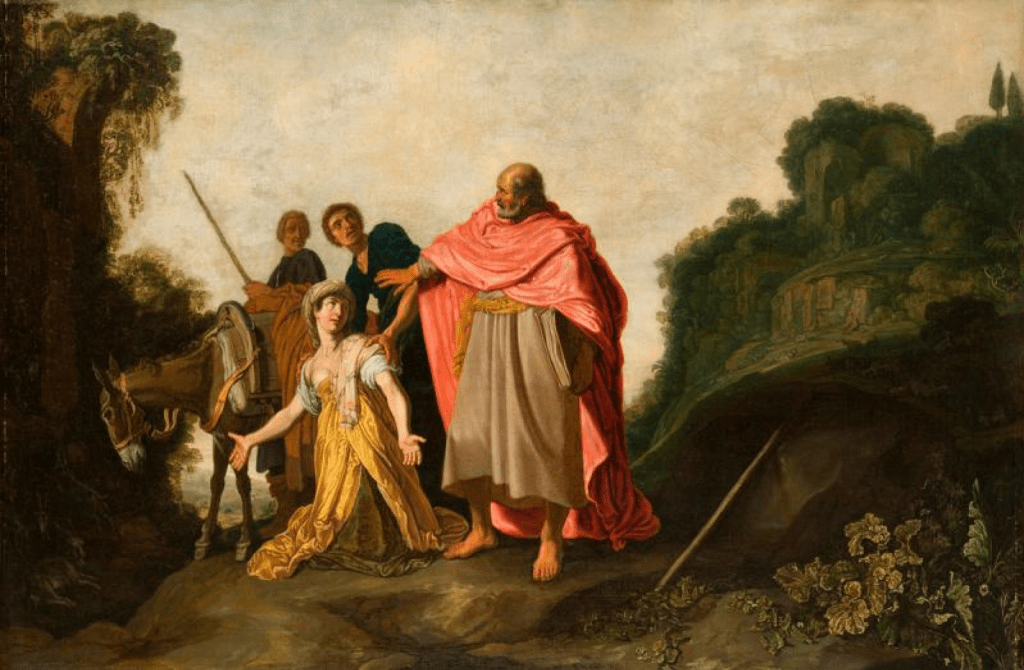
A Divine Appointment (2 Kings 8:1-6)

The prophet Elisha and the Shunammite woman, by Pieter Lastman, 1620

Elisha spoke to the woman whose son he had brought back to life: “You and your household must go away and live wherever you can, because the Lord has called for a famine. It is coming to the land and will last seven years.”

So the woman went and did what the man of God asked. She and her household moved away, living in Philistia seven years. When seven years had passed, the woman returned from Philistia. She went to appeal to the king for her house and her farmland. The king was speaking to Gehazi, the man of God’s servant, asking him, “Tell me about all the great things Elisha has done.” So Gehazi was telling the king how Elisha had brought the dead to life. At that very moment, the woman whose son he had brought back to life began to appeal to the king for her house and her farmland.

Gehazi said, “Your Majesty, this is the woman herself! And this is her son, the one Elisha brought to life!”

The king questioned the woman, and she told him her story. Then the king appointed an official to help her, saying, “Return everything that belongs to her, as well as everything that the farmland has produced, starting from the day she left the country until right now.” (Common English Bible)

People of faith typically don’t see divine appointments coming at all; they often show up in the middle of hard mundane days.

The prophecies and actions of the prophet Elisha are covered in the book of 2 Kings with a series of ten incredible narratives (chapters 2-9). Each of them are designed to demonstrate the power of God over (and sometimes against) the power of the king.

This was important because the royal decisions and actions of most of the Israelite kings were quite disconnected from God’s law and justice. Most kings did whatever they wanted, sometimes to the point of completely leading the people away from the worship of Yahweh and toward the worship of other gods.

Today’s Old Testament lesson concerns the ninth story in this series of narratives. A widow, whose son Elisha had restored to life in the second narrative (2 Kings 4:8-37) left for the land of the Philistines when there was a severe famine. Although the woman was simply listening to the prophet and doing what he said, squatters took advantage of the situation and took over her house and property while she was away.

In a clear demonstration of what a “divine appointment” looks like in Holy Scripture, Elisha’s servant and the king were talking together about this very woman and the miracle that took place with her son. The prophet had essentially raised her dead child to life. Then, lo and behold, the woman walked into the conversation to appeal the injustice that had happened to her and her family.

Even the worst of kings would discern the right thing to do in such a situation. After questioning the woman, the king ensured that she would get everything restored to her. Through it all, we are meant to see the power and sovereignty of God over the human authority of political kings.

I hope that you, at some point in your life, have experienced a meeting with another person that you can see was unmistakably arranged by God. And a great need you had was met because of this encounter. The Lord blessed you through it in a way that you didn’t see coming at all.

The fact of the matter is that God is sovereign, all-knowing, and all-powerful, along with being infinitely gracious, good, just, right, and loving. Therefore, God sets about to bless both us and other people. And when God determines to do something, nothing and no one in heaven or on earth can stop it.

Wherever you presently are, and whatever it is you are doing now in your life, is really no accident. And if your life situation is awful and far from any sort of idyllic scene of blessing, then please know that this is a circumstance that is ripe for a divine appointment.

For how could we ever know God as the Great Deliverer unless we were between a rock and a hard place with nowhere to turn? How could we ever experience God as the Divine Healer unless we were broken and/or brokenhearted?

How could we ever realize God as Provider unless we were out of resources and down to our last penny? Or God as Helper unless we were desperate and unable to move? Or God as the One who restores unless we had lost everything?

Just as there cannot be resurrection and new life without a crucifixion and an old life, so our lives will inevitably take a trajectory of suffering and hardship before glory and blessing. In order to allow the good to completely fill us, we must be totally emptied of everything else.

Maybe you will never experience something quite as dramatic as the woman did with gaining her son back to life, and her property restored after a terrible famine, but know this: The great Lord and God of all, the Sovereign of the universe, has your back through all that you’re going through on this earth.

I often get asked by patients and parishioners alike, “Where is God?” It feels to them that God is absent, silent, and far from understanding what they’re going through in the midst of their very challenging adversity.

Really, however, it’s actually an easy question for me to answer: Jesus is our Immanuel, God with us. The Spirit of God is right beside you, walking with you, even holding you up at times, through all the crud and crap of this old fallen sinful world of ours. Seeing only one set of footsteps in the sand, it turns out God is the One that carries the weak and weary in their trouble. The Lord is anything but absent.

If God has authority over earthly rulers, then the Lord most certainly has power to handle your life.

O God, why have you abandoned me? Though you have hidden your face from me, still from this dread and empty place, I cry to you, who have promised me that underneath are your everlasting arms. God, you are my help and comfort; you shelter and surround me in love so tender that I may know your presence with me, now and always. Amen.

2 Kings 4:32-37 – But That Is Not the End of the Story

Elisha and the Shunammite woman by Dutch painter Gerbrand van den Eeckhout (1621-1674)

Elisha entered the house and found the boy stretched out on the bed dead. He went into the room and locked the door—just the two of them in the room—and prayed to God. He then got into bed with the boy and covered him with his body, mouth on mouth, eyes on eyes, hands on hands. As he was stretched out over him like that, the boy’s body became warm. Elisha got up and paced back and forth in the room. Then he went back and stretched himself upon the boy again. The boy started sneezing—seven times he sneezed!—and opened his eyes.

He called Gehazi and said, “Get the Shunammite woman in here!” He called her and she came in.

Elisha said, “Embrace your son!”

She fell at Elisha’s feet, face to the ground in reverent awe. Then she embraced her son and went out with him. (The Message)

Life sometimes feels like a roller coaster. Our emotions go up and down alongside the circumstances which bring them forth.

Elisha was one of the all-time great prophets in ancient Israel. He developed an ongoing friendship with a woman from the town of Shunem. It was her simple hospitality to a stranger that brought about the enduring relationship.

Whenever Elisha passed through on his prophetic business, he would stop in and have a meal or spend the night in a special room set aside just for him.

But that is not the end of the story….

The woman was about to have a big change of life, a life she could not have ever seen coming and only dreamed of.

The Shunammite woman had no children and was not able to conceive. Yet, on one of his visits, Elisha promised her she would hold her very own infant child… which she eventually did. A year after Elisha’s pronouncement, the woman and her husband had a son.

The woman went from discouraged to elated. The child grew. The Shunammite and her family were content and living well.

But that is not the end of the story….

In today’s Old Testament lesson, we pick up the narrative as the child is a small boy, the family happy and healthy… until they weren’t.

One day the boy was playing, as he did every day. Whatever happened, he developed such a terrible headache that his dear mother rocked him for hours, trying to comfort him. The worst case scenario happened. The boy died.

The woman went from joy to despair in a matter of hours.

But that is not the end of the story….

The grieving mother refused to let death have the last word on her son. She saddled her donkey and went directly to Elisha. The Shunammite lamented to him about her son, and in her grief, cried out how Elisha had gotten her hopes up, only to be dashed by that dark enemy of death.

The prophet responded to the woman’s plea and set off  post haste to her home, which had now become a sort of funeral parlor. Elisha went into the room by himself with the dead boy. In an odd process similar to what Jesus would do centuries later, Elisha did some physical actions in bringing about a miraculous resurrection.

The boy sneezed, got up, and was given back to his mother. Her lowest of the low grinding sadness of distress and despair now turned to the highest of the high elation of joy and gratitude.

But that is not the end of the story….

The story continues because the larger overarching story of God’s gracious intervention into this world to bring about the redemption of all creation.

Along the way, across the millennia, the Lord continues to use faithful people to bring about renewal, restoration, and redemption. In the Christian tradition, the apex of this merciful work is fulfilled in the person of Jesus Christ.

God himself was pleased
    to live fully in his Son.
And God was pleased
    for him to make peace
by sacrificing his blood
    on the cross,
so that all beings in heaven
    and on earth
would be brought back to God. (Colossians 1:19-20, CEV)

The resurrection of the boy, and all risings from death before Jesus, prefigured and foretold the ultimate resurrection of Christ. And because Christ is risen, we too, shall rise from death – both spiritually and bodily.

Therefore, we have been buried with him through baptism into death, in order that just as Christ was raised from the dead through the glory of the Father, so we too may live a new life. For if we have become united with him in the likeness of his death, we will certainly also be united in the likeness of his resurrection. (Romans 6:4-5, NET)

The end of the grand narrative story is moving to a climax. Jesus is coming again to judge the living and the dead. All things shall be restored. All will be made right. We may sorrow in the night, but joy comes in the morning.

Then I saw a new heaven and a new earth, for the first heaven and the first earth had passed away, and the sea was no more. And I saw the holy city, the new Jerusalem, coming down out of heaven from God, prepared as a bride adorned for her husband. And I heard a loud voice from the throne saying,

“See, the home of God is among mortals.
He will dwell with them;
they will be his peoples,
and God himself will be with them and be their God;
he will wipe every tear from their eyes.
Death will be no more;
mourning and crying and pain will be no more,
for the first things have passed away.”

And the one who was seated on the throne said, “See, I am making all things new.” Also, he said, “Write this, for these words are trustworthy and true.” Then he said to me, “It is done! I am the Alpha and the Omega, the Beginning and the End. To the thirsty I will give water as a gift from the spring of the water of life. (Revelation 21:1-6, NRSV)

Our past grief and our present troubles will give way to a future hope – an ending to the story we can barely imagine, a glorious existence with our God which will have no end.

May the Lord come soon.

I pray the Lord Jesus will be kind to you.

May faith, hope, and love surround everyone who belongs to Christ Jesus. Amen.