

John 10:11-21 – The “Good” Shepherd

Jesus, the Good Shepherd, by P. Solomon Raj (1921-2019)

“I am the good shepherd. The good shepherd lays down his life for the sheep. When the hired hand sees the wolf coming, he leaves the sheep and runs away. That’s because he isn’t the shepherd; the sheep aren’t really his. So, the wolf attacks the sheep and scatters them. He’s only a hired hand and the sheep don’t matter to him.

“I am the good shepherd. I know my own sheep and they know me, just as the Father knows me and I know the Father. I give up my life for the sheep. I have other sheep that don’t belong to this sheep pen. I must lead them too. They will listen to my voice and there will be one flock, with one shepherd.

“This is why the Father loves me: I give up my life so that I can take it up again. No one takes it from me, but I give it up because I want to. I have the right to give it up, and I have the right to take it up again. I received this commandment from my Father.”

There was another division among the Jews because of Jesus’ words. Many of them said, “He has a demon and has lost his mind. Why listen to him?” Others said, “These aren’t the words of someone who has a demon. Can a demon heal the eyes of people who are blind?” (Common English Bible)

Many people in today’s urban and suburban world are completely unfamiliar with sheep and shepherds. So, when it comes to picturing Jesus as the good shepherd, idyllic scenes might come to mind, full of green meadows and pastoral landscapes, where there is perfect peace and rest, at all times.

Having been raised in rural Midwest America, I can confidently say there is little romanticism to the life of shepherds and sheep. Sheep eat a lot. They’ll eat just about anything that’s growing out of the ground. Think about how you would feel if you ate copious amounts of plants…. Lots of gas, trips to the bathroom, and stink.
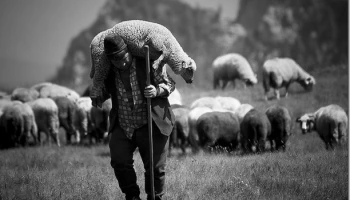
That’s how it is with sheep. They continually poop and the smell is downright awful. A lot of a shepherd’s daily work is helping sheep deal with all the gas inside them. Sheep are easily prone to bloating from excess gas. This isn’t just an uncomfortable situation for a sheep; it’s an emergency life-and-death scenario. The shepherd must continually be vigilant to the sheep and take care of such circumstances immediately and carefully.

Taking care of sheep is dangerous, difficult, and tedious work. Historically, shepherds were rough characters, constantly on the move to find lush pastures for the flock’s voracious appetite. They had to deal with both animal and human predators looking for an easy meal. Being mostly outdoors, even at night, led to their reputation as drinkers – keeping up a consistent nip of spirits to remain warm. And, of course, they smelled bad.

So, when Jesus described himself as the “good shepherd,” this was anything but a pleasing picture for people in the ancient world. The closest equivalents to our modern day might be for Jesus to say, “I am the good migrant worker,” or the “good carny” (carnival employee).

Anyone or any profession in which we might deem a person in that line of work as of dubious character – that is precisely how a shepherd, and their work, were viewed by ancient people. It’s often the low-wage workers of society who get down and dirty. Because of their work, they get a suspicious and contemptuous reputation. Remarkably, Jesus unabashedly aligned himself with such people.

And yet, it is the discounted professions and the dismissed people from which we must pay attention; God is probably at work in their midst.

The despised Samaritan gained the label of “good” by Jesus for giving himself fully to save a stranger. Jesus puts the same adjective in front of shepherd. Whereas no one in polite society would use “good” for shepherd, Jesus labels himself as the Good Shepherd who lays down his life for the sheep.

Jesus, this incredible figure who puts good and shepherd together, also goes out of his way to bring other sheep into his fold. Since Christ identifies himself as a stinky lowly shepherd, he has no problem connecting with everyone. After all, when one is already low, there’s no looking down on another.

People everywhere, no matter their station in life, can hear the voice of Jesus speaking to them when they, too, are low enough to be able to listen.

The Good Shepherd by He Qi

Jesus, the Good Shepherd, is also the sacrificial lamb. In laying down his life he takes it up again (John 10:17). And when we participate in that dying and rising, when we eat the bread and drink the cup of salvation, we know he abides in us(1 John 3:24). Remaining in Christ with our Good Shepherd means, we, too, lay down our lives:

This is how we’ve come to understand and experience love: Christ sacrificed his life for us. This is why we ought to live sacrificially for our fellow believers, and not just be out for ourselves.

If you see some brother or sister in need and have the means to do something about it but turn a cold shoulder and do nothing, what happens to God’s love? It disappears. And you made it disappear.

My dear children, let’s not just talk about love; let’s practice real love. This is the only way we’ll know we’re living truly, living in God’s reality. (1 John 3:16-18, MSG)

Community is messy. People are stinky. Stepping into another’s life is rarely picturesque or idyllic. Yet, it’s at the same time elegant and aromatic. For we discover that our old ideas of beauty are obsolete. We gain a new spiritual sense which is redolent with the fragrance of Christ.

O God, Shepherd of all your people, deliver us from all troubles, worries and cares that assail us so that we may always do what is pleasing in your sight, and remain safe in the care of our Good Shepherd, Jesus Christ our Lord. Amen.


Luke 2:1-20 – The Sound of Salvation

Host of Angels by Mike Moyers

In those days Caesar Augustus issued a decree that a census should be taken of the entire Roman world. (This was the first census that took place while Quirinius was governor of Syria.) And everyone went to their own town to register.

So, Joseph also went up from the town of Nazareth in Galilee to Judea, to Bethlehem the town of David, because he belonged to the house and line of David. He went there to register with Mary, who was pledged to be married to him and was expecting a child. While they were there, the time came for the baby to be born, and she gave birth to her firstborn, a son. She wrapped him in cloths and placed him in a manger, because there was no guest room available for them.

And there were shepherds living out in the fields nearby, keeping watch over their flocks at night. An angel of the Lord appeared to them, and the glory of the Lord shone around them, and they were terrified. But the angel said to them, “Do not be afraid. I bring you good news that will cause great joy for all the people. Today in the town of David a Savior has been born to you; he is the Messiah, the Lord. This will be a sign to you: You will find a baby wrapped in cloths and lying in a manger.”

Suddenly a great company of the heavenly host appeared with the angel, praising God and saying,

“Glory to God in the highest heaven,
    and on earth peace to those on whom his favor rests.”

When the angels had left them and gone into heaven, the shepherds said to one another, “Let’s go to Bethlehem and see this thing that has happened, which the Lord has told us about.”

So, they hurried off and found Mary and Joseph, and the baby, who was lying in the manger. When they had seen him, they spread the word concerning what had been told them about this child, and all who heard it were amazed at what the shepherds said to them. But Mary treasured up all these things and pondered them in her heart. The shepherds returned, glorifying and praising God for all the things they had heard and seen, which were just as they had been told. (New International Version)

Out of all the sounds of the season, the best of all is the sound of salvation.

The Sound of Activity

The Roman census brought a crowd of people to small village of Bethlehem. Because most were related to one another, it was like one big family reunion. There was lots of noise, with people talking, laughing, and sleeping.

We are a busy society and a busy people. The Christmas season only seems to exacerbate our busy-ness. Jesus can get lost in all the noise. We can miss the point of it all because of our preoccupations with all those seemingly necessary things in our lives. And it can be hard to hear and to listen to God. The sound of activity eventually needs to give way to another sound….

The Sound of Silence

Bethlehem was so busy that no one paid attention to the most cataclysmic event ever to take place. But out in the fields, all was quiet. The shepherds were there, quietly watching over their sheep. In the silence, they were able to experience the sound of good news.

Like a good pot of tea, we must allow the Word of God to seep in us, allowing the heat to do its work so that we might listen well to the divine voice. If we come at the Word with a cold heart, it will likely not do us a lot of good – we need to be hot and receive the Word with humility and respond to the Word with wisdom. As we allow God to seep in us, we become acutely aware of a beautiful sound….

The Sound of Joy

The shepherds heard good news of great joy from the angels. And then they shared their joy and went to worship the newborn Christ. It was a great celebration. After all, how often do a multitude of angels show up with an unsolicited concert of joy!?

We can imagine the sound of the shepherds’ unbounded joy at hearing the good news that the promised Savior has come! They just had to go and see Jesus, and then told everyone about it. And all who heard it were amazed at what the shepherds said to them.

There’s nothing quite like hearing good news, then sharing good news. Sadly, however, the story does not end there because not everyone was happy about Jesus being born as the King….

The Sound of Crying

King Herod saw Jesus as a potential rival, and he callously had every baby boy in Bethlehem killed when he found out the news. (Matthew 2:1-18)

We must keep in mind that not everyone is joyous at Christmas. Past grief associated with the holiday season can make it difficult to participate in the celebration. So, we need to be aware of the lamenting folks around us and hear their sad crying so that we can be agents of comfort and grace.

And let us also not forget, another sound of crying is the baby Jesus. Yes, he really cried. Jesus is truly human with all the sounds and experiences that go with being human. (Hebrews 2:10-17)

Conclusion

The sounds of activity, silence, joy, and crying are all part of Christmas and the birth of Jesus. To truly experience a full-orbed Christian spirituality, we will pay attention to the range of sounds occurring around us at this time of year.

Eternal God, who breathed this world into being, and placed stars into the heavens: You are the God who entrusted Jesus to the care of ordinary people, becoming vulnerable so that we might know the power of Love – a mystery so deep it is impossible to grasp, and so beautiful it is impossible to ignore.

Circle us, Lord, with the light of your presence, bright within this dark world. Enable us to be overcomers of fear and temptation, and victors over sin and despair. Circle this world with the joy of your salvation. Where there is sickness and disease, bring healing. Where there is hunger and despair, bring hope. Where there is bondage, bring freedom. Lord of our salvation, circle this world with the light of your presence. Amen.

John 10:11-18 – “Good” Shepherd?

The Good Shepherd by He Qi

“I am the good shepherd. The good shepherd lays down his life for the sheep. The hired hand is not the shepherd and does not own the sheep. So, when he sees the wolf coming, he abandons the sheep and runs away. Then the wolf attacks the flock and scatters it. The man runs away because he is a hired hand and cares nothing for the sheep.

 “I am the good shepherd; I know my sheep and my sheep know me— just as the Father knows me and I know the Father—and I lay down my life for the sheep. I have other sheep that are not of this sheep pen. I must bring them also. They too will listen to my voice, and there shall be one flock and one shepherd. The reason my Father loves me is that I lay down my life—only to take it up again. No one takes it from me, but I lay it down of my own accord. I have authority to lay it down and authority to take it up again. This command I received from my Father.” (NIV)

Sheep and Shepherds

Many people in today’s contemporary times are completely unfamiliar with sheep and shepherds. So, when it comes to picturing Jesus as the good shepherd, idyllic scenes might come to mind, full of green meadows and pastoral landscapes in which there is perfect peace and rest.

Having been raised in rural Midwest America, I can confidently say there is little romanticism to the life of shepherds and sheep. Sheep eat a lot. They’ll eat just about anything that’s growing out of the ground. Think about how you would feel if you ate copious amounts of plants. Yep. Lots of gas, trips to the bathroom, and stink.

That’s how it is with sheep. They continually poop and the smell is downright awful. A lot of a shepherd’s daily work is helping sheep deal with all the gas inside them. Sheep are easily prone to bloating from excess gas. This isn’t just an uncomfortable situation for a sheep; it’s an emergency life-and-death scenario. The shepherd must continually be vigilant to the sheep and take care of such circumstances immediately and carefully.

Taking care of sheep is dangerous, difficult, and tedious work. Historically, shepherds were rough characters, constantly on the move to find good pastures for the flock’s voracious appetite. They had to deal with both animal and human predators looking for an easy meal. Being mostly outdoors, even at night, led to their reputation as drinkers – keeping up a consistent nip of spirits to keep warm. And, of course, they smelled bad.

So, when Jesus described himself as the “good shepherd,” this was anything but a pleasing picture for people in the ancient world. The closest equivalents to our modern day might be for Jesus to say, “I am the good migrant worker,” or the “good carny” (carnival employee).

Identifying with the Lowly

Anyone or any profession in which we might deem a person in that line of work as of dubious character – that is how a shepherd and their work were viewed by ancient people. It is the lowly of society who get down and dirty. Because of their work, they get a suspicious and contemptuous reputation. Remarkably, Jesus unabashedly aligned himself with such people.

And yet, it is the discounted profession and the counted out in which we must pay attention because God is probably at work in their midst. The despised Samaritan gained the label of “good” by Jesus for giving himself fully to save a stranger. Jesus puts the same adjective in front of shepherd. Whereas no one in polite society would use “good” for shepherd, Jesus labels himself as the Good Shepherd who lays down his life for the sheep.

Jesus, this incredible figure who puts good and shepherd together also goes out of his way to bring other sheep into his fold. Since Christ identifies himself as a stinky lowly shepherd, he has no problem connecting with everyone. After all, when one is already low, there is no looking down on another.

People everywhere, no matter their station in life, can hear the voice of Jesus speaking to them when they, too, are low enough to be able to listen.

The Sacrificial Lamb

Jesus, the Good Shepherd, is also the sacrificial lamb. In laying down his life he takes it up again (John 10:17). And when we participate in that dying and rising, when we eat the bread and drink the cup of salvation, we know he abides in us (1 John 3:24). Remaining in Christ with our good shepherd means, we, too, lay down our lives:

This is how we have discovered love’s reality: Jesus sacrificed his life for us. Because of this great love, we should be willing to lay down our lives for one another… Beloved children, our love can’t be an abstract theory we only talk about, but a way of life demonstrated through our loving deeds. (1 John 3:16, 18, TPT)

Community is messy. People are stinky. Stepping into another’s life is rarely picturesque or idyllic. Yet, it is the same time elegant and aromatic. For we discover that our old ideas of beauty are obsolete. We gain a new spiritual sense which is redolent with the fragrance of Christ.

O God, Shepherd of all your people, deliver us from all troubles, worries and cares that assail us so that we may always do what is pleasing in your sight, and remain safe in the care of our Good Shepherd, Jesus Christ our Lord. Amen.

Luke 2:8-12 – All I Want for Christmas Is Joy

Welcome, friends! Christians around the world celebrate good news of great joy because God became flesh and blood and moved into the neighborhood. Click the video below, and let us enjoy a time around God’s Word.

The video below is, of course, a classic…

The Christmas speech of Linus, quoted from Luke 2

The Christian’s unspeakable joy comes from the incarnation of Christ…

My Soul Magnifies the Lord by Chris Tomlin from the album Glory in the Highest

May Christ, the Sun of Righteousness, shine upon you, scatter the darkness from before your path, and make you ready to meet him when he comes in glory. Amen.