Take the Stairs Out of the Basement Shame Lounge

Since then, you have been raised with Christ, set your hearts on things above, where Christ is, seated at the right hand of God. Set your minds on things above, not on earthly things. For you died, and your life is now hidden with Christ in God. When Christ, who is your life, appears, then you also will appear with him in glory. (Colossians 3:1-4, NIV)

A century ago, the English novelist, G.K. Chesterton, observed that in the house of life, many people are content to live in the cellar. In fact, they assume the cellar is the only room in the house. Cellars and basements have certainly changed in the past one hundred years, yet Chesterton’s observation still holds true – that people often seem content to dwell in conditions far beneath what they could experience. 

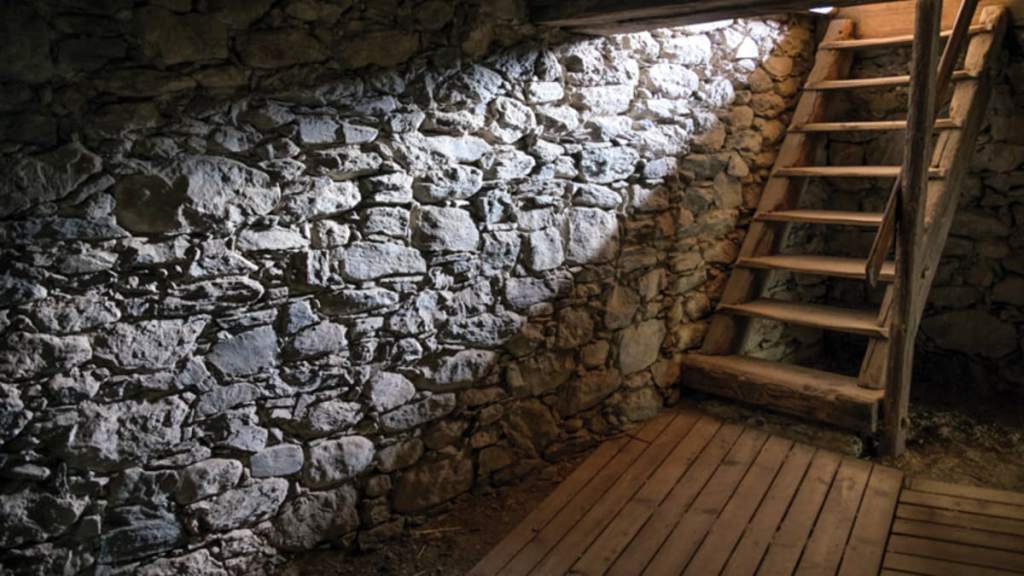
Maybe the basements of today provide a way to extend Chesterton’s metaphor. Rather than take the stairs and dwell in the house itself, we create spaces in the basement, game rooms and family rooms, to avoid dwelling in the main part of the house. We might even make the basement a shame lounge, complete with old purple shag carpeting, dimly lighted with a lava lamp, and stocked with cheap $2 a bottle wine. Its where we go when we are down on ourselves.

It’s hard to be joyful in the basement, especially when it’s a shame lounge, because it is a place where people hate themselves because of their failures, are disappointed with God for what has been allowed to happen in their lives, and blame others for their sadness.

The Apostle Paul wrote to the Colossian Church to lay a solid foundation of teaching on who Jesus Christ is and what he has done (chapters 1 & 2); and to give some solid encouragement and exhortation on what that theological foundation means for daily life (chapters 3 & 4). 

The Colossian believers were to avoid getting sidetracked by false teachers telling them they belong in the basement of life, in the shame lounge, and that the only way up the stairs and out of the cellar is through a crazy, circuitous route of constant rule-keeping.

The truth Paul wanted the Colossians to grasp is that Jesus has made the stairway clear through his cross and resurrection. Those who believe in these redemptive events are full participants in the death and life of Jesus. Christ rising from death is not merely a doctrine to believe; it is a powerful reality to be lived! Christian doctrine always has the upward trajectory of changed lives. Paul gave three reasons why we must live upstairs instead of hanging around the shame lounge….

1. We must take the stairway out of the shame lounge and live upstairs because Christ’s resurrection makes it possible.

Paul made up a word that takes five words for us to communicate in English (συνηγέρθητε – “you have been raised with”). It is meant to communicate the truth that we have a vital connection and union with Jesus (co-raised with Christ). Jesus has so closely identified with us that it is as if we are his body. 

The bond existing between Jesus and the believer is so intimate and so close that when Jesus was raised from death, we took part with him in that event. The incredible implication of this is that our life is to be the life of Christ. Our task, then, is to live up to who we are in Christ. 

Paul exhorts us toward that end by telling us to set our hearts on things above. Today, on Easter Sunday, is the day to get our hearts out of the shame lounge and live upstairs with Jesus, who is seated at the right hand of God. 

Empty Tomb by Anneli Anderson

Being seated at the right hand is a symbolic picture that the work of Jesus on the cross is finished. Therefore, the only work left to do is to believe, and to participate in the life of Christ. We do that by living upstairs with Jesus. Christ’s heart was set on giving us eternal salvation from sin and death, and he accomplished it. 

Now, Jesus Christ has his heart set on seeing us experience freedom from the habits of shame and addictive practices which keep us from living upstairs with him. Jesus wants our hearts. Christ does not want us getting headaches from smoking nasty cheap cigars in the shame lounge any longer because his resurrection has made it possible to be with him in the clear bright sunshine of grace. 

We are to set our minds on things above, not on earthly things. We must get our heads out of the cellar and get them upstairs with Jesus. If our heads are not in the main part of the house, shame thoughts will fill the void. The shame lounge becomes a prison because our thoughts do not rise above the bad circumstances we have experienced. You, however, have been raised with Christ. We can ascend the stairs of grace and enjoy life.

The believer in Jesus will follow him up the stairs and dwell with him in God’s house. The Christian will develop the life of the mind by being seeped in the living water of Jesus and not the cheap wine of shame. The follower of Jesus will take the stairs with a heart of prayer that talks to Jesus on a regular basis, instead of sitting in the shame lounge, mumbling speeches to oneself.

The person raised with Christ will take the stairs and serve the Lord with all their heart, mind, and strength because staying in the confining walls of the basement shame lounge prevents the believer from seeing the immense need of people in the neighborhood who are lost, sick, dying, hurting, hungry, depressed, and longing for someone to show them the stairway of grace out of the hopeless basement they are in.

So, take the stairs!

  • Take the stairs and leave the shame lounge behind with its anger, rage, malice, slander, and filthy language (Colossians 3:8).
  • Take the stairs as God’s chosen people who dwell in the upstairs grace by embracing the house rules of compassion, kindness, humility, gentleness, and patience, bearing with one another in love. (Colossians 3:12) 
  • Take the stairs to forgiving whatever grievances we have against one another because the Lord has forgiven us. (Colossians 3:13)
  • Take the stairs to love, which binds every good virtue together. (Colossians 3:14) 
  • Take the stairs into the large living room of peace, since as members of one body we were called to peace. (Colossians 3:15)
  • Take the stairs and let God’s house shape you as we enter the rooms of teaching and admonishing one another with all wisdom; singing psalms, hymns, and spiritual songs with gratitude in our hearts; and doing all things in the name of the Lord Jesus, giving thanks to God the Father through him for raising us up with him. (Colossians 3:16-17)

Take the stairs and live the resurrected life!

2. We must take the stairway out of the shame lounge and live upstairs because we possess new life in Christ.

We died, and our lives are now hidden with Christ in God. The shame lounge is now dead to us. We can ascend the stairs and live a new life. One of my friends in college was a party girl; she partied every chance she got. Then, she became a follower of Jesus. She received an invitation to a kegger and sent this response back: “I regret to inform you that I will be unable to attend your party because I have recently died.”

I have been crucified with Christ and I no longer live, but Christ lives in me. The life I now live in the body, I live by faith in the Son of God, who loved me and gave himself for me. (Galatians 2:20, NIV)

Since the shame lounge is dead to us, take the stairs and then burn them behind you so that you not go back there again. The basement may feel safe and familiar, but as a believer in Jesus, you and I now belong to God. Our security is firmly with Jesus upstairs, not downstairs.  God has called and gathered us upstairs out of the shame lounge.

Don’t go back downstairs. If we don’t burn that old stairway we will eventually go back down into the basement. Then, someday, someone will find your lifeless corpse down there. Put to death, therefore, whatever belongs to the shame lounge: sexual immorality, impurity, lust, evil desires, and greed, which is idolatry. (Colossians 3:5)

3. We must take the stairway out of the shame lounge and live upstairs because of the future glory that awaits us.

Christ is coming again. When Jesus returns, the believer will share in God’s glory forever.  Christ has not returned yet because he wants to live through us here on this earth for a while longer. Jesus desires to spread good news of grace and forgiveness through us. Jesus Christ wants others to have the chance to ascend the stairs and live a new life. He is patient, not wanting any to perish in the cellar, but for all to experience the resurrected life. The Apostle Paul himself struggled to put all his energy into living the resurrected life:

I want to know Christ—yes, to know the power of his resurrection and participation in his sufferings, becoming like him in his death, and so, somehow, attaining to the resurrection from the dead. Not that I have already obtained all this, or have already arrived at my goal, but I press on to take hold of that for which Christ Jesus took hold of me. Brothers and sisters, I do not consider myself yet to have taken hold of it. But one thing I do: Forgetting what is behind and straining toward what is ahead, I press on toward the goal to win the prize for which God has called me heavenward in Christ Jesus. (Philippians 3:10-14, NIV)     

Move to another level. Leave the shame lounge basement behind. The first step up the stairway of grace is always a step of surrender so that our heart, mind, soul, time, possessions, and energy are revitalized to new ways of living.

Christ is risen! He is risen indeed! Alleluia!

Praise the God and Father of our Lord Jesus Christ.

He has given us new life and hope.

He has raised Jesus from the dead.

God has claimed us as his own.

He has brought us out of darkness.

He has made us light to the world.

Christ is risen! He is risen, indeed! Alleluia!

Psalm 107:1-16 – The Necessity of Telling Our Secrets

Photo by Brett Sayles on Pexels.com

O give thanks to the Lord, for he is good;
    for his steadfast love endures forever.
Let the redeemed of the Lord say so,
    those he redeemed from trouble
and gathered in from the lands,
    from the east and from the west,
    from the north and from the south.

Some wandered in desert wastes,
    finding no way to an inhabited town;
hungry and thirsty,
    their soul fainted within them.
Then they cried to the Lord in their trouble,
    and he delivered them from their distress;
he led them by a straight way,
    until they reached an inhabited town.
Let them thank the Lord for his steadfast love,
    for his wonderful works to humankind.
For he satisfies the thirsty,
    and the hungry he fills with good things.

Some sat in darkness and in gloom,
    prisoners in misery and in irons,
for they had rebelled against the words of God,
    and spurned the counsel of the Most High.
Their hearts were bowed down with hard labor;
    they fell down, with no one to help.
Then they cried to the Lord in their trouble,
    and he saved them from their distress;
he brought them out of darkness and gloom,
    and broke their bonds asunder.
Let them thank the Lord for his steadfast love,
    for his wonderful works to humankind.
For he shatters the doors of bronze,
    and cuts in two the bars of iron. (NRSV)

The psalmist calls upon others to give thanks to the good Lord who shows enduring love to people. The psalmist furthermore exhorts those who have been redeemed to say so, to declare God’s praises for delivering them from trouble. 

Whatever the circumstances and however difficult the experiences may have been, the believer is not to remain in silence but is to publicly thank God.

Speaking our spiritual stories to others is important for those who share them, and for those who listen, so that the community of the redeemed will be strengthened in their faith and emboldened to share with others. Far too many Christians are reticent to talk about what God has done or is doing in their lives. Shame, embarrassment, or a host of other reasons might prevent us from being vulnerable enough to let others in on God’s deep work within us. But the psalmist does not let us off the hook, even if we feel we are not articulate or are too afraid to speak.

We all likely have had the privilege of hearing another person share their heart and experience of hardship and God’s deliverance. It was uplifting, encouraging, and helpful. So, let’s not keep our stories to ourselves. Stories are meant to be told, not hidden. 

Bringing to light our faith journey is healing for all, as well as declaring the light of Jesus to the world.

Author Frederick Buechner wrote a book several years ago entitled, “Telling Secrets.” Buechner tells of his own experience of keeping some stories inside and never letting them see the light of day. One of those stories was growing up with an alcoholic father and all the other stories that went along with that singular story. It was only in finally telling the family secret of alcoholism that he discovered a better path forward to healing and blessing. He writes:

“What we hunger for perhaps more than anything else is to be known in our full humanness, and yet that is often just what we also fear more than anything else. It is important to tell at least from time to time the secret of who we truly and fully are because otherwise we run the risk of losing track of who we truly and fully are and little by little come to accept instead the highly edited version which we put forth in hope that the world will find it more acceptable than the real thing. It is important to tell our secrets, too, because it makes it easier for other people to tell us a secret or two of their own.”

“My story is important not because it is mine, God knows, but because if I tell it, the chances are you will recognize that, in many ways, it is also your story. It is precisely through these stories in all their particularity, as I have long believed and often said, that God makes himself known to each of us more powerfully and personally. If this is true, it means that to lose track of our stories is to be profoundly impoverished not only humanly but also spiritually.”

Shame is like a vampire. It lives in the shadows, thirsting for and feeding upon secrets.

But when our stories are told and see the light of day, the vampire of shame is destroyed by the bright rays of truth and vulnerability. We then become open to genuine relationships without propping up a false self to pose for others. We place ourselves in a position to receive and give love. In short, we can meaningfully connect with both God and others because we found our voice and told our story.

Great God of deliverance, I praise you that I have a story to tell of your grace and faithfulness. Help me to tell of your mercy in my life so that the name of Jesus will be exalted, and that your people might be built up in the faith.  Amen.

Hebrews 9:23-28 – Once for All

Ethiopian Orthodox Church icon of Christ’s crucifixion

It was necessary for the sketches of the heavenly things to be purified with these rites, but the heavenly things themselves need better sacrifices than these. For Christ did not enter a sanctuary made by human hands, a mere copy of the true one, but he entered heaven itself, now to appear in the presence of God on our behalf. Nor was it to offer himself again and again, as the high priest enters the Holy Place year after year with blood that is not his own; for then he would have had to suffer again and again since the foundation of the world.

But as it is, he has appeared once for all at the end of the age to remove sin by the sacrifice of himself. And just as it is appointed for mortals to die once, and after that the judgment, so Christ, having been offered once to bear the sins of many, will appear a second time, not to deal with sin, but to save those who are eagerly waiting for him. (NRSV)

Once for all. Those few words are some of the most gruesome and beautiful in the entirety of Holy Scripture.  The sacrifices of bulls and goats in the Old Testament had its place. Yet, those were mere shadows pointing to the reality of the Messiah – the one whose sacrifice is so potent as to do away with sacrifice forever.

The cross of Christ was the once for all sacrifice that has settled the sin issue forever.

This is the heart of New Testament good news. Forgiveness of sins comes through the sheer grace of God in Christ. Through faith, we have the privilege of entering new life. Jesus has paved the way for eternal life, everlasting salvation, and complete remission of sins.

If it has not yet become self-apparent as to why Christ’s once for all sacrifice is such a game changer, then let’s perceive the cross from this angle: guilt is done away with, forever. Do you believe your life would change forever if you never had guilt hanging over your head?  What if all your past indiscretions, unhealthy life decisions, failures to speak or act when needed, overt things done which you cannot take back, or even the little things said or done in anger or hate were all washed away, forever?

Just as Jesus was nailed to a cruel cross, so guilt and shame was nailed there – once for all. There are three options of dealing with a guilty conscience when it happens…

Rationalize

First, you can rationalize it away, as if you have no responsibility or no culpability. One simply ignores their conscience. This is a one-way path to hardness of heart. Whenever we sin in speech or in action, and do not acknowledge it as our fault, then there is a little piece of us which hardens. The next time it happens, it’s a bit easier to respond with callousness. If you’ve ever encountered someone who seems utterly unfeeling to your situation, then there has likely been a pattern in that person’s life of keeping distance from pain. It only leads to hardness of heart.

Punish

A second way of facing guilt is just the opposite of rationalization. It is to punish and beat yourself for your faults and sins. Heaping abuse on ourselves for our sins takes two different tracks with either: discouragement, defeat, and depression resulting in inaction; or, working like crazy to try and earn God’s favor with hyper-activity. Both ways are a kind of self-imposed penance to try and atone for one’s sins or failures.

Confess

Fortunately, there is a better way to face and deal with our guilt. When there is true guilt for things done or undone, said, or unsaid, we must confess it, repent of it, and believe God has taken care of it. Unlike dealing with guilt in unhealthy ways resulting in callousness, discouragement, and hyperactivity, the path of confession and repentance allows the person to have a clear conscience, resulting in freedom. Christ’s once for all sacrifice is completely able to clear the conscience of the worshiper so that they may live into the grace and freedom of an enjoyable daily life. 

Nothing needs to hang over the believer’s head because Jesus Christ, the pioneer of our salvation, has accomplished deliverance from and forgiveness of sin, once and for all. Jesus didn’t just put a nice-looking veneer over sin; he took care of it, thoroughly and completely. Jesus didn’t whitewash things so that we looked okay; the salvation he offers is permanent.

The cross which held Christ’s naked and tortured body exposed the true violence and injustice of sin. The cross revealed what kind of world we have and what kind of God we have: a world of gross unfairness and sin, and, a God of extreme sacrificial love and grace.

What I believe this world, including you and me, need more than anything else is forgiveness – not a cheap sentimental forgiving, but a real forgiveness which lasts forever.

To justify or to judge is God’s business. Our business is to believe in the once-for-all sacrifice of Jesus that brings permanent and lasting forgiveness; and, to share that life-giving message with others so that they, too, might experience deliverance from sin and its horrible effects.

“For he delivered us from the domain of darkness and transferred us to the kingdom of his beloved Son, in whom we have redemption, the forgiveness of sins.” (Colossians 1:13-14, NIV)

May you know the freedom and joy today which comes from knowing Christ as Savior.

Hebrews 8:1-13 – Deliverance through a Manger

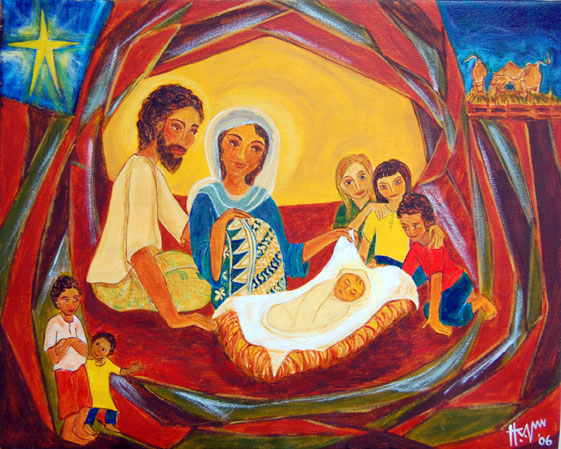
God Is With Us, by Malaysian artist Hanna Varghese, 2006

Now the main point of what we are saying is this: We do have such a high priest, who sat down at the right hand of the throne of the Majesty in heaven, and who serves in the sanctuary, the true tabernacle set up by the Lord, not by a mere human being.

Every high priest is appointed to offer both gifts and sacrifices, and so it was necessary for this one also to have something to offer. If he were on earth, he would not be a priest, for there are already priests who offer the gifts prescribed by the law. They serve at a sanctuary that is a copy and shadow of what is in heaven. Therefore, Moses was warned when he was about to build the tabernacle: “See to it that you make everything according to the pattern shown you on the mountain.” But in fact, the ministry Jesus has received is as superior to theirs as the covenant of which he is mediator is superior to the old one, since the new covenant is established on better promises.

For if there had been nothing wrong with that first covenant, no place would have been sought for another. But God found fault with the people and said:

“The days are coming, declares the Lord,
    when I will make a new covenant
with the people of Israel
    and with the people of Judah.
It will not be like the covenant
    I made with their ancestors
when I took them by the hand
    to lead them out of Egypt,
because they did not remain faithful to my covenant,
    and I turned away from them,
declares the Lord.
This is the covenant I will establish with the people of Israel
    after that time, declares the Lord.
I will put my laws in their minds
    and write them on their hearts.
I will be their God,
    and they will be my people.
No longer will they teach their neighbor,
    or say to one another, ‘Know the Lord,’
because they will all know me,
    from the least of them to the greatest.
For I will forgive their wickedness
    and will remember their sins no more.”

By calling this covenant “new,” he has made the first one obsolete; and what is obsolete and outdated will soon disappear. (NIV)

Our wait is nearly over. Christmas Day is almost here. The Messiah is coming. I genuinely believe that Jesus is the mid-point of history; everything for all time hinges upon Christ’s incarnation. The most cataclysmic event in the history of the world is a birth. The hopes of humanity are focused, of all things, in a stinky old feeding trough for animals – a manger.

Yes, Christians put a lot of focus on the cross and resurrection. Yet, the incarnation was the signature event of God’s breaking into this world. The inconceivable was conceived. God became human. Nothing would ever be the same again….

Nativity by African artist Joseph Mulamba-Mandangi, 2001

Jesus is our great high priest, the nexus between heaven and earth. All else are only mere shadows of the real Savior. Christ is the hinge upon which our own personal lives turn. The old system of law fades and gives way to the person for whom it all pointed. For the law, as important as it was, has never been able to save. In Christ there is a new covenant established by grace, taking care of the sin issue once for all.

Through the Christ child, all other means of deliverance have become obsolete. No matter how much he washed his hands, Pilate could not wash away his guilt. Despite all our efforts to hide or undo our shame, it will not go away. It is through Jesus that all guilt and shame have been banished. Human iniquity is taken away. All that we have done and left undone is forgiven – our sin is purged forever.

A new age has dawned. A new era has been inaugurated. The miracle of the Nativity explodes with continuing effect throughout history. Its continuing effects can still be felt, two-thousand years later. Nothing will ever undo the power of love and grace which was unleashed in the little town of Bethlehem.

Here is a clear and confident declaration to any and all in despondency or despair, no matter the reasons why: We may feel crushed, dejected, confused, or broken because of this past year’s events; but our salvation depends not on our mood or the constant changing of circumstances. Christ has offered himself once for all. The work is finished. Our faithful high priest is even now interceding for you and me in heaven.

Our faith is grounded not in our pedigree, our position, or our ability to produce but forever in what Christ has done in becoming human on our behalf. See the manger where he lies. Know that salvation is before us. Believe the promise of God.

May this eternal truth be always on our hearts:
That the God who breathed this world into being
Placed stars into the heavens
And designed a butterfly’s wing
Is the God who entrusted his life
to the care of ordinary people
became vulnerable that we might know
how strong is the power of Love
A mystery so deep it is impossible to grasp
A mystery so beautiful it is impossible to ignore.