Mark 10:17-22 – Jesus Intervenes

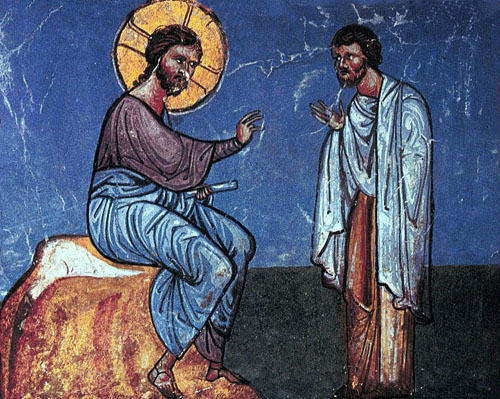
Eastern Orthodox mural of Jesus and the rich man

As Jesus started on his way, a man ran up to him and fell on his knees before him. “Good teacher,” he asked, “what must I do to inherit eternal life?”

“Why do you call me good?” Jesus answered. “No one is good—except God alone. You know the commandments: ‘You shall not murder, you shall not commit adultery, you shall not steal, you shall not give false testimony, you shall not defraud, honor your father and mother.’”

“Teacher,” he declared, “all these I have kept since I was a boy.”

Jesus looked at him and loved him. “One thing you lack,” he said. “Go, sell everything you have and give to the poor, and you will have treasure in heaven. Then come, follow me.”

At this the man’s face fell. He went away sad because he had great wealth. (New International Version)

We are all addicts. 

We all have our own sin addictions which keep us stuck in guilt and shame.

We may not all struggle with the same sin. Yet we all have some besetting sin(s) that we must be weaned off of. The most pervasive addiction found in Holy Scripture is neither substance abuse nor alcohol – it is the addiction to wealth and money.

Maybe your initial response was of someone else, besides yourself: “I don’t have as much money as____” or, “So-and-so has a real problem with that!” Those statements are what we call, in terms of addiction, denial. 

In truth, all of us are in some sort of denial about how much we really trust in paychecks, bank accounts, investments, and owning material stuff. I’m no exception. I own more books than I’ll be able to read in a lifetime, and yet, I tend to believe I don’t have enough of them.

Even the poor can have an addiction wealth and money by thinking about it and wishing for it to an unhealthy degree, as if wealth is the thing that will ultimately make them happy.

People in denial rarely have any idea how much they are hurting others, themselves, and God.  In fact, the consistent witness of the early church fathers is that the sheer accumulation of stuff is the same as stealing from the poor. 

Because of denial, people need an intervention. They need to be jolted back to their senses. Intervention is a gift. Someone cares enough about the person to intervene. Yet, interventions don’t always work. The person can choose to walk away and refuse to change.

Jesus did a gracious intervention with a rich young man. The man was addicted to wealth and money, but he didn’t see it. In fact, he thought he was quite godly and spiritual. It’s a sad story because the man walks away untransformed by his encounter with Jesus and did not accept the gracious invitation to follow the Lord. 

Chinese depiction of Jesus and the rich man, 1879

The man simply did not see himself as hopeless and desperately needing to change. He held to his denial.

The man approached Jesus with a question: “What must I do to inherit eternal life?” Whereas I would probably get all excited about being asked a question like this and launch into some long-winded gospel answer, Jesus immediately picked up on the attitude and the need behind the question. 

What must I do to get? It’s almost as if the man wants to acquire eternal life like he would acquire wealth. “I am a successful businessman with plenty of money, and a respected citizen with lots of wealth – now I want to be a success with God, as well.” 

The question may have been sincere, yet it was misguided. Eternal life is not spiritual real estate for an upwardly mobile person to acquire and possess. The man seems to believe he can purchase eternal life, as if everyone has their price, even God. “After all,” he may have been reasoning, “I have gotten everything else in life, so why not obtain eternal life?”

Jesus questioned the question. He went after the underlying assumption of doing something good to obtain eternal life. The fact of the matter is that the man cannot do anything. He can’t because only God is good. Jesus points him to God by changing the action from getting to entering. And he changed the language from a market acquisition to entering into a journey.

Jesus was inviting the man to walk with him.

Eternal life is a journey of faith in the God who is good, and not a transaction to get it. And, we too, must be careful not to treat eternal life as if it were a transaction, as if we must get a person to sign on the dotted line through a “sinner’s prayer” or some other formula that will seal the deal for eternal life. 

Instead, eternal life is a walk of obedience with God and his commands.

Jesus responded to the rich man with the Ten Commandments, specifically the ones which focus on human relationships. Jesus wanted him to realize that the path into the kingdom of God and eternal life goes through and not around how we treat our fellow human beings.

Christ and the Rich Young Ruler by Heinrich Hofmann, 1889

The Lord sought to expose the impossibility of continuing in life on the rich man’s terms. The guy just could not imagine what he might be lacking. So, Jesus helped him out. Christ gave him some major interventional language…. Sell. Give. Follow.

Sell everything. Give to the poor. Come, follow me.

One cannot simply add Jesus to their life, like adding a new car or a new fishing rod. Rather, one’s heart must change in order to accommodate real, genuine eternal life. 

Jesus offered the rich man someone to be, rather than something to get

It’s one thing to give from what you have; it’s another thing to surrender your life and all you have. 

In the New Testament Gospels, there are no easy conversations with Jesus. He gets personal in every encounter and gets under everybody’s skin. Christ doesn’t settle with superficial small talk when there are people whose hearts are little more than idol factories. 

Jesus never leaves us alone, because there is always the invitation to “Come, follow me.”

Christ exposed the wealthy man’s divided loyalties – he was trying to serve both God and money. But he would have to choose between the two. 

And that is our choice, as well. 

The question for us is not, “Am I completely devoted to money?” Instead, the question from our Gospel story today is, “Am I trying to serve God while maintaining a moonlighting job with the world?” 

God wants from us an undivided heart; the Lord desires absolute allegiance.

Jesus is looking for those who are poor in spirit, who recognize their great need for God – instead of believing that they are okay and just need to add a little Jesus to their lives. 

God is looking for spiritual beggars who understand their desperate situation and don’t practice denial by sugar-coating their actual spiritual state.

Like a drunkard who won’t give up his vodka; like a sex addict who won’t give up strip clubs or emotional affairs; or like a workaholic who just can’t come home; the rich man would not give up his disordered love for money and possessions. 

So, Jesus did an intervention. 

The Lord Jesus didn’t ask everybody to do exactly as he called the rich man to do. He didn’t ask the very wealthy Zacchaeus to do it, and he didn’t tell Peter to sell his fishing business. 

But Jesus does tell us to do something which seems impossible. Yet, where the impossible exists, so exists grace.

Blessed Lord, you have taught us that all our doings without loving generosity are worth nothing. Send your Holy Spirit and pour into our hearts your gift of love, the true bond of peace and of all virtues, without which whoever lives is counted dead before you. Grant this for the sake of your only Son Jesus Christ, who lives and reigns with you, in the unity of the Holy Spirit, one God, now and forever. Amen.

Psalm 107:1-9, 43 – Let the Redeemed Say So

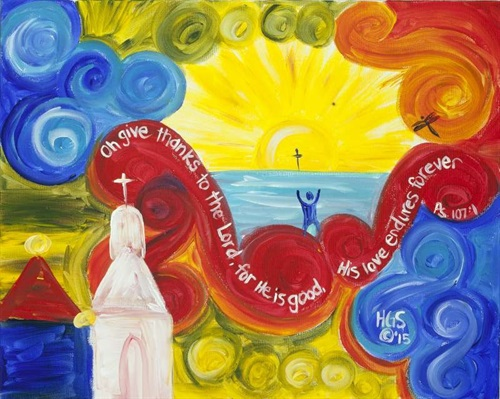
Psalm 107 by Hope Smith

O give thanks to the Lord, for he is good,
    for his steadfast love endures forever.
Let the redeemed of the Lord say so,
    those he redeemed from trouble
and gathered in from the lands,
    from the east and from the west,
    from the north and from the south.

Some wandered in desert wastes,
    finding no way to an inhabited town;
hungry and thirsty,
    their soul fainted within them.
Then they cried to the Lord in their trouble,
    and he delivered them from their distress;
he led them by a straight way,
    until they reached an inhabited town.
Let them thank the Lord for his steadfast love,
    for his wonderful works to humankind.
For he satisfies the thirsty,
    and the hungry he fills with good things….

Let those who are wise pay attention to these things
    and consider the steadfast love of the Lord. (New Revised Standard Version)

The psalmist encourages and invites us to consider God’s steadfast love (Hebrew “chesed”). In all truth, an eternity of pondering and discovering such love will never plumb the depths of the Lord’s faithful love.

Maybe there is so much hate, bitterness, and vitriol in this old fallen world because people don’t consider the God who is Love. After all, there isn’t much room for malicious anger whenever people are expressing gratitude.

We are divinely hard-wired to give and receive affirmation, gratitude, encouragement, and love. Doing the opposite of that throws a huge monkey wrench into our daily living. It’s not sustainable to live by criticism, ingratitude, judgmentalism, and hate. It goes against who we are as humans.

Instead, it is sage to acknowledge, appreciate, ponder, and express the great love of God for humanity. The Lord’s love never runs out – it is inexhaustible.

Many people have stories of wandering far from Love, stumbling in the darkness, and finding themselves in desperate straits. Like the prodigal son, they are found by the God who is Love. And instead of being chided for their herky-jerky life, they are given a prominent place in God’s kingdom.

Some of you wandered for years in the desert,
    looking but not finding a good place to live,
Half-starved and parched with thirst,
    staggering and stumbling, on the brink of exhaustion.
Then, in your desperate condition, you called out to God.
    He got you out in the nick of time. (Psalm 107:4-6, MSG)

Praise and thanksgiving become the reflexive practices of the folk who have returned home to God. And the psalmist calls us to speak out those stories of hope and deliverance.

Telling our spiritual stories to others is important – both for the storyteller, and also for those who listen. Together, the spiritual community of the redeemed becomes strengthened in their bonds of faith; and everyone is emboldened to share with others. 

Far too many Christians are reticent to talk about what God has done or is doing in their lives. Shame, embarrassment, or a host of other reasons might prevent us from being vulnerable enough to let others in on God’s deep work within.

We all likely have had the privilege of hearing another person share their heart and experience of hardship and God’s deliverance. It was uplifting, encouraging, and helpful. So, let’s not keep our stories to ourselves. Stories are meant to be told, not hidden. Bringing to light our faith journey is healing for all, as well as declaring that Jesus is the light of the world.

Author Frederick Buechner wrote a book several years ago entitled, “Telling Secrets.” Buechner tells of his own experience of keeping some stories inside and never letting them see the light of day. One of those stories was growing up with an alcoholic father and all the other stories that went along with that singular story.

It was only in finally telling the family secret of alcoholism that he discovered a better path forward to healing and blessing. He writes:

“What we hunger for perhaps more than anything else is to be known in our full humanness, and yet that is often just what we also fear more than anything else. It is important to tell at least from time to time the secret of who we truly and fully are because otherwise we run the risk of losing track of who we truly and fully are and little by little come to accept instead the highly edited version which we put forth in hope that the world will find it more acceptable than the real thing. It is important to tell our secrets, too, because it makes it easier for other people to tell us a secret or two of their own.”

Frederick Buechner, “Telling Secrets”

Buechner went on to say:

“My story is important not because it is mine, God knows, but because if I tell it, the chances are you will recognize that, in many ways, it is also your story. It is precisely through these stories in all their particularity, as I have long believed and often said, that God makes himself known to each of us more powerfully and personally. If this is true, it means that to lose track of our stories is to be profoundly impoverished not only humanly but also spiritually.”

Shame is like a vampire. It lives in the shadows, feeding upon secrets. But when our stories are told and see the light of day, the vampire of shame is destroyed by the bright rays of truth and vulnerability.

We then become open to genuine relationships without propping up a false self to pose for others. We place ourselves in a position to receive and give love. In other words, we can meaningfully connect with both God and others because we found our voice and told our story.

Great God of deliverance, I praise you that I have a story to tell of your grace and faithfulness. Help me to tell of your mercy in my life so that the name of Jesus will be exalted, and that your people might be built up in the faith.  Amen.

Psalm 31:1-4, 15-16 – Holy Saturday

I take refuge in you, Lord.
    Please never let me be put to shame.
        Rescue me by your righteousness!
Listen closely to me!
    Deliver me quickly;
        be a rock that protects me;
        be a strong fortress that saves me!
You are definitely my rock and my fortress.
    Guide me and lead me for the sake of your good name!
Get me out of this net that’s been set for me
    because you are my protective fortress….

My future is in your hands.
    Don’t hand me over to my enemies,
    to all who are out to get me!
Shine your face on your servant;
    save me by your faithful love! (Common English Bible)

Holy Saturday is a quiet place sandwiched between the ignominy of the Cross and the celebration of Resurrection – a day of solitude, silence, and stillness. 

This isn’t a particularly popular day. People don’t rave about Holy Saturday. Many Christians haven’t even a thought that this day could have any significance. Yet, this very day has its place in the scheme of the Christian life.

Whenever Christians quickly jump to triumphal language about victory and speak little-to-nothing about suffering, then we are left with a cheap grace which has been purchased with the counterfeit currency of velocity. 

Today is meant for us to get of our heads and wrap our hearts around the important reality that Jesus Christ was truly and bodily dead in the grave. 

It was real suffering on Good Friday, and it is a real death on Holy Saturday. There is no movement. All is silent and still. Jesus is in the solitude of a dark tomb. 

There’s no getting around this: If we want a Resurrection Day with all its celebration and glory, then we cannot circumvent Holy Saturday with its quiet and somber sadness. 

Holy Saturday must be observed if we are to experience real and practical freedom from the bondage of shame. And shame is powerful. It keeps a person locked within themselves, alone with their secrets hidden far from others.

Far too often we may try and cope with our shameful words or actions through promising to work harder, pledging to have greater willpower, or complaining that life is unfair. None of this gets to the root of our shame.

Unlike guilt, which our conscience identifies as specific behaviors to repent of, shame is the message of our inner critic who obnoxiously decries that we are somehow flawed, not enough, and inherently lacking intelligence, courage, or volition.

Shame is the insidious mechanism which interprets bad events as we ourselves being bad.

Shame is the vampire who lives in the shadows and feeds on secrets – which is why the posture of shame is to hide our face in our hands. If shame persists, we withdraw from others and experience grinding loneliness. 

Therefore, the path out of shame is to openly name our shame and tell our stories. In other words, nailing the stake of vulnerability into the heart of shame, and exposing it to the light, causes it to disintegrate and vaporize.

In contrast to the unhealthy hiding of ourselves within prison walls of shame is seeking refuge and hiding ourselves in God. Even a cursory look at today’s psalm evidences an open and vulnerable person who wants nothing to do with shame. The psalmist unabashedly and without shame is quite forward in presenting his wants to God.

The psalms are meant for repeated use, to be voiced aloud again and again. In doing this simple activity, we shame-proof our lives. God’s face shines upon us and takes away the shadows of shame. It is no coincidence that Jesus forsook the shame of the cross through publicly uttering the words of this psalm: “Into your hands I commit my spirit.” (Luke 23:46)

Unchecked verbal violence will eventually lead to physical violence.

If wordy persecution comes from others, the primary tactic will most likely be shaming the people such persons want to control. Such enemies will frame a justification for violence because the people for whom they are leveling shame are “bad,” even “monsters.” If the verbal persecution comes from within, the shame can reach a critical mass of suicidal ideation and perhaps outright attempts at ending one’s life.

There is no existing with the living death of shame. But the good news is that we don’t have to. Instead, we can live in the strong fortress and the rock of refuge which is God.

The Lord traffics in redeeming mercy and steadfast love, not in the demeaning judgment of shame. We can flee to God and find grace to help us in our time of need. There is no shame in reaching out for help. We all need deliverance from something. It’s a matter of whether we are open to ask for it, or not.

Holy Saturday is here for you to know that Jesus Christ absorbed all of the world’s massive shame, yesterday, on Good Friday. Christ died. And the shame he took on, died with him. It is no more and will rise no more.

But someone will rise….

Father God, into your hands I commit my spirit – everything I am and all that I hope to be – so that Jesus Christ might be exalted in me through the power of your Holy Spirit. I choose to leave shame where it belongs – nailed to the cross. With your divine enablement, I shall walk in newness of life through expressing my needs and wants with courage, confidence, and candor. May it be so according to your steadfast love. Amen.

Romans 10:8b-13 – Believe and Confess

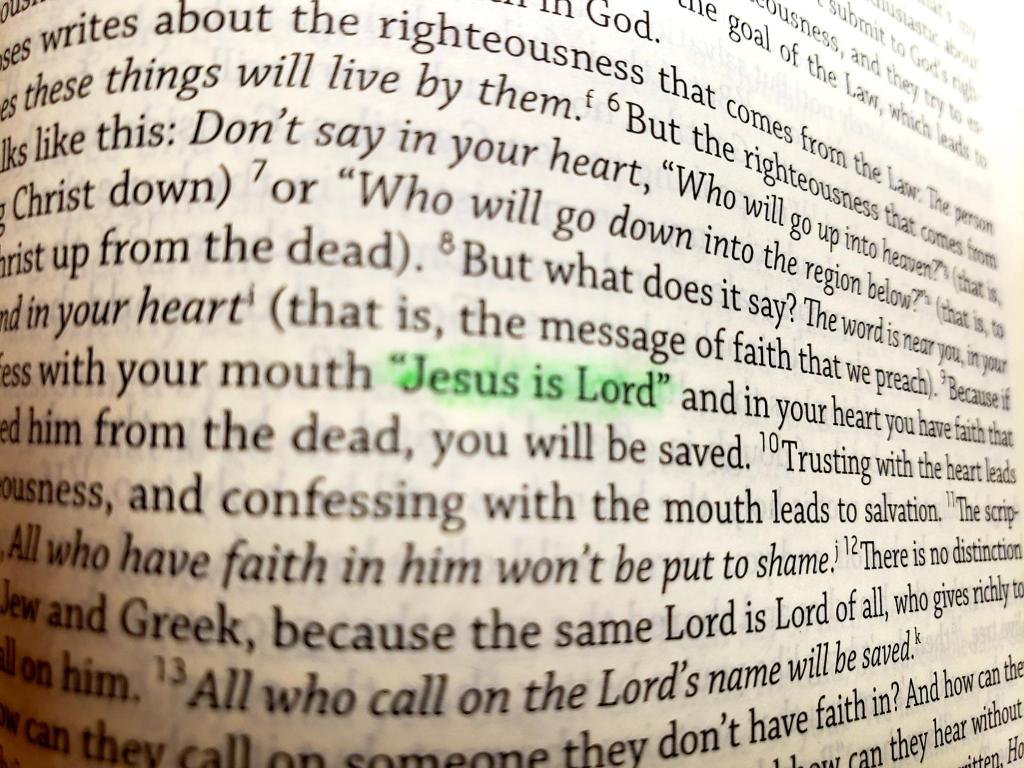
“The word is near you; it is in your mouth and in your heart,” that is, the message concerning faith that we proclaim: If you declare with your mouth, “Jesus is Lord,” and believe in your heart that God raised him from the dead, you will be saved. For it is with your heart that you believe and are justified, and it is with your mouth that you profess your faith and are saved. As Scripture says, “Anyone who believes in him will never be put to shame. ”For there is no difference between Jew and Gentile—the same Lord is Lord of all and richly blesses all who call on him, for, “Everyone who calls on the name of the Lord will be saved.” (New International Version)

Confess with the Mouth

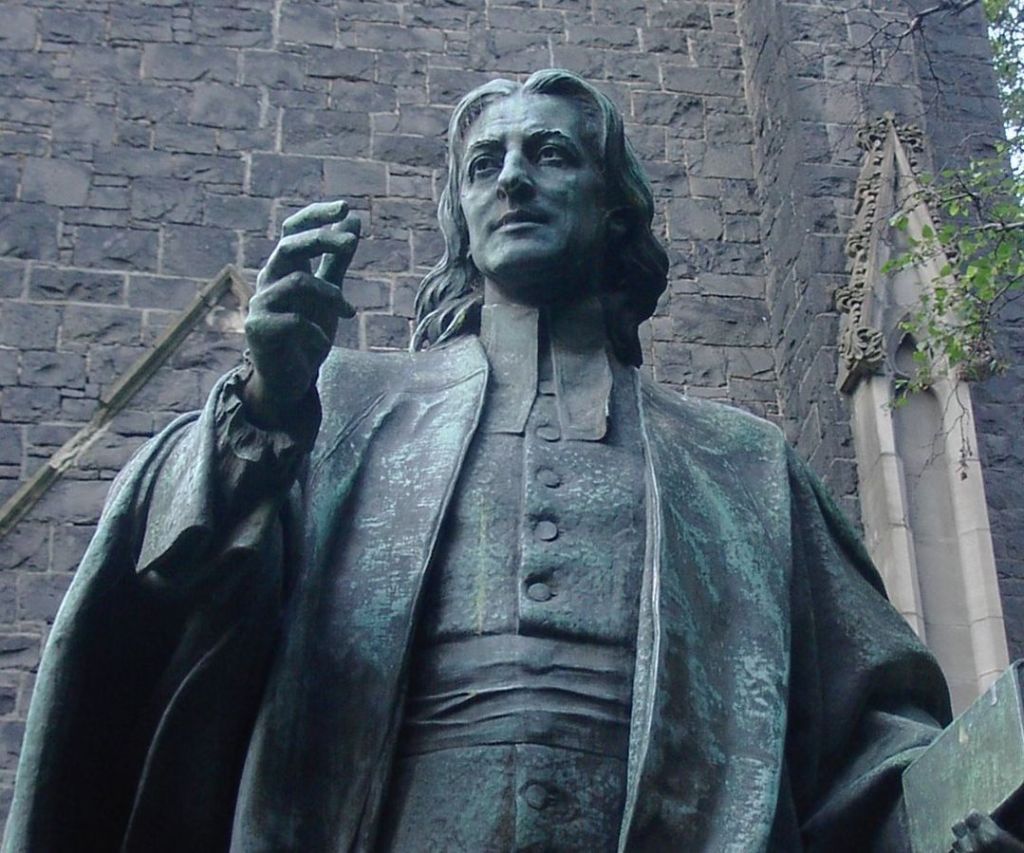
John Wesley (1703-1791) was an Oxford don who became an Anglican priest. He had all the intellectual tools to rightly handle the intricacies of theology and teach the Bible. Yet, when he first started out, there was no heart behind it. 

On a voyage across the Atlantic to America, Wesley spent much of the time on the ship with a group of German pietists – men and women who had a heart behind their practice of Christianity. The Germans deeply impressed Wesley, and he realized there was something important missing from his own religion. 

The ship encountered a storm and Wesley was afraid for his life. But the German believers seemed unfazed, having a heart-faith that John could not explain. He wanted what they had. Wesley was fearful and found little comfort in his religion. So, he confessed to one of them his growing misery and decision to give up the ministry. One of the Pietists advised, “Preach faith till you have it. And then, because you have it, you will preach faith.”

John Wesley acted on the advice. He led a prisoner to Christ by preaching faith in Christ alone for forgiveness of sins. He was astonished. Here was a man transformed instantly. Wesley cried out, “Lord, help my unbelief!” However, he still felt dull inside and little motivation even to pray for his own salvation. 

Statue of John Wesley as a young preacher, by Adam Carr, located in Melbourne, Australia

Having returned back to England, Wesley was in a church service listening to Romans expounded by the preacher. He recalled the experience years later: “While he was describing the change which God works in the heart through faith in Christ, I felt my heart strangely warmed. I felt I did trust in Christ, Christ alone for salvation; and an assurance was given me that He had taken away my sins, even mine, and saved me from the law of sin and death.”

Believe with the Heart

Simply uttering the words with our mouths, “Jesus is Lord,” by itself does not create deliverance and salvation. The heart needs to be involved. Yet, we must also consider the reality that only focusing on the heart, without having the mouth involved, is an insufficient faith. Christian belief has a solid objective real historical base from which our hearts can tether themselves. Christian confession affirms that Jesus is, indeed, risen from death and is Lord of all, having secured salvation for us through his shed blood on the cross.

Consider two hypothetical men at the time of the Passover in Egypt: Eleazar Ben Macaroni and Yakov Yarmulke. Eleazar and Yakov are talking together on the night the angel of death is about to pass through Egypt and the firstborn son in every family would be killed – that is, unless the blood from a sacrificial lamb was over the door of the house so that the angel would “pass over” the house and no one would be killed. 

Passover Angel of Death, by Arthur Hacker (1858-1919)

Yakov says to Eleazar, “Can you believe all that has been happening around here?  It’s all very scary!  All of those plagues, the disaster around us, and now this night!”  Eleazar asks, “Well, haven’t you put the blood over the door?”  “Yes, I’ve done all that – but it all is still disturbing.  My heart is troubled.  What do think will happen?” “Will we be okay?” asks Yakov nervously.  Eleazar responds, “I trust in the promises of God; let the angel come!”

So, when the angel of death came, which house do you suppose lost his firstborn son: Eleazar ben Macaroni, or Yakov Yarmulke?  The answer: neither of them. The angel of death did not come to either man’s house because deliverance is determined by the blood of the lamb and not by the quality or intensity of faith of the person. 

“For me His precious blood he shed – for me His life He gave. I need no other argument, I need no other plea; it is enough that Jesus died, and that he died for me.”

My Faith Has Found a Resting Place, hymn by Eliza Edmunds Hewitt (1851-1920)

If we only focus on the heart, our hearts will condemn us. We need to say the words of our faith, to confess them with our mouths, repeatedly, again and again, until we believe them. We are not to wait for our hearts to feel like having faith and living for God, because our hearts can be desperately wicked, and they will keep deceiving us. The heart needs to be informed by God’s Word and accept the words of Holy Scripture by faith:

“If we confess our sins, he is faithful and just to forgive us our sins, and to purify us from all unrighteousness.” (1 John 1:9, NIV)

Have the Heart and Mouth Work Together

We need both a right confession with our mouths and a right confession in our hearts for saving faith. When the heart receives grace, and the mouth expresses the beauty of faith – when heart and mouth work in concert with each other – something beautiful and gracious happens: 

“Everyone who calls on the name of the Lord will be saved.”

Romans 10:13

When Holy Scripture says “everyone,” it means “everyone.” All who cry out to God with their mouths, from a heart desiring God, will be saved. It does not matter whether that call is melodious, sweet, and in tune; or whether the call is a jumbled off-key joyful noise. It makes no difference; both will be saved. 

Only uttering the right words like some magical incantation does not save us. Only sincerity of heart does not save us. One does not achieve salvation through self-effort or trying to be worthy. No one is saved by finding the right combination of words in prayer or having a nice feeling.

Calling on the name of the Lord with both mouth and heart, trusting in the redemptive events of Jesus Christ, is what saves us.

Whether Jew or Gentile, rich or poor, American or Arab, famous or infamous, it is no matter – because salvation isn’t dependent on our looks, our past, or our zeal in doing good works. Salvation is completely from God and freely given to all who call upon the name of the Lord.

Make No Room for Shame

What’s more, all who trust in Jesus Christ will never be put to shame. In ancient Roman society, nearly three-fourths of all the people in the Empire were slaves to the other one-fourth. It was a culture built around the concept of honor and shame. It was shameful to be a slave, and honorable to be privileged, wealthy, and influential with a good Roman pedigree and citizenship. It was beneath such people to interact with those who served them because dealing with shameful people would make them shameful, as well.

Jesus forsook his honorable position in order to hob-nob with us rabble. He became one of us to save us and lift us up with him.

“For you know the grace of our Lord Jesus Christ, that though he was rich, yet for your sakes he became poor, so that you, through his poverty, might become rich.” 

2 Corinthians 8:9, NIV

Jesus embraced the shame of the cross. Therefore, we need never live in a state of shame ever again. Our hearts need not condemn us. Jesus has already taken care of shame, once for all.

“Let us fix our eyes on Jesus, the author and perfecter of our faith, who for the joy set before him endured the cross, scorning its shame, and sat down at the right hand of the throne of God.  Consider him who endured such opposition from sinful men, so that you will not grow weary and lose heart.” (Hebrews 12:2-3, NIV)

Put a Focus on Lent

The season of Lent lets us know we are neither brains-on-a-stick nor walking-headless-hearts. We have both heart and mouth, both deep feeling and real intellectual knowledge. Together, they form belief and confession. Lent is an invitation to prepare our hearts for Christ’s passion and resurrection. It includes an examination of our hearts so that we can deepen our piety and devotion to Jesus. And it incorporates confession of Jesus with the mouth.

The good news is this: Jesus is Savior and Lord; he has risen from death; and there is forgiveness of sins and deliverance from guilt and shame through is cross. When all is said and done, people need the Lord.

“I have not come to call the righteous, but sinners,” said Jesus. (Matthew 9:13)

Repentance involves both heart and mouth. And Lent is just the season for it, to turn from everything we have previously been living for other than Jesus. It’s an opportunity to start afresh with new life in Christ. It’s enough to make old John Wesley smile from the grave.

Have mercy on me, O God, according to your unfailing love; according to your great compassion blot out my transgressions. Wash away all my iniquity and cleanse me from my sin. 

Create in me a pure heart, O God, and renew a steadfast spirit within me. Restore to me the joy of your salvation and grant me a willing spirit, to sustain me.

Save me from guilt and shame and my tongue will sing of your righteousness. Open my lips, and my mouth will declare your praise. You do not delight in sacrifice, or I would bring it; you do not take pleasure in burnt offerings. The sacrifices of God are a broken spirit; a broken a contrite heart, O God, you will not despise. Amen.