The Light of the World (John 8:12-19)

The Light of the World, by the Jyoti Art Ashram

Again Jesus spoke to them, saying, “I am the light of the world. Whoever follows me will never walk in darkness but will have the light of life.” 

Then the Pharisees said to him, “You are testifying on your own behalf; your testimony is not valid.” 

Jesus answered, “Even if I testify on my own behalf, my testimony is valid because I know where I have come from and where I am going, but you do not know where I come from or where I am going. You judge by human standards; I judge no one. Yet even if I do judge, my judgment is valid, for it is not I alone who judge but I and the Father who sent me. In your law it is written that the testimony of two witnesses is valid. I testify on my own behalf, and the Father who sent me testifies on my behalf.” 

Then they said to him, “Where is your Father?”

Jesus answered, “You know neither me nor my Father. If you knew me, you would know my Father also.” (New Revised Standard Version)

In this season of Christmastide, I am reminded that my own joy over the birth of Jesus as the incarnation of God upon this earth, is not shared by everyone. Where I see good news, there are others who feel threatened. As I bask in glorious light, some prefer to remain in the shadows.

Not everyone, of course, buys into this distinctively Christian way of seeing things – which is why it’s important for all Christians and Churches everywhere to be characterized by the Light and not by the darkness.

Humanity is a strange alchemy of both light and dark, hopefulness and hopelessness, awareness and ignorance, love and hate. We must acknowledge the light, bring it out, and let it shine.

Hiding the light only gives the dark forces of this world an opportunity to hold a sinister and shadowy grip of guilt and shame on the people of this world.

I find that most people want truth and authenticity. They want to discover, know, and be told the truth from a genuine place of care and attention.

There are, however, those few persons who only want what they want, and don’t care much about truth and authenticity, that is, unless they can use it as leverage for their personal agenda.

Jesus Christ, Light of the World, by William Holman Hunt (1827-1910)

One of the reasons I like Jesus so much, is that he lived and spoke truth from a good place, and actually worked to better the human condition in its most awful situation.

It doesn’t take a biblical scholar to see that most of the religious leaders, especially the Pharisees, rejected the words of Jesus. They brought up a legitimate legal issue (after all, they were the experts in the Mosaic law) of Jesus bearing witness to himself. How could Jesus possibly be Messiah without the proper testimony of two or three witnesses to his messiahship?

Put another way, why should anyone believe anything Jesus was saying? What stamp of authenticity is upon his ministry? The Pharisees wanted legal evidence, so they confronted Jesus. Most of all, they wanted to expose him as an illegal.

Christ’s response to the religious leaders was consistent with most all of his responses, whenever he was queried about his authenticity. And those responses rarely made sense to most of the people hearing it – largely because they were jerks to begin with.

What I’m getting at is that whenever our hearts are oriented toward humility, gentleness, empathy, good relations, mercy, and peacemaking, then Jesus makes a whole lot of sense.

But whenever the heart is full of shadows and darkness, the person is then driven by unconscious forces which never consciously understand what in the world Jesus is saying to them.

A well-oriented heart is a gift obtained from God. A disoriented heart and a fragmented mind are the result of arrogant pride and selfish agendas.

Therefore, what Jesus said makes perfect sense when he stated that, because of his divine connection, anything and everything he says and does is true, no matter what the issue is.

The problem with the Pharisees speaking with Jesus is that they were not familiar with the two witnesses which he provided for them. Since they didn’t know the Father, the Father’s witness meant nothing to the religious leaders.

Notice that in the banter between Jesus and the Pharisees, Christ seemed to understand that he was not going to convince the unconvinced.

That’s one of the reasons Christ spoke in parables and answered questions other than what people asked of him. Jesus was not going to waste his time with folks who already had their minds made up.

“Do not give what is holy to dogs, and do not throw your pearls before swine, or they will trample them under foot and turn and maul you.”

Jesus (Matthew 7:6, NRSV)

Jesus wants people to make right judgments, instead of ignoring all of the epistemic knowledge which is available to them. If you desire the real deal, and want the truth, then open yourself to the means of authenticating it.

Why do you see the speck in your neighbor’s eye but do not notice the log in your own eye? Or how can you say to your neighbor, ‘Let me take the speck out of your eye,’ while the log is in your own eye? You hypocrite, first take the log out of your own eye, and then you will see clearly to take the speck out of your neighbor’s eye. (Matthew 7:3-5, NRSV)

It’s hard to see the light whenever there is a problem with your eyesight. Jesus claims to be the Light of the World. In order to test that claim, you’d better first have your eyes examined.

For those with the eyes to see, the Light illumines the way. Trust the Light. Take it where it leads you.

Almighty God, whose Son our Savior Jesus Christ is the light of the world: Grant that your people, illumined by Word and Sacrament, may shine with the radiance of Christ’s glory. May you bless us with the brightness of Christ’s glory! And, may you enable us to keep seeking the light of Christ. Amen.

The Almighty Has Dealt Bitterly with Me (Ruth 1:18-22)

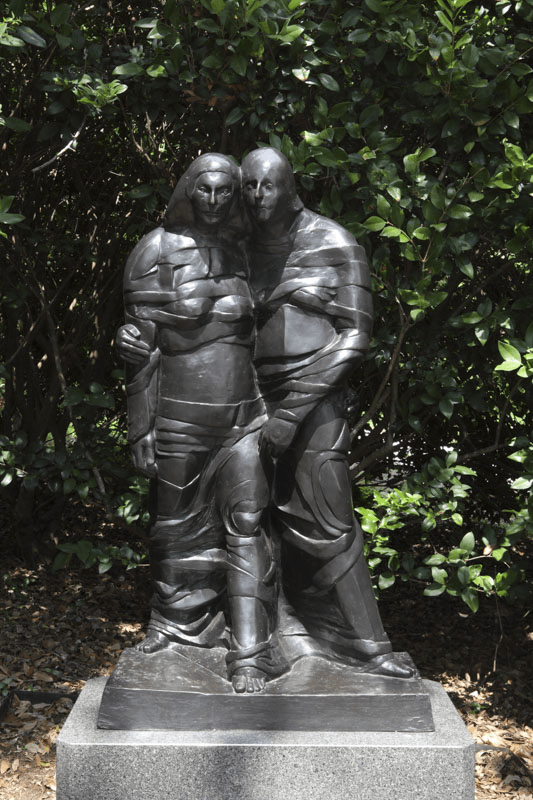
Statue of Ruth and Naomi, by Leonard Baskin (1922-2000)

When Naomi saw that she was determined to go with her, she said no more to her.

So the two of them went on until they came to Bethlehem. When they came to Bethlehem, the whole town was stirred because of them, and the women said, “Is this Naomi?” She said to them,

“Call me no longer Naomi;
    call me Mara,
    for the Almighty has dealt bitterly with me.
I went away full,
    but the Lord has brought me back empty;
why call me Naomi
    when the Lord has dealt harshly with me
    and the Almighty has brought calamity upon me?”

So Naomi returned together with Ruth the Moabite, her daughter-in-law, who came back with her from the country of Moab. They came to Bethlehem at the beginning of the barley harvest. (New Revised Standard Version)

A famine in Judah had brought Naomi and her husband Elimelech to the country of Moab. While there, they had two sons who eventually married two Moabite women: Orpah and Ruth. Over time, each of the husbands died, leaving Naomi and her two daughters-in-law as widows.

Naomi heard that things were finally better in her native Judah. So, she decided to go there, alone. Naomi encouraged her daughters-in-law to remain with their own people and remarry. Orpah did so. Ruth, however, wasn’t having it.

Ruth was determined to stay with her mother-in-law – which meant that she would enter Judah as a foreigner. Despite Naomi’s insistence that Ruth do what is best for herself, Ruth stuck with Naomi.

Once they arrived, the people of Naomi’s hometown were surprised to see the two of them. Naomi was not shy about communicating her bitterness in losing a husband and two sons. She commented that God had turned against her and made her life hard and bitter.

In saying that the Lord had emptied her and brought calamity, Naomi was not speaking against God. Rather, Naomi was expressing some significant theology that has become lost to many modern day Christians around the globe.

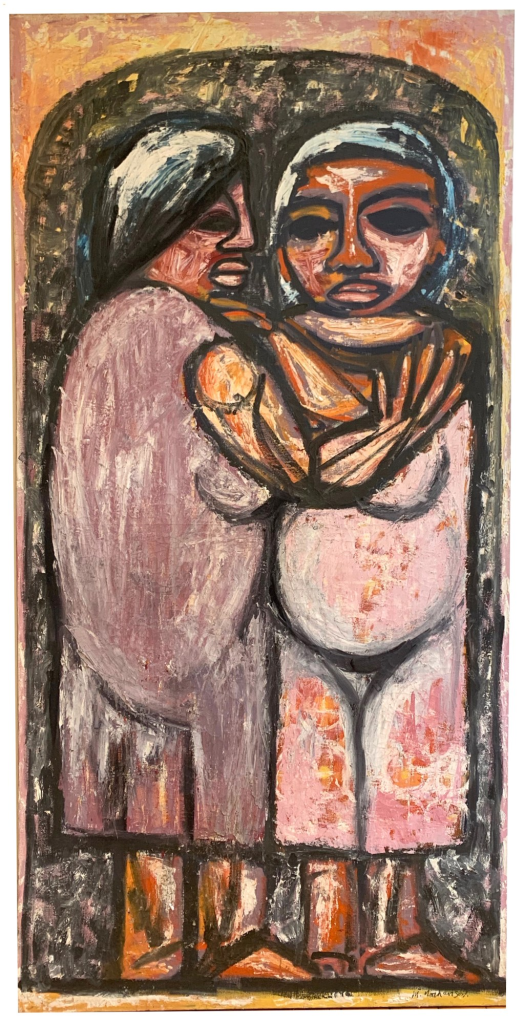
Ruth and Naomi, by Morris Nathanson (1927-2022)

I believe that Ruth was not expressing something malevolent about God, but rather made a statement of faithful recognition, not unlike what Job had to say when he lost his family and his health:

“Naked I came from my mother’s womb, and naked shall I return there; the Lord gave, and the Lord has taken away; blessed be the name of the Lord.” (Job 1:21, NRSV)

No one can escape the dark side of life. Yet, we can deal with that darkness intelligently. It is most necessary to be aware that light creates a shadow that was not there before. The bigger and brighter the light, the bigger and darker the shadow.

There is a centuries old idiom which says, “You can’t have your cake, and eat it, too!” This is a proverbial way of saying that we cannot expect everything to always be good in this life; we must also accept that we cannot always have our way, and that we will go without, experiencing loss.

Whether we want to acknowledge it, or not, an integral part of life is receiving some bad things from God. The Lord does not just go around dispensing everyone’s wishes and making everything a utopia of unicorns and butterflies.

God is most certainly benevolent; yet God also brings darkness to people. We cannot have the Light of the world without experiencing the world’s darkness. Another way of stating this is that a very big God creates quite a large shadow.

In Christianity, the predominant symbol is the cross. The Cross of Christ is both light and dark. Christians may reflexively associate the cross with salvation from sin, while forgetting that the cross is an instrument of torture and death, a tool of execution, like an electric chair.

We must honor the axis crossing at the center of the cross. It is the place of equilibrium, the place of wholeness, where we have the opportunity of integrating all of that unwanted grief and loss into our lives. Failing to do this, let alone neglecting to acknowledge the shadowy places of our hearts, brings harm and hurt to ourselves and to the world.

Naomi acknowledged the shadow. She accepted the darkness, which enabled her to return to her homeland of Judah, the very place where the God of light and dark is worshiped.

I’m not talking about the sort of darkness that is malevolent and mean-spirited, the darkness which comes from Satan. I’m talking about the darkness which weans us away from all things and the ways that hinder us from knowing God.

This is what St. John of the Cross was referring to in naming the dark night of the soul. In our quest to experience union with God, we journey through the darkness, and learn that purification isn’t simply putting something impure away. Purity of heart comes through joining with the God who is pure love itself.

“In the dark night of the soul, bright flows the river of God.”

St. John of the Cross

God loves us so much as to be nailed to a cross and suffer darkness. The Christian is to take up their cross and follow Jesus. That is, we embrace the darkness with an honest engagement of God and God’s world, and through a vulnerable assessment of our own shadow.

For if we fail to acknowledge our shadow, we shall fail to be in union with God.

Not only do many people disown the parts of themselves they don’t like, but they do the same with God – thus making God into their own image of how God should be, instead of taking God as God is.

If you have ears to hear, take this to heart: To accept and honor your own shadow is a profound and necessary spiritual discipline. By “shadow” I mean all of the characteristics of myself that I withhold from others, so that they will only see what I want them to see.

We often put a false self out into the world, for others to see. It is a sort of psychological clothing we wear, much as we have actual clothing. Whether the clothes are real or metaphorical, we dress ourselves in the particular way we want to be seen.

Naomi was a true Israelite, showing her honest true self. There was no separation or division between the inner self and the self she presented to others.

I tend to think that Naomi knew something about God that many don’t know today – and was therefore able to be faithful to both her people and her God.

It is no wonder, then, that Ruth wanted to remain with her mother-in-law Naomi, who was a real person acknowledging the real God.

Almighty God and Father, maker of heaven and earth, of all that is seen and unseen: You are the God of light who illumines our way. And You are the God of darkness who is shadowed in mystery. In knowing You, may I know myself; and in knowing myself, may I more fully know You. Amen.

Dealing with Disrespect and Disbelief (John 12:34-50)

Christ and the Pharisees, by Anthony van Dyck (1599–1641)

The crowd spoke up, “We have heard from the Law that the Messiah will remain forever, so how can you say, ‘The Son of Man must be lifted up’? Who is this ‘Son of Man’?”

Then Jesus told them, “You are going to have the light just a little while longer. Walk while you have the light, before darkness overtakes you. Whoever walks in the dark does not know where they are going. Believe in the light while you have the light, so that you may become children of light.” When he had finished speaking, Jesus left and hid himself from them.

Even after Jesus had performed so many signs in their presence, they still would not believe in him. This was to fulfill the word of Isaiah the prophet:

“Lord, who has believed our message
    and to whom has the arm of the Lord been revealed?”

For this reason they could not believe, because, as Isaiah says elsewhere:

“He has blinded their eyes
    and hardened their hearts,
so they can neither see with their eyes,
    nor understand with their hearts,
    nor turn—and I would heal them.”

Isaiah said this because he saw Jesus’ glory and spoke about him.

Yet at the same time many even among the leaders believed in him. But because of the Pharisees they would not openly acknowledge their faith for fear they would be put out of the synagogue; for they loved human praise more than praise from God.

Then Jesus cried out, “Whoever believes in me does not believe in me only, but in the one who sent me. The one who looks at me is seeing the one who sent me. I have come into the world as a light, so that no one who believes in me should stay in darkness.

“If anyone hears my words but does not keep them, I do not judge that person. For I did not come to judge the world, but to save the world. There is a judge for the one who rejects me and does not accept my words; the very words I have spoken will condemn them at the last day. For I did not speak on my own, but the Father who sent me commanded me to say all that I have spoken. I know that his command leads to eternal life. So whatever I say is just what the Father has told me to say.” (New International Version)

It seems that nowadays, the more one rises in popularity and garners national attention, the more some folks want to disrespect them.

Out of the many examples of this phenomenon, consider the case of a young woman from my home state of Iowa. Sportswriter Mike DeCourcy recently mused on why the University of Iowa’s Caitlin Clark has discovered that not all the greats of women’s college basketball welcome her success.

Several women – who ought to know better – have cynically reacted to Clark’s legitimate college greatness with a sort of “Why her, why not us?” attitude. They’ve indulged in misinformation and cheap shots that clearly say more about them than Caitlin Clark.

This is especially curious, since Clark has elevated women’s basketball to a level of attention that her now detractors and others have envied for decades. DeCourcy writes, “None of this [delegitimizing Clark] is a good look for NCAA women’s basketball, and neither does it appear to be the most prudent way to continue growing the sport.”

The same type of thing could be said about Jesus and the movement he was sparking during his ministry on this earth. Many of the religious leaders refused to acknowledge his greatness, nor believe in the words he was saying. Instead, they sought to knock down Jesus and the good work he was doing.

It seems the religious leaders wanted the praise and attention Jesus was getting. Even many who believed in what was happening, kept their mouths shut and let the misinformation spread, because they, too, loved the praise of others instead of praise from God.

Playing with the game of darkness, nobody wins. People end up only being a mere shadow of the person they could be. Trying to disrespect others in order to shine the light on yourself is a convoluted and misguided way of handling anyone or any situation.

Carl Jung (1875-1961) described this hidden shadow self as an unconscious aspect of the human personality. In other words, the shadow results from the conscious self being unaware or unconscious concerning areas of its own personality. Without the light of conscious awareness, the shadow self runs amok within the psyche of a person and far too often calls the shots in speaking and behavior.

“Everyone carries a shadow,” Jung wrote, “and the less it is embodied in the individual’s conscious life, the blacker and denser it is.” (Psychology and Religion, 1938)

According to Jung, the shadow side of a person is prone to psychological projection, in which a perceived personal inferiority is recognized as a perceived moral deficiency in someone else. If those projections remain hidden, they eventually come out sideways by harming others because there is a dark illusion, even delusion, that others are stealing what is rightfully mine.

Hence, the sinless Jesus is denigrated, disrespected, and disbelieved. And it is what led to him being tortured and killed by those who thought they are doing a good thing.

It’s easy to be hard on the religious rulers in the New Testament, but this is the Christian season of Lent, and so, we must shine the light of Scripture upon ourselves. This is the time to deliberately gain awareness of our own shadow selves.

Perhaps the burning question for all believers at this time of year is: Do I seek the presence of God more than the presence of anything or anyone else?  

Maybe you live in fear at work and are more concerned about the presence of people around you than the presence of God, so you keep quiet when you ought to speak up or turn a blind eye to the shadows of an organization. Or worse, you talk bad about someone good, just because they’re getting the attention you feel you deserve.

In these remaining days of Lent, as we journey with Jesus to Jerusalem, let’s let the light of his gracious ministry dispel the dark shadows of our hearts and make us aware of who we are, and what we need to change.

If we can learn to appreciate the God-given and hard-earned talents of a young woman playing basketball, then perhaps we can then also learn to glory in One who is greater than any sports celebrity, and celebrate the great work done on this earth for us and for our salvation.

Good and gracious God, we are far too often influenced by what others think of us. We sometimes pretend to be either richer or smarter or nicer than we really are. So, prevent us from trying to divert attention from others to ourselves. Don’t let us gloat over praise received from others, nor be discouraged by criticism from another. Show us, instead, how to be humble of heart, like the Lord Jesus, in whose name we pray. Amen.

Accept Your Shadow Side (Acts 7:30-40)

“Forty years later, in the desert near Mount Sinai, an angel appeared to Moses in the flame of a burning bush. When Moses saw it, he was amazed at the sight. As he went to take a closer look, the voice of the Lord called out to him, ‘I am the God of your ancestors—the God of Abraham, Isaac, and Jacob.’ Moses shook with terror and did not dare to look.

“Then the Lord said to him, ‘Take off your sandals, for you are standing on holy ground. I have certainly seen the oppression of my people in Egypt. I have heard their groans and have come down to rescue them. Now go, for I am sending you back to Egypt.’

“So God sent back the same man his people had previously rejected when they demanded, ‘Who made you a ruler and judge over us?’ Through the angel who appeared to him in the burning bush, God sent Moses to be their ruler and savior. And by means of many wonders and miraculous signs, he led them out of Egypt, through the Red Sea, and through the wilderness for forty years.

“Moses himself told the people of Israel, ‘God will raise up for you a Prophet like me from among your own people.’Moses was with our ancestors, the assembly of God’s people in the wilderness, when the angel spoke to him at Mount Sinai. And there Moses received life-giving words to pass on to us.

“But our ancestors refused to listen to Moses. They rejected him and wanted to return to Egypt. They told Aaron, ‘Make us some gods who can lead us, for we don’t know what has become of this Moses, who brought us out of Egypt.’ (New Living Translation)

We humans are a confusing paradox of sinner and saint. We are majestic people, created in the image and likeness of a good God. We are also profoundly fallen, touched by sin in every area of our lives. Our hearts exist with both light and darkness, having the capacity for both incredible altruism as well as inexplicable evil.

So then, it will do no good to retreat into binary definitions of people as being either good or bad. No, we shine and shadow at the same time. What really gets us into a terrible mess is when we ignore or deny our shadow selves. We then demonize the other while claiming purity for ourselves.

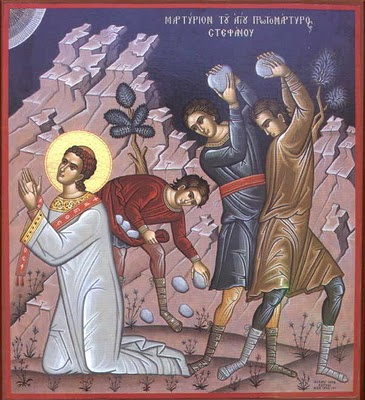
This is precisely what occurred when Stephen stood and spoke to a group of his fellow Jews. They stubbornly refused to acknowledge their shadow side. And it resulted in Stephen’s stoning and death. Whereas Stephen lifted and brought to light the unseemly aspects of their collective heritage, the people wanted nothing to do with it.

The Martyrdom of Stephen

In our present day, responses that do not want to acknowledge the shadow side include statements such as, “Quit being so negative. We focus on the positive. Expel this recalcitrant troublemaker once and for all!”

Oy. Acceptance cuts two ways. We must accept both our blessings and our curses. The acceptance of reality will not occur apart from a solid self-acceptance of who we are and how we are feeling in any given situation. On the practical level, it works something like the following story…

Several years ago, I went on a leadership retreat in the Canadian wilderness. We were so far out in the sticks that we needed special first aid training before leaving because if someone got severely injured it would be hours before any medical attention could be received. There was no cell phone service, no towns, no anything except mile after square mile of wilderness. 

One day, I was canoeing with a group of leaders, far out into the Canadian wilderness where there were no towns or people anywhere near us. It was very windy on this day in late May – which meant the water was still ice cold in Canada. One of the canoes capsized. We had to act quickly and deliberately – which was no small feat in a stiff wind. More than fifteen minutes would result in hypothermia for the two people in the water.

I did not like being in that situation. In fact, I didn’t much like the Canadian wilderness. Too many black flies and giant mosquitoes for me. My shadow side was coming out. But here I was, and I had to accept the reality I was in. One of the lessons I learned in that moment was that acceptance can sit alongside other reactions and emotions.

For example, a person can be outraged by an injustice, as Stephen was, and accept that it is a reality. Acceptance does not mean complacency or giving up. We can accept something while at the same time trying to make it better.

I also needed to accept what was happening inside of me. I was cold and worried. Trying to push those feelings away would have only added to the stress of the situation. If I failed to accept what was true about myself, I would be less able to deal with the situation, and so, would compromise my ability to help two people at risk.

I needed to accept the entire circumstance, including myself. Accepting what is inside gave me more influence over the situation, not less. Self-acceptance became the key to acceptance of unwanted conditions, and more importantly, acceptance of one another as human beings.

In that moment of rescuing two people (which ultimately proved successful) I became aware of a part of myself – the part that gets afraid and irritated – and chose not to stuff it or deny its existence.

I became the guy who talked to the panicked people in the water and kept them as calm as possible so that the others could get them out. I was able to do my part to help fearful people because I acknowledged and accepted my own fear.

Unlike my situation, however, Stephen’s experience ended in martyrdom. Just because we respond rightly, is no guarantee that everything will work out for our benefit. Rather, we say and do the things we must say and do, while leaving the results to a sovereign Lord.

It is our responsibility to work on ourselves, not others. And acceptance is the path to get there, all of it – including the shadow side – and not just part of it.

Jesus, let your mighty calmness lift me above my fears and frustrations. By your deep patience, give me tranquility and stillness of soul in you. Make me in this, and in all things, more and more like you. Amen.