Philippians 2:5-11 – Palm Sunday

In your relationships with one another, have the same mindset as Christ Jesus:

Who, being in very nature God,
    did not consider equality with God something to be used to his own advantage;
rather, he made himself nothing
    by taking the very nature of a servant,
    being made in human likeness.
And being found in appearance as a man,
    he humbled himself
    by becoming obedient to death—
        even death on a cross!

Therefore, God exalted him to the highest place
    and gave him the name that is above every name,
that at the name of Jesus every knee should bow,
    in heaven and on earth and under the earth,
and every tongue acknowledge that Jesus Christ is Lord,
    to the glory of God the Father. (NIV)

I often take the posture of kneeling or prostrating when I pray. I do this, not because I think my prayers are more effective that way, but because this embodies my petitions with a recognition of Christ’s lordship over my life. Also, for me, there is no experience quite like using the kneelers on church pews and bowing together in a common experience of recognizing the lordship of Jesus Christ.

I sometimes ponder a question as I am on my knees: What kind of people would we be if we looked like these verses in Philippians?  The Apostle Paul said to the church in Philippi that their “attitude” should be the same as that of Christ Jesus. Their mindset, the way they think about everything, ought to be just like the mind of Christ. If we want to know how to think well and live well, how to relate to others in a good way, then we ought to thoroughly adopt the mind and the attitude of Jesus.  

How we should think and live comes from God. Within the life of the triune God exists three persons: Father, Son, and Spirit. Within this great three-in-one God exists perfect love, absolute holiness, united harmony, and constant respect. The Holy Scriptures tell us that just as God is holy, we are to be holy. Just as God is love, so we are to love one another. Just as God is harmonious, we are to live in harmony with one another. And just as God is supremely exemplified in the person of Jesus as a humble servant, so we are to practice humility and service in all our relations.

None of this is optional for the Christian. There is no place in the believer’s life for pride, posturing, and power-broking. There is to be humility, taking the posture of lowliness, and using any kind of influence for the benefit and encouragement of others – just like Jesus did while on this earth.

In a world pre-occupied with power and control, safety and security, influence and throwing its weight around, there is Jesus. He did just the opposite of engaging in upward mobility; he practiced downward mobility, and in doing so Christ descended into greatness as Lord and Savior.

Jesus did not consider equality with God as something to be grasped. The pre-incarnate Christ did not sit in heaven as the second person of the Trinity and hold onto his lofty position with tight fists – he did not grasp it tightly. When Jesus came to this earth, there was a humble willingness to open his hands and relinquish his rights and privileges as God. Christ made himself nothing, taking the very nature of a servant. Jesus gladly, not reluctantly, emptied himself for us. Jesus became one of us.

The television series, Undercover Boss, is a reality show in which high-level corporate executives leave the comfort of their offices and secretly take low-level jobs within their companies to find out how things are really working and what their employees are honestly thinking about their jobs and what is happening. In the process of this undercover mission, they learn of the perceptions about their companies, the spirit of their work forces and — maybe — something about themselves as well.

None of the executives cease to be executives. They just make a willing decision to take the lowest level job in their own company to hopefully benefit the employees and the entire corporation. The best episodes are when the most generous executives go above and beyond helping the employees around them at the end of the show. 

Jesus descended to earth. He never ceased to be God. Yet, Christ willingly put his kingly robe in the closet and donned Dickies and work boots. He came among us and purposely limited himself to identify with us fully – and secured for us the greatest generosity imaginable – an answer to the problem of guilt and shame through forgiveness of sins.

Jesus became a servant. He completely tied himself to us. Jesus did not come to this earth seeking to be served, but sought to serve and give his life as a ransom for many. Christ kept going lower and lower to the point of descending to the greatest humiliation of all – death on a cross. Jesus endured the ultimate shame of the ancient world by dying a terrible death. The King of the universe was killed by vicious humanity so that he might redeem and save those very same people from their terrible plight of bondage to evil.

We are to be humble people, embracing a lowly status of slaves to God and to one another. The ancient Philippian church had a real problem with pride which is why Paul talked about emulating the mind and attitude of Christ in his humiliation. The following are exhortations Paul gave to the Philippians, which were to reflect the practice of humility in relationships:

  • Whatever happens, conduct yourselves in a manner worthy of the gospel of Christ (1:27). 
  • Do nothing out of selfish ambition or vain conceit, but in humility consider others better than yourselves (2:3). 
  • Continue to work out your salvation with fear and trembling (2:12). 
  • Do everything without complaining or arguing (2:14). 
  • Join with others in following my example and take note of those who live according to the pattern we gave you (3:17). 
  • Do not be anxious about anything, but in everything, by prayer and petition, with thanksgiving, present your requests to God (4:6). 

Because of Christ’s humble obedience to the Father, he was exalted from the lowest place to the highest place.  King Jesus is on the throne, above everyone and everything. Because of his descent to this earth, Christ has ascended in glory and honor. We can now see God in a new way, through Jesus. And when we do, it causes us to kneel in prayer and profess that Jesus Christ is Lord.

In the ancient world, this was subversive language. If Jesus is Lord, Caesar is not, and ultimate allegiance does not belong to the Roman Empire. If Jesus is Lord, the local gods are not. And in our day, it is no different. Historical characters and religious deities may come and go, but the issue of ultimate allegiance still pertains to us. If Jesus is Lord, no politician or celebrity is owed lordship status. Pride and arrogance are to be put down at every turn in favor of humble service and loving actions.
If we are to follow Jesus Christ truly and really, we will practice downward mobility and embrace humility. Bowing, kneeling, and prostrating will become second nature to us as we give our unflagging allegiance to Jesus. We will accept our creaturehood and God as Creator. We will live in the reality that Jesus is Sovereign over all creation. 

As we enter the Christian Holy Week, let us acknowledge and know the humiliation and exaltation of Christ….

Just watch my servant blossom!
    Exalted, tall, head and shoulders above the crowd!
But he didn’t begin that way.
    At first everyone was appalled.
He didn’t even look human—
    a ruined face, disfigured past recognition.
Nations all over the world will be in awe, taken aback,
    kings shocked into silence when they see him.
For what was unheard of they’ll see with their own eyes,
    what was unthinkable they’ll have right before them.

Who believes what we’ve heard and seen?
    Who would have thought God’s saving power would look like this?

The servant grew up before God—a scrawny seedling,
    a scrubby plant in a parched field.
There was nothing attractive about him,
    nothing to cause us to take a second look.
He was looked down on and passed over,
    a man who suffered, who knew pain firsthand.
One look at him and people turned away.
    We looked down on him, thought he was scum.
But the fact is, it was our pains he carried—
    our disfigurements, all the things wrong with us.
We thought he brought it on himself,
    that God was punishing him for his own failures.
But it was our sins that did that to him,
    that ripped and tore and crushed him—our sins!
He took the punishment, and that made us whole.
    Through his bruises we get healed.
We’re all like sheep who’ve wandered off and gotten lost.
    We’ve all done our own thing, gone our own way.
And God has piled all our sins, everything we’ve done wrong,
    on him, on him.

He was beaten, he was tortured,
    but he didn’t say a word.
Like a lamb taken to be slaughtered
    and like a sheep being sheared,
    he took it all in silence.
Justice miscarried, and he was led off—
    and did anyone really know what was happening?
He died without a thought for his own welfare,
    beaten bloody for the sins of my people.
They buried him with the wicked,
    threw him in a grave with a rich man,
Even though he’d never hurt a soul
    or said one word that wasn’t true.

Still, it’s what God had in mind all along,
    to crush him with pain.
The plan was that he gives himself as an offering for sin
    so that he’d see life come from it—life, life, and more life.
    And God’s plan will deeply prosper through him.

Out of that terrible travail of soul,
    he’ll see that it’s worth it and be glad he did it.
Through what he experienced, my righteous one, my servant,
    will make many “righteous ones,”
    as he himself carries the burden of their sins.
Therefore I’ll reward him extravagantly—
    the best of everything, the highest honors—
Because he looked death in the face and didn’t flinch,
    because he embraced the company of the lowest.
He took on his own shoulders the sin of the many,
    he took up the cause of all the black sheep. (Isaiah 52:13-53:12, MSG)

John 13:1-17 – Do as I Have Done for You

Jesus washing feet

It was just before the Passover Festival. Jesus knew that the hour had come for him to leave this world and go to the Father. Having loved his own who were in the world, he loved them to the end.

The evening meal was in progress, and the devil had already prompted Judas, the son of Simon Iscariot, to betray Jesus. Jesus knew that the Father had put all things under his power, and that he had come from God and was returning to God; so he got up from the meal, took off his outer clothing, and wrapped a towel around his waist. After that, he poured water into a basin and began to wash his disciples’ feet, drying them with the towel that was wrapped around him.

He came to Simon Peter, who said to him, “Lord, are you going to wash my feet?”

Jesus replied, “You do not realize now what I am doing, but later you will understand.”

“No,” said Peter, “you shall never wash my feet.”

Jesus answered, “Unless I wash you, you have no part with me.”

 “Then, Lord,” Simon Peter replied, “not just my feet but my hands and my head as well!”

Jesus answered, “Those who have had a bath need only to wash their feet; their whole body is clean. And you are clean, though not every one of you.” For he knew who was going to betray him, and that was why he said not everyone was clean.

When he had finished washing their feet, he put on his clothes and returned to his place. “Do you understand what I have done for you?” he asked them. “You call me ‘Teacher’ and ‘Lord,’ and rightly so, for that is what I am. Now that I, your Lord and Teacher, have washed your feet, you also should wash one another’s feet. I have set you an example that you should do as I have done for you. Very truly I tell you, no servant is greater than his master, nor is a messenger greater than the one who sent him. Now that you know these things, you will be blessed if you do them. (NIV)

One of the reasons I like Jesus Christ so much is that he loves me as I am, and not as I should be. Jesus loves me even with my dirty stinky feet, my herky-jerky commitment to him, and my pre-meditated sin. Jesus loved even Judas and washed his feet. Jesus serves people because they need his love, and not so that they will love him back.

I recently read about a man who lives in Paris. His wife has Alzheimer’s. He was an important businessman and his life was filled with busyness. Yet, he said when his wife fell sick, “I just couldn’t put her into an institution, so I kept her. I fed her. I bathed her. Through the experience of serving my wife every day, I have changed. I have become more human. The other night, in the middle of the night, my wife woke me up. She came out of the fog for a moment, and she said, ‘Darling, I just want to say thank you for all you are doing for me.’ Then she fell back into the fog. I wept for hours to know this grace.”

Sometimes Christ calls me to love people who either cannot or will not love me in return. They live in the fog of some sort of disability, depression, poverty, or common spiritual blindness. As I serve them, I may only receive brief glimpses of gratitude. Just as Jesus loves me within my own spiritual confusion, so I desire to continue loving others as they walk through whatever fog they are in.

I can truthfully say that I have no interest in anything but the love of God which in Christ Jesus.  Lord willing, my life will be useful through my words and my witness. If God desires, my life will bear fruit through my prayers, my service, and my love. Yet, the usefulness of my life is God’s concern, not mine; it would be indecent of me to worry about that. I simply desire follow my Lord’s example.

dirty dishes

Neither many Christians nor churches wash feet anymore. So, the following is today’s Gospel lesson put in a slightly different context:

It was just before the biggest and most important feast of the year, Passover. Jesus knew that it was finally the time for him to face the cross and die for the world’s sins. Having spent the past three years loving his followers, he now wanted to leave them with a clear demonstration of his love that they would never forget.

The evening meal was being served, and the devil had already gotten a hold of Judas Iscariot to betray Jesus to those who wanted him dead and gone. But it was all according to plan. Jesus knew that his heavenly Father had given him all authority because he was his Son, and he was ready to do what needed to be done to secure salvation and return to his rightful place at his Father’s right hand.  So, Jesus got up from the meal, rolled up his sleeves, put an apron on, and ran a sink full of hot water.  Jesus told the servants to take the night off, and he began taking the dishes from the dinner table and started washing them, taking care to do all that waiters and dishwashers would do.

When Jesus came to take care of Simon Peter’s dishes and serve him dessert and coffee, Peter said to him, “Lord, are you going to serve me?” Jesus replied, “I know you do not understand why I am doing this since it seems like something that is beneath me to do, but later you will look back on this night and understand completely what I am doing.”

“No,” said Peter, “this is not right – you are the Master, and this is not what a well-respected rabbi does – you are only disrespecting yourself and making us all look foolish. You are not going to take my dishes and wash them.”

Jesus answered, “Unless I wash these dishes and serve you, you are not going to be able to follow me anymore and you will have no part of what I am doing in this world.”

“Well, then, Lord,” Simon Peter replied, “if that is the way it really is, then don’t just wash the dishes – come on over to my place and clean out the fridge and scrub the kitchen floor!”

Jesus answered, “A person who has had a decent meal needs only to wash the dishes so that he can enjoy the freedom of hospitable relationships with me and those around him.  And all of you here have had a decent meal, though not every one of you.”  For Jesus knew that Judas was only picking at his food in anticipation of betraying him.

When Jesus was all done washing the dishes and serving his disciples, he took his apron off, rolled his sleeves back down, and returned to the table.  He looked them all squarely in the eye and said, “Do you understand what I just did for you?  You call me ‘Teacher’ and ‘Master,’ and rightly so, for that is exactly what I am.  So, now that I, your Master, and your Teacher have washed your dishes, you also should wash one another’s dishes.  I have set you an example that you should do as I have done for you.  I am telling you the plain truth that no follower is greater than the one he follows, nor is a preacher greater than the one he preaches about.  Now that you know that it is your task in this life to provide humble loving service, you will have God’s stamp of approval on your life if you quit thinking about how to possess and use power for your own purposes, and start thinking about how to use the authority I am giving you to love other people into the kingdom of God.

Loving Lord Jesus, how shocking it was for your disciples to be served by you in such a humble manner.  But I cannot be spiritually cleansed unless I allow you to love me in an almost embarrassing fashion.  Help me not to be so proud that I neither refuse your humble loving service toward me, nor neglect to offer that same kind of service to others.  May love be the word, the idea, and the action that governs my every motivation and movement in your most gracious Name, I pray.  Amen.

Matthew 20:17-28 – On Being a Servant

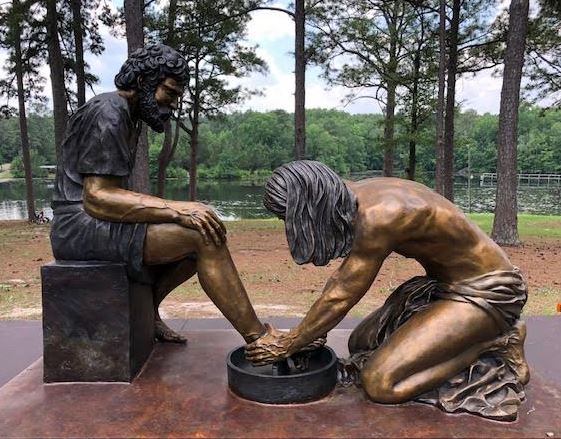
Jesus bronze sculpture washing feet
Bronze statue of Jesus washing Peter’s feet, Pittsburgh, Texas

Now Jesus was going up to Jerusalem. On the way, he took the Twelve aside and said to them, “We are going up to Jerusalem, and the Son of Man will be delivered over to the chief priests and the teachers of the law. They will condemn him to death and will hand him over to the Gentiles to be mocked and flogged and crucified. On the third day he will be raised to life!”

Then the mother of Zebedee’s sons came to Jesus with her sons and, kneeling, asked a favor of him.

“What is it you want?” he asked.

She said, “Grant that one of these two sons of mine may sit at your right and the other at your left in your kingdom.”

 “You don’t know what you are asking,” Jesus said to them. “Can you drink the cup I am going to drink?”

“We can,” they answered.

Jesus said to them, “You will indeed drink from my cup, but to sit at my right or left is not for me to grant. These places belong to those for whom they have been prepared by my Father.”

When the ten heard about this, they were indignant with the two brothers. Jesus called them together and said, “You know that the rulers of the Gentiles lord it over them, and their high officials exercise authority over them. Not so with you. Instead, whoever wants to become great among you must be your servant, and whoever wants to be first must be your slave— just as the Son of Man did not come to be served, but to serve, and to give his life as a ransom for many.” (NIV)

Today’s story from the Gospel of Matthew is the very description of not being on the same page. There were two variant responses from Jesus and from everyone else because there were two different agendas.

Jesus was quite clear about how things were going to shake out. Torture, insults, crucifixion, and death was ahead for him. The disciples and the mother of James and John missed the memo on this. Christ’s words went way over their heads. It could be the disciples simply did not hear what Jesus was saying to them (repeatedly!). It is more likely that the message of Jesus got filtered through an existing agenda of how they believed things ought to go.

The disciples, along with a lot of other Jewish folk in the first century, were looking for a Messiah in the mold of King David – a strong leader who would come and beat up the Romans, exert all kinds of power and influence, and establish an earthly rule over all the people they don’t like. Submission to torture, humility before the very people they detested, and being killed by them were not factors into the disciples understanding of leadership and government.

Much like the powerful Aslan who had a thorough understanding of the world’s deep magic and submitted himself to the White Witch and death in C.S. Lewis’s The Lion, the Witch, and the Wardrobe – Jesus knew what he was doing while everyone else seemed clueless about the true power which exists in the universe.

So, let us be perfectly clear about what that power really is: Grace. Yes, grace. Powerful, resplendent, subversive, scandalous, and radical grace. Mercy was the missing factor in the disciples’ agenda. Jesus is not like other rulers. He does not operate by throwing his weight around to forcefully impose a crushing my-way-or-the-highway kind of rule (even though, ironically, he is The Way). No, Jesus freely and unabashedly uses grace with its merciful tools of humility, gentleness, kindness, goodness, and love to introduce and establish a new kind of rule which is not posturing for selfish power.

Power, authority, and the positions which go with them are to be used for the common good of all persons. To be in any kind of leadership is to be a servant of grace for the benefit of humanity and the world. And, if Christ’s disciples had looked a bit closer into their Old Testament, they might have noticed, for all his power and authority, King David trafficked in grace. When David was at the pinnacle of power his first act as King was to look over the kingdom and see who from the family of his enemy, the former King Saul (who was into the power thing for himself) was around so he could show grace (2 Samuel 9). It was typical of ancient kings to secure their rule and power through killing-off rivals and former family members of previous kings. Not so with David. And not so with Jesus.

Wherever there is posturing for position, preening for power, and a pestering for privilege – there you will find everything grace is not: reliance on making and calling-in favors; overinflated egos; unrealistic expectations; suspicion; judgment, arrogance; an insistence on recognition; compulsive control over everything and everyone; unilateral decision-making; shaming of others; hoarding of resources; coups; in-fighting; hatred; and, a demand of rights. We in the western world may not be in the habit of offing leaders and killing others to consolidate power, yet, we still too often rely on violent speech and language, partisan policies, and good-old-boy systems which are foreign to the way of Christ. In contrast to this, grace exists.

Grace is the deep magic which resides within the universe.

Wherever grace operates, there you will find the heart of a servant: attending to the needs of all persons; freely consulting and collaborating with others; focusing on responsibility; loving discipline; embracing accountability; pursuing truth; sharing power and resources; encouraging others; giving generously; and, looking for ways to show mercy.

In this Christian season of Eastertide, the Church focuses on exploring new life, and new ways of being with one another and the world. The old life is consumed with unmerciful uses of position and power. New life brings a shift to a gracious means of wielding such authority. Yes, it will likely bring some short-term suffering. It will hurt. Grace, however, results in a longevity of righteousness and peace for those who have been trained by it. True service is being a servant of grace.

May it be so, to the glory of God.

Click Make Me a Servant by the Maranatha Singers and allow it to be our prayer today and everyday.

John 13:1-17

            Feet are important.  An Illinois podiatrist, Dr. Paul Brezinski, says, “The health of your feet, despite their distance from your heart, can affect your overall health.”  Turns out we should not tip-toe around attention to feet – Jesus certainly didn’t.  Despite the fact that feet, especially in the first century, were perpetually dirty and stinky, Jesus took the posture of a servant and washed each and every gross foot – including Judas Iscariot’s.
 
            This act absolutely blew the minds of the disciples who could barely fathom that Jesus would do such a thing as wash feet.  What is more, Jesus went on to tell them, “If I, your Lord and Teacher, have washed your feet, you also ought to wash one another’s feet.  For I have given you an example, that you also should do just as I have done to you.”  I imagine the disciples’ jaws had to be picked up off the ground over that zinger from Jesus.
 
            Here’s the deal:  unhealthy Christians and churches do not pay attention to foot health; but healthy Christians and churches give intentional focus to serving in the lowest capacities to the lowliest in the Body of Christ and in society.  They even serve their enemies – the ones whom they know have it out for them.  Healthy disciples do such things because they have the distinguishing mark of their Lord pulsating through their lives:  love.  Love motivated Jesus to serve, and, as his followers, the same motivation exists to serve the church and the world.  Mother Teresa got it right when she once said, “Not all of us can do great things.  But we can do small things with great love.”


            Loving Lord Jesus, you are the perfect model of service.  Help me to pay attention to the all the people in my life and all the responsibilities I have with the love you give me, through the power of the Holy Spirit.  Amen.