I Am Among You As One Who Serves (Luke 22:24-30)

The Last Supper, by Mamdouh Kashlan (1929-2022)

A dispute also arose among them as to which one of them was to be regarded as the greatest. But he said to them, “The kings of the Gentiles lord it over them; and those in authority over them are called benefactors. But not so with you; rather the greatest among you must become like the youngest, and the leader like one who serves. For who is greater, the one who is at the table or the one who serves? Is it not the one at the table? But I am among you as one who serves.

“You are those who have stood by me in my trials; and I confer on you, just as my Father has conferred on me, a kingdom, so that you may eat and drink at my table in my kingdom, and you will sit on thrones judging the twelve tribes of Israel. (New Revised Standard Version)

Jesus and his disciples had prepared for the Passover meal. They ate and drank together. Christ gave them words which have endured throughout Christian history as the Lord’s Supper. He spoke of the bread as his body, and the cup as the new covenant in his blood. Jesus communed with them and communicated about his impending death.

It was a moving experience for all. The disciples received from their Lord an intense act of love; and a new humanity around Christ’s body and blood. Indeed, the essence of new life is self-sacrificial love.

And then… the disciples began quarreling with each other about positions, and titles, and honors, and who was better, and who would be top dog in God’s kingdom….

It was a moment that I think every parent can relate to, at some level. Sitting around a dinner table, enjoying a rich conversation, becoming close with one another as a family… and then the kids begin bickering with each other about the most mundane of things.

Just a minute ago, you believed you were getting somewhere, and experiencing a shared family bond of love, commitment, and purpose… and then, in a matter of seconds, it all crashes down in a ridiculous display of posturing and positioning of one sibling over another….

I admit, this has happened to me more than once, when my own kids were growing up. And I also admit that I lost my sanctification on more than one occasion, watching this crazy schizophrenic scene play out in front of me.

Which is why I have a lot of respect for Jesus in responding to his disciples with humility, calmness, and a forthright spirit. He addressed their puny questions in a way that rebuked them without making them feel like they just got a Dad lecture.

In the sort of table fellowship that Jesus practiced with his disciples throughout his earthly ministry, he consistently sought to undermine the existing systems of domination in all levels of society. Even the religious system of Christ’s day had a distinct stratifying of persons in an inequitable structure of power.

The kingdom of God, however, is different. God’s economy is characterized by equality, mutuality, diversity, and shared power. It’s all based in a communal, as well as individual, relational connection with the Creator God.

God almighty, Creator of heaven and earth, is gracious, merciful, and kind. The Lord brings rain on both the righteous and the wicked. Thus, any sort of claim to being greater or superior or better than another person or group of people, has no place around the table of Christ’s body and blood.

Catholics are no better than Protestants. Evangelical Christians have no superiority over Progressive Christians. The Coptic Church doesn’t have the high ground on Eastern Orthodoxy. Christians who observe the Lord’s Supper as a remembrance are not greater than those who discern the Table as a sacrament.

And if one has the ears to hear it, Christians really ought to know better than to believe they should have greater control over the world and its systems than Buddhists, Muslims, or Jews.

Puffing up one’s chest and insisting that “My Dad is better than your Dad” is the stuff of childish preoccupations, and not of God’s kingdom.
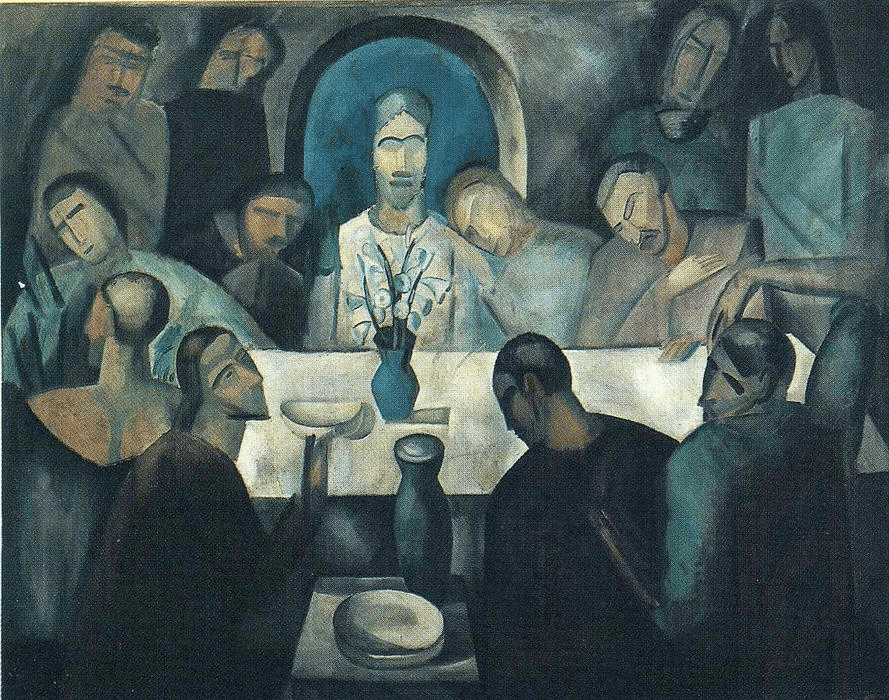
The Last Supper of Jesus, by André Derain (1880-1954)

There are plenty of people in this old messed-up world who lord their power and authority over others. If we take the words of Jesus seriously, Christians are not to be part of that structure and system.

And yet, here we are, in this contemporary time and place in history, having a chunk of the population thinking Christendom is the way to go, that a form of Christian Nationalism should be the political system – as if the kingdom of God and the kingdom of this world are what’s on the ballot.

Christians are the very folks who need to insist on serving, not leading; building up, not tearing down; loving, not hating; being integrated and connected, not fragmented and disconnected from others, as well as from reality.

Any sort of earthly power and authority the Christian has, must be used to include, help, and support, instead of excluding, ignoring, and destroying. The greatest among us must become like the youngest, and the leader like one who serves.

Christians must support and promote the idea of political office as a public service; and the concept of being a citizen as serving the common good of all persons, not just some persons.

Jesus came to this earth to serve. Therefore, his followers are also to serve. The words and ways of Christ centered in humble service, merciful justice, and prayer for one’s enemies. His followers must do no less.

Jesus Christ came to usher in a moral and ethical kingdom in which God’s gracious and benevolent will is done on this earth, as it is always done in heaven. He did not come to make sure Christians have lots of political power and authority over all the non-Christians.

Yes, indeed, we will be given power and authority – but not to baptize existing earthly structures so that the system serves the interests of Christians. We receive so that we can give. We give so that we might serve. And we serve because our Lord is a servant.

So, if Christians truly desire to bring change and transformation to this world, it will be through a compassionate and caring system of service to our fellow humanity – and not by imposing our beliefs and will upon others in a modern day form of the Inquisition.

Let us then, traffic in love; aspire to meekness; practice servanthood; and become the wait staff for the world’s needs.

That is what it really means to stand with Jesus in this time of trial.

Gracious and loving God, you work everywhere reconciling, loving, and healing your creatures and your creation. In your Son, and through the power of your Holy Spirit, you invite each of us to join you in your work.

I ask you to form me more and more in your image and likeness, through my prayers and worship of you; and through the study of Holy Scripture, so that my eyes will be fully opened to your mission in the world.

Send me into my family, church, community, workplace, and world to serve Christ with faith, hope, and love, through the power of the Holy Spirit. Amen.


The Servant of the Lord (Isaiah 42:5-9)

This is what God the Lord says—
the Creator of the heavens, who stretches them out,
    who spreads out the earth with all that springs from it,
    who gives breath to its people,
    and life to those who walk on it:
“I, the Lord, have called you in righteousness;
    I will take hold of your hand.
I will keep you and will make you
    to be a covenant for the people
    and a light for the Gentiles,
to open eyes that are blind,
    to free captives from prison
    and to release from the dungeon those who sit in darkness.

“I am the Lord; that is my name!
    I will not yield my glory to another
    or my praise to idols.
See, the former things have taken place,
    and new things I declare;
before they spring into being
    I announce them to you.” (New International Version)

For those who serve the God of Scripture, there is work to be done.

According to Scripture, people are created in the image and likeness of God (Genesis 1:26-27). As the only creatures on earth with the divine stamp of God’s image, humanity’s purpose is to reflect and work toward that which characterizes God:

  • Be holy because God is holy. That is, set apart your life for good and right purposes, and not for ill. Devote yourself to being above board in everything, and work for the common good of all persons.
  • Love one another as God has loved you. Since the Lord demonstrated a sacrificial and unconditional love toward you, so do the same for others. Love God. Love your neighbor.
  • Do justice because God is just. God is concerned that everyone on planet earth has what they need – both physically and spiritually – to live and thrive in this world. Ensure that people’s needs are met, without any prejudice or favoritism.

The servant of God has a mandate to be a covenant and light for people. Since God makes and keeps promises to people; and since the Lord is light without any darkness, so God’s servant is to embrace and embody a steadfast commitment to continually doing good.

We are meant to be a blessing to people on this earth – and not a curse. (Galatians 3:8)

I don’t have much stomach for fellow believers who think they are responsible to let people know how sinful they really are. Such supposed messengers end up puking the “good news” on others, often leaving people in such a bad state that they want nothing to do with religion.

Any sort of forceful verbiage, or manipulative gaslighting of others, does not in any way reflect the God whom I serve; I view such underhanded methods as inconsistent with Scripture. Besides, the Lord certainly doesn’t need any of us, as if God is dependent on people’s gospel witness.

Instead, the Lord graciously cuts us in on the benevolent and gracious divine action that is being accomplished in the world. That God allows me to be a mouthpiece is a privilege and a responsibility. So, I will steward that trust well by using words that build up and encourage, without verbally accosting another in the name of serving God.

In the ancient world, the poor often found themselves in prison through the inability to pay off a debt. Part of the servant’s work is to cancel debt, thus providing freedom and a further means to work and support family. For the Christian, this is an elementary part of our prayers:

And forgive us our debts, as we also have forgiven our debtors. (Matthew 6:12, NIV)

Those words of Jesus are meant to uphold the ethical teachings of the Law:

At the end of every seven years you must cancel debts… There need be no poor people among you, for in the land the Lord your God is giving you to possess as your inheritance, he will richly bless you, if only you fully obey the Lord your God and are careful to follow all these commands I am giving you today. For the Lord your God will bless you as he has promised, and you will lend to many nations but will borrow from none. You will rule over many nations but none will rule over you.

If anyone is poor among your fellow Israelites in any of the towns of the land the Lord your God is giving you, do not be hardhearted or tightfisted toward them. Rather, be openhanded and freely lend them whatever they need. (Deuteronomy 15:1, 4-8, NIV)

Holiness, love, and justice are done by paying attention to the neediest of persons around us. The Lord’s servant can bring light because God is against the darkness. And the reason debts are cancelled (both real economic and spiritual forgiveness) is so that the monetary poor, and the poor in spirit, are liberated.

God is attentive to the vulnerable and needy; it is the Lord’s will that no one lives under the oppression of debilitating debt.

The work of the humble servant brings dignity, honor, and respect to human beings, thus honoring God and showing to the world what sort of God the Lord is – a gracious and merciful God who has a zeal for justice and for right relations in society. The Servant of the Lord, the ultimate Servant, is described in this way by the prophet:

Of the greatness of his government and peace there will be no end. He will reign on David’s throne and over his kingdom, establishing and upholding it with justice and righteousness from that time on and forever. The zeal of the Lord Almighty will accomplish this. (Isaiah 9:7, NIV)

Our Father in heaven,
hallowed be your name.
Your kingdom come,
your will be done,
    on earth as it is in heaven.
Give us this day our daily bread,
and forgive us our debts,
    as we also have forgiven our debtors.
And lead us not into temptation,
    but deliver us from evil. Amen.

Go and Serve the Lord (Genesis 24:1-9)

Abraham was now a very old man. The Lord had made him rich, and he was successful in everything he did. One day, Abraham called in his most trusted servant and said to him, “Solemnly promise me in the name of the Lord, who rules heaven and earth, that you won’t choose a wife for my son Isaac from the people here in the land of Canaan. Instead, go back to the land where I was born and find a wife for him from among my relatives.”

But the servant asked, “What if the young woman I choose refuses to leave home and come here with me? Should I send Isaac there to look for a wife?”

“No!” Abraham answered. “Don’t ever do that, no matter what. The Lord who rules heaven brought me here from the land where I was born and promised that he would give this land to my descendants forever. When you go back there, the Lord will send his angel ahead of you to help you find a wife for my son. If the woman refuses to come along, you don’t have to keep this promise. But don’t ever take my son back there.” So the servant gave Abraham his word that he would do everything he had been told to do. (Contemporary English Version)

The Spirit of God operates through us, God’s people. Although the Lord could do everything without us, God chooses to use us as servants doing the divine will. All of life is really and ideally a divine/human cooperative of the Lord working in and through us to accomplish good and divine purposes.

The spotlight of today’s Old Testament lesson follows Abraham’s servant – which is a picture of the Holy Spirit’s work. God has given us the responsibility and privilege of being humble servants in the world. Much like Abraham’s faithful and trusted servant, we are to fulfill God’s expectations to leave and go do the Lord’s bidding.

We have both the duty and delight of giving ourselves to the task of going out and finding the person(s) for whom the Lord sends us to find.

Jesus once said to his disciples:

“If any of you wants to be my follower, you must give up your own way, take up your cross, and follow me. If you try to hang on to your life, you will lose it. But if you give up your life for my sake and for the sake of the Good News, you will save it.” (Mark 8:34-35, NLT) 

Blessing from God happens when we leave everything and follow Jesus. God is still holding out this promise of blessing that can be realized through leaving and going. As Abraham sent out his servant, the Lord sends out so that divine promises are realized and humanity is blessed. Consider some biblical examples:

  • In order to experience marital blessing, God said in the beginning that a man must “leave his mother and father and cleave to his wife.” (Genesis 2:24) 
  • The writer of Proverbs says that if we want to see blessing, to experience God’s presence and approval, you must “leave your simple ways.” (Proverbs 9:6) 
  • Jesus said that if you have relational problems and are getting ready to worship you must “leave your gift at the altar.” Then, “first go and be reconciled to your brother.” (Matthew 5:23-24)  
  • Christ stated that, as the Great Shepherd, he will leave the ninety-nine sheep to go after one lost one. (Luke 15:4) 
  • The Lord Jesus commissioned us to do the business of leaving: “Go, and make disciples of all nations.” (Matthew 28:19). 
  • Jesus also said, “If you want to be perfect, go, sell your possessions and give to the poor, and you will have treasure in heaven.”(Matthew 19:21) 
  • The invitation has gone out concerning God’s great banquet of blessing: “Go to the street corners and invite to the banquet anyone you find.” (Matthew 22:9)

Being sent, leaving and blessing, go together.

I “leave” you with some thoughts on stepping out of our friendly and familiar environment to know the blessing of God:

  1. Hang around with others who want the blessing of God. Spend time with those who are eager to do God’s will and be God’s servant. Light each other’s fire, and let the Holy Spirit kindle a fresh flame in your heart by being around passionate Christian people. Don’t be a lone ranger, but instead consult and collaborate with others.
  2. Walk across the room. God may not be calling all of us to leave this country and go to an unreached people-group, but he is calling us all to leave our seats and walk across the room to encourage another person in their faith; or across the street to strike up a spiritual conversation with a lost neighbor; or across town to a lonely or hurting elderly person; or down the street to hang out at the laundry mat to meet new people who need the good news of grace. And, by all means, we are to walk across the pages of Scripture to follow Jesus in obedience to the Holy Spirit’s promptings.
  3. Step out in faith, no matter who you are. We might all consider Mother Teresa, who died in 1997, to be a super-Christian. She once stated, “By blood, I am Albanian. By citizenship, an Indian. By faith, I am a Catholic nun. As to my calling, I belong to the world. As to my heart, I belong entirely to the Heart of Jesus. God still loves the world and He sends you and me to be His love and His compassion to the poor to quench His thirst for love and for souls.”  Yet, at the same time, Teresa struggled in her faith for most of her life and often felt like her own soul was desolate. She once confessed, “In my soul, I feel just the terrible pain of loss, of God not wanting me, of God not being God, of God not really existing.” Even in this, her dark night of the soul was still the salvation for thousands.
  4. Don’t talk it to death. There is always more research and information and counsel to obtain. At some point you need to act. We have no need to create a sub-committee to investigate the findings of that other committee in order to decide. Frederick Buechner said, “The place God calls you to is the place where your deep gladness and the world’s deep hunger meet.” Where does your passion and the world’s great need meet? Leave, and go there. 

We are servants, meant to fulfill the instructions of a God who is calling us and sending us to do good work in this world.

Lord Jesus Christ, you stretched out your arms of love on the hard wood of the cross that everyone might come within the reach of your saving embrace. Clothe us in your Spirit so that, reaching forth our hands in love, we may bring those who do not know you to the knowledge and love of you; for the honor of your Name. Amen.

The Gentle King (Matthew 21:1-11)

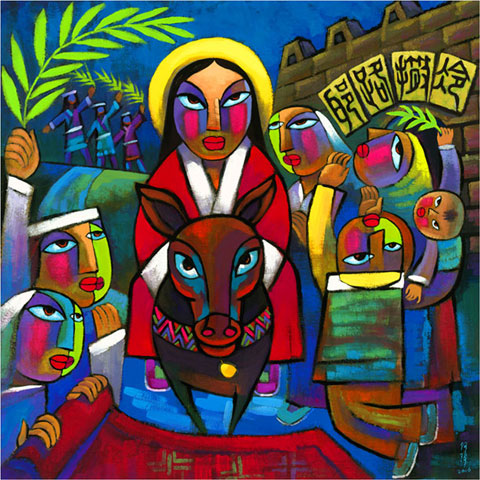
The Triumphal Entry, by He Qi

As they approached Jerusalem and came to Bethphage on the Mount of Olives, Jesus sent two disciples, saying to them, “Go to the village ahead of you, and at once you will find a donkey tied there, with her colt by her. Untie them and bring them to me. If anyone says anything to you, say that the Lord needs them, and he will send them right away.”

This took place to fulfill what was spoken through the prophet:

“Say to Daughter Zion,
    ‘See, your king comes to you,
gentle and riding on a donkey,
    and on a colt, the foal of a donkey.’”

The disciples went and did as Jesus had instructed them. They brought the donkey and the colt and placed their cloaks on them for Jesus to sit on. A very large crowd spread their cloaks on the road, while others cut branches from the trees and spread them on the road. The crowds that went ahead of him and those that followed shouted,

“Hosanna to the Son of David!”

“Blessed is he who comes in the name of the Lord!”

“Hosanna in the highest heaven!”

When Jesus entered Jerusalem, the whole city was stirred and asked, “Who is this?”

The crowds answered, “This is Jesus, the prophet from Nazareth in Galilee.” (New International Version)

A Humble Leader

Gentle humility and strong leadership are not mutually exclusive concepts. They can and should co-exist together.

Los Angeles County traffic cops receive plenty of complaints about their work. After all, most motorists don’t think they deserve a ticket. Each complaint gets documented and placed in the officer’s personnel file. One officer, however, Deputy Sheriff Elton Simmons, made 25,000 traffic stops over a span of 20 years, without a single complaint on his record.

When his supervisor started looking through Simmons’ file, he was stunned to find plenty of commendations, but not a single complaint. It was so unusual, that a CBS News crew was assigned to follow Simmons in an attempt to learn his secret. They described Deputy Simmons as having a “pitch-perfect mix of authority and diplomacy” without a trace of arrogance or self-righteousness.

Although handing out plenty of tickets, they never came with a guilt trip.  Deputy Simmons described his mentality: “I’m here with you. I won’t look down at you.” 

One driver who got a ticket from Simmons said, “It’s his smile. How could you be mad at that guy?”  “Apparently, you can’t,” concluded the CBS News team. “Time after time, ticket after ticket, we saw Officer Simmons melt away a polar ice cap of preconceptions.”

A Meek Celebrity

As Jesus entered Jerusalem for the last week of his life, he was at the height of his fame. Christ’s teaching and healing ministry touched thousands of people. Jesus was the most famous celebrity to come into town since David captured the city a thousand years before. 

But Jesus did not ride into Jerusalem as a great and mighty warrior who conquered Jerusalem in a military battle. There is coming a time, at the end of the age, when Jesus will take on this role, but that was not his purpose on this occasion. 

Hosanna in the Highest, by Malaysian artist Hanna-Cheriyan Varghese

One of the challenges for people in every era is to properly balance scriptural truth. Many Jews emphasized King David’s victories in battle, and his great political dynasty, and so, tended to overlook that David was also a humble servant. 

King David showed steadfast love and kindness to his subjects and submitted himself to God in such a way that, even with opportunities to seize the kingship from Saul who was trying to take his life, he left vengeance to God alone.

Christ’s triumphal entry portrays Jesus as King, the Son of David, but as a gentle king. He embodied both powerful authority and gentle humility. Jesus wanted the crowd to understand that he was not like most kings – he was a lowly king. 

Jesus as a meek celebrity seemed so odd that many people saw that combination of gentle authority as being wishy-washy. Jesus didn’t fit any of the typical labels that people expected. They wondered, “Is he a Pharisee? Or a Zealot? What’s his position on the Romans?  How is he going to lead us out from under Gentile rule?” There was lots of anxiety and concern over Jesus; the people could not nail down exactly what kind of guy he was.

A Servant Pastor

Over the years, as a Pastor, many people have wanted to label me as something, but have had a hard time doing it. Am I liberal or conservative? liturgical or non-liturgical? open or closed to particular people or groups? e.g. LGBTQ folks, Black Lives Matter, etc.

The problem with all this is that it assumes you cannot be both, as if life is all either/or, instead of both/and. It makes ministry about choosing sides, instead of breaking down barriers.

Meekness and strength, gentleness and authority, humility and leadership, grace and truth, love and anger, are all meant to be together – not compartmentalized in sequestered ghettos of the mind.

Jesus sought to hold kingly authority and divine righteousness together, at the same time, all the time. Christ came into Jerusalem to face the cross and take upon himself the sin of the whole world. He came as a gentle king.

Yet, many people do not want this kind of leader because they think leadership is all about power – taking charge with strong authority, telling people what to do, and controlling every aspect of the realm.  

Jesus, at times, acts like a decisive and absolute authority. He knocks over the tables of the money changers in the temple, curses fig trees, and refuses to answer direct questions. But then he turns around and goes against the people’s expectations of him as a leader by riding on a lowly donkey, inviting tax collectors and prostitutes to join him, going after the lost, and embracing the least persons in society.

A Donkey Lord

Jesus displayed a combination that seemed confusing and wishy-washy to many. Christ is both sovereign lord, and humble servant. Jesus riding on a donkey seemed a strange fusion of authority and humility. 

On the one hand, a donkey was the beast of burden for most working class poor people. Donkeys are ordinary, and not like war horses. Kings didn’t ride into conquered cities on donkeys. But, on the other hand, the donkey is also linked to Messiah’s power and authority.

Rejoice, rejoice, people of Zion!
    Shout for joy, you people of Jerusalem!
    Look, your king is coming to you!
He comes triumphant and victorious,
    but humble and riding on a donkey—
    on a colt, the foal of a donkey.

The Lord says,

“I will remove the war chariots from Israel
    and take the horses from Jerusalem;
    the bows used in battle will be destroyed.
Your king will make peace among the nations;
    he will rule from sea to sea,
    from the Euphrates River to the ends of the earth.” (Zechariah 9:9-10, GNT)

Jesus is the ultimate leader who uses his authority for the benefit of others, to bring peace. Jesus did not use his authority to consolidate power and squish enemies, but instead, gave his life so that others might live. 

Gentle and meek does not mean being a washrag or a limp noodle. Rather, it means to have power under control, e.g. a broke horse; it is power for useful purposes to serve people, not like other kings who were concerned with getting, consolidating, and keeping power, at all costs.

Jesus is the crucified Messiah; the modest leader; the lowly Lord; the God Man. We must hold it all, not emphasizing one aspect above another, so that we have the complete picture of Christ.

A Gracious Royal

Believers and followers of Jesus are royal children of the King. That means we live in the way of Jesus by bestowing grace to others. What does this “look like?”

  • In our families, Christian parents do not merely bark orders at kids, but love and support them by humbly and gently coming alongside and helping. 
  • In our neighborhoods, Christian citizens pray for the welfare of their neighbors, even and especially the ones who we may not like very well.   
  • In our work, Christian workers use their skills and abilities to serve others, transforming what we do from a secular job to a sacred vocation. 
  • In our daily life, Christians scan the horizon to seek people whom we might show God’s kindness, instead of just waiting for something to fall into our laps, if it ever does.

A Talking Donkey

From the Old Testament, we know that donkeys can talk (Numbers 22:21-38). If Christ’s donkey could speak, I imagine him saying: 

“King Jesus, why did you choose a lowly donkey like me to carry you to ride in your parade? Didn’t you have a friend who owned a horse – a spirited royal mount, fit for a king to ride? Why choose me, a small unassuming beast of burden, trained to plow and not to carry kings?”

It is a privilege to be a Christian. Perhaps you will say: 

“King Jesus, why did you choose me, a lowly unimportant person to bear you in my world today? I am poor and unimportant, trained to work, and not to carry kings – let alone the King of kings; and yet, you’ve chosen me to carry you in triumph in this world’s parade. King Jesus, keep me humble, so everyone may say, ‘Blessed is he who comes in the name of the Lord,’ and not ‘what a great Christian he is.’”

God of all, you gave your only begotten Son to take the form of a servant, and to be obedient, even to death on a cross: give us the same mind that was in Christ Jesus that, sharing in his humility, we may come to be with him in his glory, who lives and reigns with you and the Holy Spirit, one God, now and forever. Amen.