Develop a Virtuous Ethic (Matthew 7:15-20)

“Beware of false prophets who come disguised as harmless sheep but are really vicious wolves. You can identify them by their fruit, that is, by the way they act. Can you pick grapes from thornbushes, or figs from thistles? A good tree produces good fruit, and a bad tree produces bad fruit. A good tree can’t produce bad fruit, and a bad tree can’t produce good fruit. So every tree that does not produce good fruit is chopped down and thrown into the fire. Yes, just as you can identify a tree by its fruit, so you can identify people by their actions.” (New Living Translation)

God has always been concerned for ethical virtue. And Jesus was always careful to take that ethic and help others identify it and apply it.

Virtuous ethics was well-known in the ancient world, especially thanks to the Greeks and Aristotle – who espoused that a person’s character is the determinative factor in discerning the extent to which that person is a good person.

For Aristotle, ethics includes moral virtues such as courage, temperance, compassion, generosity, honesty, and justice. The person in whom these moral virtues are to be found as steadfast dispositions can be relied on to exhibit a good character, and therefore, is able to make morally correct actions in moral decision-making situations.

For Jesus, religious legalism was a clear outward sign of the lack of inward moral virtue. Bad religion was a result of bad character. Therefore, everyone ought to beware of the religious leaders who exhibited stifling religious legalism.

Nothing can choke the heart and soul out of a person’s true spirituality, and hinder the development of virtue, like the legalist who teaches a precise extra-biblical list of do’s and don’ts.

For many folks, it seems easier to live by the list than to pursue the harder road of developing the character qualities needed for a solid and virtuous religious ethic. Christian discipleship involves growing into spiritual maturity and allowing a seasoned character to shape how we make decisions. 

To do so, we must patiently and consistently follow in the way of Jesus, which is the way of grace and of life.

Today’s Gospel lesson is Christ’s conclusion to his Sermon on the Mount. It is a sermon that sets forth the values of God’s kingdom and devalues the core of legalistic thought. 

I define legalism as a compulsion to spell out, in great detail, how everyone is to live a godly life; purposely going beyond the stated commands of Holy Scripture so that all persons can know exactly what they are supposed to do in any situation.

The problem with this approach to the Christian life is that godliness is merely an outward expression of our ability to hold to the list. It really has nothing to do with cultivating a virtuous ethic of life.

“Do not do what they do, for they do not practice what they preach. They tie up heavy, cumbersome loads and put them on other people’s shoulders, but they themselves are not willing to lift a finger to move them. Everything they do is done for people to see.”

Jesus on the legalist (Matthew 23:3-5, NIV)

The legalistic way of life and religion feeds human pride and boasting; it goes against the inner heart values of humility and meekness in Christ’s Beatitudes. The teaching of Jesus ends up getting lost in trying to do everything right or perfect.

Jesus, through the Sermon on the Mount, led the crowd to a point of decision, letting them know they are at a crossroads. There are two alternatives: Choose the way of life as expressed in Christ’s teaching, or else choose the way of destruction through the legalistic list. In order to press the crowd toward the necessity of choosing wisely, Jesus used metaphors to make his point.

False teaching in the form of legalism is like a wolf in sheep’s clothing. Be wary of people who seem pious and sincere, yet who do not quite pass the smell test. After all, Satan himself, the Apostle Paul once said, masquerades as an angel of light, appearing righteous, yet, is intent on deceiving many. (2 Corinthians 11:13-15)

So, how do we recognize a wolf who spiritually and emotionally devours people, and has no intention of helping but harming? Look at the fruit of the tree. 

Jesus is the good tree. Christ advocates for a searching of the heart. This leads to the result of righteous fruit. The bad tree is also seen by its fruit. Anyone who fails to live the Beatitudes of Jesus will be seen by the rotten fruit of boasting and pride.

False teachers tend to believe they are above others. After all, they are experts at keeping the list of do’s and don’ts! Yet, a false disciple will always be shown by their profound lack of grace, gentleness, and genuine humility. They inevitably advocate for holding to their brand of religion and keeping the unscriptural list. The absence of true righteousness and justice in their lives eventually results in their being cut down and thrown into the fire.

For Jesus, there is no riding the fence between the two alternatives presented – and it is a matter for him of life and death. The way of Jesus leads to life, good fruit, entrance into the kingdom of heaven, and stability. The other alternative ends in destruction, bad fruit and fire, exclusion from the kingdom, and being ruined.

The sobering reality of Christ’s teaching is that many people can be deceived with a devil’s bargain: “Take the nice handy legalistic list and you will become godly. Here are twelve principles to change your life. Follow these rules, pray this prayer, give your money to this, and all will be well.” It is, however, a highway to the grave.

The false teacher proclaims himself a “fruit inspector” and then goes on to judge everyone by his own contrived legalistic list. So then, there is a need to repent of religious lists, political agendas, and teachings which ignore and demean Christ’s Sermon on the Mount.

One of the telltale signs of holding to a conjured list is when we are not honest with one another about our struggles. The bald fact of list-living is that we cannot fulfill it. So, when we know we are not measuring up to the list, the temptation is to keep up appearances as if we are doing just fine. 

List-living eschews showing any weakness or imperfection:

  • I cannot admit my sin to anyone because the list pronounces me a failure if I do. 
  • I cannot enter a deep and prolonged grief over my loss because the list says I need to stay strong. 
  • I cannot profess my doubts about God because the list says if I doubt, I am not a real Christian.

My response and recommendation to legalistic list-living is this: To hell with the list! 

Instead, give praise to Jesus Christ who has given us the way of grace! For it is grace which transforms hearts, turns lives around, and provides genuine joy and satisfaction. If grace is not the answer, we are not asking the right question. The tree of life has an abundant supply of gracious fruit.

The greatest anti-legalistic prayer we can pray is the tried and true ancient prayer of the Church: “Lord Jesus Christ, Son of God, have mercy on me a sinner.”

Go Up the Mountain (Isaiah 2:1-4)

Jerusalem from the Mount of Olives, by William Simpson (1823-1899)

The word that Isaiah, son of Amoz, saw concerning Judah and Jerusalem.

In days to come
    the mountain of the Lord’s house
shall be established as the highest of the mountains
    and shall be raised above the hills;
all the nations shall stream to it.
    Many peoples shall come and say,
“Come, let us go up to the mountain of the Lord,
    to the house of the God of Jacob,
that he may teach us his ways
    and that we may walk in his paths.”
For out of Zion shall go forth instruction
    and the word of the Lord from Jerusalem.
He shall judge between the nations
    and shall arbitrate for many peoples;
they shall beat their swords into plowshares
    and their spears into pruning hooks;
nation shall not lift up sword against nation;
    neither shall they learn war any more. (New Revised Standard Version)

Mountains make up about one-fifth of the world’s landscape and 12% of the world’s population live on them. They are more than imposing and impressive statues of rock. About 80% of our planet’s fresh water originates in the mountains.

It was on a mountain that Noah’s ark settled; Moses was given the law; and Jesus preached and died. Even the beans from my morning coffee were grown on the side of a mountain. I have everything I need in the mountainous God of all.

The most fundamental truths about God are consistency and constancy in the divine nature. God is forever present with people. 

So, it is no coincidence that the temple of God was built on a mountain at the highest point in the city of Jerusalem. Ascending the temple mount reminded every worshiper of the Lord’s ever-present protection and strength. It pointed them to the source of life. With God, every need is met and satisfied, because on the mountain and in the temple, people learn how to live in this world. They are taught the ways of the Lord.

We learn to live in peace and harmony by ascending the mountain, entering the house of God, and adopting a teachable spirit.

Today’s Old Testament lesson is a vision of the future – the way things will be. Now, things are not as they ought to be. Injustice, unrighteousness, indifference, and impurity leave their mark everywhere. It may cause folks to wonder whether the Lord is truly present, or not.

If God seems or feels aloof or unconcerned, it is not that the Lord is avoiding us or is distracted with other important matters of running the universe. It simply means God chooses to reveal the divine character and the divine will when the appropriate time warrants it, for our benefit.

A mountain looks like it never moves. Yet the slow but steady rains, the creeping of tectonic plates, and undiscernible changes within the earth shift mountain ranges over time. The Lord is most certainly responding to us, our movements and changes, in a way we cannot perceive with the naked eye.

Our responsibility in the entire affair is to engage in consistent rhythms of spirituality which place us in a position to receive grace when God decides to give it. If we are still, we can feel the movements of grace developing within us, and enveloping us with life.

Perhaps we need to become adept at being spiritual mountain goats, using our wide cloven hooves of faith to negotiate the immense crags and rocks of God. After all, we will spend an eternity getting to know God and never exhaust the exploration.

Therefore, we must not despair. Rather, we can anticipate meeting with God, just as the Israelites of old looked forward and upward in ascending the temple mountain. The truth is that God surrounds people, even when we do not always perceive it to be so. 

The sturdiness of God is able to handle and bear the weight of our heaviest burdens.

Throw all your anxiety onto him because he cares about you. (1 Peter 5:7, CEB)

If we will but look up, there is abiding help for the most vexing of problems.


I raise my eyes toward the mountains.
    Where will my help come from?
My help comes from the Lord,
    the maker of heaven and earth.
God won’t let your foot slip.
    Your protector won’t fall asleep on the job. (Psalm 121:1-3, CEB)

There is peace and settled rest when we call upon the God who surrounds us.

I call out to the Lord,
    and he answers me from his holy mountain.

I lie down and sleep;
    I wake again because the Lord sustains me. (Psalm 3:4-5, NIV)

It is through trust that we become mountains ourselves – strong in faith and giving life to those around us. And it is also no coincidence that Jesus ascended a mountain in order to deliver his most important teachings.

When Jesus saw the crowds, he went up the mountain, and after he sat down, his disciples came to him. And he began to speak and taught them, saying:

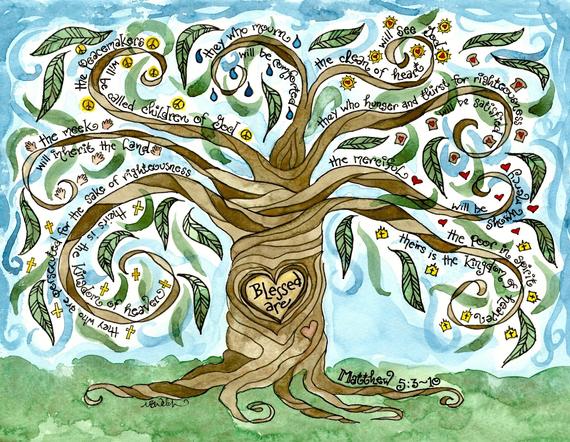
Blessed are the poor in spirit, for theirs is the kingdom of heaven.

Blessed are those who mourn, for they will be comforted.

Blessed are the meek, for they will inherit the earth.

Blessed are those who hunger and thirst for righteousness, for they will be filled.

Blessed are the merciful, for they will receive mercy.

Blessed are the pure in heart, for they will see God.

Blessed are the peacemakers, for they will be called children of God.

Blessed are those who are persecuted for the sake of righteousness, for theirs is the kingdom of heaven. (Matthew 5:1-10, NRSV)

On the mountain we encounter the Lord. In that place, we find that humility, gentleness, mercy, purity, and peacemaking are the sacred pathways of pushing back on the world’s injustice and establishing a more just and right culture.

All sorts of people, from everywhere, from every nation, will stream to receive gracious teaching. They will become aware of how to live in an egalitarian society. Everyone’s needs shall be met.

Great and mountainous God, help me to keep my heart clean and to live honestly and fearlessly, so that no outward failure can dishearten me or take away my joy of conscious integrity. Open wide the eyes of my soul so that I may see good in all things. Grant me today a vision of your truth. Inspire me with the spirit of gladness and make me to be a cup of strength to suffering souls; in the name of the strong Deliverer, our Lord and Savior, Jesus Christ. Amen.

Lynching, Lusting, Liquidating, and Lying (Matthew 5:21-37)

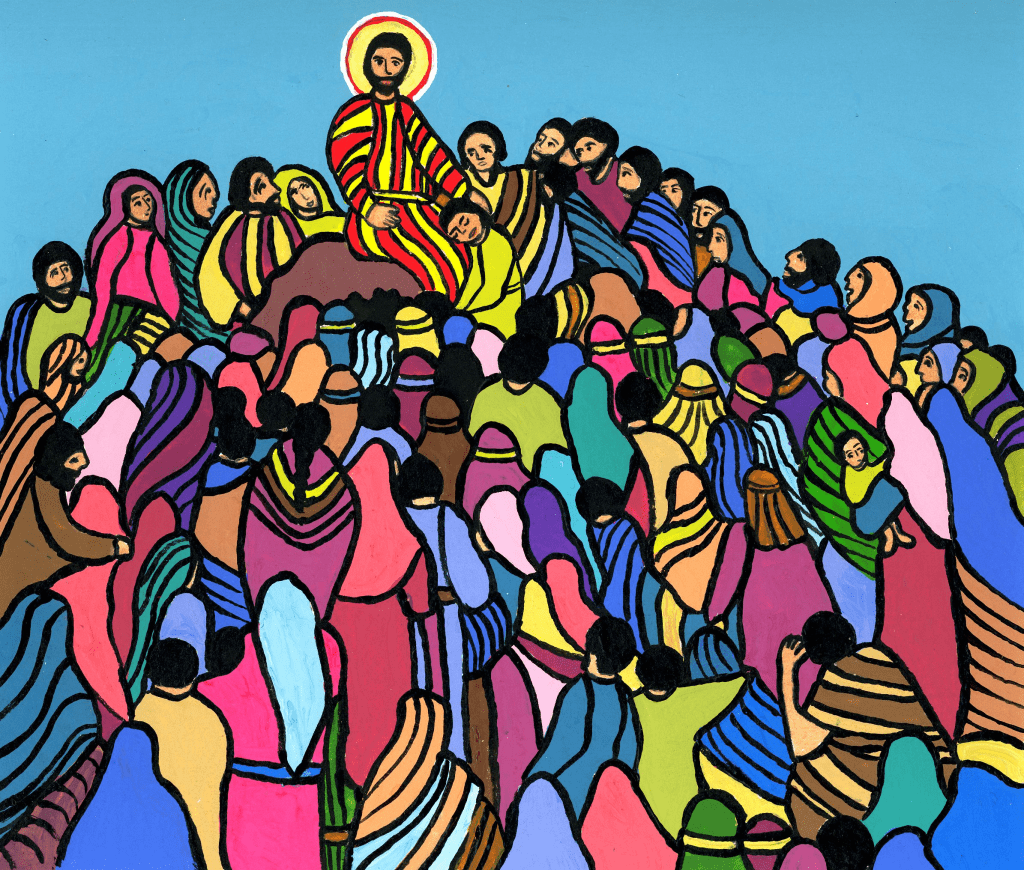
A Bengali depiction of Christ’s Sermon on the Mount

“You have heard that it was said to the people long ago, ‘You shall not murder, and anyone who murders will be subject to judgment.’ But I tell you that anyone who is angry with a brother or sister will be subject to judgment. Again, anyone who says to a brother or sister, ‘Raca,’ is answerable to the court. And anyone who says, ‘You fool!’ will be in danger of the fire of hell.

“Therefore, if you are offering your gift at the altar and there remember that your brother or sister has something against you, leave your gift there in front of the altar. First go and be reconciled to them; then come and offer your gift.

“Settle matters quickly with your adversary who is taking you to court. Do it while you are still together on the way, or your adversary may hand you over to the judge, and the judge may hand you over to the officer, and you may be thrown into prison. Truly I tell you; you will not get out until you have paid the last penny.

“You have heard that it was said, ‘You shall not commit adultery.’ But I tell you that anyone who looks at a woman lustfully has already committed adultery with her in his heart. If your right eye causes you to stumble, gouge it out and throw it away. It is better for you to lose one part of your body than for your whole body to be thrown into hell. And if your right hand causes you to stumble, cut it off and throw it away. It is better for you to lose one part of your body than for your whole body to go into hell.

“It has been said, ‘Anyone who divorces his wife must give her a certificate of divorce.’ But I tell you that anyone who divorces his wife, except for sexual immorality, makes her the victim of adultery, and anyone who marries a divorced woman commits adultery.

“Again, you have heard that it was said to the people long ago, ‘Do not break your oath, but fulfill to the Lord the vows you have made.’ But I tell you, do not swear an oath at all: either by heaven, for it is God’s throne; or by the earth, for it is his footstool; or by Jerusalem, for it is the city of the Great King. And do not swear by your head, for you cannot make even one hair white or black. All you need to say is simply ‘Yes’ or ‘No’; anything beyond this comes from the evil one. (New International Version)

Christ’s Sermon on the Mount by Joseph Matar

Relationships are important to God (and us!); we need one another because we are created in the image of a relational God. So, God wants us to have good relations with each other.

Murder, adultery, divorce, and oaths all have to do with interpersonal relations. These are topics from the Ten Commandments (6, 7, 9, and 10) that Jesus wanted to uphold.

Murder

Just because no blood is spilled doesn’t mean a killing hasn’t taken place. At the heart of the killing is angry contempt – which makes us all mass-murderers. The sort of anger Jesus refers to is nursing a grudge that morphs into hatred. It’s the deliberate decision to let anger sit in the pit of the gut and slow cook into deep resentment. Once that resentment is well done, murder becomes the meal.

Name-calling is the outward expression of resentful grudge bearing. “Raca” is an “airhead.” It means to be empty or stupid. The word “fool” is literally a “moron” – one who lacks both brains and morality. Both names hurt deeply, which is the expressed aim of the name caller. To have our intelligence and character questioned, cuts to the heart.

Jesus insists that harboring internal resentment comes out in external name-calling, verbally lynching people without a trial. Whenever we string a person up, divine judgment is coming to town. 

No one has a right to nurse a grudge. Repaying hatred with hatred is a highway to the grave. If you have ever wished someone dead, hated anyone, or belittled another; then, you have assassinated that person in your heart and are under the judgment of a holy God.

So, what to do in overcoming the resentment? Seek reconciliation immediately. Jesus used two illustrations to illumine the need for reconciliation with others when there are sour relations: an example of worship and an example with the court.

If you are worshiping, and remember that someone else is nursing a grudge against you, it is your responsibility to go and make things right. The Lord does not want to talk to anyone who won’t talk to their sister or brother.

Forgive us our debts, as we also have forgiven our debtors… For if you forgive other people when they sin against you, your heavenly Father will also forgive you. But if you do not forgive others their sins, your Father will not forgive your sins. (Matthew 6:12, 14-15, NIV)

None of this is meant to minimize the hurt or trauma that has taken place. Many people have faced hell in the shape of a human. Yet, because Jesus takes your hurt seriously, he calls for forgiveness and reconciliation. Without it, the pain unnecessarily continues and there is no healing.

In the illustration of court, we are to settle matters quickly and make things right so that judgment won’t happen. Let’s avoid living with the regret of vengeance because of destroying someone’s life. Forgiveness and reconciliation are always options on the table.

See to it that no one falls short of the grace of God and that no bitter root grows up to cause trouble and defile many.

Hebrews 12:15, NIV

Adultery

Adultery has its origins in mental sexual activity with another person. Jesus is not against normal gender attraction, nor sex itself (which is a gift of God). Rather, Jesus condemns the leering upon another with sexual fantasy. All adulterous relationships and inappropriate sexual relations start with the “look.”

“Lust” is to intensely desire something, to seek mastery over another. The reason people stare, and lust, is not because of the other person’s manner or dress; it’s because they already have an adulterous heart.

Managing adultery with a band aid is like trying to contain a nuclear meltdown with some duct tape; it’s an amputation we need. Jesus leaves no room to think it’s okay to lust in the heart because “I’m not hurting anybody.” Mental adultery demeans and degrades women.

Our lustful desires are powerful; yet God’s grace is more powerful. There’s no need to be burdened with shame and guilt when the cross of Christ has already taken care of it. There is a multi-billion dollar industry of pornography because our hearts are black. Now is the time for forgiveness, grace, and healing in Jesus Christ.

Sermon on the Mount by Jorge Cocco Santiago

Divorce

Today in America, more than one-third of all adults have experienced divorce. Jesus condemns the cavalier divorce, the thought of having a better spouse, even though there is no marital unfaithfulness. This is yet another form of mental adultery which believes someone else can better meet my needs. 

Jesus makes provision for divorce to occur in certain circumstances. Yet, he doesn’t bend to liquidating a marriage over unhappiness with what God has joined together. The intent of Old Testament legislation on divorce is to avoid a casual stance toward marriage (Deuteronomy 24:1-4). Over the centuries, people found creative ways of getting around the law. Although a divorce may be legal, it might not be ethical. Jesus wanted divorce practiced with concern for the woman, so that her rights and needs were considered.

For most of human history, if a husband did not like his wife (e.g. for continually burning his supper) he could divorce her. Jesus, however, insisted divorce must not happen because of a hard time getting along; or don’t love your spouse anymore; or that your spouse keeps irritating you. 

Being frustrated or unhappy are not biblical grounds for divorce. The answer to most marital problems does not lie in a new spouse, but in the hard work of identifying the idols of our hearts, overthrowing them, and re-connecting.

Christ sought to defend women who are victims. In biblical times, if a wife was given a certificate of divorce, she had four options: 1) return to her family of origin; 2) become a beggar; 3) become a prostitute to make ends meet; or, 4) marry again, which was extremely difficult to do. 

In reality, divorce is a legal testimony verifying that a separation has already occurred. It’s a recognition that disunity and division is already present, that a terrible break already happened, damaging the people involved.   

If God found it necessary to divorce his own covenant people, then it’s inevitable that divorce will happen among couples (Jeremiah 3:1-8). So, let’s be discerning in how we handle each individual situation of marital difficulty.

Oaths

“I swear on a stack of Bibles I won’t…” “I will, if I get around to it….” These are a few of the caveats we give when making a promise or oath. Oaths communicate our level or ability of getting something done, or not.

That’s fine. What isn’t fine is making excuses or false promises with no intention of doing what you say you will do. Jesus takes all that extraneous language out. Say “yes” or “no” and then follow through; if you don’t, you’re a liar.

We often lie because we don’t want to do something to begin with. “Yes” and “no” are clear boundary words. Boundaries define where I end and someone else begins, leading me to a sense of ownership. Knowing what I am to take and not take responsibility for gives me freedom.

Jesus wants us to clarify our values; make wise decisions; identify what we will accept and reject; and follow through on what we say we will do, period.

Murder, adultery, divorce, and oaths are all related. They have to do with how we relate to others, especially those closest to us and to God. We are to live responsibly by keeping our hearts large and soft.

Christ’s Beatitudes (Matthew 5:1-12)

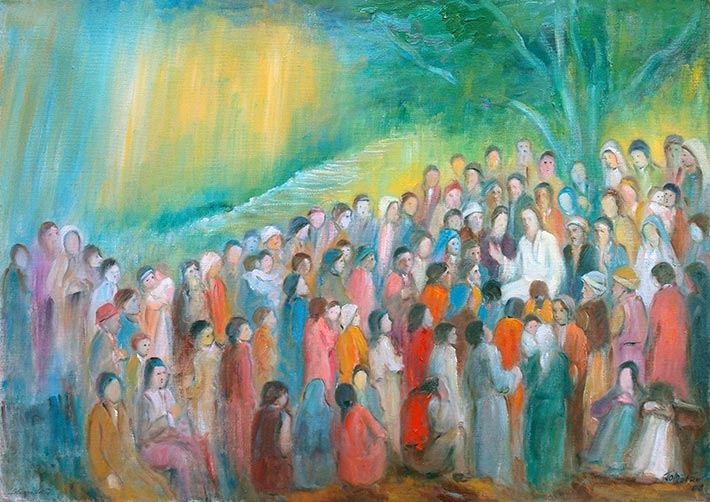
Sermon on the Mount by Gisele Bauche

When Jesus saw the crowds, he went up the mountain, and after he sat down, his disciples came to him. And he began to speak and taught them, saying:

“Blessed are the poor in spirit, for theirs is the kingdom of heaven.

“Blessed are those who mourn, for they will be comforted.

“Blessed are the meek, for they will inherit the earth.

“Blessed are those who hunger and thirst for righteousness, for they will be filled.

“Blessed are the merciful, for they will receive mercy.

“Blessed are the pure in heart, for they will see God.

“Blessed are the peacemakers, for they will be called children of God.

“Blessed are those who are persecuted for the sake of righteousness, for theirs is the kingdom of heaven.

“Blessed are you when people revile you and persecute you and utter all kinds of evil against you falsely on my account. Rejoice and be glad, for your reward is great in heaven, for in the same way they persecuted the prophets who were before you. (New Revised Standard Version)

God’s Law (The Ten Commandments) was given on a mountain. That Law was restated and reframed on a mountain by Jesus in his Sermon on the Mount.

I believe that arguably one of the most important and impactful portions of Holy Scripture are the Beatitudes of Jesus, which serve as the foundation to all of Christ’s teaching.

Christ’s Beatitudes are not simply a random collection of pithy phrases from Jesus on what constitutes approval and blessing from God. They intentionally build upon each other and describe the nature of true righteousness.

The Poor in Spirit

Spiritual poverty, not wealth, is the spiritual base to the Christian life. Most of the original crowd listening to Jesus thought they were on the outside of the kingdom, on the margins of true religion. But Jesus told them they have a place in God’s reign as poor and pitiable people.

To be “poor in spirit” is to be a spiritual beggar who recognizes they have nothing to offer God. It is seeing oneself, one’s sin, and one’s life as spiritually bankrupt apart from God.

Beggars have neither the leverage nor the ability to strike deals with anybody; and so, they do one thing: beg continually.

The proud person would never be caught begging for anything. Yet, the humble spiritual beggar constantly prays because they need God. They discern that without God there is no hope. The kingdom of heaven belongs to the penitent and not to the proud.

The Mourners 

Mourning is the emotional response of acknowledging one’s spiritual poverty. 

Grief and lament have a central place in Christian theology and life. To avoid it, work around it, or short-circuit its process is to refuse Christ; there is no righteousness apart from mourning over sin. Crying, weeping, and even intense tears are important and necessary.

To experience personal grief over one’s sins and the sins of the church and the world is a Beatitude of Jesus. You neither need position, power, privilege, nor pedigree to be a mourner. All can mourn. This is the door by which we enter the kingdom of God.

The Meek

A meek and gentle spirit is the result of realizing poverty of spirit and practicing lament.

At the heart of what it means to be meek is a spirit of non-retaliation. Whenever we are flat on our backs before God, there is no place to look but up. Thus, there is no ability to look down on others.

To be meek is to be broken and moldable before God. A meek person takes personal responsibility for their attitudes and actions. The meek have no need to retaliate, even when egregiously wronged, because they fully entrust themselves to God alone who judges the living and the dead.

Ironically, brokenness is the path to righteous wholeness.

The Hungry and Thirsty

Only those who know their poverty of spirit, personally grieve over sin, and are gentle, end up longing for righteousness.

The desire for righteousness is a recognition that without God I will not make it. I cannot be righteous without Jesus. Simply put, righteousness is a right relationship with God and others.

Those who hunger and thirst for God’s righteousness know they cannot make things right by themselves; they need God’s help.

If we think we can live most days of our lives without God, we do not yet know true righteousness. People who understand their great need for Jesus are easy to spot. They crave and devour God’s Word as their daily food; and they cannot stop blabbering on about Jesus.

There are three practices of living that arise from being filled with God’s righteousness: mercy, purity, and peacemaking. These Beatitudes cannot be conjured up by our own will; instead, they organically grow within us and are freely expressed because of what God is doing in our lives.

You cannot force them any more than you can force a stalk of corn to grow on your terms. Rather, you work with the unforced rhythms of God’s grace and allow righteousness to take root in you.

Down below in the soil, spiritual poverty, mourning, and humility germinate. Then, when the plant breaks the soil and flowers, it produces mercy, purity, and peace-making.

The Merciful 

Mercy begins with a heart that seeks to be generous; it is a loving response to someone or a group of people in misery. We accept them and help them because we ourselves have been there.

The merciful person looks for ways to come alongside others and help, rather than pile expectations and burdens on others without mentoring them in the ways of God.

The Pure In Heart

Purity also results from true righteousness. A stalk of corn might look good, but if you shuck it and it’s filled with worms, it’s not worth much. Legalistic righteousness is concerned to look good; it’s obsessed with performance, perfection, and possessions.

Conversely, the righteousness of God fills our hungry hearts and makes us pure and holy, set apart for good use.

The Peacemakers 

Those who make peace intentionally put themselves in the middle of trouble because they want to live righteously with the mercy and purity that God has provided for them.

Peace is realized through peacemakers. It seems we all desire peace, and yet, peacemakers are hard to come by. It’s a tough gig. To achieve peace, one must first be at peace with God and self – which is why we need the cross of Jesus Christ.

The Persecuted 

Living righteously, as presented by Jesus, tends to bring persecution; and the persecuted consider it a small price to pay for realizing God’s justice in the world.

Folks who are offended by even slight criticisms are usually the ones who are privileged and in power. They have not yet learned the ways of Jesus. Pettiness is nothing more than a sign of unrighteousness.

Yoking up with Jesus, following him, and living into his words and ways has always been risky and dangerous. The Beatitudes of Jesus are not characteristics that lead to power, prestige, or possessions, but likely just the opposite.

“The Beatitudes, spoken with the community of Jesus’ disciples in view, are paradoxes – the standards of the world are turned upside down as soon as things are seen in their right perspective, which is to say, in terms of God’s values, so different from those of the world. It is precisely those who are poor in worldly terms, those thought of as lost souls, who are truly fortunate ones, the blessed, who have every reason to rejoice and exult in their suffering. The Beatitudes are promises resplendent with the new image of the world and humanity inaugurated by Jesus.”

Pope Benedict XVI

Truly righteous persons become living Beatitudes; they are walking, talking blessings to the world. They abide with Christ and are witnesses to a subversive, yet wonderful, way of life, where the last are first and the greatest are the least.

O Lamb of God, that takes away the sins of the world, have mercy upon me.

O Lamb of God, that takes away the sins of the world, have mercy upon me.

O Lamb of God, that takes away the sins of the world, grant me your peace.