How Much Is Too Much? (1 Kings 4:20-28)

King Solomon’s court, by Claude Vignon (1593-1670)

The people of Judah and Israel were as numerous as the sand on the seashore; they ate, they drank and they were happy. And Solomon ruled over all the kingdoms from the Euphrates River to the land of the Philistines, as far as the border of Egypt. These countries brought tribute and were Solomon’s subjects all his life.

Solomon’s daily provisions were thirty cors of the finest flour and sixty cors of meal, ten head of stall-fed cattle, twenty of pasture-fed cattle and a hundred sheep and goats, as well as deer, gazelles, roebucks and choice fowl. For he ruled over all the kingdoms west of the Euphrates River, from Tiphsah to Gaza, and had peace on all sides. During Solomon’s lifetime Judah and Israel, from Dan to Beersheba, lived in safety, everyone under their own vine and under their own fig tree.

Solomon had four thousand stalls for chariot horses, and twelve thousand horses.

The district governors, each in his month, supplied provisions for King Solomon and all who came to the king’s table. They saw to it that nothing was lacking. They also brought to the proper place their quotas of barley and straw for the chariot horses and the other horses. (New International Version)

Wealth, in and of itself, is neither good nor bad – it just is. The real issue is why any particular person wants to be wealthy, how we view wealth, and what we do with it when we have it.

In ancient Israel, under King Solomon, the Israelites enjoyed a time of prosperity, safety, and abundance. To flourish and thrive in life is good. The ability to meet basic needs, and to enjoy life is good.

King Solomon on his throne, by Frans Francken the Younger (1581-1642)

But what about beyond that? Is there such a thing as too much? And what about others who may not be able to make ends meet?

Solomon certainly had a lot. Yet, we do have warnings in Holy Scripture about exorbitant wealth. Here is what the Deuteronomic law says concerning any future king:

The king, moreover, must not acquire great numbers of horses for himself or make the people return to Egypt to get more of them, for the Lord has told you, “You are not to go back that way again.” He must not take many wives, or his heart will be led astray. He must not accumulate large amounts of silver and gold. (Deuteronomy 17:16-17, NIV)

Whatever standard one may use, I would say 12,000 horses falls into the great-numbers-of-horses category. And likewise, having 1,000 wives is most likely 999 too many for just about every man on the planet.

Indeed, Solomon’s heart was eventually led astray. It’s quite sad. Even the wisest and wealthiest person who ever lived was not able to sustain complete faithfulness to God. The remainder of Deuteronomy’s instruction about a future king is this:

When he takes the throne of his kingdom, he is to write for himself on a scroll a copy of this law, taken from that of the Levitical priests. It is to be with him, and he is to read it all the days of his life so that he may learn to revere the Lord his God and follow carefully all the words of this law and these decrees and not consider himself better than his fellow Israelites and turn from the law to the right or to the left. Then he and his descendants will reign a long time over his kingdom in Israel. (Deuteronomy 17:18-20, NIV)

In all fairness, King Solomon started out paying attention to God’s law. In his wisdom, he sought to learn and obey – but it ended up being only a partial obedience.

A dimension of any rule or government is to realize that – with any sort of success, security, and wealth – there is always a dark underbelly to it. That is, there are people within that government who are not enjoying its largess and wealth.

Under the new expanded governmental system, Solomon had his kingdom, and its subject peoples, divided into districts in order to give provisions, as well as laborers for his ambitious building projects. Not everyone was enjoying leisure time under a fig tree.

King Solomon set up an economic system that transferred wealth from nations subservient to Israel, and from subsistence farmers within Israel, to support the massive needs of Jerusalem.

The city, under Solomon, was living off the surplus grain to feed all of the horses, as well as the tribute exacted from surrounding nations. In other words, the wealth was being centralized by Solomon for his many projects and interests.

All of the opulence was meant to impress people with wealth, exhibiting Israel’s and Solomon’s great power and wisdom. Yet, if we are to follow the old adage, “follow the money,” we would discover a governmental system that extracted money from others; and produces a lot of oppression, grievances, and exploitation – hence, the dark underbelly of it all.

This sort of situation is precisely why we have prophetic literature in the Old Testament. The prophets are especially attuned to the cries of injustice amongst the people. Every society needs such persons who are within the system, yet are able to be a voice for those who are voiceless.

Had King Solomon moved beyond his partial obedience to complete and total obedience, I surmise that he likely would have considered the needs of everyone within his empire, before establishing a system of government that depended upon economic exploitation.

Specifically, perhaps Solomon ought to have engaged more vigorously and robustly with the covenant code between God and Israel that he was supposed to know so well.

And perhaps, Christianity and the Church have been too lax on the subject of handling Holy Scripture. Because, for all of our talk of being faithful to scripture, that talk has not translated into a solid social and economic understanding of human need and justice.

It simply will not do to label anything we don’t like as communist or socialist. And it will not do to say King Solomon was wealthy and successful, as if that, in and of itself, is the evidence of God’s favor. In reality, it means little, apart from a complete fidelity to God’s law.

In my judgment, Jesus did better than all of this. He pointed us to an alternative system which considers the common good of all persons, and not just some people. The ethics and morality of his Sermon on the Mount lays out the foundational means upon which any sort of governmental system ought to build upon. (Matthew 5-7)

But seek first his kingdom and his righteousness, and all these things will be given to you as well.

Jesus (Matthew 6:33, NIV)

If we are looking for the same sort of wealth and success as Solomon, that means we’ll need to ignore Jesus. Yet, if faithfulness, obedience, humility, righteousness, mercy, purity, and peacemaking matter more than our economic bottom line, then I believe we will discover that the pursuit of these virtues leads to having all of our needs met, as well.

Lord of our lives, teach us how to use our money and our possessions. Deliver us from stinginess and wasteful extravagance; inspire our giving with the spirit of true generosity. Help us always to remember your generous love for us, that we may be wise and faithful stewards of the good gifts you have given us. Amen.

What Do You Value? (Matthew 6:1-6, 16-21)

The Sermon on the Mount, by Beryl Lewis (1939-2021)

“Be careful not to practice your righteousness in front of others to be seen by them. If you do, you will have no reward from your Father in heaven.

“So when you give to the needy, do not announce it with trumpets, as the hypocrites do in the synagogues and on the streets, to be honored by others. Truly I tell you, they have received their reward in full. But when you give to the needy, do not let your left hand know what your right hand is doing, so that your giving may be in secret. Then your Father, who sees what is done in secret, will reward you.

“And when you pray, do not be like the hypocrites, for they love to pray standing in the synagogues and on the street corners to be seen by others. Truly I tell you, they have received their reward in full. But when you pray, go into your room, close the door and pray to your Father, who is unseen. Then your Father, who sees what is done in secret, will reward you….

“When you fast, do not look somber as the hypocrites do, for they disfigure their faces to show others they are fasting. Truly I tell you, they have received their reward in full. But when you fast, put oil on your head and wash your face, so that it will not be obvious to others that you are fasting, but only to your Father, who is unseen; and your Father, who sees what is done in secret, will reward you.

“Do not store up for yourselves treasures on earth, where moths and vermin destroy, and where thieves break in and steal. But store up for yourselves treasures in heaven, where moths and vermin do not destroy, and where thieves do not break in and steal. For where your treasure is, there your heart will be also. (New International Version)

Spiritual Disciplines

In Christ’s day, there were three spiritual disciplines that were especially important: giving, prayer, and fasting. For the Jewish faithful, these three practices were meant to work together in helping them to know God and serve others. 

Yet, over time, although the disciplines were maintained, they were observed for all the wrong reasons. Jesus was concerned to communicate that not only are people to do the right thing, but that they do the right things for the right reasons.

To do any less, is to be a hypocrite who maintains an outward form of religion, but is inwardly motivated by the praise and recognition of others. Such a person is, in reality, far from God. 

Ash Wednesday is the beginning of Lent on the Christian Calendar. This season is a time devoted to spiritual disciplines, especially fasting.

Fasting

Those who truly hunger and thirst for righteousness take the time eat spiritual food in order to pursue God and seek right relationships in this world. It’s not a matter if we fast, but when.

The Bible has a great deal to say about fasting:

  • Fasting is a sign of humility and brokenness before God in recognizing both personal and corporate guilt. (1 Samuel 7:2-6)
  • Fasting is a means of preparation for ministry. Jesus used fasting in the desert as preparation for his ministry, and to face down the devil (Matthew 4:1-2). And the apostles fasted when seeking God’s direction about a new ministry. (Acts 13:2-3)
  • Fasting is meant to connect with God and serve others; and not to simply go through the motions. (Isaiah 58:3-7)

Therefore, fasting is a time to get in touch with God, to know the divine will, and then to do it. 

God doesn’t operate on a point system. If we only go through the motions of a spiritual discipline, or do it so that others will notice that I am doing my duty, then we have come under the condemnation of Jesus and are proved as hypocrites.

True fasting in an outward practice reflecting an inner attitude of heart; it’s an expression of devotion in order to connect with God and do good works of service to others.

Framing the topic another way: Why don’t we fast? Because it’s culturally okay not to? Because nobody cares whether I do, or don’t?

The spiritual disciplines of giving, praying, fasting, and other Christian practices have changed my life because they are a vital means of connecting with God and engaging the world.

A farmer disciplines himself to plow, plant, and cultivate – not because he wants to impress others (“Y’all see my big ol’ tractor and my implements!?”) but so that he will receive the reward of reaping a harvest at the proper time. 

So, we also, can engage in spiritual disciplines, like fasting, in order to see a harvest of righteousness.

Earthly vs. Heavenly Treasure

Do not store up for yourselves treasures on earth. What are earthly treasures? It’s stuff, money, possessions, as well as control, power, position, and recognition from others.

You may rightly ask, “Is this really, in and of itself, wrong?” No, it’s not. The real question is not whether we possess earthly treasure (because we all do) but rather:

Do I use my earthly treasure to build heavenly treasure? Do I hoard earthly treasure for my own purposes apart from Christ’s kingdom values?

Jesus once illustrated the difference:

Someone in the crowd said to him, “Teacher, tell my brother to divide the inheritance with me.” 

Jesus replied, “Man, who appointed me a judge or an arbiter between you?” 

Then he said to them, “Watch out! Be on your guard against all kinds of greed; life does not consist in an abundance of possessions.” 

And he told them this parable: “The ground of a certain rich man yielded an abundant harvest. He thought to himself, ‘What shall I do? I have no place to store my crops.’ “Then he said, ‘This is what I’ll do. I will tear down my barns and build bigger ones, and there I will store my surplus grain. And I’ll say to myself, “You have plenty of grain laid up for many years. Take life easy; eat, drink and be merry.”’  “But God said to him, ‘You fool! This very night your life will be demanded from you. Then who will get what you have prepared for yourself?’ 

“This is how it will be with whoever stores up things for themselves but is not rich toward God.”(Luke 12:13-21, NIV)

Again, earthly possessions are tools to be used; and not for accumulating personal wealth, esteem, and success for the sake of security in money. Rather, everything the Christian has is for the advancement of God’s kingdom values. 

Why do this? Because earthly treasure is temporary, and heavenly treasure is permanent. 

Is what you are pursuing today really going to matter in 50 billion millennia?

Heavenly treasure is righteousness as defined by Jesus: right relationships with both God and other humans.  Humility, peace, grace, mercy, purity, forgiveness are all relational values. The only thing that we will take with us when we die is relationships.

If I am genuinely committed to God’s kingdom, my most cherished values will be established by God. 

Our real values consume our thoughts and our efforts; what is in our hearts directs our work. And our ultimate values derive from how we perceive our identity. 

For a great many Americans, the primary noun that characterizes and defines us is not American Christians, not American citizens, not American workers; we are known primarily as American Consumers. 

Jesus is not necessarily advocating that we take vows of poverty, or that we ought not to enjoy the good things we have; what he is asking of us is to make a decision where your loyalty is placed.

Spiritual disciplines such as fasting help us to maintain our most cherished values, to see them clearly, and to choose wisely based upon those values.

May it be so, to the glory of God. Amen.

A Call to Truth and Justice (Exodus 23:1-9)

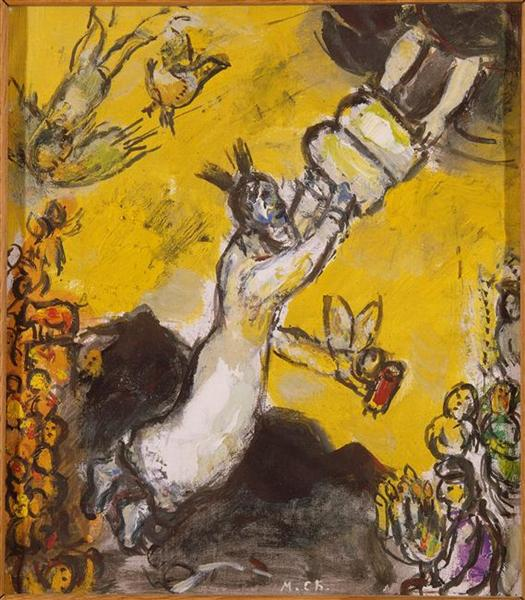
Moses Receives the Law, by Marc Chagall, 1963

“You must not pass along false rumors. You must not cooperate with evil people by lying on the witness stand.

“You must not follow the crowd in doing wrong. When you are called to testify in a dispute, do not be swayed by the crowd to twist justice. And do not slant your testimony in favor of a person just because that person is poor.

“If you come upon your enemy’s ox or donkey that has strayed away, take it back to its owner. If you see that the donkey of someone who hates you has collapsed under its load, do not walk by. Instead, stop and help.

“In a lawsuit, you must not deny justice to the poor.

“Be sure never to charge anyone falsely with evil. Never sentence an innocent or blameless person to death, for I never declare a guilty person to be innocent.

“Take no bribes, for a bribe makes you ignore something that you clearly see. A bribe makes even a righteous person twist the truth.

“You must not oppress foreigners. You know what it’s like to be a foreigner, for you yourselves were once foreigners in the land of Egypt. (New Living Translation)

On Mount Sinai, God gave Moses the Ten Commandments. These laws are basic ethical commands given to the people in their relationship to God and to one another. Following those Ten Words, the next several chapters of Exodus provide detailed instructions and commands for the Israelites in their own social, economic, and cultural context.

Today’s Old Testament lesson is part of this sequence of specific laws for the Israelites. These laws all have to do with being honest in legal matters. There is to be no perversion of justice through perjury, favoritism, bending to dishonest pressure, bribery, and false charges. What’s more, there must be no overlooking of the poor and powerless; and no disregard for the immigrant and foreigner.

All the sequences of commands – covering Exodus chapters 20-25 – are connected back to the basic Ten Commandments. The laws about justice and injustice are the fleshing-out of the ninth command to not testify falsely against your neighbor.

In other words, we are not to lie in public, especially when a person’s life or livelihood is at stake. We are to practice right relations with others; and do justice for all persons without prejudice or favoritism. We do this because God shows no favoritism and judges rightly with proper justice.

He will not judge by what he sees with his eyes,
    or decide by what he hears with his ears;
but with righteousness he will judge the needy,
    with justice he will give decisions for the poor of the earth. (Isaiah 11:3-4, NIV)

The Lord is a just God – it is inherent to the divine character. Therefore, our actions, as people created in the image of God, are to always be just, right, and truthful. There is a special place in God’s heart for the poor and powerless, and so, we ought also to consider their needs and treat them well and with respect – because true religion gives to those who we know cannot pay us back.

This, then, also is why immigrants and foreigners are mentioned. They need proper justice, and not negligence on our part to provide them with what they need. Throughout Holy Scripture we are admonished to not oppress the stranger from another place.

For through him [Christ] we both have access to the Father by one Spirit. Consequently, you are no longer foreigners and strangers, but fellow citizens with God’s people and also members of his household, built on the foundation of the apostles and prophets, with Christ Jesus himself as the chief cornerstone. (Ephesians 2:18-20, NIV)

The Lord watches over the foreigner
    and sustains the fatherless and the widow,
    but he frustrates the ways of the wicked. (Psalm 146:9, NIV)

Jesus picked up on the basic commands of God in his Sermon on the Mount – which, in many ways, is a restatement of the Ten Commandments by getting to the heart of them. Concerning the matter of giving false pledges, he said:

“Again you have heard that it was said to those who lived long ago: Don’t make a false solemn pledge, but you should follow through on what you have pledged to the Lord… Let your yes mean yes, and your no mean no. Anything more than this comes from the evil one. (Matthew 5:33, 37, CEB)

In court, we offer an oath, swearing that we will tell the truth and only the truth – and no lying. This is the only way that injustice can be avoided and justice can be established.

“I swear on a stack of Bibles I won’t…” “I will, if I get around to it….” These are a few of the caveats we give when making a promise or oath. Oaths communicate our truthful intentions of being above board with a high level of integrity.

It’s not okay when we bear false testimony concerning an event or incident that has taken place. There is no excuse for saying something is truthful when you know it isn’t quite true or all true. That makes us liars.

The Lord detests lying lips, but he delights in people who are trustworthy. (Proverbs 12:22, NIV)

Jesus wants us to clarify our values of right and wrong; make wise decisions; identify what we know is truth and error; and follow through on speaking the truth in love.

Any human society cannot stand unless it is committed to justice for all. People everywhere have a universal need for communities and nations which pursue truth, justice, benevolence, and integrity for everyone within their sphere of influence and responsibility.

Almighty God, who created us in your own image: Grant us grace to fearlessly contend against evil; and to make no peace with oppression, so that we may reverently use our freedom. Help us to employ that freedom in the maintenance of justice in our communities and among the nations, to the glory of your holy Name; through Jesus Christ our Lord, who lives and reigns with you and the Holy Spirit, one God, now and forever. Amen.

The Model Prayer (Matthew 6:7-15)

The Lord’s Prayer, by He Qi

And when you pray, do not use vain repetitions as the heathen do. For they think that they will be heard for their many words.

“Therefore do not be like them. For your Father knows the things you have need of before you ask Him. In this manner, therefore, pray:

Our Father in heaven,
Hallowed be Your name.
Your kingdom come.
Your will be done
On earth as it is in heaven.
Give us this day our daily bread.
And forgive us our debts,
As we forgive our debtors.
And do not lead us into temptation,
But deliver us from the evil one.
For Yours is the kingdom and the power and the glory forever. Amen.

“For if you forgive men their trespasses, your heavenly Father will also forgive you. But if you do not forgive men their trespasses, neither will your Father forgive your trespasses. (New King James Version)

God knows what we need before we even ask, which means the Creator of the universe has the divine ear inclined to listen to us. The Lord desires, even longs for us to pray to him.

Since this is God’s daily disposition, Jesus communicated for us a model way of prayer which exemplifies the values of Christ’s Beatitudes and reflects the priorities of God’s kingdom.

The Lord’s Prayer is meant to be prayed often, mindfully, and with flavor.

Jesus gave us six petitions to guide us in our prayers: The first three petitions are priorities of God that set the tone for the next three petitions, which are centered in our problems of living in this fallen world.

Addressing God

Jesus gave us instruction of how to address God: “Our Father in heaven.” All the pronouns in the Lord’s Prayer are plural, not singular. We are to be concerned for both our own individual issues, and for the needs of the community, and of the problems of the world.

“Father” is an endearing and relational word. “In heaven” balances the closeness and nearness of our heavenly Father with his sovereign and transcendent nature. Our God is both near and far – a close friend as well as a holy king. So, we address our prayers with a proper understanding of who God is.

First Petition: “Hallowed be your name.”

“Hallow” comes from the root word for holiness; it is to sanctify and set apart. God is concerned that we know the distinction between the Creator is holy, and so, the creatures are also to be holy. 

As He who called you is holy, you also be holy in all your conduct, because it is written, “Be holy, for I am holy.” (1 Peter 1:15-16, NKJV)

Notice the use of the verb: not hallowed “is” your name, but hallowed, or holy “be” your name. Jesus guides us to pray that God’s name would be shown as holy through us by the way we live. The world sees a holy God when God’s people walk in holiness, reflecting the Lord’s benevolent nature. 

Second Petition: “Your kingdom come.”

We live in a fallen world that has come under the domain of dark forces. The unfolding drama of Holy Scripture is that God is on a mission to restore creation to a benevolent rule.

Jesus is the King, we are the subjects, and God’s realm exists wherever his subjects go.  And where his subjects go, they are to pierce the darkness by embodying the good news that King Jesus has overcome the demonic realm and brought us into God’s kingdom. The prayer and proclamation of this good news is of utmost priority to God.

Third Petition: “Your will be done on earth as it is in heaven.”

God’s ethical will has been revealed to us by Jesus in the Sermon on the Mount; the Beatitudes are the cornerstone of his teaching (Matthew 5-7). God’s will is that Christ’s followers be humble; grieve over sin in the world; act with gentleness instead of prideful condescension; hunger for true righteousness instead of legalistic self-righteousness; show mercy; be pure in heart; pursue peace; and, rejoice when persecuted. All of this results in being salt and light in this dark world. (Matthew 5:3-16)

Jesus spells out God’s will in his sermon. Christ’s followers are to:

  1. reconcile with others instead of hold grudges
  2. deal with lust through accountability instead of making excuses for mental adultery
  3. cherish our spouse instead of taking the easy way out when problems arise in marriage
  4. tell the truth at all times instead of shading it
  5. love, not retaliate when personally hurt or insulted.

If God’s will seems an impossible task, that’s because we need divine resources to live a Christian ethic; we need to pray!

The first three petitions are priorities for God. They are asking the same thing – that the full manifestation of God’s reign on earth be realized. 

Therefore, our prayers are not primarily to receive goods and services from God, but for us to render service to God. These prioritized petitions are a desire to see God honored on earth as God is already honored in heaven.

Fourth Petition: “Give us today our daily bread.”

Our bodies enable us to do God’s will, and so we must be concerned for them. Daily, we must have the basic necessities of life to carry out God’s priorities for the church and the world.

In the ancient world, people were paid at the end of each day. Folks also shopped every day at the marketplace for their food because there was no refrigeration. Whenever there was a flood or a drought, it meant much more than high grocery prices; people faced starvation and death.

They needed to trust God for today, and not worry about tomorrow. Even though contemporary people may not always readily perceive their great dependence on God, we still are in divine hands and need faith.

Fifth Petition: “Forgive our debts, as we also have forgiven our debtors.”

Sin is pictured as a debt. If someone has sinned (trespassed) against us, we must forgive them, thus releasing them from their debt. To forgive does not mean to forget. Rather, we do not hold the debt (the sin) over someone’s head for the rest of their life. 

The person who is forgiven by God is a forgiving person. Our own forgiveness implies that we have done the hard work of repentance through identifying our sin and renouncing it. So, if we fail to forgive, it demonstrates a lack of change on our part. We cannot be forgiven if we spurn God’s freely offered grace. 

Forgiveness is important to Jesus. Thus, we are to squarely face our bitterness. Simply sweeping our hurt under the rug and not extending forgiveness only gives the darkness a foothold into our lives – which is why we are to pray the final petition:

Sixth Petition: “And lead us not into temptation but deliver us from evil.”

Just as we must trust God for our physical necessities, we also must trust God for our spiritual needs – which hinge on the issue of forgiveness – our forgiveness from God through Christ, and the forgiveness we extend to others who have hurt or offended us. 

An unforgiving heart is a major temptation to hate, seek revenge, and retaliate. If we have spent days, weeks, months, years, or even decades harboring an unforgiving spirit through anger, bitterness, and avoidance of facing our past trauma, we have embraced the dark side and need deliverance from evil. 

Freedom comes through acknowledging the offense, receiving grace and forgiveness from God, and passing that same forgiveness and grace to those who hurt us. This is not about whether they deserve it or not; it’s a matter of what I need to do.

Conclusion

The truth sets us free; telling our secrets brings freedom. Apart from naming our shame, we will remain bound and in need of liberation. Tell your secrets to God in the prayer closet, and then tell them to a trusted friend(s). We pray, and we act on what God tells us in prayer.  

The Lord’s Prayer is a model prayer. That means we use the six petitions of Jesus to frame our prayers in our own words, as well as say the words in our favorite translation of the Bible.

Praying this prayer daily shapes our everyday lives, serves as a guide for how to live, and provides discernment in making life’s many decisions. So, let us daily and in every way make use of our Lord’s Prayer.

Our Father in heaven, the One who is both near and far,

May your Name be shown as holy through us, your people.

May others submit to your lordship and become holy, too.

Help us to know your will and to do it.

We need you God, so provide our necessities for today.

Forgive us of our great and many sins, just as we forgive those who have sinned egregiously against us.

Lead us in paths of righteousness, which shoo the devil away.

For you are the Ruler, the Mighty One, forever full of glory and grace. Amen!