Get Rid of Sin (1 Corinthians 6:1-11)

The Apostle Paul at his Desk, by Rembrandt, 1657

When any of you has a grievance against another, do you dare to take it to court before the unrighteous, instead of taking it before the saints? Do you not know that the saints will judge the world? And if the world is to be judged by you, are you incompetent to try trivial cases? Do you not know that we are to judge angels, to say nothing of ordinary matters? If you have ordinary cases, then, do you appoint as judges those who have no standing in the church? I say this to your shame. Can it be that there is no one person wise enough to decide between brothers and sisters? Instead, brothers and sisters go to court against one another, and this before the unbelievers.

In fact, to have lawsuits at all with one another is already a defeat for you. Why not rather be wronged? Why not rather be defrauded? But you yourselves wrong and defraud—and brothers and sisters at that.

Do you not know that wrongdoers will not inherit the kingdom of God? Do not be deceived! The sexually immoral, idolaters, adulterers, male prostitutes, men who engage in illicit sex, thieves, the greedy, drunkards, revilers, swindlers—none of these will inherit the kingdom of God. And this is what some of you used to be. But you were washed, you were sanctified, you were justified in the name of the Lord Jesus Christ and in the Spirit of our God. (New Revised Standard Version)

The one constant which every Church and each Christian will have to deal with until Jesus returns is the ever-present reality of sin

“Sin” isn’t a word that is much used anymore, even among many Christians. This is both good and bad. It’s good in the sense that we have expanded our vocabulary to better understand the concept and reality; and it’s bad because we sometimes label something as different than what it really is.

The Apostle Paul’s letter to the Corinthian Church confronts the presence of sin within the congregation. The reason why the letter is so long is that Paul painstakingly deals with every sin that had taken root in the community.
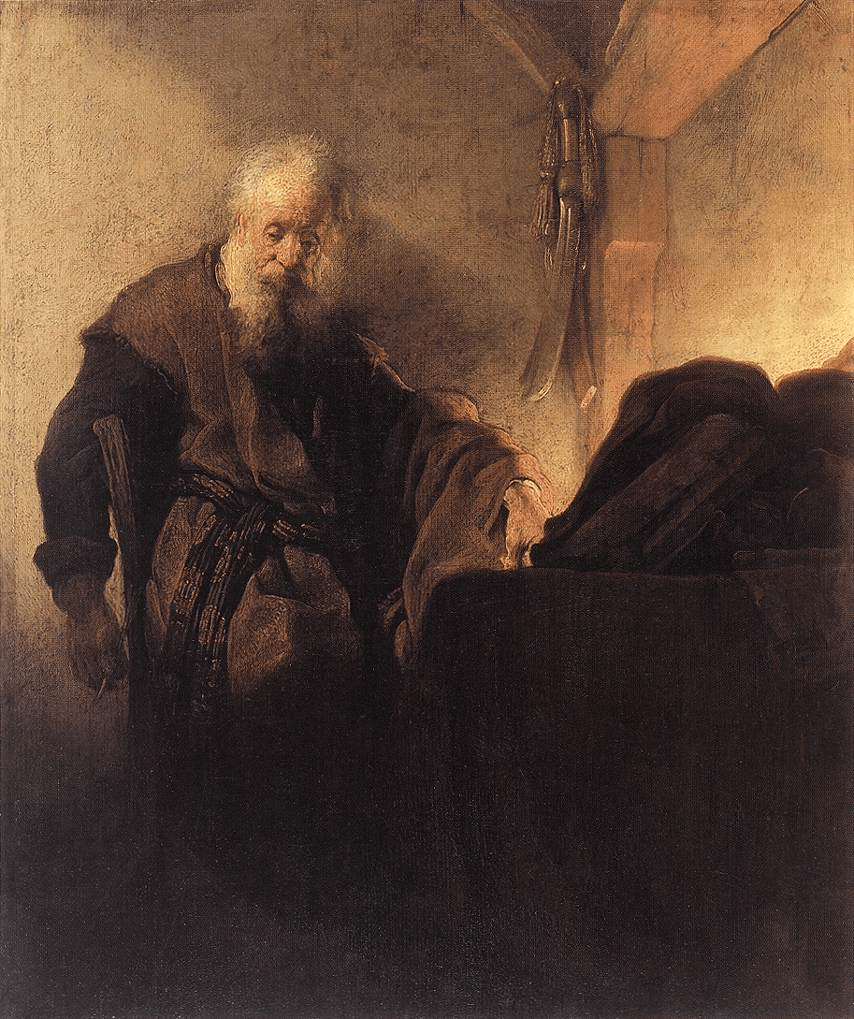
St. Paul at His Writing Desk by Rembrandt, 1630

In our New Testament lesson for today, Paul mentions some of those sins, especially tackling the unhealthy way the Christians were dealing with their internal strained relations of each other. One of the ways sin manifests itself is through confronting another’s sin with our own sin. Yeah, it gets complicated pretty quickly when that happens.

In other words, we too often try to meet a legitimate need through illegitimate means. That sort of practice is at the core of many a sinful attitude and action.

So then, there were those in the Corinthian Church who had legitimate grievances but sought to rectify the situation using secular means to handle a sacred need. Instead of focusing on restoration and relationship, utilizing the spiritual implements of gentleness and humility, they gave into the temptation for retribution through unrighteous persons who would level judgment.

None of this is intended for Christians to avoid the established court systems of the land. Rather, it is a warning not to punch somebody in the face when they slap you on the cheek. Seeking punishment isn’t the way of Christ. Reconciliation and restoration has been achieved through the cross of Christ – and Paul expected the Church to live as a new community based in mutual encouragement and accountability.

Paul clearly saw the shadowy places of the human heart and understood that light needed to come to those hidden areas. And he wasn’t about to sit back and let bitterness spread like gangrene in the Body of Christ.

Sin is both things we do (1 John 3:4), as well as things we leave undone (James 4:17). Sin is both the breaking of God’s commands, and the lack of conforming to the teachings of Jesus. 

Christians throughout the ages have generally understood that the Ten Commandments (Exodus 20:1-17) and Christ’s law of love (Luke 10:27) constitute a brief summary of God’s holy and moral instruction for humanity.  This is all based in the character of God as a holy and loving Being. 

Sin, then, may be defined as anything in a person which does not express, or is contrary to, the basic character of God. All sin, whether in our actions or inactions, is rooted in an attitude and activity of self-centeredness, of thinking about ourselves as the center of the universe, rather than God. 

The Apostle Paul, by Rembrandt, 1633

The consequence of this sin brings about an obsession with lust (1 John 8:34; Galatians 5:16); a broken relationship with God (Romans 3:23; Galatians 5:17); bondage to Satan (1 Timothy 3:6-7; 2 Timothy 2:26); death (Romans 6:23; 8:6); hardening of the heart (Hebrews 3:13); and deception (1 Corinthians 3:18; James 1:22, 26) just to a name a few.

This means that we are guilty of transgressing basic morality; we fail to live into being ethically virtuous people on any sort of consistent basis. Yes, I know this all sounds like a total Debbie-Downer. Well, actually, it’s total depravity. But being depraved doesn’t mean we are never capable of doing good; it just means that sin has profoundly touched everything in our lives, without exception.

The ironic paradox is that experiencing true joy and satisfaction comes through knowing how great our sin is. We live above sin by being set free from it through the grace of God in Jesus Christ. 

In order to be redeemed from sin, a provision must be made – and sin has been dealt with, once and for all, through the person and work of Jesus. Christ is our representative, taking our place with the retribution we deserved (Galatians 4:4-5; Ephesians 2:5-6; Colossians 2:9-15; Hebrews 2:17-18; 1 John 2:1).

Jesus Christ is our ultimate substitute (Romans 5:8); which resulted in our redemption (Galatians 5:13); which resulted in his sacrifice for sin satisfying all justice (Romans 3:25); which resulted in our reconciliation to God (Romans 5:10). 

Therefore the believer in Jesus is forgiven of sin because Christ’s sacrifice is sufficient to deal with all the effects, consequences, and origin of sin. The sin issue has been handled decisively and definitively; the Christian is now complete in Christ (Colossians 2:10).

Sin is awful. It ruins relationships and destroys everything it touches. Sin leaves terrible consequences in its wake and a bad aftertaste. Yet, sin does not have the last word; grace does. 

Christ’s crucifixion and resurrection is the decisive blow to sin’s power. The Church is built on this foundation of grace and reconciliation between God and people. Anything less is neither Christian nor a Church but a country club of people plotting to get back at others while eating tartlets and talking gossip. 

The bad news is that sin is really bad; but the good news is that Christ is really good, and overcomes the worst that sin can throw at him. Thank you, Jesus. Amen.

A Warning about Wealth (James 5:1-6)

Pay attention, you wealthy people! Weep and moan over the miseries coming upon you. Your riches have rotted. Moths have destroyed your clothes. Your gold and silver have rusted, and their rust will be evidence against you. It will eat your flesh like fire. Consider the treasure you have hoarded in the last days. 

Listen! Hear the cries of the wages of your field hands. These are the wages you stole from those who harvested your fields. The cries of the harvesters have reached the ears of the Lord of heavenly forces. You have lived a self-satisfying life on this earth, a life of luxury. You have stuffed your hearts in preparation for the day of slaughter. You have condemned and murdered the righteous one, who doesn’t oppose you. (Common English Bible)

Everyone’s station in life has its own particular temptations.

In the church for which the Apostle James wrote his letter, the rich had completely succumbed to the temptation of using their wealth to build more wealth on the backs of the poor. And the Apostle called them out on it.

Just because you nor I might not be rich in assets and wealth, doesn’t mean today’s New Testament lesson has nothing to do with us. We all inhabit some position of influence or authority, as well as own something, even if it is not much. So, how we use what has been given to us by God is of utmost importance for everyone.

The poor are tempted to envy the rich. And the rich are tempted to trust in their money, resources, and business acumen with no thought to God. Both rich and poor can identify so closely with their respective situations that their primary identity is defined by wealth, or the lack thereof.

Hoarding Wealth

It’s not unusual for a person who appears middle or lower class to have hundreds of thousands of dollars stashed away. I have met more than a few of them in my life. Some people die millionaires, having been penny pinchers their entire lives.

Stockpiling wealth, whether hiding it or flaunting it, without the intention of using it for godly purposes, is tragic. No one is blessed by it. Money is temporary; but relationships are permanent. A wise Christian focuses on storing heavenly treasure and taking an eternal view of their resources.

Don’t hoard treasure down here where it gets eaten by moths and corroded by rust or—worse! —stolen by burglars. Stockpile treasure in heaven, where it’s safe from moth and rust and burglars. It’s obvious, isn’t it? The place where your treasure is, is the place you will most want to be, and end up being. (Matthew 6:19-21, MSG)

Fraudulent Wealth

A person can become addicted to wealth. People can also desire to be wealthy to the degree that they use illegal and dishonest ways of obtaining it and holding on to it.

Withholding wages from workers is a crime, both legally and biblically. In the ancient world, and still in many places around the globe today, workers are paid daily, at the end of the workday. To not receive their pay means their families will go hungry that night.

Don’t take advantage of poor or needy workers, whether they are fellow Israelites or immigrants who live in your land or your cities. Pay them their salary the same day, before the sun sets, because they are poor, and their very life depends on that pay, and so they don’t cry out against you to the Lord. That would make you guilty. (Deuteronomy 24:14-15, CEB)

Self-Indulgent Wealth

The person who lives completely for self is only building wealth in vain, like a hog being fattened for the slaughter. Daydreaming and fantasizing about possessing money for personal indulgence, at the expense of others, will not end well.

Jesus said, “Be careful and guard against all kinds of greed. People do not get life from the many things they own.”

Then Jesus used this story: “There was a rich man who had some land. His land grew a very good crop of food. He thought to himself, ‘What will I do? I have no place to keep all my crops.’

“Then he said, ‘I know what I will do. I will tear down my barns and build bigger barns! I will put all my wheat and good things together in my new barns. Then I can say to myself, I have many good things stored. I have saved enough for many years. Rest, eat, drink, and enjoy life!’

“But God said to that man, ‘Foolish man! Tonight, you will die. So, what about the things you prepared for yourself? Who will get those things now?’ (Luke 12:15-20, ERV)

Murderous Wealth

Whenever the rich and powerful are bent on accumulating and hoarding wealth, they step all over workers to get what they want. And the poor laborers possess neither the ability nor the authority to handle the injustice. They are helpless.

By withholding wages and resources, or purposefully paying a non-living wage, the neglect puts people in poverty. Then, the poor struggle to survive. They may starve, even die, through no fault of their own. And the ones who put them in such a position will have to answer to a higher authority – God. (1 Kings 21)

Stewarding Wealth

The Lord gives us money, resources, even wealth, for us to enjoy and give to others. We are stewards, accountable for the time, assets, and relationships, given us by God in this life. So, then, we must emulate godly models of asset allocation and thoughtful stewardship.

Command those who are rich in this present world not to be arrogant nor to put their hope in wealth, which is so uncertain, but to put their hope in God, who richly provides us with everything for our enjoyment. 

Command them to do good, to be rich in good deeds, and to be generous and willing to share. In this way they will lay up treasure for themselves as a firm foundation for the coming age, so that they may take hold of the life that is truly life. (1 Timothy 6:17-19)

May we all use whatever resources, gifts, abilities, and time we have to bless others and contribute to the common good of all persons. Amen.

Deuteronomy 9:1-5 – A Reality Check

Jordan River by Ilan Szekely, 1944

Listen, Israel! Today you will cross the Jordan River to enter and take possession of nations larger and more powerful than you, along with huge cities with fortifications that reach to the sky. These people are large and tall—they are the Anakim. You know and have heard what people say: “Who can stand up to the Anakim?” Know right now that the Lord your God, who is crossing over before you, is an all-consuming fire! He will wipe them out! He will subdue them before you! Then you will take possession of their land, eliminating them quickly, exactly as the Lord told you.

Once the Lord your God has driven them out before you, don’t think to yourself, It’s because I’m righteous that the Lord brought me in to possess this land. It is instead because of these nations’ wickedness that the Lord is removing them before you. You aren’t entering and taking possession of their land because you are righteous or because your heart is especially virtuous; rather, it is because these nations are wicked—that’s why the Lord your God is removing them before you, and because he wishes to establish the promise he made to your ancestors: to Abraham, Isaac, and Jacob. (Common English Bible)

When my kids were small, I dealt with the issue of sharing, as every parent has to do. Once, two of my girls were fighting over a doll. As I entered the room, one of them quickly said, “She has my doll!” So, I sat her down with me and calmly asked, “Whose doll is it?” “It’s mine!” my daughter cried.

I asked again, “Whose doll is it?” Again, the answer came, “It’s my doll!” I asked yet a third time, “Whose doll is it?” Because this was not our first rodeo together about fighting over dolls and toys, my daughter bowed her head, gave a big sigh, and quietly said, “It’s God’s doll.”

“Yes, it’s God’s doll,” I said. “God is just letting you borrow it for a while and expects you to take good care of it and share his stuff with others.”

Kids often need a reality check of where things come from and who really owns it all. Many times, adults need the very same reality check.

We big people grow up and tend to think we are bigger than we really are. Over the years, we gain misguided notions of our possessions and accomplishments. We believe we did it all through our own skills and character.

Maybe you recognize some of these common notions about our life, work, and ministry:

  • “I worked a long time for my money. I’m not giving it to so-and-so.”
  • My church has a lot of people because we preach the Bible, not like other churches.”
  • “The government takes too much of my hard earned money.”
  • “Here, you can have this couch. I was going to throw it away, anyway. My couch is a nice new one.”
  • “I made a lot of sacrifices for my job. I’m not letting anyone steal my position from me.”
  • “I raised my kids and they’re all doing very well in life. They wouldn’t have made it without me.”
  • “Hey, that’s my yard. Your dog can’t be on it.”
  • “This is my time.”
  • “It’s my car. Don’t touch it.”
  • My way or the highway.”

Those are actual statements Christians have said to me over the years. In their extreme individualism, they believed they were the masters of their own goodness and achievements. In other words, they gave themselves more credit than they really deserved.

A person is proud and selfish not for pursuing their own good but for neglecting their neighbor’s.

It’s far too easy to chalk-up our positions, titles, degrees, jobs, and the good things which come with them as of our own doing. We then believe we are the true owners of all our stuff. Some can even take the next step of believing that if others would just do what I do and think the way I think, then all would be well in the world.

That’s pretty much how Lucifer thought about things. And even after getting cast from heaven, he still exists with the delusion that he didn’t deserve it, as if he were above ever getting treated any other way than like God does.

The reality, however, is that everything and everyone belongs to God. The Lord is the rightful ruler of the universe, and we are not. Every good and perfect thing we have in this life is a gift from a gracious heavenly Father.

Stupidity doesn’t come from a lack of brains or smarts; it’s a result of pride taking over one’s thinking.

Indifference doesn’t have its source in a lack of caring; it comes from believing certain people don’t deserve to have my attention, my stuff, or my time.

Arrogance isn’t an inbred personality trait; it’s the logical end of the successful person’s life who is convinced that everyone ought to adopt their particular set of societal mores, cultural values, political views, and personal disciplines.

Conversely, a person in humble circumstances with little to their name is not necessarily lazy or unwilling to work. And when they have giants in their lives, they can trust the God who specializes in taking down the stupid, the indifferent, and the arrogant.

All things are a gift from the Lord, even the difficult people and hard circumstances we face. They are really opportunities for God to show up and give us precisely what we need.

Everything is a trust from God that we are to steward well, whether it is people, things, or money. They are given to us, not because of any superior spirituality on our part or righteous ingenuity, but because God simply gives it. We have what we have because of God, period.

The appropriate way of stewarding our resources, as well as expressing thanks to God, is through sharing our stuff, our money, our time, and our love with others.

Whose life is it?

We do not presume to come to your Table, O merciful Lord, trusting in our own righteousness, but in your abundant and great mercies. We are not worthy so much as to gather up the crumbs under your table; but you are the same Lord whose character is always to have mercy. Grant us, therefore, gracious Lord, so to eat and drink that our sinful bodies may be made clean by his body, and our souls washed through his most precious blood, and that we may evermore dwell in him, and he in us. Amen.

Amos 6:1-8 – Against Complacency

Woe to you who think you live on easy street in Zion,
    who think Mount Samaria is the good life.
You assume you’re at the top of the heap,
    voted the number-one best place to live.
Well, wake up and look around. Get off your pedestal.
    Take a look at Calneh.
Go and visit Great Hamath.
    Look in on Gath of the Philistines.
Doesn’t that take you off your high horse?
    Compared to them, you’re not much, are you?

Woe to you who are rushing headlong to disaster!
    Catastrophe is just around the corner!
Woe to those who live in luxury
    and expect everyone else to serve them!
Woe to those who live only for today,
    indifferent to the fate of others!
Woe to the playboys, the playgirls,
    who think life is a party held just for them!
Woe to those addicted to feeling good—life without pain!
    those obsessed with looking good—life without wrinkles!
They could not care less
    about their country going to ruin.

But here’s what’s really coming:
    a forced march into exile.
They’ll leave the country whining,
    a rag-tag bunch of good-for-nothings.

God, the Master, has sworn, and solemnly stands by his Word.
    The God-of-the-Angel-Armies speaks:

“I hate the arrogance of Jacob.
    I have nothing but contempt for his forts.
I’m about to hand over the city
    and everyone in it.” (The Message)

A fool is one who either cannot or will not see that their personal actions have communal ramifications. Arrogant people are shortsighted, and when there is no immediate consequence to their selfish actions, they quickly assume everything is okay.

Perhaps we are fools – not so much because of any heinous sins – but because of our great indifference toward the mass of humanity across the world, as well as the neighbor across the street.

If there is any foolishness with the Christian, I submit to you that it could likely be because we believers have abjectly avoided the Old Testament minor prophets as some anachronistic judgment of the past which has little to do with living in today’s New Testament grace.

It is high time that Christians, especially Western Christians, take the entirety of their Bibles seriously through a hard examination of the prophet Amos.

“Morally, there is no limit to the concern one must feel for the suffering of human beings. Indifference to evil is worse than evil itself; in a free society, some are guilty, but all are responsible.”

Abraham Joshua Heschel

Those with power and privilege nearly always believe that what is good for themselves is good for everybody else. In their pride, they either cannot or will not look under the ghost of Christmas Present’s robe. The boy Ignorance, and the girl Want, are out-of-sight, out-of-mind, for the foolish person of indifference.

The issue is not one of actually possessing wealth and influence. After all, the Lord God is wealthy and influential beyond anything we can imagine. The real issue is how we have obtained such things and whether we seek to use them for the common good of all people, and not just for myself or people just like me.

It will not do to be a simpleton and toss out flippant phrases such as, “If they want money they can get a job,” “They’re just lazy and unmotivated,” “The government takes plenty from me for those people,” “They could be self-sufficient if they really wanted to,” “They should be happy that I give them a [minimum wage] job,” “The poor are uneducated…addicts…drug seekers…unreliable…” And on the blustering goes, ad infinitum, ad nauseum.

Those, and many more statements like them, are nothing more than mere projections of the privileged few upon the masses. Truth is that addiction, debt, ingratitude, and laziness are marks of the rich and powerful in the same way you can find them anywhere. What’s more, projecting and deflecting are endemic of the mind that either cannot or will not engage in critical thinking and avoid logical fallacies.

Such persons are unaware that their luxurious eating and drinking in the dining room of the Titanic will suddenly be their last meal. Their complacency is their ruin.

Many of us tend to see the sins of others rather than our own sins. So, reading Amos, we may reflexively think of “those people’s sins, back then,” or, the sins of “other people.” Yet, as Jesus suggests in the Sermon on the Mount, when we interpret the law, we should first examine the logs in our own eyes, rather than starting with the slivers in our neighbor’s eye. (Matthew 7:3-5)

The place to begin with giving Amos an honest hearing, is to look inwardly at our own shadow selves. The lack of self-awareness is the beginning of all callousness, complacency, and conceit.

“Unfortunately, there can be no doubt that man is, on the whole, less good than he imagines himself or wants to be. Everyone carries a shadow, and the less it is embodied in the individual’s conscious life, the blacker and denser it is. If an inferiority is conscious, one always has a chance to correct it.”

Carl Jung

There are two practices which can help illumine our inner person, thus opening the way to greater compassion for others:

  1. Listen to your self-talk. What’s going on in your mind? Is it a series of negative thoughts that make you feel like crud? Or do you also consider gratitude and positive thoughts? Take a couple of minutes each day to sit in silence and listen to the tone of your inner voice. It might even help to write down your thoughts so that you can get a better idea of what they are truly like. If we cannot listen to ourselves, we won’t be able to listen to the voice of others – which means we’ll never really understand other people.
  2. Pay attention to your feelings. Emotions are barometers of how we are truly doing, as well as flags which signal what we are supposed to be paying attention to.For example, a warm feeling in your face might mean you’re embarrassed; ‘butterflies’ in your stomach can mean you’re nervous; or clenching your teeth might mean you’re angry. Stuffing emotions or trying to avoid them will inevitably lead to hardness of heart.

I suggest focusing on these two practices while you are reading the prophet Amos. That’s because reading the prophets never leaves us the same. They evoke lots of self-talk and plenty of emotion. This is the path to better understanding the prophet’s message.

God of the prophets, and of all living things: We are all hungry in a world full of abundance. Give us the grace and awareness to see the abundance of our world and to acknowledge our sins of greed and fear. Give us openness of soul and courageous, willing hearts to be with our sisters and brothers who are in need. We ask for your intervention on behalf of every person hungry for earthly food and hungry for the taste of the Spirit of God.

We give thanks that we can be part of your compassion for all people. This world is blessed with enough food for every person to eat and be satisfied. And we can all feed on the bread of Christ, as God makes a home in our hearts. We are in awe and wonder your great love for us, that we are invited and urged to participate with you in the care of our brothers and sisters. In the name of the Father, Son, and Spirit, one God, now and forever. Amen.