Work, Love, and Dignity (Proverbs 27:1-27)

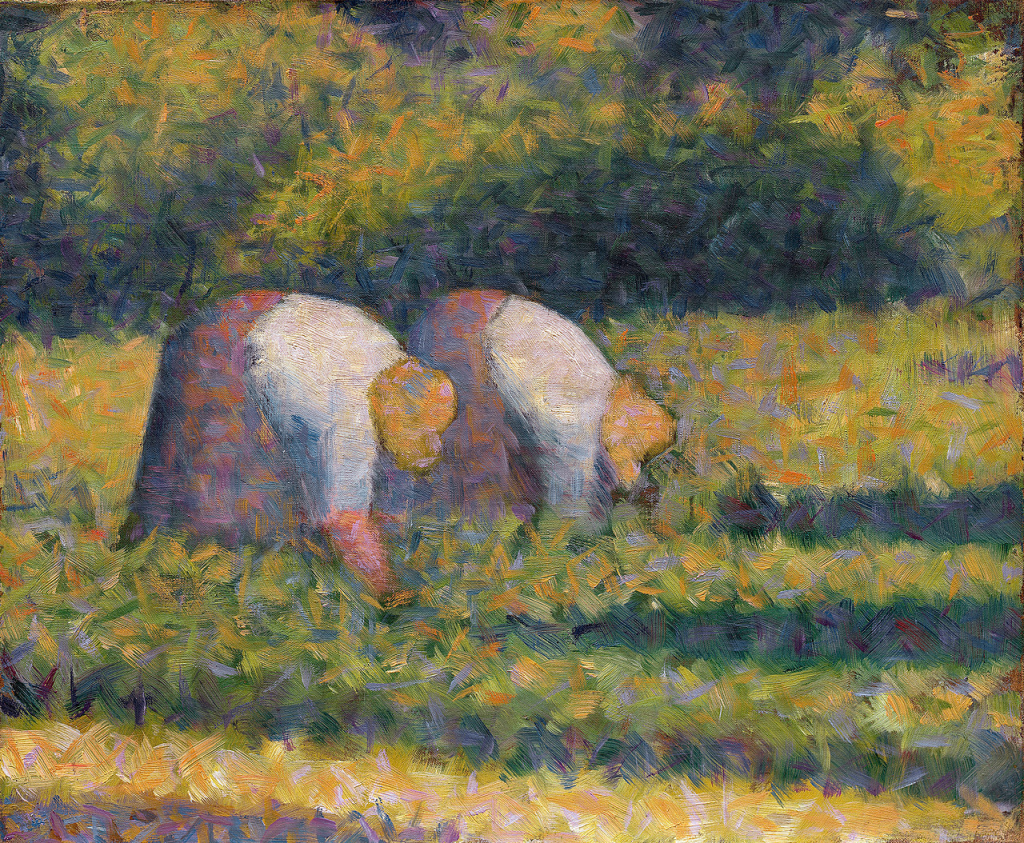
Farm Women at Work, by Georges Seurat (1859-1891)

Do not boast about tomorrow,
    for you do not know what a day may bring.

Let someone else praise you, and not your own mouth;
    an outsider, and not your own lips.

Stone is heavy and sand a burden,
    but a fool’s provocation is heavier than both.

Anger is cruel and fury overwhelming,
    but who can stand before jealousy?

Better is open rebuke
    than hidden love.

Wounds from a friend can be trusted,
    but an enemy multiplies kisses.

One who is full loathes honey from the comb,
    but to the hungry even what is bitter tastes sweet.

Like a bird that flees its nest
    is anyone who flees from home.

Perfume and incense bring joy to the heart,
    and the pleasantness of a friend
    springs from their heartfelt advice.

Do not forsake your friend or a friend of your family,
    and do not go to your relative’s house when disaster strikes you—
    better a neighbor nearby than a relative far away.

Be wise, my son, and bring joy to my heart;
    then I can answer anyone who treats me with contempt.

The prudent see danger and take refuge,
    but the simple keep going and pay the penalty.

Take the garment of one who puts up security for a stranger;
    hold it in pledge if it is done for an outsider.

If anyone loudly blesses their neighbor early in the morning,
    it will be taken as a curse.

A quarrelsome wife is like the dripping
    of a leaky roof in a rainstorm;
restraining her is like restraining the wind
    or grasping oil with the hand.

As iron sharpens iron,
    so one person sharpens another.

The one who guards a fig tree will eat its fruit,
    and whoever protects their master will be honored.

As water reflects the face,
    so one’s life reflects the heart.

Death and Destruction are never satisfied,
    and neither are human eyes.

The crucible for silver and the furnace for gold,
    but people are tested by their praise.

Though you grind a fool in a mortar,
    grinding them like grain with a pestle,
    you will not remove their folly from them.

Be sure you know the condition of your flocks,
    give careful attention to your herds;
for riches do not endure forever,
    and a crown is not secure for all generations.
When the hay is removed and new growth appears
    and the grass from the hills is gathered in,
the lambs will provide you with clothing,
    and the goats with the price of a field.
You will have plenty of goats’ milk to feed your family
    and to nourish your female servants. (New International Version)

Hard Work

The Lord God took the man and put him in the Garden of Eden to work it and take care of it. (Genesis 2:15, NIV)

Work itself is not a result of humanity’s fall. Before Adam and Eve disobeyed God, they were tasked to work and take care of the Garden of Eden. Therefore, work is inherently good. Yet, hard labor is certainly a result of the fall.

What we humans ought to have done through our created nature, now because of the fall into sin and disobedience, we have to work with focused deliberate intention. And even then, we often don’t perform our work as we would like.

“Cursed is the ground because of you;
    through painful toil you will eat food from it
    all the days of your life.
It will produce thorns and thistles for you,
    and you will eat the plants of the field.
By the sweat of your brow
    you will eat your food
until you return to the ground,
    since from it you were taken;
for dust you are
    and to dust you will return.” (Genesis 3:17-19, NIV)

This is why wise persons throughout the ages have given priority to hard work, and branded laziness as detrimental to our human welfare.

Much of our labor is menial and mundane, no matter what the work is. Yet, through vision and persistence, the fruit of our labor eventually breaks through. It is important for us to keep our nose to the grindstone, namely, because this is what it takes to produce, and to keep ourselves out of trouble!

Like a shepherd who cares for the sheep, we are to be present, pay attention, do whatever it takes to help the sheep flourish, and hang in there through the thick and thin of the job.

Diligence and consistency are vital to our hard work. The temptation of get-rich-quick schemes and other supposedly easy paths to success and wealth sometimes rear their heads to lure us away from our daily chores.

Well-kept sheep will produce wool and milk for several years. Riches and achievements and accolades, however, do not necessarily last for long.

Affectionate Love

Hard work and relationships nurtured by affectionate love are meant to go hand-in-hand. In other words, ideally, the duty and diligence of our daily tasks, and the consistency of establishing relational well-being with others, is well-balanced and works seamlessly together.

Loving another entails both encouragement and correction, heartfelt words as well as open words of rebuke. That is, we continually think of what another needs, and what is best for the community as a whole.

Our love must entail what is good for the one being loved, for the one doing the loving, and for the whole community to which both belong. Love leaves angry speeches and jealous motives behind and doesn’t utilize them, because they are tools of hate and hurt.

Gracious Dignity

Everyone is responsible to extend basic human kindness to one another, without exception. We are to listen to and honor our parents and elders; practice self-control and patience with all; and use gentle words in every communication.

Poise under pressure, and motivation to do what is right and good helps to lift the worth and dignity of others. We extend this to people for no other reason than that it is another human being who is in front of us; this is a person in God’s image.

God created mankind in his own image,
    in the image of God he created them;
    male and female he created them. (Genesis 1:27, NIV)

All persons have inherent worth as image-bearers of God. The wise person amongst us knows this and continually applies it in all their words and actions toward others.

Wise people also understand the value of hard work, and the intrinsic worth of work itself. Furthermore, they discern that love is to be the motivation and animating principle in doing work and working with others.

The bottom line of all the proverbial wise saying in today’s lesson is that we are to help and encourage others through both our words and our working actions. Our individual lives are to benefit the whole community, so that we are a blessing to others, as well as to receive blessings from those around us.

In engaging a healthy rhythm of giving and receiving, we reverse the curse, and enable the world to return to Eden.

Almighty God, we pray that You will bless all of our various labor and work in the world. Help us to pray fervently, diligently work hard, and give liberally. In all that we do, enable us to do it with all the love You provide. Amen.

Anxious (Genesis 32:3-21)

Jacob praying for deliverance from his brother Esau, by Gustave Doré (1832-1883)

Jacob sent messengers on ahead to Esau, who lived in the land of Seir, also known as Edom. Jacob told them to say to Esau, “Master, I am your servant! I have lived with Laban all this time, and now I own cattle, donkeys, and sheep, as well as many slaves. Master, I am sending these messengers in the hope that you will be kind to me.”

When the messengers returned, they told Jacob, “We went to your brother Esau, and now he is heading this way with 400 men.”

Jacob was so frightened that he divided his people, sheep, cattle, and camels into two groups. He thought, “If Esau attacks one group, perhaps the other can escape.”

Then Jacob prayed:

You, Lord, are the God who was worshiped by my grandfather Abraham and by my father Isaac. You told me to return home to my family, and you promised to be with me and make me successful. I don’t deserve all the good things you have done for me, your servant. When I first crossed the Jordan, I had only my walking stick, but now I have two large groups of people and animals. Please rescue me from my brother. I am afraid he will come and attack not only me, but my wives and children as well. But you have promised that I would be a success and that someday it will be as hard to count my descendants as it is to count the grains of sand along the seashore.

After Jacob had spent the night there, he chose some animals as gifts for Esau: 200 female goats and 20 males, 200 female sheep and 20 males, 30 female camels with their young, 40 cows and 10 bulls, and 20 female donkeys and 10 males.

Jacob put servants in charge of each herd and told them, “Go ahead of me and keep a space between each herd.” Then he said to the servant in charge of the first herd, “When Esau meets you, he will ask whose servant you are. He will want to know where you are going and who owns those animals in front of you. So tell him, ‘They belong to your servant Jacob, who is coming this way. He is sending them as a gift to his master Esau.’ ”

Jacob also told the men in charge of the second and third herds and those who followed to say the same thing when they met Esau. And Jacob told them to be sure to say that he was right behind them. Jacob hoped the gifts would make Esau friendly, so Esau would be glad to see him when they met. Jacob’s men took the gifts on ahead of him, but he spent the night in camp. (Contemporary English Version)

Anxiety’s a booger. It arises as an unwanted guest within our psyche, putting pressure on our chest, and becoming a squatter in the pit of our gut. To be anxious is to have a vague sense of dread, anticipating some upcoming threat.

Jacob knew the feeling well. His mind raced with thoughts of what might happen and how to placate Esau when he encountered his brother. Jacob left home two decades earlier to escape Esau’s vengeance. Now their meeting up was imminent. Jacob was scared spitless.

What do you do when distress and dread wrap you in a straitjacket of anxiety?

Avoid avoidance

The only way to deal with fear is to face it. Avoiding it prevents us from moving forward. It makes us anxious.  One way of facing your fear and/or anxiety is to name it. When fear, anxiety, terror, apprehension, or distress arises, then name it. In naming our fears and anxieties, they become real and, thus, manageable. 

“Every time your fear is invited up, every time you recognize it and smile at it, your fear will lose some of its strength.”

Thict Nhat Hanh (1926-2022)

Another way to face fear is to “sit with it” for a short while. Give yourself permission to feel the anxiety for a set amount of time without judgment or trying to get over it. Pay attention to where you are carrying your anxiety in your body.

Focus on what’s within your control

We cannot control other people. There’s no way Jacob was going to control or manipulate his brother Esau. Many circumstances are outside our control. And yet, we always have the choice of self-control. Giving into addictions, or not facing problems are ways of giving up control of ourselves. Taking good care of ourselves, and focusing on good attitudes are ways of strengthening personal control.

The Serenity Prayer is a good reminder in those times when we feel out of control:

God, grant me the serenity to accept the things I cannot change,

The courage to change the things I can,

And the wisdom to know the difference.

Promote a positive mindset

Positive attitudes help us widen our perspective on things – and with a broader view of things comes more awareness of choices. Making wise choices for ourselves now, builds resilience and fortifies us for difficult situations down the road – without succumbing to old unhealthy coping mechanisms.

Find purpose and meaning in life

Experiencing traumatic events might cause us to question whether our lives have meaning, or not. We may feel unnecessary or expendable, and see no meaning for the future. 

So, it’s important to discover or reconnect with the spirituality within you. Take the time and energy to read Scripture, walk through nature, or discuss matters of the spirit with others. Just as our physical spine helps to support us and is not optional, so we also have a spiritual spine that needs attention for which we cannot live without.

Get support

Other people, like trusted friends and family, can help us make a realistic assessment of the fear and anxiety we are experiencing. With the support of others, we become more confident that we can deal with issues. Finding a church or some other religious gathering can be a fresh means of emotional support.

You are not alone. We are all in this life together. So, let’s rely upon one another and not believe that we just need to pull up ourselves out of impending trouble. There is a God (and God’s people) who are ready to help, if but we just ask.

O God, preserve us from faithless fears and worldly anxieties, and grant that no clouds of this mortal life may hide from us the light of that love which is immortal, and which you have manifested to us in your Son, Jesus Christ our Lord. Amen.

Ecclesiastes 3:1-13 – What Time Is It?

There is a right time for everything, and everything on earth will happen at the right time.

There is a time to be born
    and a time to die.
There is a time to plant
    and a time to pull up plants.
There is a time to kill
    and a time to heal.
There is a time to destroy
    and a time to build.
There is a time to cry
    and a time to laugh.
There is a time to be sad
    and a time to dance with joy.
There is a time to throw weapons down
    and a time to pick them up.
There is a time to hug someone
    and a time to stop holding so tightly.
There is a time to look for something
    and a time to consider it lost.
There is a time to keep things
    and a time to throw things away.
There is a time to tear cloth
    and a time to sew it.
There is a time to be silent
    and a time to speak.
There is a time to love
    and a time to hate.
There is a time for war
    and a time for peace.

Do people really gain anything from their hard work? I saw all the hard work God gave us to do. God gave us the ability to think about his world, but we can never completely understand everything he does. And yet, he does everything at just the right time.

I learned that the best thing for people to do is to be happy and enjoy themselves, as long as they live. God wants everyone to eat, drink, and enjoy their work. These are gifts from God. (ERV)

Time is finite. We cannot get it back once we lose it. So, it is important to use our time in ways that reflect our most cherished values and commitments. For that, we need wisdom to know what to do, what not to do, and when to do it.

We can often use our time in strange ways. For example, Rafael Antonio Lozano of Plano, Texas has been on a quest to visit every company-owned Starbucks on the planet. He began his mission in 1997, when there were 1,304 Starbucks stores worldwide. Currently, there are 31,256 stores. As of September 2019, Lozano reported having visited over 15,000 global locations. 

Despite his impressive pace, Lozano is realistic about the nature of his quest, saying, “As long as they keep building Starbucks, I’ll never be finished.” He is also realistic about the importance of his mission. “Every time I reach a Starbucks, I feel like I’ve accomplished something,” he said, “when actually I’ve accomplished nothing.”

The book of Ecclesiastes would say, “There is a time to drink coffee, and a time to stay home.” Certainly, Lozano’s personal mission is extreme. But before we get too hard on Rafael, do we have a personal mission?  Does it reflect the stewardship of time God has given us?  When we get to the end of our lives, will we feel like we have accomplished something only to discover that we have accomplished nothing?

Time is a gift from God, and a temporary commodity to be used for God before the end of time comes.

One of the realities of time is that our lives are full of seasonal rhythms and change over time. These are built into the life God has given us. The book of Ecclesiastes is one that, throughout its contents, explains that nothing we pursue has any permanence to it. We throw ourselves into some work or activity, but what does that activity really do for us in the end?

Time is our master, and we must respect it.

When I was twenty years old, I thought nothing of playing a round of golf in the morning and three sets of tennis in the afternoon, then staying up late at night with friends. If I did that same thing today, I would have a team of doctors attending me in the hospital. We all, at some point, try to defy time and act like we can do the things we once did in the past. Sometimes it takes a lot for us to accept our limitations, whether it is our play or our work. Ecclesiastes teaches us that forces from the outside seem to always dictate what we can do and not do.

Time can be a harsh taskmaster.

The clock relentlessly and inexorably moves forward with the cycles and rhythms of life offering only meaninglessness, as we discover we are prisoners of time. But for the believer, time can be redeemed with godly purpose and meaning, no matter what the season of life is. Because there is time, and all things will someday come to an end – all activity, or the lack of it, will be judged according to how we denied or accepted our limitations due to time. 

Ecclesiastes also offers to us what seems a subversive perspective that is counter-cultural to our society. Whereas many Americans believe that if we work hard and do the right thing we can shape our own lives and our own prosperity, the Teacher of Ecclesiastes insists on submitting and moving with the events, rhythms, and seasons of God.  

Apart from God, time is futile and meaningless. In our denial, it is no wonder so many persons are so unhappy with their lives.

In the seasons of life and experiences we have from birth to death, the conclusion of Ecclesiastes is that everything is out of our control. Too many of us try to exert control over events, people, and circumstances when, in truth, any control we have is an illusion. I call this the “c-clamp syndrome,” trying to clamp down on others to get them to submit to our agenda.

Instead, Holy Scripture directs us to practice self-control – to focus on myself and my own actions:

Moderation is better than muscle, self-control better than political power. (Proverbs 16:32, MSG)

Prepare your minds for action and exercise self-control. Put all your hope in the gracious salvation that will come to you when Jesus Christ is revealed to the world. (1 Peter 1:13, NLT)

The end of everything has come. Therefore, be self-controlled and clearheaded so you can pray. (1 Peter 4:7, CEB)

Do your best to improve your faith. You can do this by adding goodness, understanding, self-control, patience, devotion to God, concern for others, and love. If you keep growing in this way, it will show that what you know about our Lord Jesus Christ has made your lives useful and meaningful. (2 Peter 1:5-7, CEV)

We cannot make time stand still. So, we must focus on how we spend our time now. It is time for us to lay aside lesser pursuits and diligently pursue God. We each must give ourselves to the unforced rhythms of grace and let God redeem the time. What time is it?  It is time to live in harmony with God in all we say and do.

God of all time help us to know ourselves. Teach us to recognize our weaknesses and work to walk in holiness. Let us follow you in all things, submitting to the times you have for us. Thank you for your unending grace and mercy toward us when we need it most. Help us to trust you with our lives through Jesus Christ our Lord in the power of the Holy Spirit. Amen.