Comfort For Those with Troubles (2 Corinthians 1:1-11)

St. Paul, by Rembrandt Harmenszoon van Rijn, 1657

Paul, an apostle of Christ Jesus by the will of God, and Timothy our brother,

To the church of God in Corinth, together with all his holy people throughout Achaia:

Grace and peace to you from God our Father and the Lord Jesus Christ.

Praise be to the God and Father of our Lord Jesus Christ, the Father of compassion and the God of all comfort, who comforts us in all our troubles, so that we can comfort those in any trouble with the comfort we ourselves receive from God. 

For just as we share abundantly in the sufferings of Christ, so also our comfort abounds through Christ. If we are distressed, it is for your comfort and salvation; if we are comforted, it is for your comfort, which produces in you patient endurance of the same sufferings we suffer. And our hope for you is firm because we know that just as you share in our sufferings, so also you share in our comfort.

We do not want you to be uninformed, brothers and sisters, about the troubles we experienced in the province of Asia. We were under great pressure, far beyond our ability to endure, so that we despaired of life itself. Indeed, we felt we had received the sentence of death.

But this happened that we might not rely on ourselves but on God, who raises the dead. He has delivered us from such a deadly peril, and he will deliver us again. On him we have set our hope that he will continue to deliver us, as you help us by your prayers. Then many will give thanks on our behalf for the gracious favor granted us in answer to the prayers of many. (New International Version)

You probably didn’t sign-up for trouble.

Although varying from person to person and from group to group, all of us experience trouble in this world.

The Apostle Paul experienced a lot of trouble throughout his Christian life:

Five times I received from the Jews the forty lashes minus one. 

Three times I was beaten with rods, once I was pelted with stones, three times I was shipwrecked, I spent a night and a day in the open sea, I have been constantly on the move.

I have been in danger from rivers, in danger from bandits, in danger from my fellow Jews, in danger from Gentiles; in danger in the city, in danger in the country, in danger at sea; and in danger from false believers. 

I have labored and toiled and have often gone without sleep; I have known hunger and thirst and have often gone without food; I have been cold and naked. Besides everything else, I face daily the pressure of my concern for all the churches. (2 Corinthians 11:24-28, NIV)

Why didn’t Paul get cynical or jaded by his awful troubles?

What was the secret to Paul’s incredible resilience in the face of such trouble?

How did Paul get through all of that nasty trouble?

Paul, in my opinion, was the consummate Christian. He is the model missionary, mentor, pastor, and caregiver. Yet, it wasn’t his superior giftedness or dogged personality which got him through the tough times.

The Apostle persevered through trouble without succumbing to despondency by receiving help.

Let’s be honest: Most people would rather give than receive – and that is a good thing. Yet, what isn’t a good thing is continual caregiving without yourself receiving care.

We cannot expect to help others without accepting it ourselves. 

The caregiving Christian needs to be vigilant about practicing selfcare and understanding their limitations. One must not pretend to be super-spiritual, with unlimited super-strength and super-compassion, extended to others 24/7 with super-skill. It’s neither realistic, nor smart. 

Caregivers, and not only care recipients, need to accept comfort from both God and others.

“We must accept our vulnerability and limitations in regard to others.  We cannot expect to help others without accepting it ourselves.”

Mother Teresa

The word dominating today’s New Testament lesson is “comfort.” It’s used by Paul ten times in these verses. Comfort involves both speech and action, words and deeds. For comfort to happen, someone comes alongside another and helps them with both loving actions and encouraging words.

We can only give what we have – which means that if we want to continue helping and caring for others, there will need to be continual healthy rhythms of receiving comfort yourself. We provide for others from the largess of grace given to us by the God of abundance.

Sometimes people get stuck in their grief. The troubles have caused such a change and loss that they need help getting out. And the way people get unstuck and resolve their troubles, is through telling their story – which requires someone else to listen. 
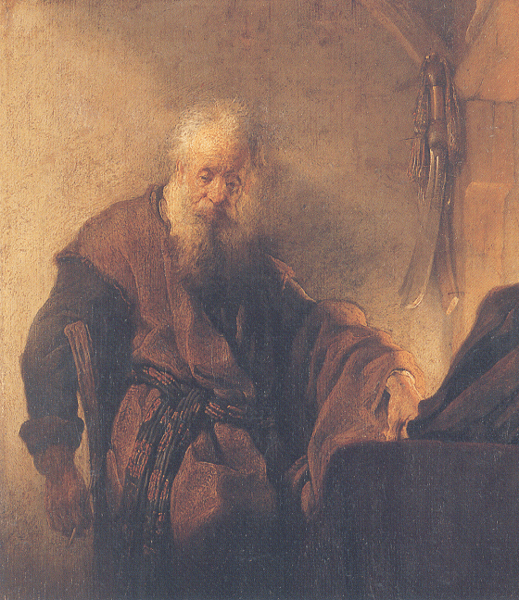
St. Paul, by Rembrandt, 1630

Through my own experience of trouble, as well as helping others through their trouble (and sometimes being a troublemaker!) I have developed a checklist of things to do, to allow, and to keep in mind as a caregiver:

  • Live a balanced life. Live in the tension between caring for others and caring for self – without assigning any judgment, shame, or guilt to any of it.
  • Learn to trust other people. You aren’t the only person on earth who can care for the people you care for. Let them contribute so that you can take have a respite.
  • Make a list of needs and concerns. Do this both for yourself and those you care for. Delete those needs that you personally cannot meet. Of the remaining needs, determine the ones for which you are primarily responsible, then, decide which ones are the most important.
  • Contact your Pastor. That’s what he/she is there for. Reach out. You aren’t in a John Wayne movie or an episode of the Lone Ranger. By the way, you know they’re fictional characters, right?
  • Carry your own backpack. Other people have their own backpacks to carry filled with troubles and responsibilities. Although you can help shoulder their load, taking the weight completely off is Christ’s job, not yours. What’s more, don’t fill your own backpack with rocks that leave you with a crushing weight. Be realistic and confident in what you can and ought to do, as well as what you cannot and should not do.
  • Listen to others. Trusted family members and friends usually see the signs of stress in your life before you do. When they speak up, give them your attention. They know what they’re talking about.
  • Accept help. The fast track to bitterness and burnout is refusing the assistance of others who can give you a break in your constant caregiving.
  • Involve others. There are individuals willing and ready to participate if you would just inform them as to what would be helpful.
  • Talk to a therapist. We all get overwhelmed in particular seasons of life. If caregiving has become a compulsion, then take one hour per week to meet with a good therapist or counselor to talk through things in your life.
  • Delegate. Delegate. Delegate. Then, delegate some more.
  • Recharge your soul. Find personal time for yourself daily. Engage in things that feed your spirit and energize your inner person.
  • Don’t waste your time and energy. Some people aren’t going to understand what you’re doing and why you’re doing it; and they don’t really want to understand. And it is not our job to make them understand.
  • Don’t manipulate others. A common temptation is to try and force family, friends, and faith communities to do what we want them to do, whenever we are heavy into ministry. Instead, focus on your own responsibilities and don’t worry about everybody else’s.

God always has a listening ear. The Lord knows grief better than all of us. Jesus understands trouble. In Christ, hope is kindled, care is received, and comfort abounds.

May you, by faith, enter into abundant life – despite the circumstances – so that your overwhelming trouble is transformed into overflowing comfort. Amen.


Psalm 104:1-9, 24, 35b – God Is Bigger Than Our Fears

Psalm 104:3 by J. Michael Orr

I praise you, Lord God,
    with all my heart.
You are glorious and majestic,
dressed in royal robes
    and surrounded by light.
You spread out the sky
    like a tent,
    and you built your home
    over the mighty ocean.
The clouds are your chariot
    with the wind as its wings.
The winds are your messengers,
    and flames of fire
    are your servants.

You built foundations
for the earth,
    and it
    will never be shaken.
You covered the earth
with the ocean
    that rose
    above the mountains.
Then your voice thundered!
And the water flowed
    down the mountains
    and through the valleys
    to the place you prepared.
Now you have set boundaries,
    so that the water will never
    flood the earth again….

Our Lord, by your wisdom
    you made so many things;
    the whole earth is covered
    with your living creatures….
With all my heart
I praise you, Lord!
    I praise you! (Contemporary English Version)

The world is a gift from God.

When God created the heavens and the earth, Adam and Eve, the first humans, were the apex of God’s creative activity. Their charge, as people created in the image of God, was to steward the earth. And that mandate is still in effect. We are to take good care of this creation we inhabit.

However, due to the fall of humanity, there has always been a bent toward exploiting the earth for our own purposes, rather than carefully maintaining it. Wherever we see abuse of both land and lives, behind it is the fear of not having enough and not being safe enough. Our anxiety gets the best of us.

It seems to me that creation care must begin with ourselves. The lack of self-care inevitably works itself out by neither caring for other creatures nor creation. We need to acknowledge our fears and address them. Then, place those fears in the shining light of our Creator’s glory.

My kids grew up in the ‘90s watching Veggie Tales. The tunes were catchy and full of some solid truth about God. One of their favorites was “God is Bigger.” Here is the chorus:

God is bigger than the boogie man.
He’s bigger than Godzilla or the monsters on TV.
Oh, God is bigger than the boogie man,
And he’s watching out for you and me.

Today’s Psalm expresses the bigness of God – clothed with splendor and majesty, covered with light as with a garment, stretching out the heavens like a tent. Indeed, God is big – bigger than anything and everything. The Lord is sovereign and supreme over all creation, and always does what is right, just, and fair. God sees all and watches over the earth.

Sometimes we get lost in our situations, problems, and screw-ups. We get stuck in our anxiety and fears. We view them as larger than life and can become so overwhelmed and burdened with our inabilities, weaknesses, and lack of handling things well, that we lose sight of the reality that God is bigger than it all. 

Instead of fear and anxiety ruling the day, we can allow sound theology to purge the worry and trouble from our minds and hearts. Using today’s psalm to pray and praise God is a foundational way of beginning to put into perspective the issues and problems of our lives.

Confident living, and mitigating our fears, cannot simply be mentally or emotionally stirred up. Confidence needs a foundation, a basis in truth and reality. The believer’s assurance comes from the firm ground of God’s character and competence. Trust is born when we have a vision of a Divine Being, large and filling the universe with grace and justice.

Tending to our physical, mental, emotional, and spiritual health begins with a sense of divine largeness. Initiative and assertiveness can be freely exercised when we are secure and non-anxious because of God’s immense presence.

Caring for creation, and enjoying our great big world, is the logical action of being peacefully connected to the Creator of it all. We are all bound together as creatures and creation. We’re all made up of the same stuff.

Everything in the universe, including creatures and creation, share 97% percent of the same kind of atoms.

The crucial elements for life on Earth – carbon, hydrogen, nitrogen, oxygen, phosphorus and sulfur – are all found in abundance across the stars of our galaxy.

Our differences make us unique. Our similarities connect us. And we are inextricably connected to every atom in this universe. Just as we carry the DNA of our ancestors within our biological bodies, so we are all holding the same elements of the physical creation.

The ultimate connection, from a Christian perspective, is that Jesus holds it all together – thus making him the supreme Connector.

The Son is the image of the invisible God,
        the one who is first over all creation,

Because all things were created by him:
        both in the heavens and on the earth,
        the things that are visible and the things that are invisible.
            Whether they are thrones or powers,
            or rulers or authorities,
        all things were created through him and for him.

He existed before all things,
        and all things are held together in him.

He is the head of the body, the church,
who is the beginning,
        the one who is firstborn from among the dead
        so that he might occupy the first place in everything. (Colossians 1:15-18, CEB)

Christ is our connection to all things, reconciling us to our fellow creatures, creation, and the Creator. All the bigness of God lives in Jesus. In the face of the Lord, all fears melt away.

Almighty God, you are mighty big! My problems are really small as I glimpse your sheer immensity. Lord God, you are very great! I bless your holy name. Praise the Lord! Hallelujah, Amen.

Revelation 7:9-17 – Persevering to the End

After this I looked, and there was a great crowd that no one could number. They were from every nation, tribe, people, and language. They were standing before the throne and before the Lamb. They wore white robes and held palm branches in their hands. They cried out with a loud voice:

“Victory belongs to our God
        who sits on the throne,
            and to the Lamb.”

All the angels stood in a circle around the throne, and around the elders and the four living creatures. They fell facedown before the throne and worshipped God, saying,

“Amen! Blessing and glory
        and wisdom and thanksgiving
        and honor and power and might
            be to our God forever and always. Amen.”

Then one of the elders said to me, “Who are these people wearing white robes, and where did they come from?”

I said to him, “Sir, you know.”

Then he said to me, “These people have come out of great hardship. They have washed their robes and made them white in the Lamb’s blood. This is the reason they are before God’s throne. They worship him day and night in his temple, and the one seated on the throne will shelter them. They won’t hunger or thirst anymore. No sun or scorching heat will beat down on them because the Lamb who is in the midst of the throne will shepherd them. He will lead them to the springs of life-giving water, and God will wipe away every tear from their eyes.” (Common English Bible)

There is a day coming when followers of Jesus will see him face to face. Believers will serve the Lord continually. God’s very presence will be their permanent shelter. It will be a glorious time of unending peace, harmony, and rest.

There shall be no more worrying about how to make ends meet, where we are going to get our needs met, and anxiety about the future. Injustice will be a thing of the past. Unending love and light will replace it.

First, however, before this permanent Sabbath, there will be trouble, hardship, trial, and even martyrdom. There is presently pain and suffering. Like a woman in labor, this must take place before there is the glory of new life. 

“A hero is an ordinary individual who finds the strength to persevere and endure in spite of overwhelming obstacles.”

Christopher Reeve

Sometimes the difficult circumstances of life seem to have no end. Yet, they will eventually pass, and we must continually keep this in mind. Christians have the hope of God’s pastoral presence forever guarding and keeping our lives if we endure to the end.

Perseverance, endurance, and pushing through hard situations are necessary to realize the finish line. We cannot just sit here on earth in some sort of holding pattern waiting for the end to occur. Just as an athlete must go into strict training in order to run the race well, finish strong, and cross the line, so we as Christians are to be in training – utilizing an array of spiritual practices that will fortify our souls to keep going and finish the race. 

The book of Revelation was a vision of the Apostle John given to believers in hardship who needed to persevere. Giving them a glimpse of the glorious ending was one way of helping them in the present to live for Jesus Christ, despite the pain.

Since the Christian life is not a sprint but a marathon, here are some ways we can build a enduring and persevering spirit until Christ returns:

Don’t be afraid to fail.

That’s because, for the believer, we know the ending. We may feel like colossal failures, at times, yet, because the Lord is with us, we have nothing to fear. Being secure in our identity as God’s people enables us to step out and engage the world.

When I am afraid,
    I put my trust in you.
I trust God, so I am not afraid of what people can do to me!
    I praise God for his promise to me. (Psalm 56:3-4, ERV)

Take small steps of faith.

We can incrementally improve ourselves daily through our growth in grace. We don’t need to always do big things for God. We can do small acts of kindness with big love.

Continue to grow in the grace and knowledge of our Lord and Savior Jesus Christ. To him be the glory, now and forever! Amen. (2 Peter 3:18, GNT)

Love the Lord your God with all your heart, all your soul, all your mind, and all your strength.’The second most important command is this: ‘Love your neighbor the same as you love yourself.’ These two commands are the most important. (Mark 12:30-31, ERV)

Identify the resistance.

Name the obstacles, impediments, and challenges to perseverance. Our awareness of what hinders us gives us the power to choose how to handle it.

We should remove from our lives anything that would slow us down and the sin that so often makes us fall. We must never stop looking to Jesus. He is the leader of our faith, and he is the one who makes our faith complete. (Hebrews 12:1-2, ERV)

Practice good self-care.

The body, mind, emotions, and spirit are our vehicles to doing the will of God. So, it is imperative we steward these precious gifts of humanity with care. The only way we will make it over the long haul of our lives is through paying attention to this.

God has made us what we are. In Christ Jesus, God made us new people so that we would spend our lives doing the good things he had already planned for us to do. (Ephesians 2:10, ERV)

Surely you know that you are God’s temple and that God’s Spirit lives in you! (1 Corinthians 3:16, GNT)

Know why you are persevering.

Losing connection with why we do what we do leads to dropping out and giving up. Yet, when we can maintain what is most important to us, it helps us push through all the sticky points of our lives.

So, if you eat, or if you drink, or if you do anything, do it for the glory of God. (1 Corinthians 10:31, ERV)

Whatever you do, whether in speech or action, do it all in the name of the Lord Jesus and give thanks to God the Father through him. (Colossians 3:17, CEB)

Patient God, you tediously work until your plans and purposes are accomplished.  As you are slowly bringing your kingdom to the world, strengthen me so that I do not give up.  Help me to persevere, living and loving like Jesus, to his glory.  Amen.