The Second Woe Upon the Earth (Revelation 9:13-21)

The sixth angel sounded his trumpet, and I heard a voice coming from the four horns of the golden altar that is before God. It said to the sixth angel who had the trumpet, “Release the four angels who are bound at the great river Euphrates.” And the four angels who had been kept ready for this very hour and day and month and year were released to kill a third of mankind. The number of the mounted troops was twice ten thousand times ten thousand. I heard their number.

The horses and riders I saw in my vision looked like this: Their breastplates were fiery red, dark blue, and yellow as sulfur. The heads of the horses resembled the heads of lions, and out of their mouths came fire, smoke and sulfur. A third of mankind was killed by the three plagues of fire, smoke and sulfur that came out of their mouths. The power of the horses was in their mouths and in their tails; for their tails were like snakes, having heads with which they inflict injury.

The rest of mankind who were not killed by these plagues still did not repent of the work of their hands; they did not stop worshiping demons, and idols of gold, silver, bronze, stone and wood—idols that cannot see or hear or walk. Nor did they repent of their murders, their magic arts, their sexual immorality or their thefts. (New International Version)

In an apocalyptic vision of God’s judgment at the end of time, the Apostle John saw seven angels with seven trumpets. Each blast of the horn brought ever increasing levels of destruction upon the earth. The final three trumpets are also described as the three woes. (Revelation 8:2-6, 13)

The Sixth Trumpet (Second Woe)

The sixth angel sounded the sixth trumpet, which was also the second woe pronounced on the world. Four angels are released from their place of restraint. Whereas the invasion of locusts in the fifth trumpet (first woe) came from the pit of hell, the next invasion comes from the east, from the outskirts, that is, outside the Roman Empire.

The terrible angels go out to kill a third of all humanity. They lead a massive destructive force that overwhelms the earth. The incredible army looks something like centaurs, being horse and rider in one. And out of their mouths come fire, smoke, and sulfur. These are three plagues which brings death to a third of humanity.

The Response to the Second Woe’s Invasion

John records the human response to the divine judgment unleashed upon humanity with the four angels and their three plagues. In reality, it’s actually a lack of response; there is no change of heart and no repentant attitude from anyone. The awful devastation does nothing to elicit any sort of self-reflection, public awareness of sin, or reconsideration of ways by those left alive.

The Apostle records that the rest of the people, after going through such a traumatic time, keep up their worship of demons and their idolatry. They continue to murder, carouse, and steal, as if nothing had happened.

What’s more, John’s graphic and disturbing vision – from it’s very beginning – does not record a single person turning away from their evil ways. The surviving inhabitants of the earth act like old Pharaoh in Egypt during the days of Moses and the exodus; their hearts are hard, and they are not about to change.

What It Means For Us

A big question for us as contemporary people, two-thousand years removed from John’s apocalyptic vision is this: Do the judgments contained in the book of Revelation have any relevance for us today?

Some might dismiss all of this as weird historical story that nobody can really understand, so we might just as well put it aside as belonging in the past. Others grew up hearing “fire and brimstone” sermons from Revelation that did nothing for them other than help them decided that they never want to be in a church again and listen to a sinner about how sinful everybody is.

Although I do not condone hellfire preaching that does little more than make people feel bad, I do believe these difficult judgment chapters in the book of Revelation have something to say to us which we would do well to hear.

  • If we dig in and want what we want, without considering anyone else or even God, then we really cannot expect blessing either in this life or the life to come.
  • If and when disaster or destruction happens – and afterwards go on our merry way as if nothing even occurred – then we have come under divine judgment.
  • If we purposely stick our heads in the sand, and intentionally avoid what is happening around us in this world, then it will not go well for us in the end.
  • If we become angry, and nurse the grudge to the point of becoming hateful and unloving, then the hardness of heart will not recognize God’s visitation when it comes.
  • If we hurt and harm others without any remorse, or make excuses for bad behavior when called out on it, then we are no better than the unrepentant mass of humanity in the book of Revelation.

There is coming a time when it will be too late. The Day of the Lord will come. There will be a final judgment. But if you are reading this, there is obviously still time. Spiritual procrastination only leads to destruction. Spiritual attention to the here-and-now leads to life. What will you do “Today?”

Our Father who is in heaven,

uphold the holiness of your name.

Bring in your kingdom

so that your will is done on earth as it’s done in heaven.

Give us the bread we need for today.

Forgive us for the ways we have wronged you,

just as we also forgive those who have wronged us.

And don’t lead us into temptation,

but rescue us from the evil one. Amen.

The Trumpets of Judgment (Revelation 8:6-9:12)

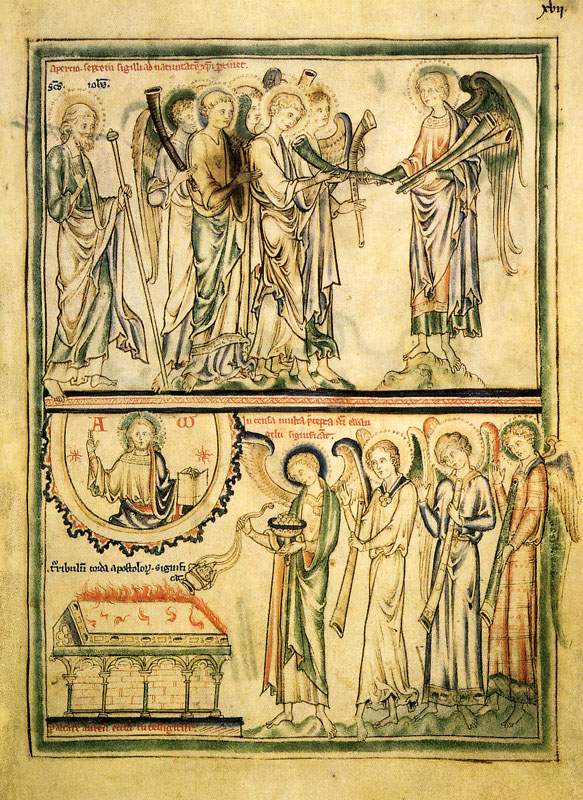
The seven angels with seven trumpets, and the angel with a censer, c. 1020 C. E.

Then the seven angels who had the seven trumpets prepared to sound them.

The first angel sounded his trumpet, and there came hail and fire mixed with blood, and it was hurled down on the earth. A third of the earth was burned up, a third of the trees were burned up, and all the green grass was burned up.

The second angel sounded his trumpet, and something like a huge mountain, all ablaze, was thrown into the sea. A third of the sea turned into blood, a third of the living creatures in the sea died, and a third of the ships were destroyed.

The third angel sounded his trumpet, and a great star, blazing like a torch, fell from the sky on a third of the rivers and on the springs of water—the name of the star is Wormwood. A third of the waters turned bitter, and many people died from the waters that had become bitter.

The fourth angel sounded his trumpet, and a third of the sun was struck, a third of the moon, and a third of the stars, so that a third of them turned dark. A third of the day was without light, and also a third of the night.

As I watched, I heard an eagle that was flying in midair call out in a loud voice: “Woe! Woe! Woe to the inhabitants of the earth, because of the trumpet blasts about to be sounded by the other three angels!”

The fifth angel sounded his trumpet, and I saw a star that had fallen from the sky to the earth. The star was given the key to the shaft of the Abyss. When he opened the Abyss, smoke rose from it like the smoke from a gigantic furnace. The sun and sky were darkened by the smoke from the Abyss. And out of the smoke locusts came down on the earth and were given power like that of scorpions of the earth. 

They were told not to harm the grass of the earth or any plant or tree, but only those people who did not have the seal of God on their foreheads. They were not allowed to kill them but only to torture them for five months. And the agony they suffered was like that of the sting of a scorpion when it strikes. During those days people will seek death but will not find it; they will long to die, but death will elude them.

The locusts looked like horses prepared for battle. On their heads they wore something like crowns of gold, and their faces resembled human faces. Their hair was like women’s hair, and their teeth were like lions’ teeth. They had breastplates like breastplates of iron, and the sound of their wings was like the thundering of many horses and chariots rushing into battle. They had tails with stingers, like scorpions, and in their tails they had power to torment people for five months. They had as king over them the angel of the Abyss, whose name in Hebrew is Abaddon and in Greek is Apollyon (that is, Destroyer).

The first woe is past; two other woes are yet to come. (New International Version)

Angels receiving seven trumpets, c. 1255 C.E.

Woah; this isn’t exactly some light bedtime reading. It has to do with the end of all things, with God’s judgment upon the earth. Seven angels with seven trumpets are about to sound them with disastrous results. The last three trumpets are also referred to as the three woes upon the earth.

The first four trumpets are bad, yet not nearly as terrible as the last three. The first four affect the natural world and one-third of the earth; whereas the last three directly impact the earth’s inhabitants and affect the entire world.

As hard as it may be to accept biblical readings like today’s, God is not only the author of abundant flourishing, but also of devastating destruction. And it’s in direct answer to the prayers of the saints. (Revelation 8:3)

Although hail and blood remind the biblical student of the plagues of judgment in ancient Egypt before the great exodus of Israelites, it’s the fire that does damage to the trees and grass of the earth. A third of the earth’s land resources are completely burned up.

The second angel blowing the second trumpet results in a great mountain being hurled into the sea. This is reminiscent, for those familiar with the Gospels, of Jesus stating that one with a small amount of faith can command a mountain to be thrown into the sea, and it will be done. (Mark 11:23)

Going back into the Old Testament, in the giving of the Law on the mountain, and with the disobedience of the people at the foot of the mountain, Mount Sinai was ablaze with fire and the glory of God. The New Testament scene in Revelation appears to be something of a Mount Sinai taken up and thrown into the sea – signifying that the grace of Christ has supplanted the curse of the law.

As a result of the second trumpet, a third of all the great oceans are destroyed.

Although C.S. Lewis gave the name “Wormwood” to a fictional agent of Satan, the Wormwood here is a messenger of God, a star that falls from the sky as a result of the third trumpet blown. A third of all the earth’s drinkable water becomes bitter because of the star – which seems to be a link to previous times of judgment from God:

“I will make them eat bitter food
    and drink poisoned water,
because from the prophets of Jerusalem
    ungodliness has spread throughout the land.” (Jeremiah 23:15, NIV)

“They have followed the stubbornness of their hearts; they have followed the Baals, as their ancestors taught them.” Therefore this is what the Lord Almighty, the God of Israel, says: “See, I will make this people eat bitter food and drink poisoned water. (Jeremiah 9:14-15, NIV)

There’s nothing that falls from the sky with the blast of the fourth trumpet. Yet a third of the sun, moon, and stars are dimmed. This is a portent that something worse is about to happen – which is what the “eagle” [vulture] announces against the earth’s inhabitants.

Another star falls to the earth, but with even more disaster than the previous star – opening a pit in the heart of the earth. Smoke comes billowing out, darkening the sun. Then, locusts with the stinging power of scorpions, come upon the land.

Rather than humans having authority to trample on snakes and scorpions, these demonic insects carry the ability and the authority to harm humanity – much like the great locust horde of judgment during the time of the prophet Joel (Joel 2:1-11). The difference with John’s Apocalypse is that these are a demonic host with Apollyon the Destroyer leading them.

The previous judgments were from above; this first woe is from below – connecting the powers of death, destruction, and the grave together with the force of evil. It’s a time of sheer torture; a traumatic five months of horrendous agony.

Conclusion

None of these terrible scenes of judgment are meant to scare the hell out of anybody and put the fear of heaven into them. Instead, the New Testament book of Revelation (also known as the Apocalypse of John) is meant for devoted believers in Jesus to be encouraged that an end is coming. They can persevere in following Jesus because it will be worth it.

The hardships, difficulties, and persecutions experienced – for following the words and ways of Jesus – will not last; a time is coming soon when God will judge the living and the dead. Evil will be dealt its final blow. And we will enter a realm of unending peace with the God for whom we have given our all.

Therefore, since we are receiving a kingdom that cannot be shaken, let us be thankful, and so worship God acceptably with reverence and awe, for our “God is a consuming fire.” (Hebrews 12:28-29; Deuteronomy 4:24)

May the Lord answer you in the day of trouble!
    The name of the God of Jacob protect you!
May he send you help from the sanctuary
    and give you support from Zion.
May he remember all your offerings
    and regard with favor your burnt sacrifices. Selah

May he grant you your heart’s desire
    and fulfill all your plans. Amen. (Psalm 20:1-4)

Endure Patiently to the End (Revelation 14:12-20)

God’s holy people must endure persecution patiently, obeying his commands and maintaining their faith in Jesus.

And I heard a voice from heaven saying, “Write this down: Blessed are those who die in the Lord from now on. Yes, says the Spirit, they are blessed indeed, for they will rest from their hard work; for their good deeds follow them!”

Then I saw a white cloud, and seated on the cloud was someone like the Son of Man. He had a gold crown on his head and a sharp sickle in his hand.

Then another angel came from the Temple and shouted to the one sitting on the cloud, “Swing the sickle, for the time of harvest has come; the crop on earth is ripe.” So the one sitting on the cloud swung his sickle over the earth, and the whole earth was harvested.

After that, another angel came from the Temple in heaven, and he also had a sharp sickle. Then another angel, who had power to destroy with fire, came from the altar. He shouted to the angel with the sharp sickle, “Swing your sickle now to gather the clusters of grapes from the vines of the earth, for they are ripe for judgment.” So the angel swung his sickle over the earth and loaded the grapes into the great winepress of God’s wrath. The grapes were trampled in the winepress outside the city, and blood flowed from the winepress in a stream about 180 miles long and as high as a horse’s bridle. (New Living Translation)

The Scripture meditations I offer each day are based in the daily readings of the Revised Common Lectionary. The readings are designed to move us through the whole of the Bible in a three year cycle. And they are arranged so that Thursday, Friday, and Saturday readings anticipate the Sunday scriptures, and the Monday, Tuesday, and Wednesday readings reflect on Sunday’s texts. Today’s New Testament lesson is such a reflection on Sunday’s Gospel reading of Christ’s Parable of the Weeds (Parable of the Wheat and Tares).

Jesus made it clear in the parable that it is not our job to weed out evil. This will be done by the angels at the end of the age. In Revelation, we look forward into the future as to what happens with the plants and the weeds. As you can readily see, it is a grim picture. Those who are visual learners, and picture the words in their minds, their stomachs might be turning after the reading of today’s text.

The entire book of Revelation was originally meant to encourage believers in Jesus to persevere, endure, and keep going in their commitment to Christ. As they were undergoing difficulty and even persecution for their faith, this apocalyptic vision of the Apostle John was to instill hope: It will not always be this way.

There is a time coming soon in which the problem of evil is taken care of, once and for all. Until that final day of judgment comes, we are to hold fast to our faith, and continue to keep the commandments of Christ.

The wrath of God has always been an issue with various people throughout history. In contemporary theology, it is common to have groups of folks polarized between either making God out to be constantly angry and looking to zap people; or dismissing God’s wrath altogether as some outdated and antiquated idea. Neither of these approaches will do.

God’s anger and wrath exist, yet is never divorced from God’s love. Rather than viewing wrath and love as two sides of the same coin, I believe a healthier and more biblical understanding is to discern God’s wrath as an expression of God’s love. I will explain….

When God bends to observe us in the world and sees injustice, war, poverty, oppression, trauma, and abuse from narcissistic people who exalt themselves above others and use them for selfish purposes, God is not okay with this!

Whenever God looks at the world and sees governments, institutions, corporations, and even churches which maintain structures that keep others from becoming all that God intends for them to become, divine compassion is stirred up, along with a determination to bring about justice and righteousness.

Only God has the combination of willingness, power, and ability to handle the evil of this world, in a way which is both just and loving.

I realize there are many times when we wonder if God is really watching, or not, and are curious if the Lord is aloof and uncaring to our plight. There is a day when the dramatic will happen, but that day is not today. For now, God is patiently and carefully working divine love into the fabric of this world, in such a way that it will not destroy the innocent and compromise the integrity of the righteous.

Until the time is ripe for God to act in a more decisive manner by equipping angels with scythes and bringing in the final harvest, we experience pain and hurt.

We sometimes are misjudged and misunderstood by others. We often get shafted by systems which are supposed to be helping us. We can, however, be assured that God is working behind the scenes, planting seeds of love and grace. The Lord is pastorally tending to our growth, till the time is right to gather the abundant crop.

Acting too soon, and going off half-cocked without enough information, is what we humans tend to do. Not so with God.

The fact of the matter is: Justice and injustice will co-exist side-by-side for a while. Righteousness and evil will be found together everywhere we go, including our own hearts – holding both our altruistic motives and our evil inclinations.

Sisters and brothers, let us endure, persevere, and be patient. God is good, and will not forget your deeds done in faith; your actions inspired by hope; and your work animated by love.

Lord Christ, you came into the world as one of us, and suffered as we do. As I go through the trials of life, help me to realize that you are with me at all times and in all things; that I have no secrets from you; and that your loving grace enfolds me for eternity. In the security of your embrace I pray. Amen.

Preparing the Way (John 1:19-28)

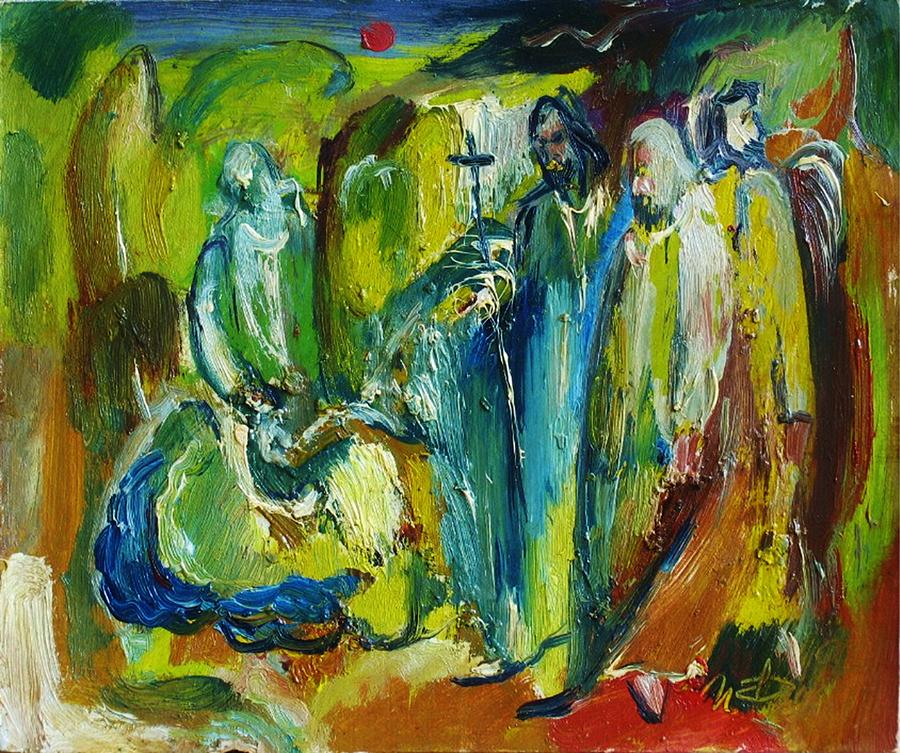
John the Baptist by Ivan Filichev, 1992

Now this was John’s testimony when the Jewish leaders in Jerusalem sent priests and Levites to ask him who he was. He did not fail to confess, but confessed freely, “I am not the Messiah.”

They asked him, “Then who are you? Are you Elijah?”

He said, “I am not.”

“Are you the Prophet?”

He answered, “No.”

Finally they said, “Who are you? Give us an answer to take back to those who sent us. What do you say about yourself?”

John replied in the words of Isaiah the prophet, “I am the voice of one calling in the wilderness, ‘Make straight the way for the Lord.’”

Now the Pharisees who had been sent questioned him, “Why then do you baptize if you are not the Messiah, nor Elijah, nor the Prophet?”

“I baptize with water,” John replied, “but among you stands one you do not know. He is the one who comes after me, the straps of whose sandals I am not worthy to untie.”

This all happened at Bethany on the other side of the Jordan, where John was baptizing. (New International Version)

John was not the Messiah. Jesus is the Messiah. John’s life was devoted to preparing people and pointing them to Jesus. You and I are not the Messiah; Jesus is. You and I are to devote are lives to preparing people and pointing them to Jesus.

John the Baptist had a way of communicating that didn’t exactly win friends; but he sure influenced a lot of people. (Matthew 3:1-12) 

Considering that John lived in seclusion, dressed weird, and ate different food, it’s not a stretch to see how people might dismiss him as a kook and move on. Yet, there’s no evidence that people viewed John that way. 

Instead, John the Baptist had an effective ministry. I suggest that’s because John didn’t seek his own gain, wasn’t trying to build a big following, but understood that he was to point to the coming Christ. 

John believed judgment was imminent, so he put all his efforts into getting people to realize the wrath of God was real and coming soon.

The kingdom of God cannot be entered by forcefully pushing the door in; we enter God’s kingdom through the humility of confession and repentance. The way to the Nativity goes through John the Baptist and his message of “Repent, for the kingdom of God is near.” (Matthew 3:2; Mark 1:4; Luke 3:3)

We are, like John, to make a straight and level way for folks to come to Jesus. That’s going to require some change on our part. But if we’re stuck in our ways, that makes it really hard to make a level path to Jesus.

There’s all sorts of ways we get stuck. We might be mired in a destructive habit because we think we need it to keep going; we may get cemented into rehearsing all the past dumb decisions we made, and so, cannot move forward; or we might become fastened in an unhealthy relationship and see no way to move. 

If we are stuck long enough, we blandly accept this as a new normal, then go about our daily lives with a “meh” kind of attitude; not too low, not too high, but just “meh.”

All this sticky stuff – the patterns, behaviors, activities and habits which trap us – keep us in an immovable bondage. And we might become so used to “meh” that we are cut off from the source that would get us un-stuck.

The reason people didn’t dismiss John as some creepy clown is that he offered them something better than their sticky situations. 

Awareness of our real selves and our true condition brings hope – because God will not leave us stuck. The Lord will turn us into free people, delivered from the stickiness, to live fully for the coming King. God doesn’t give up on us, so we do not need to settle for a “meh” existence.

It can be scary, looking squarely at our sins, habits, memories, and emotions because they might keep us on the flypaper of death. We may feel overwhelmed and think there is hope for other people, but not me. Or, conversely, we might think that everyone else has a problem except me. 

Jesus will baptize with the Holy Spirit and with fire. Christ will shake things up. He’ll unstick people and free them from narrow thinking and a lack of self-awareness.

The season of Advent means that the time of the Lord’s coming is near. Therefore, preparation for the Nativity of the Lord, Christmas, is of primary importance. And the best way of preparing for Christmas Day is to repent and believe that the kingdom of God is near (as opposed to far away). 

God has come near to us in the person of Jesus; and that makes all the difference. 

It’s hard to admit we’re stuck. Yet, if many are honest, their relationship with God and/or the Church is nothing more than a shoulder shrugging “meh.”

There are two ways to deal with being stuck in guilt and shame: either justify it or confess it. 

Denying, minimizing, or excusing sin leads to separation from God – whereas confession leads to connecting with God. 

John the Baptist’s message is this: Get ready because Jesus is coming! Through the grace of repentance and faith there is hope – the hope of stopping all the petty games we play to hide our sin and hide the fact we are really super-glued to our idols. Our hope is in being cleansed from our impurities and ready for God to be with us in the person of Jesus.

God unsticks us so we can bear good fruit that is in keeping with repentance. Our lives need to be congruent between what we profess and how we live. Outward religious observance, although important, is not the way into the kingdom. And confession without genuine change is not repentance – it’s just confession. 

The God who came to his people in Jesus will one day unveil his kingdom in all its glory. We need to get ready for that day. There are roads that need straightening; fires that need to be lit in order to burn away the rubbish and brush in the path; dead trees that need to be cut down; there are people who need to repent because the kingdom of God is near.

We must clear the road so that Jesus has a way into our hearts. 

Just as law enforcement and the secret service are serious about making presidential motorcades free of obstacles and having a clear road to the destination, so we need to ensure that we are doing all we can to pave the way for Christ’s coming. 

This is no time for a spiritually milquetoast deadpan “meh” kind of life; this is the day to clear the way for Jesus. Now is the time to prepare for Christ’s coming. 

And the proper preparation for the Lord’s return is with admitting our stickiness and asking God to unstick us from the sin that so easily entraps us on the devil’s flypaper. 

The kingdom of God belongs to those who prepare the way and produce good fruit in keeping with repentance. 

Maranatha. Even so, come, Lord Jesus.