2 Kings 22:11-20 – Humble Yourself

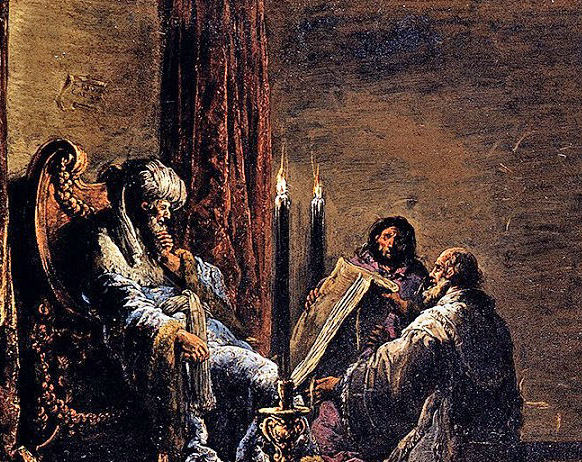
The Scribe Shaphan Reading The Book Of Law To King Josiah by Leonaert Bramer (1596-1674)

When Josiah heard what was in The Book of God’s Law, he tore his clothes in sorrow. At once he called together Hilkiah, Shaphan, Ahikam son of Shaphan, Achbor son of Micaiah, and his own servant Asaiah. He said, “The Lord must be furious with me and everyone else in Judah, because our ancestors did not obey the laws written in this book. Go find out what the Lord wants us to do.”

The five men left right away and went to talk with Huldah the prophet. Her husband was Shallum, who was in charge of the king’s clothes. Huldah lived in the northern part of Jerusalem, and when they met in her home, she said:

You were sent here by King Josiah, and this is what the Lord God of Israel says to him: “Josiah, I am the Lord! And I will see to it that this country and everyone living in it will be destroyed. It will happen just as this book says. The people of Judah have rejected me. They have offered sacrifices to foreign gods and have worshiped their own idols. I cannot stand it any longer. I am furious.

“Josiah, listen to what I am going to do. I noticed how sad you were when you read that this country and its people would be completely wiped out. You even tore your clothes in sorrow, and I heard you cry. So, I will let you die in peace before I destroy this place.”

The men left and took Huldah’s answer back to Josiah. (Contemporary English Version)

It is hard to fathom that things spiritually degenerated so much in the kingdom of Judah that the Book of Law, God’s Word to Israel, was completely lost. The Law was tucked so far back in the temple, and had gathered so much dust, that everyone simply forgot it existed. 

Maybe we in the Western world can relate to this more than we think. When a plethora of Bibles and translations exist, yet they gather dust on the shelf, and we have not cracked it open since….?

We are approaching the end of the Christian Year which annually culminates in Christ the King Sunday. As we journey with Jesus and ascend his holy hill, we anticipate corporately acknowledging Christ’s lordship. A good and biblical way to do so is through penitent humility. 

King Josiah’s officials found the Book of the Law and brought it to him. After they read the words, which had not been uttered for a very long time, the king was completely undone with humble repentance. He realized the life of the nation did not revolve around the majesty and kingship of God, and it cut him to the core of his being.  

An appropriate response to the realization of God’s sovereignty and Christ’s lordship is humility. Without humility, there is no going forward; there is only the ghastly state of remaining stuck in one place with ancient dust accumulating on our static hearts. However, with humility there is repentance; and with repentance there opens up the grand vistas of hope, new life, and fresh beginnings.

“It was pride that changed angels into devils; it is humility that makes men as angels.”

St. Augustine

I (humbly) ask that you try something quite different from your regular experience today. Put on some old clothes then carefully read the words of today’s Old Testament Scripture lesson. Take the time to acknowledge a sin of omission in your life. Then, tear your clothes; yes, rip your shirt. 

Allow yourself to feel, like Josiah, the realization of missing the mark. Yet do not remain in this condition. Drink in the grace of God in Christ and receive the forgiveness that is yours in Christ. The trajectory of our Christian lives is determined by the depth of humility we experience and filling the hole with mercy.

It’s difficult to be submissive. To acknowledge, without denial, that we are in a bad place and will reorient our lives takes a lot of courage and humility. If pride and arrogance are the original sin, then the remedy to that malady is a meek and obedient spirit. 

No matter who we are, people are meant and designed by their Creator to live a humble life of submission to the moral and ethical will of God.

Humility is the cornerstone to every good thing in this life.  Jesus said:

“Blessed are the poor in spirit, for theirs is the kingdom of heaven… Blessed are the meek, for they will inherit the earth.” (Matthew 5:3, 5 NIV)

The door of God’s kingdom swings-open on the hinges of humility. The Apostle Paul, seeking to follow his Master Jesus in his teaching and humility said:

“Since God chose you to be the holy people he loves, you must clothe yourselves with tenderhearted mercy, kindness, humility, gentleness, and patience.” (Colossians 3:12, NLT)

Basic human relations are to be firmly grounded in humility. The old prophet made his expectations clear:

“He has told you, O mortal, what is good; and what does the Lord require of you but to do justice, and to love kindness, and to walk humbly with your God?” (Micah 6:8, NRSV)

Life is truly life when it is based in humility. We live with the confidence of the psalmist:

“God leads humble people to do what is right, and he teaches them his way.” (Psalm 25:9, GW)

In the end, we are to bow to the God of the Word, for the Word is life.

Awesome God, although I might not always perceive your majesty and sovereignty, you stand above all creation as the Lord whom I am to submit to in all things.  I come to you in great humility of heart and vow to obey everything I read in your Holy Word through Jesus Christ, my King. Amen.

Psalm 119:9-16 – How Can a Young Person Live a Pure Life?

How can a young person live a pure life?
    By obeying your word.
I try with all my heart to serve you.
    Help me obey your commands.
I study your teachings very carefully
    so that I will not sin against you.
Lord, you are worthy of praise!
    Teach me your laws.
I will repeat the laws we have heard from you.
I enjoy following your rules
    as much as others enjoy great riches.
I will study your instructions.
    I will give thought to your way of life.
I enjoy your laws.
    I will not forget your word. (ERV)

Pornography is a multi-billion-dollar a year industry and is steadily growing. The younger generation is particularly susceptible in this internet age of easy access and multiple porn websites.

  • 35% of all internet downloads worldwide are related to pornography.
  • Teen-aged boys are the largest consumers of pornographic internet sites. 

The following percentages of children report having seen pornography in some way:

  • 50% of 11-13-year-olds
  • 65% of 14-15-year-olds
  • 78% of 16-17-year-olds
  • 75% of parents believe their children have not seen pornography online.
  • 53% of the children said that they had seen pornography online.

Into this terrible muck of impurity an impropriety enters the biblical psalmist with his ancient, yet truly relevant question for us today: How can a young person live a pure life? 

The answer the psalmist gives is this: By guarding the heart through obedience to God’s Holy Word. The psalmist himself stored up the commands and teachings of Scripture in his heart so that he might not sin against God.

A solid tried-and-true activity parents can do for themselves (the statistics for adult use of porn are staggering) and for their kids in this area of purity is for the entire family to do some old school Bible memorization. Yes, I mean getting down to rote memory work. 

This is to be neither a legalistic practice nor some fetish that will keep evil away. Instead, memorizing verses and large sections of the Bible provides a solid foundation from which to construct of base of operations for the work of meditation. When temptation occurs, there will be something to stand upon in the heat of the moment.

Today’s lesson from Psalm 119 is a great place to begin. Expand to memorize the entire psalm, all 176 verses of it. When faced with the decision of viewing pornography or not, it would be wise to dedicate the time to memorizing Scripture so that there will be a delight in God’s statutes rather than a depressed guilt over another fall into impure thoughts and/or actions.

Now, I can feel the pushback from some folks. You might not have memorized anything your entire life, or so you think. One of the reasons many people can freely quote lines from movies is that they have watched their favorites repeatedly. Ah, so we are on to something, right!?

I have been reading the Holy Bible for over forty years, every day. I have large chunks of Scripture memorized – mostly because of all that reading. So far in my life I’ve read the entire Old Testament around 100 times and the New Testament about 300 times – not because I ever had the goal of doing all that reading but because I need God’s Word.

What’s more, I take the further step of spending some time in reflection and ongoing meditation on Scripture, especially at night before retiring. This might seem over the top to some. However, the reading and reflection of Scripture is about a 30-minute venture for me on most days. The goal is engrafting the message of the Bible into the heart and life. Memorization is simply the means of helping that to happen.

There are some memorization tips I use and have picked up along the way to aid in pressing Scripture firmly into my soul:

  • Sleep on it. Studies show that our brains process and store information while we sleep. Try to review some Scripture just before you go to sleep—even if it’s only for a few minutes—and see if it helps embed the information in your memory.
  • Repeat it. There is no substitute for consistent and repetitive reading or listening to Scripture being read to you. This one practice alone has been key to my own ability to memorize. 
  • Write it out. Writing helps deeply encode biblical truth we’re trying to learn because there is a direct connection between our hand and our brain. To increase recall, speak the Scripture out loud and visualize the concepts as well.
  • Sing it. Singing is what got my middle daughter through school. Songs or jingles use your brain’s right hemisphere, helping us to remember. There are already plenty of songs out there for all kinds of biblical passages. And, of course, you can always try making your own music.
  • Sense it. Use as many of the five senses as possible. Our senses enable us to use more parts of our brains and retain information better. For example, when I read Scripture, I use a physical Bible to hold and often use a pointer when reading (touch); have a cross in front of me (sight); read out loud, sometimes with worship music in the background (hearing); light a candle (smell); and, I always have a cup of coffee to sip while reading! (taste)

The biblical psalms are meant to be prayed. So, using them for that purpose has the effect of shaping our prayers and desires in a good direction, as well as helping us to live into the commands of God to “repeat the laws I have heard from you.” In a world of spiritual impurity, emotional assault, and mental adultery, we need the purifying work of God’s Word to wash our souls clean.

May it be so, to the glory of God.

Merciful God, thank you for providing your Word to me so that I might read it, use it, memorize it, meditate upon it, and engraft it into my soul.  Fortify my spirit against the demons of impurity by the power of your Holy Spirit, to the glory of Jesus Christ.  Amen.

Matthew 12:46-50 – Family

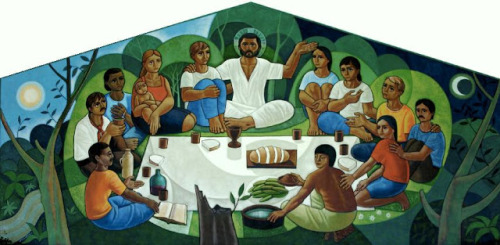
En la Cena ecológica del Reino (At the Ecological Kingdom Dinner) by Spanish artist Cerezo Barredo

While Jesus was still talking to the crowd, his mother and brothers stood outside, wanting to speak to him. Someone told him, “Your mother and brothers are standing outside, wanting to speak to you.”

He replied to him, “Who is my mother, and who are my brothers?” Pointing to his disciples, he said, “Here are my mother and my brothers. For whoever does the will of my Father in heaven is my brother and sister and mother.” (NIV)

Jesus obviously did not get the memo that blood is thicker than water. When his own blood family were waiting outside for him, Jesus used the occasion to speak of what makes up a true follower of God. Christ boldly asserted that his true family is made up of people who do God’s will.  By saying this, Jesus brought the point home that the kingdom of God turns on obedience.

Rather than solely confessing belief, or appealing to a family heritage of faith, Jesus said that a genuine believer in God is one who listens to God’s words and then promptly obeys them. Therefore, a Christian is defined by allegiance to Jesus, and not by having a certain bloodline. 

Identity determines activity. For example, if I identify myself primarily as a worker at my job, my activity will show it – I will spend long hours at my labor, and will do whatever it takes to please my boss and gain promotions. If I identify myself primarily as an athlete, I will spend long hours honing my skills, and do whatever it takes to please the coach and to win. If my identity is mostly wrapped around being a husband and father, I will focus most of my attention on my family and seek to please my spouse and children in all things. 

If my identity is first and foremost as a Christian, I will always seek to please Jesus. I will then view my job as an opportunity to express the ethics of God’s kingdom, as a calling from God, and as a means for God to transform me for his glory. I will view athletics as means to glorify God, and not as an end in and of itself but as a special gift for God to teach me about the importance of community and working together. 

If my identity is clearly in Christ, I will view my kids as belonging to God and I will steward the trust of children given me by doing whatever it takes to teach and train them in the way of Jesus. I will thank God for my family and not confuse them with being God by idolizing them.

In today’s Gospel lesson, Jesus was inside a house, with his family on the outside. So, why were the family members of Jesus not inside the house sitting at his feet, taking the posture of a disciple? The disciple Matthew wanted to communicate more than physical distance between Jesus and his physical family – being “outside” was meant to convey the posture of Christ’s family as spiritually distant, skeptical of him, and indecisive about who he was and what he was up to. In fact, the disciple Mark made this spiritual and emotional distance clear:

Jesus entered a house. A crowd gathered again so that it was impossible for him and his followers even to eat. When his family heard what was happening, they came to take control of him. They were saying, “He’s out of his mind!” (Mark 3:20-21, CEB)

Christ’s earthly family were not looking for Jesus to give them warm-fuzzies and have a family group hug. They were there to tell him: “Cut it out, Jesus, because you’re acting like a nut-cake and embarrassing us all!” The kid brothers of Jesus (James and Jude) would go on to become powerful Christian preachers and each pen a New Testament letter, but that does not happen till after Jesus’ resurrection.

Ethiopian Orthodox Church depiction of Christ and his disciples

Jesus was saying that identifying only with a biological family leads to only pleasing that family. However, identifying with Jesus leads to a radical form of following God that seeks to please him instead of submitting to family practices, mores, and beliefs which are inconsistent with the kingdom of God. 

For the follower of Christ, the church is the family of God, and we are to act consistent with being in such a family.  We are to go hard after God’s will, serve one another, and adopt outsiders into our family.  The church is a family, not a restaurant.  When we go to a restaurant, we either like the food and the service, or not. If the experience was unpleasant, we might complain to the waitress and may or may not come back.  Try doing that with your mother and see where it gets you!  As a biological family, we are committed to each other. There is no complaining about mom because of dad’s wrath. Instead, we are expected to clear our plates and put them in the dishwasher, to sweep the floor and clean the table, and to work together for the benefit of the entire family.  In the same way, following Jesus means being committed to his family, the church.

Priority is to be given in doing God’s will, regardless of blood, because obedience to Christ identifies us as being in the family of God.  Our actions and the way we live points to what we honestly believe and where our commitments truly lie. 

The first step of God’s desire for us is quality focused time in sitting at Christ’s feet and listening to him because this is at the heart of all Christian discipleship. We cannot do God’s will until we have clearly heard it; and we cannot hear God’s will unless we take the time to be at the feet of Jesus. 

Both listening and doing are necessary.  Listening without engaging the world is a failure of mission; and doing without first listening leads to misguided acts and eventual burn-out. Allow Jesus to call the shots and let him instruct us so that we can act wisely and obediently. 

Jesus did not devalue blood relatives as irrelevant. Rather, Christ emphasized that our primary allegiance is to him, and not to our biological family.  The kingdom of God seeks to restore and redeem all things, including family. Both church and family are important. The relationships within each are to be nurtured.

The family of Jesus, the church, is important because Christ suffered and died for her. So, we are to be committed to the church, love the church, and serve the church because we are family. If we have a good grasp of this, we will make decisions based in what we believe God’s will is, instead of whether a relative will get upset, or not. 

Our biological families are important.  Jesus never pitted one against the other, because he wants to see families redeemed and work together as the family of God. Every Christian family can do this:

  • Appoint a time to read Scripture together and listen to Jesus and discuss it.
  • Show hospitality so that we can eat and drink our way into the kingdom of God. 

We need to persistently pray for spiritually lost family members, and those whom we are estranged from. Most families have at least a few toxic persons in their orbit. Here is how we might pray for them:

  • That God will arrange divine appointments between them and other believers who love Jesus.
  • That God will draw them to the mercy of Christ.
  • That God will hinder the devil’s schemes against them.
  • That they will understand and respond to the good news of God’s grace.

Soli Deo Gloria

Nehemiah 8:1-12 – Word and Worship

Ezra Reads the Law to the People by Bernadette Lopez

All the people came together as one in the square before the Water Gate. They told Ezra the teacher of the Law to bring out the Book of the Law of Moses, which the Lord had commanded for Israel.

So, on the first day of the seventh month Ezra the priest brought the Law before the assembly, which was made up of men and women and all who were able to understand. He read it aloud from daybreak till noon as he faced the square before the Water Gate in the presence of the men, women and others who could understand. And all the people listened attentively to the Book of the Law.

Ezra the teacher of the Law stood on a high wooden platform built for the occasion. Beside him on his right stood Mattithiah, Shema, Anaiah, Uriah, Hilkiah and Maaseiah; and on his left were Pedaiah, Mishael, Malkijah, Hashum, Hashbaddanah, Zechariah and Meshullam.

Ezra opened the book. All the people could see him because he was standing above them; and as he opened it, the people all stood up. Ezra praised the Lord, the great God; and all the people lifted their hands and responded, “Amen! Amen!” Then they bowed down and worshiped the Lord with their faces to the ground.

The Levites—Jeshua, Bani, Sherebiah, Jamin, Akkub, Shabbethai, Hodiah, Maaseiah, Kelita, Azariah, Jozabad, Hanan and Pelaiah—instructed the people in the Law while the people were standing there. They read from the Book of the Law of God, making it clear and giving the meaning so that the people understood what was being read.

Then Nehemiah the governor, Ezra the priest and teacher of the Law, and the Levites who were instructing the people said to them all, “This day is holy to the Lord your God. Do not mourn or weep.” For all the people had been weeping as they listened to the words of the Law.

Nehemiah said, “Go and enjoy choice food and sweet drinks, and send some to those who have nothing prepared. This day is holy to our Lord. Do not grieve, for the joy of the Lord is your strength.”

The Levites calmed all the people, saying, “Be still, for this is a holy day. Do not grieve.”

Then all the people went away to eat and drink, to send portions of food and to celebrate with great joy, because they now understood the words that had been made known to them. (NIV)

God’s Holy Word is central to worship. Since the Bible is God’s self-revelation, it makes sense to gather in worship which is saturated with Scripture. The proclamation of God’s Word is important because it is a means of knowing God and teaches us how to live.

The ancient Israelites were taken into captivity from their home in Jerusalem to Babylon. Nehemiah became the king’s cupbearer (a servant who fills wine cups for royalty). Years later, Nehemiah heard about the condition of Jerusalem and determined to do something about it. The walls were broken down and the people were without leadership. Because of his relationship to the king and God’s sovereign working on the king’s heart, Nehemiah returned from exile in Babylon to Jerusalem to rebuild the wall. 

Ezra was a scribe (a copier of the Scriptures), a priest, and a teacher of the Law of Moses (the first five books of the Old Testament). Together, Ezra and Nehemiah were like God’s dynamic duo, renewing the worship of God. It was a time of revival, in which the Israelites found new life around God’s Word.

Renewal, revival, and reformation happen when God’s revelation is carefully and faithfully read, listened to, and acted upon. Life change occurs through Holy Scripture, as we come to understand and apply it to all our circumstances and relationships.

Ezra arrived in Jerusalem first, fourteen years before Nehemiah. At that time, morality was low, and the spiritual condition of the people was unhealthy. Yet, as Ezra prayerfully taught them God’s Word, over time they began to respond.

The rebuilding of the wall under Nehemiah’s leadership was a direct result of the spiritual foundation Ezra had built through the Word of God. After the wall was finished, it was time to hear the entire Book of the Law read aloud. 

Imagine and picture your entire community gathering early in the morning in a park or large space, staying till noon doing nothing but listening to Scripture being read, with various local pastors taking their turn reading and making the meaning clear. All the while the people are responding in worship, tears, and celebration…. If this seems far-fetched for today, it also seemed that way to most people in Nehemiah’s day.

Holy Scripture is a powerful unifying force within the life of God’s people. We may not explain every Bible verse the same way; and the riffraff might attempt to magnify differences and minimize a common confession of faith around Scripture. However, a universal desire to honor, apply, and obey God’s Word draws us closer together rather than separates us.

A first century Jewish teacher, Rabbi Akiva, once noticed a tiny stream trickling down a hillside, dripping over a ledge on its way toward the river below. Below was a massive boulder. The rock bore a deep impression. The drip, drip, drip of water over the centuries had hollowed away the stone. Rabbi Akiva commented, “If mere water can do this to hard rock, how much more can God’s Word carve a way into my heart of flesh?” He realized that if the water had flowed over the rock all at once, the rock would have been unchanged. It was the slow steady impact of each droplet, year after year, that completely reformed the stone.

We oftentimes want quick answers to our questions without taking the time to prayerfully listen and reflect on the Word of God. Yet, God tends to reveal truth over days, months, and years, as we read and discuss Scripture. Through the slow drip of study, prayer, and reflection, day after day, year after year, God shapes and spiritually forms us.

The people in today’s story were responsive, both vocally and physically. They shouted “Amen!” (literally, “yes, may it be so!”)  and raised their hands. Word and worship always go together. 

The people were submissive, bowing in worship (literally, “to prostrate oneself”). True worship listens attentively to God’s Word and surrenders to the Lord. It is an act of humility, pledging to act upon what is heard.

The people were teachable, attentively listening to the Levite priests explain Scripture. Sometimes the Bible is not apparently relevant. We need others to help us, and the patience to stick with it, even when we are not sure about what it is saying. Interpreting Scripture (hermeneutics) typically happens in community, not isolation, which is why small groups of people interacting on the Bible’s message is significant.

The people mourned and wept. Hearing the Word illumined their failures and disobedience. When we look intently into Scripture, we see divine faithfulness and human disloyalty; God’s compassion and our selfishness; the Lord’s holiness and people’s fickle nature.

Awareness of truth causes grief and distress over personal sin and the sin of the world. Yet, there is mercy and forgiveness. Grace washes away guilt and shame and brings restoration. God’s Word both slays us and gives us new life.

In ancient Israel, every Jewish boy had the first five books of the Old Testament memorized by age twelve. The goal was to have Torah internalized and known so that it influenced every situation and every relationship of their lives.

Ezra and Nehemiah were only reinstituting what their ancestors had done:

Moses said, “Gather the people together—men, women, children, and the foreigners living among you—so they can listen well, so they may learn to live in holy awe before God, your God, and diligently keep everything in this Revelation. And do this so that their children, who do not yet know all this, will also listen and learn to live in holy awe before God.” (Deuteronomy 31:12-13, MSG)

Joshua said, “Never stop reading The Book of the Law. Day and night, you must think about what it says.” (Joshua 1:8, CEV) 

David said, “I have hidden your Word in my heart, that I might not sin against you.” (Psalm 119:11, NLT)

The practice of personal and public worship through God’s Holy Word continued with the New Testament writers:

Paul said, “All Scripture is inspired by God and is useful for teaching, for reproof, for correction, and for training in righteousness so that everyone who belongs to God may be proficient, equipped for every good work.” (2 Timothy 3:16-17, NRSV)

“God means what he says. What he says goes. His powerful Word is sharp as a surgeon’s scalpel, cutting through everything, whether doubt or defense, laying us open to listen and obey. Nothing and no one are impervious to God’s Word. We can’t get away from it—no matter what.” (Hebrews 4:12-13, MSG)

Jesus, quoting the Law, said, “It is not just bread that keeps people alive. Their lives depend on what God says.” (Matthew 4:4, ERV, Deuteronomy 8:3)

We need God’s Word because we need God. It is a delight and a duty to learn the Scriptures so that we can know God and know God’s will.

God Almighty, your statutes are wonderful; therefore, I obey them. The unfolding of your words gives light; it gives understanding to the simple. I open my mouth and pant, longing for your commands. Turn to me and have mercy, as you always do to those who love your name. Direct my footsteps according to your word; let no sin rule over me. Redeem me from the oppression of men, that I may obey your precepts. Make your face shine upon your servant and teach me your decrees. Amen. (Psalm 119:129-135)