Welcome, friends! The season of Advent is all about hope – a confident expectation that Jesus is coming. Click the video below and let us wait and watch together for the Savior.
For a kid version of Simeon and Anna’s story, click the video below:
God’s Story: Anna and Simeon by CrossroadsKidsClub.net
And for the story set to song…
Now You let me go in peace (Simeon’s song) – Nina Åström feat. Phil Keaggy
May starlight guide your steps toward the place of wonder. May angels sing their news as you travel to the manger. May promise fill these days as we watch at the edge of birth. May hope inform you, Emmanuel will be with us soon, in human skin. Amen.
Welcome, friends! Advent is upon us. May this season spark faith, increase hope, stir up love, and surprise the world with joy. Click the video below and let us acknowledge the coming of the Christ child…
Isaiah 11:1-10
For the Scripture set to song…
And for a traditional Advent hymn…
Come, Thou Long-Expected Jesus by Shannon Wexelberg
May the light of Christ lead us to the joy of his kingdom, now and for ever.Amen.
Jesus carrying his cross, from the Stations of the Cross at Holy Hill in Hubertus, Wisconsin.
It is not to angels that he [God] has subjected the world to come, about which we are speaking. But there is a place where someone has testified:
“What is mankind that you are mindful of them,
a son of man that you care for him? You made them a little lower than the angels;
you crowned them with glory and honor and put everything under their feet.”
In putting everything under them, God left nothing that is not subject to them. Yet at present we do not see everything subject to them. But we do see Jesus, who was made lower than the angels for a little while, now crowned with glory and honor because he suffered death, so that by the grace of God he might taste death for everyone. (NIV)
By Christmas eve of 1914, World War I had come to the point of trench warfare. On one point along the miles of trenches, there were the allied troops of French and Scots, and on the other side, the Germans. That night one Frenchman began singing Nuit Silencieuse(Silent Night). Eventually his comrades joined in. Much to their surprise, the Germans on the other side of the trench, recognizing the familiar tune, began singing in their native tongue, Stille Nacht, along with them. The Scots then joined in with their bagpipes. After the song, heads began to stick out from the trenches as both sides realized they had a common celebration in song. This led to the white flags going up on both sides, and then the unthinkable happened. Both trenches, allied and axis powers, enemies of one another, left their holes in the ground and met in the middle, exchanging pictures, and communicating with each other. The evening was capped off with the Scottish chaplain leading all the men together in a celebration of communion. The 2006 movie, Joyeux Noel, recounts the actual events.
Whenever we come together, expressed most highly for the Christian through the sacrament of communion, it puts our differences in their proper perspective – we all come together as one, not seeing each other as rich or poor, black or white, American or Asian, or anything else. The events of that Christmas eve in 1914, however, did not have a happy ending. The two sides found that, once the holiday had passed, they did not have the will to fight their new brothers. The top brass on each side were very upset and sent the Germans to the Russian front (and certain death); and, the Scottish chaplain was defrocked for his actions and sent home never to pastor again, letting us see in dramatic fashion that unity has a price.
Scene from Joyeux Noel, 2006. A Scot, German, and Frenchman together on Christmas Eve on the western front of World War I.
The book of Hebrews was originally written (or preached) to encourage and exhort struggling Jewish Christians. The way the author of Hebrews did that was to point them squarely at Jesus. They were in danger of forgetting what the pioneer and champion of their salvation had done for them, and, what is more, they were in danger of reneging on their commitment to Christ. So, the entire book is dedicated to demonstrating and reminding discouraged believers that Jesus Christ is superior to everything, both in heaven and on earth. Because of that truth, Jesus is worthy of our eternal devotion and remembrance.
Jesus is qualified to be our Savior and Lord. Every day and each minute of our lives are an opportunity for a fresh commitment to Jesus. The regular practice of Christian communion and consistent spiritual practices are meant to lead us into celebrating our Savior’s work. The worldwide communion of saints is celebrating with us in remembering and committing ourselves afresh to the lordship of Jesus Christ. A great victory has been won, not just in the trenches of human wars, but on the cross of Christ. This singular death on our behalf qualified Jesus to be our Savior from sin, once and for all.
Christ’s suffering qualified him to be our Savior.
Jesus suffered an inglorious and ignominious death. Yet, paradoxically, glory came through suffering. Jesus did not only suffer at his crucifixion; he experienced the full range of human suffering throughout his life. He knew what it was like to face adversity and hardship. It is Christ’s suffering that helps us make sense of our own suffering. We can only truly be free from all that binds us by embracing that which makes us suffer. And because we live in a fallen world, we all personally suffer in some way. In addition, entire groups of people suffer – whether it is religious persecution, racial profiling, class warfare, or government oppression. This suffering is very much real, damaging, and dehumanizing which results in terrible living conditions and even death.
Maybe because of this reality, some tend to minimize their own suffering. After all, what is a harshly worded e-mail, trying to lose a few extra pounds, or an unexpected car repair compared to families devastated by COVID-19 and entire black neighborhoods in deathly peril? It is all suffering none-the-less. It is good to keep our life situations in proper perspective; and, we must be careful to not tell God what he should and shouldn’t care about in this world. If the only things that matter and qualify as hardship and difficulty is human trafficking, the terrors of war, or grinding poverty, then you will soon find yourself plastering a smile on your face and nodding over-enthusiastically whenever someone asks you how you are doing. Happy with-it Christians are insufferable, (pun intended).
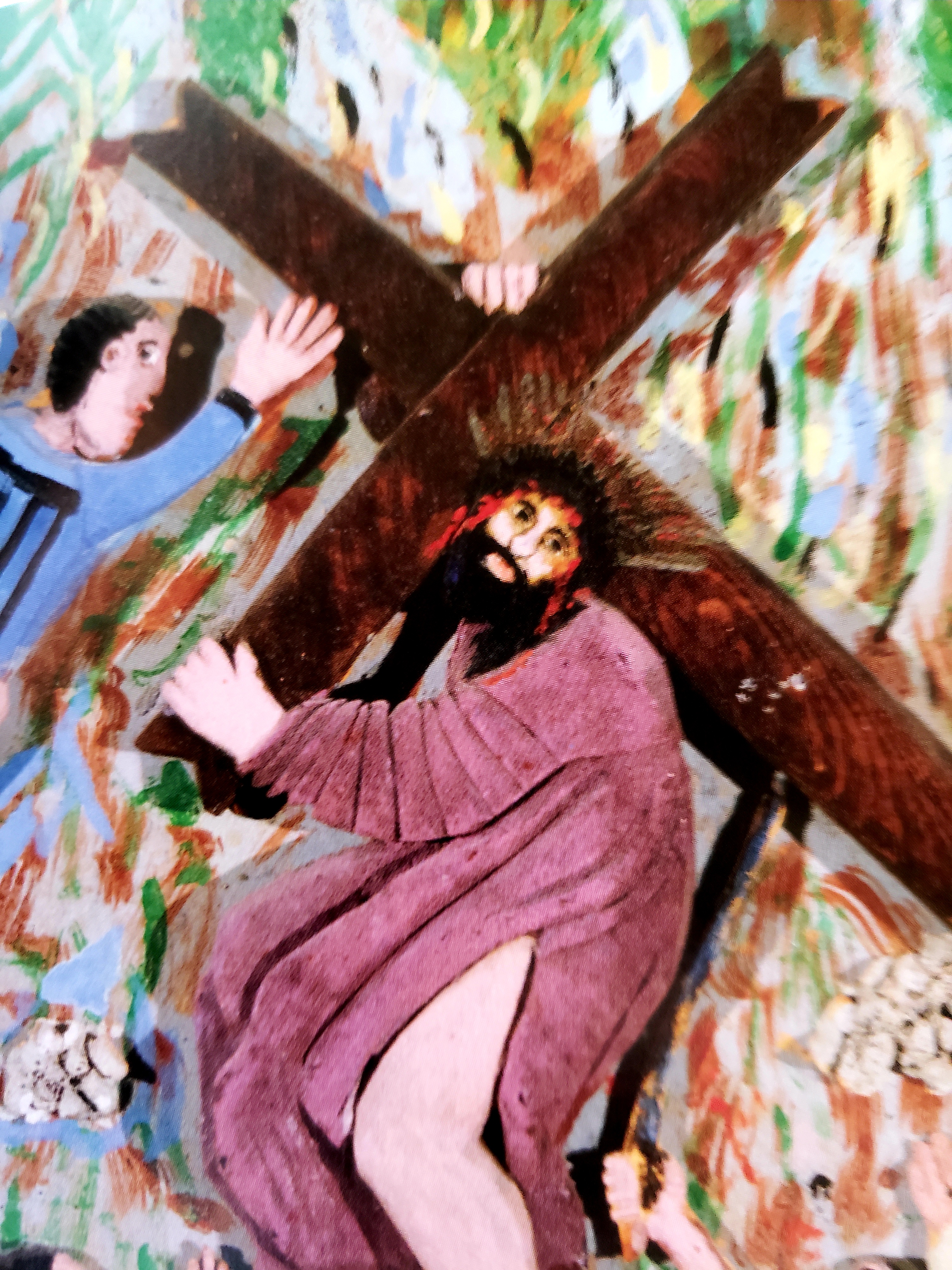
Christ Carrying the Cross by Elijah Pierce, 1892-1984.
It is our task to find commonality and solidarity with Jesus in our own personal and corporate suffering. An admission of weakness, trouble, hardship, or suffering is neither a lack of faith nor the unpardonable sin. We know there must be a Good Friday before there is an Easter. Identifying with the adversity of our brothers and sisters in Christ throughout this nation and the world can be transformed into suffering that has meaning and significance. Our temporary sufferings now will someday result in the glory of being with Christ forever.
Christ’s suffering qualified him to be our compassionate helper.
Through the death of Jesus on the cross we have victory over Satan and all his wicked spirits. I have heard more than one motivational speaker say: “If you could do one thing in your life and not be able to fail, what would it be?” The truth is, because of Christ’s atoning sacrifice, we have victory and can live our lives in confidence and commitment to Jesus. What is more, we know that temporary failures and failings are not the end of the story. We possess a union with Christ because of the cross. Jesus is our champion. He stands with us in our suffering and temptations.
Christian speaker, author, and professor emeritus, Tony Campolo, told a story about observing communion when he was a child: “Sitting with my parents at a Communion service when I was very young, perhaps six or seven years old, I became aware of a young woman in the pew in front of us who was sobbing and shaking. The minister had just finished reading the passage of Scripture written by Paul that says, ‘Whosoever shall eat the bread and drink the cup of the Lord unworthily, shall be guilty of the body and blood of the Lord’ (1 Corinthians 11:27). As the Communion plate with its small pieces of bread was passed to the crying woman before me, she waved it away and then lowered her head in despair. It was then that my Sicilian father leaned over her shoulder and, in his broken English, said sternly, ‘Take it, girl! It was meant for you. Do you hear me?’ She raised her head and nodded—and then she took the bread and ate it. I knew that at that moment a heavy burden was lifted from her heart and mind. Since then, I have always known that a church that could offer communion to hurting people was a special gift from God.”
In solidarity with all who suffer, along with your brothers and sisters who agonize throughout the world, we have the blessed opportunity of bringing our troubles to a gracious God – thus finding forgiveness and hope. May your burdens be lifted, and may you know Christ, and him crucified, died, buried, risen, ascended, and coming again. For, precious one, he knows you because he tasted death for you – for everyone.
Merciful Lord help me to remember in these troubled times the cross you carried for my sake so that I may better carry mine and help others do the same. Since you tasted death that I might taste life, I forever belong to you and offer up all that I am and all I hope to be to the glory of Jesus Christ through the power of the Holy Spirit. Amen.
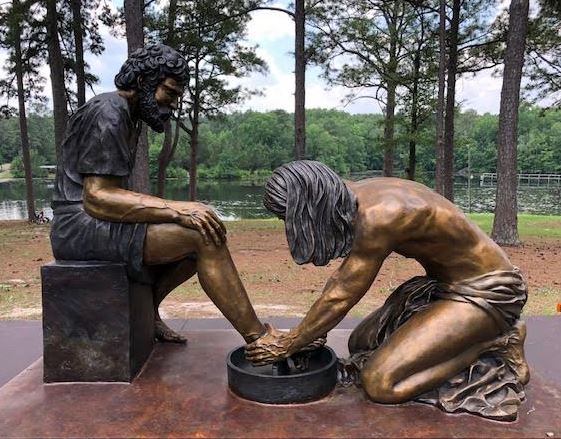
Bronze statue of Jesus washing Peter’s feet, Pittsburgh, Texas
Now Jesus was going up to Jerusalem. On the way, he took the Twelve aside and said to them, “We are going up to Jerusalem, and the Son of Man will be delivered over to the chief priests and the teachers of the law. They will condemn him to death and will hand him over to the Gentiles to be mocked and flogged and crucified. On the third day he will be raised to life!”
Then the mother of Zebedee’s sons came to Jesus with her sons and, kneeling, asked a favor of him.
“What is it you want?” he asked.
She said, “Grant that one of these two sons of mine may sit at your right and the other at your left in your kingdom.”
“You don’t know what you are asking,” Jesus said to them. “Can you drink the cup I am going to drink?”
“We can,” they answered.
Jesus said to them, “You will indeed drink from my cup, but to sit at my right or left is not for me to grant. These places belong to those for whom they have been prepared by my Father.”
When the ten heard about this, they were indignant with the two brothers. Jesus called them together and said, “You know that the rulers of the Gentiles lord it over them, and their high officials exercise authority over them. Not so with you. Instead, whoever wants to become great among you must be your servant, and whoever wants to be first must be your slave— just as the Son of Man did not come to be served, but to serve, and to give his life as a ransom for many.” (NIV)
Today’s story from the Gospel of Matthew is the very description of not being on the same page. There were two variant responses from Jesus and from everyone else because there were two different agendas.
Jesus was quite clear about how things were going to shake out. Torture, insults, crucifixion, and death was ahead for him. The disciples and the mother of James and John missed the memo on this. Christ’s words went way over their heads. It could be the disciples simply did not hear what Jesus was saying to them (repeatedly!). It is more likely that the message of Jesus got filtered through an existing agenda of how they believed things ought to go.
The disciples, along with a lot of other Jewish folk in the first century, were looking for a Messiah in the mold of King David – a strong leader who would come and beat up the Romans, exert all kinds of power and influence, and establish an earthly rule over all the people they don’t like. Submission to torture, humility before the very people they detested, and being killed by them were not factors into the disciples understanding of leadership and government.
Much like the powerful Aslan who had a thorough understanding of the world’s deep magic and submitted himself to the White Witch and death in C.S. Lewis’s The Lion, the Witch, and the Wardrobe – Jesus knew what he was doing while everyone else seemed clueless about the true power which exists in the universe.
So, let us be perfectly clear about what that power really is: Grace. Yes, grace. Powerful, resplendent, subversive, scandalous, and radical grace. Mercy was the missing factor in the disciples’ agenda. Jesus is not like other rulers. He does not operate by throwing his weight around to forcefully impose a crushing my-way-or-the-highway kind of rule (even though, ironically, he is The Way). No, Jesus freely and unabashedly uses grace with its merciful tools of humility, gentleness, kindness, goodness, and love to introduce and establish a new kind of rule which is not posturing for selfish power.
Power, authority, and the positions which go with them are to be used for the common good of all persons. To be in any kind of leadership is to be a servant of grace for the benefit of humanity and the world. And, if Christ’s disciples had looked a bit closer into their Old Testament, they might have noticed, for all his power and authority, King David trafficked in grace. When David was at the pinnacle of power his first act as King was to look over the kingdom and see who from the family of his enemy, the former King Saul (who was into the power thing for himself) was around so he could show grace (2 Samuel 9). It was typical of ancient kings to secure their rule and power through killing-off rivals and former family members of previous kings. Not so with David. And not so with Jesus.
Wherever there is posturing for position, preening for power, and a pestering for privilege – there you will find everything grace is not: reliance on making and calling-in favors; overinflated egos; unrealistic expectations; suspicion; judgment, arrogance; an insistence on recognition; compulsive control over everything and everyone; unilateral decision-making; shaming of others; hoarding of resources; coups; in-fighting; hatred; and, a demand of rights. We in the western world may not be in the habit of offing leaders and killing others to consolidate power, yet, we still too often rely on violent speech and language, partisan policies, and good-old-boy systems which are foreign to the way of Christ. In contrast to this, grace exists.
Grace is the deep magic which resides within the universe.
Wherever grace operates, there you will find the heart of a servant: attending to the needs of all persons; freely consulting and collaborating with others; focusing on responsibility; loving discipline; embracing accountability; pursuing truth; sharing power and resources; encouraging others; giving generously; and, looking for ways to show mercy.
In this Christian season of Eastertide, the Church focuses on exploring new life, and new ways of being with one another and the world. The old life is consumed with unmerciful uses of position and power. New life brings a shift to a gracious means of wielding such authority. Yes, it will likely bring some short-term suffering. It will hurt. Grace, however, results in a longevity of righteousness and peace for those who have been trained by it. True service is being a servant of grace.
May it be so, to the glory of God.
Click Make Me a Servant by the Maranatha Singers and allow it to be our prayer today and everyday.






 Rev. Tim Ehrhardt