Born to Die (Judges 13:2-24)

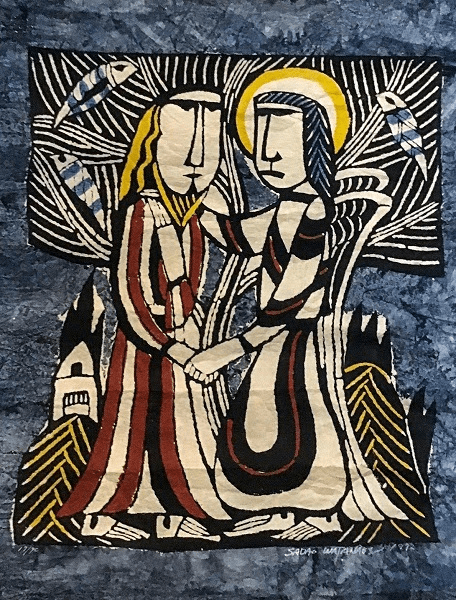
The angel and Manoah, by Sadao Watanabe, 1972

There was a man from Zorah named Manoah. Manoah was from the family of Dan. His wife was not able to have children. The Messenger of the Lord appeared to her and said, “You’ve never been able to have a child, but now you will become pregnant and have a son. Now you must be careful. Don’t drink any wine or liquor or eat any unclean  food. You’re going to become pregnant and have a son. You must never cut his hair because the boy will be a Nazirite dedicated to God from birth. He will begin to rescue Israel from the power of the Philistines.”

The woman went to tell her husband. She said, “A man of God came to me. He had a very frightening appearance like the Messenger of God. So I didn’t ask him where he came from, and he didn’t tell me his name. He told me, ‘You’re going to become pregnant and have a son. So don’t drink any wine or liquor or eat any unclean food because the boy will be a Nazirite dedicated to God from the time he is born until he dies.’ ”

Then Manoah pleaded with the Lord, “Please, Lord, let the man of God you sent come back to us. Let him teach us what we must do for the boy who will be born.”

God did what Manoah asked. The Messenger of God came back to his wife while she was sitting out in the fields. But her husband Manoah was not with her. The woman ran quickly to tell her husband. She said, “The man who came to me the other day has just appeared to me again.”

Manoah immediately followed his wife. When he came to the man, he asked him, “Are you the man who spoke to my wife?”

“Yes,” he answered.

Then Manoah asked, “When your words come true, how should the boy live and what should he do?”

The Messenger of the Lord answered Manoah, “Your wife must be careful to do everything I told her to do. She must not eat anything that comes from the grapevines, drink any wine or liquor, or eat any unclean food. She must be careful to do everything I commanded.”

Manoah said to the Messenger of the Lord, “Please stay while we prepare a young goat for you to eat.”

But the Messenger of the Lord responded, “If I stay here, I will not eat any of your food. But if you make a burnt offering, sacrifice it to the Lord.” (Manoah did not realize that it was the Messenger of the Lord.)

Then Manoah asked the Messenger of the Lord, “What is your name? When your words come true, we will honor you.”

The Messenger of the Lord asked him, “Why do you ask for my name? It’s a name that works miracles.”

So Manoah took a young goat and a grain offering and sacrificed them to the Lord on a rock he used as an altar. While Manoah and his wife watched, the Lord did something miraculous. As the flame went up toward heaven from the altar, the Messenger of the Lord went up in the flame. When Manoah and his wife saw this, they immediately bowed down with their faces touching the ground.

The Messenger of the Lord didn’t appear again to Manoah and his wife. Then Manoah knew that this had been the Messenger of the Lord. So Manoah said to his wife, “We will certainly die because we have seen God.”

But Manoah’s wife replied, “If the Lord wanted to kill us, he would not have accepted our burnt offering and grain offering. He would not have let us see or hear all these things just now.”

So the woman had a son and named him Samson. The boy grew up, and the Lord blessed him. (God’s Word Translation)

The Sacrifice of Manoah, by Charles Blanc (1813-1882)

In the anticipation of Christ’s birth, we are reminded today that there have been extraordinary births in history – a sign that the delivery of a baby will lead to a deliverance of the people.

The ancient Israelites were yet again in one of their downward spirals into apostasy. As a result, their arch-nemesis, the Philistines, had domination over them. The tribe of Dan – from which Samson was born into – was geographically situated in such a way that they would have borne the brunt of Philistine oppression.

In the case of miraculous births in Holy Scripture, an angel comes to announce the coming child. These sorts of situations always have an infertile woman who was not planning on becoming a mother. And in many cultures, including Israel, a son born to a woman who was childless for a long time is recognized as a particularly special gift from God.

There are typically, therefore, high expectations that such a special child is destined for great things in this life. Indeed, Samson would become an extraordinary person by initiating the deliverance of Israel from the Philistines.

Samson, according to the angel, was not only to make sure he never eats any unclean food, but also was to be set apart from his very conception as a Nazirite – one who has the special rules of abstinence from alcohol, cutting the hair, and touching corpses. (Numbers 6:1-8)

From the very beginning of Samson’s existence in the womb of his mother, the Spirit of God was with him and began empowering him for his destiny of deliverance.

Since we know the rest of the story, as contained in the Bible, we understand that the way the deliverance of Israel came was not by any sort of conventional means. It was a rather circuitous and complicated set of circumstances and decisions which brought about Israel’s freedom from oppression.

In a similar way, the deliverance which Jesus secured – not only for Israel, but according to Christianity, for all nations – came about through unexpected and tragic circumstances. This is why many Christians will state that Jesus was born to die – because his death, like Samson’s, brought about a great saving event that vastly outdid anything done during life.

Perhaps you existentially know something in this season about such bittersweet circumstances and events. It could be that you are experiencing a situation that is both very sad and quite joyous at the same time.

So, may you, especially, in this time of year, find satisfaction in your grief, and contentment in your lament. May the angel’s announcement stir in your soul the peace that passes all understanding. May the Lord be with you, my friend.

Soli Deo Gloria

The Son (Hebrews 1:1-4)

In the past God spoke to our ancestors through the prophets at many times and in various ways, but in these last days he has spoken to us by his Son, whom he appointed heir of all things, and through whom also he made the universe. The Son is the radiance of God’s glory and the exact representation of his being, sustaining all things by his powerful word. After he had provided purification for sins, he sat down at the right hand of the Majesty in heaven. So he became as much superior to the angels as the name he has inherited is superior to theirs. (New International Version)

For Christians everywhere, we are only a few days until the culmination of Advent season: observing, remembering, and celebrating the birth of our Lord and Savior, Jesus Christ.

Christianity discerns that all of history hinges on it’s midpoint of the incarnation and birth, life and ministry, death and resurrection, and ascension and glorification of Jesus. Everything in the Bible looks to Christ.

The entire Old Testament Scriptures point forward to the time of Christ; the Gospels focus upon him; and all the rest of the New Testament points back to Jesus as the fulfillment of all God’s good promises to people.

Indeed, the Lord Jesus is central to everything in the Christian’s world and life view. Jesus Christ is the center of all Christian worship, Christian belief, Christian practice, Christian ethics, and the entirety of the Christian life.

The New Testament book of Hebrews has a lot to do with this approach to life. It’s overarching theme and focus is to point out and demonstrate the superiority of Jesus over everything and everyone in all of history.

And the reason the author of Hebrews takes pains to do this for a lengthy thirteen chapters, is that his recipients needed the reminder and the exhortation that their difficulties and hardships in living the Christian life is worth it. Jesus is worth completely centering our lives around because he is indeed the central figure of literally everything.

Historically, God spoke through many prophets. Yet, Jesus is the ultimate prophet, because he is not merely a servant of God; Christ is the very Son of God who is over all of God’s big world – and even participated in making the world.

Like Father, like Son. Jesus Christ exemplifies and shows us the very nature of God. He is the light of God’s glory, representing God in all his words and ways of being in the world.

What’s more, Jesus not only came to reveal God to us, but also to get involved in saving us from ourselves by actually becoming one of us. And after all his work was done, and his earthly life over, he sat down in his rightful place – showing us that it is finished, once and for all.

We need no longer try and purify or perfect ourselves, to try and fix all that we have messed up in this life, or to prop up our fragile egos to make it at least look like we have it all together. None of this is needed because the Lord Jesus Christ became our Savior, delivering us from a hole so deep that there was no way we could ever climb out of it on our own.

So, it is rather ironic that people (even and especially Christians) can let Jesus get pushed out of the Advent and Christmas seasons as less than superior to our worries about finances, discouragements about family, and wonderings about the future. Advent is intended to put our focus and our delight where it rightly belongs, in Jesus Christ, our Lord and Savior.

Embedded within the season of Advent are a message and a mission. The Gospel of John begins with the great proclamation that the Word became flesh and made his dwelling among us. God enters into human history in the person of Jesus. It is a message of grace and hope, completely centering around Christ. 

It is also a story – the greatest ever told – of the Creator God loving the creatures so much as to become one of them. This redemption narrative gives shape to our own witness. We simply tell the story of God’s love to humanity through the sending of the Son, Jesus, to deliver us from sin, death, and hell and bring us into a kingdom full of grace, joy, wholeness, and love.

Some may believe that Jesus laid aside his glory in order to be among us. I disagree. I believe that coming to this earth was the logical and loving thing to do in order to show and live into the radiance of God’s glory.

The word “glory” in the Hebrew Scriptures literally means to be “heavy.” In other words, God carries a lot of weight, namely because God is able to do so. That is, God is glorious. To enter this world and bear the great burden of human suffering and sin is perhaps the most glorious thing that God could ever do.

So, when we talk of the glory of God in Jesus Christ, we are really talking about the ultimate burden bearer showing who God is really like. The God, who is Love, is the God of glory, and the two are actually both sides of the same coin.

Therefore, Christians, the little Christs who walk about this earth, show the light of the glory of God in Jesus Christ when they carry one another’s burdens:

Carry each other’s burdens, and in this way you will fulfill the law of Christ. (Galatians 6:2, NIV)

In a few days, gift giving and receiving will take place. And that is appropriate. What is also more than appropriate is to be able to relate to each other in such a way that we are showing the radiance of Jesus Christ in helping others carry their heavy emotional and/or spiritual loads.

As light comes into this world through the birth of the Son, so also let your light shine before others, so that they may see your good deeds and glorify your Father in heaven. (Matthew 5:16) Amen.

A Reality Check (Hebrews 10:1-4)

The law is only a shadow of the good things that are coming—not the realities themselves. For this reason it can never, by the same sacrifices repeated endlessly year after year, make perfect those who draw near to worship. Otherwise, would they not have stopped being offered? For the worshipers would have been cleansed once for all and would no longer have felt guilty for their sins. But those sacrifices are an annual reminder of sins. It is impossible for the blood of bulls and goats to take away sins. (New International Version)

Sometimes, we silly people confuse the sign for the real deal. It’s important to distinguish between the two. We discern the difference all the time when it comes to more mundane affairs.

People generally know that looking at a movie poster is not watching the actual film; that wearing a string of cheap pearls is only mimicking the real and expensive ones; or that sitting in a doctor’s waiting room isn’t the same thing as being in the appointment.

However, when it comes to our religion, we seem to blur the lines between sign and substance. Praying a “sinners prayer” or making a profession of faith isn’t the same as growing, maturing, following, and living a committed Christianity.

Knowing some Christian lingo and/or going with the flow of cultural Christianity doesn’t necessarily mean that Christ’s words and ways are being followed.

And today’s New Testament lesson is a reminder, and not a guilt trip, that the law points to the actual substance of religious life – and is not life itself.

The laws surrounding the old system of animal sacrifice were never meant to be an end in itself. It pointed forward to the real deal and was, therefore, completely inadequate to bring deliverance from sin, death, and hell to anyone.

The very fact that sacrifices needed to be repeated year and after year demonstrated that they were ineffectual in saving a person. Rather, those sacrifices were designed to cause the worshiper to long for a sacrifice to end all sacrifices – to anticipate that the sin issue would be settled once and for all.

The only thing the sacrifices did was remind people they were sinners in need of a savior. Just as a slap on the hand is grossly inadequate for handling a murderer, so offering an animal was never going to do the trick in taking care of divine justice.

And besides, God has never been pleased with a bunch of sacrifices anyway. So, what is God really pleased with? The Lord is pleased with a heart devoted to obedience and fealty to Jesus Christ; God cares about inner attitudes and dispositions of the spirit which are inclined toward righteousness, holiness, mercy, humility, and justice for all.

Sacrifices, in and of themselves, have no power; they are like a toothless lion who couldn’t bite into you if he tried. The way to set things right is through the once for all mighty sacrifice of the Son – an offering to end all offerings.

God doesn’t want a checklist of daily sacrifices, any more than a spouse only wants supper on the table at night, or a paycheck every month. It’s nice but falls short of the full scope of marital interactions and relations. A marriage built on law won’t stand. It needs real flesh and blood relationship, complete with a devoted heart, sincere attitudes, and loving words and actions.

Since Christ has ably and permanently taken care of the sin issue, what sort of impact ought that to have on the Christian’s life? What kind of people are we to be?

To begin listing things to do is to go back to law and fail to grasp the gospel. And that’s where many churches and believers get tripped up and miss the grace of God altogether. Observing rules of cultural Christian activities or holding to some accepted Christian norms isn’t going to cut it.

Christ’s Sermon on the Mount by Jorge Cocco Santángelo

Jesus described the sort of people who go beyond ritual regulations and rules to embrace the true spirit and end of the law:

“You’re blessed when you’re at the end of your rope. With less of you there is more of God and his rule.

“You’re blessed when you feel you’ve lost what is most dear to you. Only then can you be embraced by the One most dear to you.

“You’re blessed when you’re content with just who you are—no more, no less. That’s the moment you find yourselves proud owners of everything that can’t be bought.

“You’re blessed when you’ve worked up a good appetite for God. He’s food and drink in the best meal you’ll ever eat.

“You’re blessed when you care. At the moment of being ‘care-full,’ you find yourselves cared for.

“You’re blessed when you get your inside world—your mind and heart—put right. Then you can see God in the outside world.

“You’re blessed when you can show people how to cooperate instead of competing or fight. That’s when you discover who you really are, and your place in God’s family.

“You’re blessed when your commitment to God provokes persecution. The persecution drives you even deeper into God’s kingdom. (Matthew 5:3-10, MSG)

That describes folk who have embraced faith as the fulfillment of law. It’s a summary of the law’s intended purpose and end.

So, let’s worship Christ; and not some caricature of him. Maybe carefully reading through the entire book of Hebrews in one sitting will help.

Blessed God, purify your people by your abiding presence. Enlighten the minds of your people with the light of your good news. Bring wandering souls to an awareness and knowledge of Jesus Christ; and those who are walking in the way of life, keep them steadfast to the end. Guard those who are strong and prosperous from forgetting you. Increase in us your many gifts of grace and make us all fruitful in good works for the sake of Christ in the power of the Holy Spirit. Amen.

Jesus of Nazareth (Matthew 2:13-23)

Nazareth Village, Israel

When they had gone, an angel of the Lord appeared to Joseph in a dream. “Get up,” he said, “take the child and his mother and escape to Egypt. Stay there until I tell you, for Herod is going to search for the child to kill him.”

So he got up, took the child and his mother during the night and left for Egypt, where he stayed until the death of Herod. And so was fulfilled what the Lord had said through the prophet: “Out of Egypt I called my son.”

When Herod realized that he had been outwitted by the Magi, he was furious, and he gave orders to kill all the boys in Bethlehem and its vicinity who were two years old and under, in accordance with the time he had learned from the Magi. Then what was said through the prophet Jeremiah was fulfilled:

“A voice is heard in Ramah,
    weeping and great mourning,
Rachel weeping for her children
    and refusing to be comforted,
    because they are no more.”

After Herod died, an angel of the Lord appeared in a dream to Joseph in Egypt and said, “Get up, take the child and his mother and go to the land of Israel, for those who were trying to take the child’s life are dead.”

So he got up, took the child and his mother and went to the land of Israel. But when he heard that Archelaus was reigning in Judea in place of his father Herod, he was afraid to go there. Having been warned in a dream, he withdrew to the district of Galilee, and he went and lived in a town called Nazareth. So was fulfilled what was said through the prophets, that he would be called a Nazarene. (New International Version)

Jesus is the New Exodus

Joseph was told to take Jesus to Egypt. He obeyed the Lord and assumed the role of protecting the child Jesus, unlike King Herod’s demented attempt to murder Jesus. Whereas Herod sought only his own personal agenda, Jesus identified with the people of God and sought their best interests.

Just as God brought the Israelites out of Egypt through a great deliverance, so God brought up Jesus, the Great Deliverer, out of Egypt as the unique Son of God. Jesus is God’s divine Son, and so is the rightful Ruler in God’s kingdom.

In Christianity, Jesus is the special God Man who secures salvation for us. God preserved Israel from Pharaoh’s wrath; God protected Jesus from Herod’s wrath.

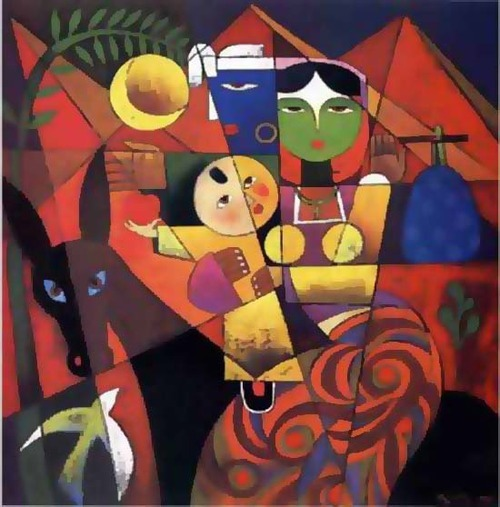
Flight to Egypt by He Qi

God’s kindness and loyalty preserves us from the wrath of the devil who seeks to keep as many people as possible in the realm of darkness. 

Our hope is in the Lord, specifically, in Jesus who has conquered the devil; and he did it by first establishing a beachhead on this earth through his incarnation as the Son of God.

Just as Hosea’s prophecy was an appeal to turn from other gods to the true and living God of mercy and grace, so Matthew calls us to turn from idolatry, from anything that would displace Jesus as the rightful Ruler of our lives.

Jesus brought us out of exile

King Herod massacred innocent toddlers in order to ensure the destruction of Jesus. Behind his atrocity was the devil himself who knew that Jesus was the coming King who would one day bring salvation, and the satanic agenda was set in place.

However, nothing can thwart the fulfillment of God’s promises – including Satan, whose most powerful weapon, death, has now lost its sting because of Jesus.

Just as the prophet Jeremiah spoke hope to the people that exile will not be forever, so Matthew speaks the fulfillment of that hope. The incarnation is here. Jesus has arrived. Salvation has come in the form of a child. He is the Deliverer, the Savior. Christ brings us from captivity into the promises of God.

Jesus came to save the littlest, the lowly, the least, the lost, the lonely, and the last. God demonstrated the commitment to deliver such persons through a humble existence in a backwater town called Nazareth.

Jesus is the new Moses

Joseph is, again, unexpectedly visited by an angel with instructions concerning Jesus. Herod, after all his sinister shenanigans, finally dies. The ancient Jewish historian, Josephus, described Herod’s death: 

He had a terrible craving to scratch himself, his bowels were ulcerated, and his privates were full of gangrene and worms. At Jericho he assembled the men of distinction from all parts of the nation and ordered them shut inside the hippodrome. He told his sister, Salome, that as soon as he died, all these men were to be killed, so that there would be grief throughout the country at his death rather than joy. (Paul Maier, Josephus: The Essential Works, 252)

The contrast between King Herod and King Jesus could not be any more pronounced; Jesus said in a clear demonstration of his humility and grace at his death:

“Father, forgive them, for they do not know what they are doing.” (Luke 23:24, NIV)

With Herod dead, it was safe to return to Israel. Matthew links Jesus to the exodus and deliverance of the Israelites as the new Moses. Just as Moses was by God to go back to Egypt because all the men who wanted to kill him were dead (Exodus 4:19) so Jesus is also told to return from Egypt because he will save the people from their sins.

Everything in Holy Scripture points to Jesus, in one way or another, on purpose, as the center from which all things hinge and revolve. 

Christ the Deliverer, Rio De Janeiro, Brazil

At the beginning of this New Year, in the middle of Christmastide, it is good to remember the incarnation of Jesus to help set the tone for the entire year.

Christ came to us so that he might set apart a holy people, dedicated to doing his will, and living according to the ethics of God’s kingdom. 

God doesn’t determine who is a good follow through the metrics of perfect attendance to church services, but in how we interact with people while we are there, and how we live our lives when we are outside the four walls of a church building. 

God has found us, and the purpose of our existence is to know God and enjoy the Lord forever.

Jesus of Nazareth

Nazareth was an obscure village, not a likely place for a king to settle down and live. Yet, this is in line with what the prophet said would occur:

Nevertheless, there will be no more gloom for those who were in distress. In the past he humbled the land of Zebulun and the land of Naphtali, but in the future he will honor Galilee of the nations, by the Way of the Sea, beyond the Jordan—

The people walking in darkness
    have seen a great light;
on those living in the land of deep darkness
    a light has dawned. (Isaiah 9:1-2, NIV)

The choice of settling in Nazareth underlines that the gospel is not only for particular people, not just for Jews, the wealthy, or the influential; the gospel is for everyone, especially for the lost, the least, and the lowly. 

Describing Christ as “Jesus of Nazareth” means we are expressing an important theological truth that God is with us, that the Lord identifies with us, that the universal Sovereign of all is concerned for the common person, the poor, needy, and powerless among humanity.

The settling in Nazareth also underscores that Jesus is a different kind of king – he rules over God’s kingdom as a servant leader, using his power to dispense grace. Christ shares that power by giving it away, and together with the Father, gives the Holy Spirit. 

Unlike earthly political kings who demanded outward allegiance, Jesus gains followers through touching the heart by means of grace and love. Christ doesn’t coerce and cajole but serves others. He is patient, not wanting any to perish but all to come to eternal life.

Jesus is the culmination and climax of history. Hope is not found in electing the right politicians or having the right boss at a workplace; hope is not in attending church services and doing all the acceptable Christian activities.

Rather, hope resides in the child Jesus who was born to die so that we might live. We aren’t saved by the right people in the right positions, or in doing the right things, or having the right ideas – because Jesus is the Savior; he is our hope.

Almighty Lord God, give us true faith, and make that faith grow in us day by day. Also give us hope and love, so that we may serve our neighbors according to your will; through your Son, Jesus Christ our Lord, who lives and reigns with you and the Holy Spirit, one God, now and forever. Amen.