Christmas Day (John 1:1-14)

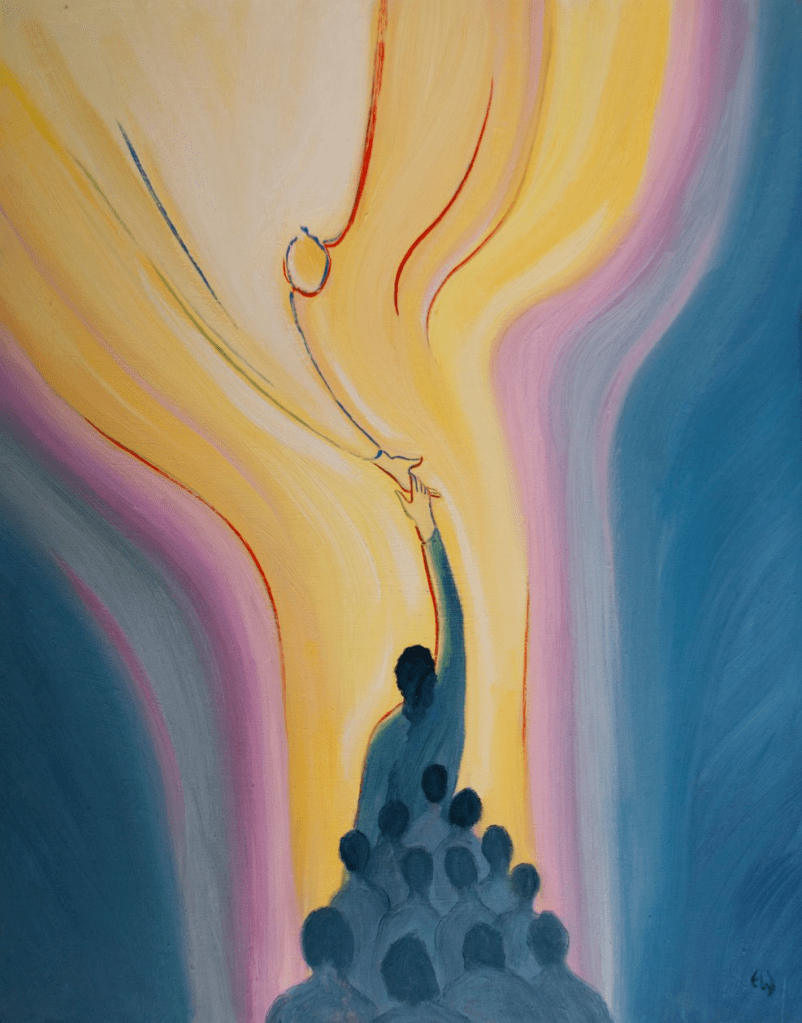
Art by Lourry Legarde

The Word was first,
    the Word present to God,
    God present to the Word.
The Word was God,
    in readiness for God from day one.

Everything was created through him;
    nothing—not one thing!—
    came into being without him.
What came into existence was Life,
    and the Life was Light to live by.
The Life-Light blazed out of the darkness;
    the darkness couldn’t put it out.

There once was a man, his name John, sent by God to point out the way to the Life-Light. He came to show everyone where to look, who to believe in. John was not himself the Light; he was there to show the way to the Light.

The Life-Light was the real thing:
    Every person entering Life
    he brings into Light.
He was in the world,
    the world was there through him,
    and yet the world didn’t even notice.
He came to his own people,
    but they didn’t want him.
But whoever did want him,
    who believed he was who he claimed
    and would do what he said,
He made to be their true selves,
    their child-of-God selves.
These are the God-begotten,
    not blood-begotten,
    not flesh-begotten,
    not sex-begotten.

The Word became flesh and blood,
    and moved into the neighborhood.
We saw the glory with our own eyes,
    the one-of-a-kind glory,
    like Father, like Son,
Generous inside and out,
    true from start to finish. (The Message)
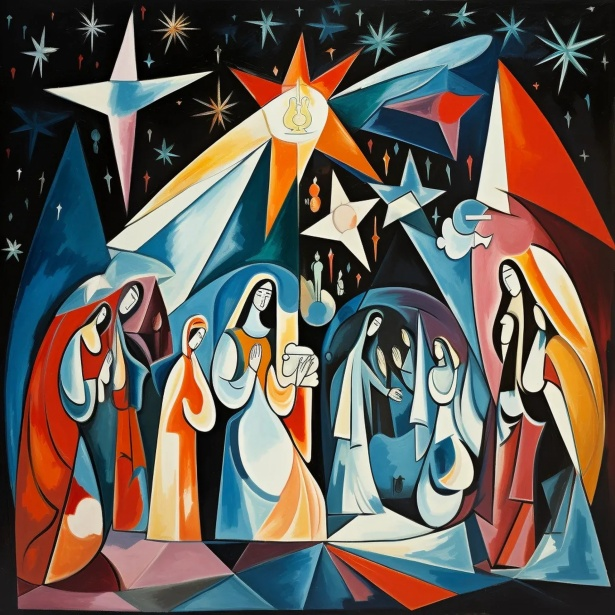
Art by Linnaea Mallette

Joy to the world! Merry Christmas to you, my friend. On this day, and for the next twelve days, we remember and celebrate the nativity of Christ, and the mystery of his incarnation.

We acknowledge with Christians, both past and present, all around the world, in proclaiming together:

“Glory to God in heaven, and on earth peace among those whom he favors.” (Luke 2:14, CEB)

We relate to the shepherds, out in their fields, caring for the flocks of sheep at night, who were terrified, yet went and offered their worship to the newborn king, listening to the angelic message:

Then the angel said to them, “Do not be afraid, for behold, I bring you good tidings of great joy which will be to all people. For there is born to you this day in the city of David a Savior, who is Christ the Lord.” (Luke 2:10-11, NKJV)

We identify with Mary, the mother of Jesus, who pondered the meaning of the nativity in her heart. (Luke 2:19)

This Christmas season extends from December 25 through January 5. Celebrating throughout these days helps us enter into the profound meaning and mystery of Christ’s incarnation – rather than just observing one day.

Today’s Gospel lesson moves us to do just that, to acknowledge and affirm the identity of Jesus Christ as fully human, and at the same time, all the time, fully divine.

Christ was both born into this world, and pre-existed from the very beginning. Indeed, Jesus has always existed, without any sort of preconditions to his eternal being. He is a person, a persona of God. In other words, Jesus is God.

The Lord Jesus is the pre-existent light-bearer who is designated to come as the light-giver, whose light is unquenchable and never goes out. He is the Light of the world.

John is a witness to that light. And although this light should have been expected, there were (and are) many who reject the Light, who is the Word for the world.

Yet, any sort of rejection cannot possibly hinder the light’s ability to illumine the hearts of many people.

This Word, this Light, this pre-existing Christ, has actually enfleshed himself, becoming present with us in this world. And this is precisely what the faithful are celebrating this day, and in this season. God has come among us!

The giving of the Son, this person of God, this incredible light and life, is a grace well beyond the divine giving of the Law – because the Law has been incarnated in the person of Jesus the Christ.

There is much to ponder, and much to celebrate, on this day, and for the upcoming days of this season.

We were all physically born of the flesh. We may all also become spiritually born of God through the Word of God, Jesus, the Savior whom we acknowledge and adore today and every day.

“The Word of God, our Lord Jesus Christ, through his transcendent love, became what we are, so that he might bring us to what he is himself.”

St. Irenaeus

By means of the incarnation, in Christ, and through the Spirit, we have the chance, the ability, made possible by God’s grace, to participate in the divine nature; and in the divine dance of unhindered and unending unity, harmony, peace, and love which continually exists within the Holy Trinity – Father, Son, and Spirit.

This is a spiritual reality worth a robust celebration today – and all the days which God gives us on this earth. To God be the glory.

God, you spoke, and your Word became flesh, breathing a new song of joy and praise into the world. Grant that we may bear the good news of your salvation, proclaiming your promise of peace to the ends of the earth. Amen.

The Real Thing (Hebrews 9:24-28)

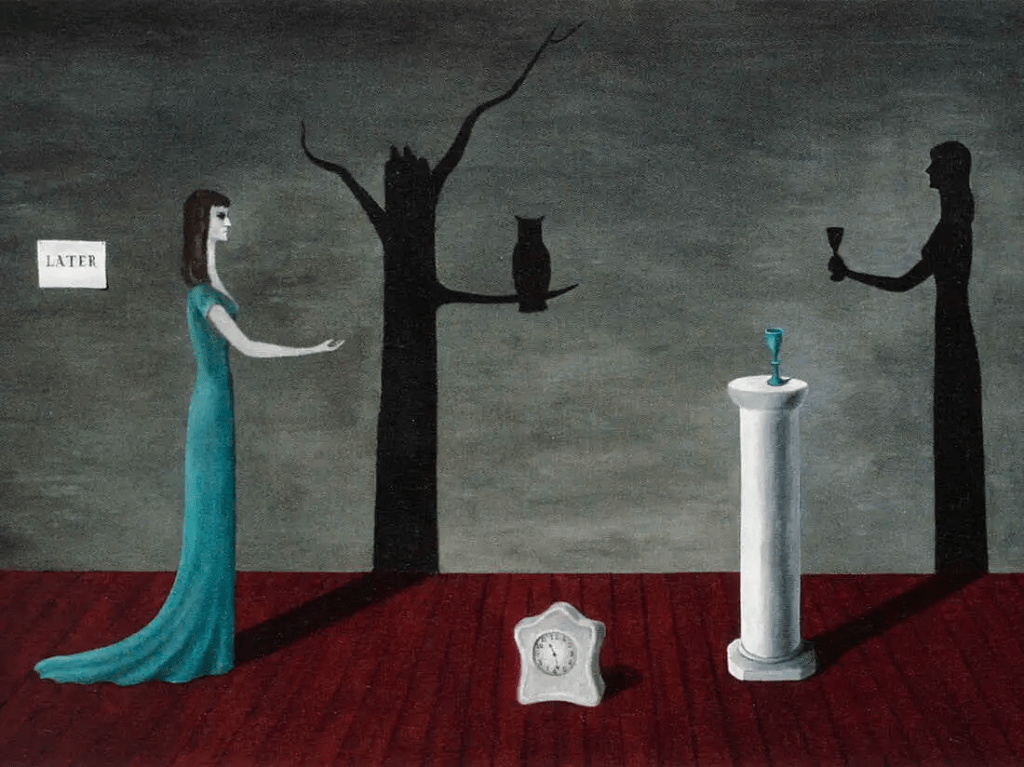
Strange Shadows (Shadows and Substance), by Gertrude Abercrombie, 1950

For Christ did not enter a sanctuary made by human hands, a mere copy of the true one, but he entered into heaven itself, now to appear in the presence of God on our behalf. 

Nor was it to offer himself again and again, as the high priest enters the holy place year after year with blood that is not his own, for then he would have had to suffer again and again since the foundation of the world.

But as it is, he has appeared once for all at the end of the ages to remove sin by the sacrifice of himself. And just as it is appointed for mortals to die once and after that the judgment, so Christ, having been offered once to bear the sins of many, will appear a second time, not to deal with sin but to save those who are eagerly waiting for him. (New Revised Standard Version)

I admit that the Book of Hebrews in the New Testament is one of my favorite books of the Bible. I also recognize that Hebrews is one of the most difficult books to deal with. And specifically, chapter 9 can be quite mind-boggling.

The author of Hebrews, whoever he was actually was, did the intellectually and theologically staggering job of establishing continuity between the two testaments of the Bible.

He compared and contrasted the old (or first) covenant with the new (or second) covenant, examining the Levitical priesthood and its sacrificial system, with Christ as the high priest whose singular sacrifice ended all sacrifices.

The old sacrificial system began on Mount Sinai. Moses sprinkled the sacrificial blood of bulls and goats on both the people and the tabernacle. He was consecrating them, and the sacrificial implements, so that everyone could participate in the worship of Yahweh.

In the new covenantal system, blood is also used to purify. Yet, the heavenly tabernacle could not be cleansed with the blood of animals. It required a better and superior sacrifice. (Hebrews 9:23)

The Sacrifice of Christ, by Elizabeth Wang, 2002

That sacrifice is Jesus. He was both the high priest officiating the ritual, and the actual sacrificial offering. It is the life of Jesus, given in self-sacrificial death, which enables worshipers to come to God without any obstruction whatsoever.

Jesus does not have to keep offering himself. It was a one and done affair. One sacrifice on behalf of everyone. Once for all.

This is, of course, a distinctively Christian view and approach to the problem of guilt, shame, disobedience, and death. It has been a very compelling view for millions of people over the past two millennia.

In whatever way one seeks to understand and make sense of the author’s line of reasoning concerning a Christian approach to sacrifice and dealing with sin, what is apparent to me is that the author talked of a reality that we do not presently see.

The author of Hebrews was lifting up something important that he wanted us to notice. He was pointing out the reality of spiritual forces that have the power to both destroy and give life.

The earthly objects that we can see, touch, feel, hear, and smell are mere representations or shadows of heavenly things.

Many people, if not most people, today would say that invisible things such as our ideas and philosophies of religion are mere mental ways of understanding the objective reality in front of us that we can use our five senses to detect.

But the author of Hebrews insists – and I believe rightly so – that it’s the other way around. Everything we are presently experiencing with our objective senses is a projection of the ultimate invisible reality.

In other words, this entire world will pass away, because it is but a shadow in the history of eternity. The invisible God is the real deal. The heavenly sanctuary is reality. Love is the permanent operating system of eternity, and not your 401(k) or the next political election.

Jesus the Christ has offered himself once for all time, and for all sins. And he did it because the triune God – Father, Son, and Spirit – is a community of unitive love. That is, God is Love. So therefore, God can only do that which is love.

The end of time is not yet here. This present world with all of its inconsistent ways of doing both good and bad is still with us. But Jesus will come again.

The sin issue has been dealt with, once and for all. Christ did that. Jesus will return in order to bring salvation to those who are waiting for him.

If we must wait, let us do it patiently, with all of the faith and endurance it requires. Yet, this is not a passive waiting. We are to be busy proclaiming the good news of God’s invisible realm with both words and sacraments – with the signs and shadows and representations we have that point to the reality of God.

Everything visible and tangible on this earth is mirroring a greater, better, and superior reality which we cannot see with our eyes or touch with our hands.

Christianity is unabashed that all things point to Christ, who is the first and the last, the alpha and omega, the be all and end all of everything.

Come, Lord Jesus, Son of God, Son of Humanity. We long for you to return in glory and set us and this entire sinful world aright with your divine justice.

Be our guest, Lord Jesus, our Savior and Friend. We receive in faith your salvation. We trust that both the physical food and spiritual food you give will sustain us for our work and worship in this world.

May it be so, to the glory of God, and through the enablement of the Holy Spirit. You are one God – Father, Son, and Spirit – in one holy community of Love, now and forevermore. Amen.

Visible Signs of Invisible Realities (Hebrews 9:15-24)

For this reason Christ is the mediator of a new covenant, that those who are called may receive the promised eternal inheritance—now that he has died as a ransom to set them free from the sins committed under the first covenant.

In the case of a will, it is necessary to prove the death of the one who made it, because a will is in force only when somebody has died; it never takes effect while the one who made it is living. This is why even the first covenant was not put into effect without blood. When Moses had proclaimed every command of the law to all the people, he took the blood of calves, together with water, scarlet wool and branches of hyssop, and sprinkled the scroll and all the people. He said, “This is the blood of the covenant, which God has commanded you to keep.” In the same way, he sprinkled with the blood both the tabernacle and everything used in its ceremonies. In fact, the law requires that nearly everything be cleansed with blood, and without the shedding of blood there is no forgiveness.

It was necessary, then, for the copies of the heavenly things to be purified with these sacrifices, but the heavenly things themselves with better sacrifices than these. For Christ did not enter a sanctuary made with human hands that was only a copy of the true one; he entered heaven itself, now to appear for us in God’s presence. (Hebrews 9:15-24)

The Hebrew Christians were tired. They had faced adverse circumstances, unjust imprisonments, persecution, prejudice, confiscation of their property, and public ridicule.

Most of all, they encountered rejection from their Jewish families of origin. There was precious little support for them, outside of their group.

The suffering went on long enough that the Christians began to experience a weakening of faith. In their distress, they started considering whether to return to Judaism, and renege on their commitment to Christ.

The author of Hebrews saw the struggle and spoke up, encouraging and exhorting the believers to keep going, to exercise faith and perseverance in the face of their ongoing troubles.

The author’s overall message to the discouraged believers was that Jesus Christ is superior over everything and everyone. Christ is better than the angels, Moses, and Aaron. Jesus is the ultimate high priest who offered himself as a sacrifice, once for all.

By means of the cross, Jesus became the mediator of a new and better covenant. There is, therefore, no more need of another high priest. Christ now occupies that office permanently.

Jesus Christ Points us to God, by Elizabeth Wang

Christ’s death was efficacious for all. The sacrificial system with all of the officiating Levitical priests was the old order of things, meant to point us to Christ.

Offering sacrifices day after day, and engaging in prescribed liturgical rituals in order to access God, are no longer necessary. Perpetual anxiety exists wherever people keep wondering if they have done enough to satisfy their guilt and/or responsibility.

The answer of Christianity is yes, the work is finished; Jesus completed it, once and for all.

There is no longer anything that can distress us. Sin, death, and hell have been conquered through the death of Christ. His singular sacrifice has achieved victory over the sinful powers, and reconciliation and peace with God.

Blessed is the one
    whose sin the Lord does not count against them
    and in whose spirit is no deceit. (Psalm 32:2, NIV)

The covenant code’s sacrificial system was never designed to be a permanent way of doing things. All of the implements used in that system were symbols pointing to the real deal. They were a temporary means of leading people to Christ, who is the once for all sacrifice to end all sacrifices, the one who truly takes away our guilt and shame forever.

The picture is of Christ, as our high priest, who sprinkled us with his own blood and made us clean – not only today or for some temporary period of time – but for all time. We are not only made clean; we are made clean forever by the blood of Christ.

Cleanse me with hyssop, and I will be clean;
    wash me, and I will be whiter than snow. (Psalm 51:7, NIV)

The historical person of Jesus – his life, ministry, crucifixion, death, resurrection, ascension and glorification – was a visible image showing us the great importance of invisible realities.

The Ark of the Covenant was a visible sign of God’s invisible presence, and the need for a restoration of the divine/human connection.

The temple, the worship implements, and the whole sacrificial system was a visible sign of God’s invisible holiness, and the need for purity of heart amongst the people.

Jesus was a real person with a real body and real human needs, a visible reality which showed us the invisible God, and what God truly deems as right and good.

It is Jesus Christ, the Son of God and Son of Humanity, in whom we have redemption the forgiveness of sins. He is the image of the invisible God. (Colossians 1:14-15)

Christ is our Mediator, bridging the gap between heaven and earth.

Christ is our Savior, delivering us from our guilt and shame, our worry and anxiety, and our old enemy, death itself.

Christ is our Advocate, stepping in and acting on our behalf, and sending the Holy Spirit to be his continuing presence on this earth.

Christ is our champion, the pioneer of our salvation, securing redemption for us through his singular death.

Christ is our Intercessor, who even now lives to intercede for us, as we strive and struggle to live in humility, justice, and righteousness, as peacemakers in this world.

What this all means, from the vantage of Christianity, is that we need Jesus.

Without Christ, there is no hope. With Christ, all things are possible.

Jesus is the answer to every question, because Jesus is the center of all things. He is the fertile soil from which all of life sprouts; the first-fruit which provides life; and the continuing sustenance which saves us from a disconnected, fragmented, discouraging existence.

Along with the ancient Hebrew Christians, let us be encouraged with Christ, who is truly our everything.

Accept, O Lord, our thanks and praise for all that you have done for us. We thank you for the disappointments and failures that lead us to acknowledge our dependence on you alone.

Above all, we thank you for your Son Jesus Christ; for the truth of his Word, and the example of his life; for his steadfast obedience, by which he overcame temptation; for his dying, through which he overcame death; and for his rising to life again, in which we are raised to the life of your kingdom.

Grant us the gift of your Spirit; that we may know you and make you known; and through your Spirit, at all times and in all places, may give thanks to you in all things. Amen.

Deliver Us From Evil (Psalm 144:9-15)

I will sing a new song to you, God.
    I will sing praises to you on a ten-stringed harp,
        to you—the one who gives saving help to rulers,
        and who rescues his servant David from the evil sword.
Rescue me and deliver me from the power of strangers,
        whose mouths speak lies,
        and whose strong hand is a strong hand of deception,
    so that our sons can grow up fully, in their youth, like plants;
    so that our daughters can be like pillars carved to decorate a palace;
    so that our barns can be full, providing all kinds of food;
    so that our flocks can be in the thousands—
        even tens of thousands—in our fields;
    so that our cattle can be loaded with calves;
    so that there won’t be any breach in the walls,
    no exile, no outcries in our streets!

The people who have it like this are truly happy!
    The people whose God is the Lord are truly happy! (Common English Bible)

And lead us not into temptation, but deliver us from evil.”

Jesus (Matthew 6:13, KJV)

Evil lurks everywhere. It resides in the human heart, hidden in the dark shadows, coming out sideways through shameful lies and guilty actions.

The presence of evil is also found throughout the world in every institution, organization, and group, ensconced as systemic injustice – hoarding resources for the powerful at the expense of the powerless; showing prejudice and favoritism to some, while ignoring others.

Since there is wickedness found in all places and with all people, evil needs to be dealt with and expunged from both hearts as well as institutions and organizations. Part of the solution is to do away with all obstacles which stand in the way of human flourishing.

Save us from the Evil One. (Matthew 6:13, ERV)

To be sure, the heart of humanity must be dealt with and be the focus of change. Yet, if we only focus one-dimensionally on evil, it will persist, and even grow into monstrous proportions, unless we equally direct our right and just efforts on structural and systemic evil.

People and their institutions need deliverance from the power of evil in the world. And for that to happen, the hindrances and handicaps to human thriving must be eliminated.

Our entire concept of salvation needs a fuller scope. Not only do individuals need personal deliverance from sin, death, and hell, so do entire societies. Complete systemic rescue from oppressive obstacles is a must. Far too many people in this fallen world are weighed down from institutional sin.

Christ obeyed God our Father and gave himself as a sacrifice for our sins to rescue us from this evil world.

Galatians 1:4, CEV

In looking at the need for deliverance from evil in a different context, the genius of the American experiment was that the founding fathers (and mothers!) of the United States created a political and societal system which sought to eliminate class distinctions and allowed people of lower means to achieve land ownership and business acumen simply through hard work and thrift.

Unfortunately, the experiment only extended mostly to landowning white men. Native American and African American people still had huge systemic obstacles to overcome. And the new republic had different expectations for women.

It took a Civil War and decades of grueling work to address political and social change (not to mention religious). We are still today laboring to truly give liberty and justice for all, and to achieve the ideal of an egalitarian nation.

We, as both individuals and citizens, need divine intervention through deliverance. Like Gilligan and the crew of the Minnow stranded on a deserted island, we seek to be rescued – knowing we need help beyond ourselves for salvation.

Rescue us from the evil one. (Matthew 6:13, NRSV)

The psalmist looked ahead in hope, convinced that a good God will deliver and provide good people with everything they need to thrive and flourish in this life, and in the life to come.

If God doesn’t fight our overwhelming battles for us, we are lost. This present darkness, this both ancient and contemporary evil, is an extremely powerful foe. However, the Lord is greater and will have the last word.

Christianity asserts that Jesus is the pioneer of our salvation, and the once for all answer to the problem of evil, for both the world and the human heart. Christ, in other words, is the fulfillment of the psalmist’s prayers for deliverance, health, and hope.

Protect us from evil. (Matthew 6:13, CEV)

In his earthly ministry, Jesus did not give explanations for our pain and sorrow. Instead, Jesus comes where our pain is most acute, and takes it upon himself – bringing healing and hope.

The Lord tackles evil, not by having a Zoom conference on the subject of wickedness, but by allowing evil to do its worst to him. Christ exhausts evil by draining it of its power, emerging resurrected with new life for all.

The good news: Jesus is Lord and has defeated the powers of evil.

Now, renewal and reform can occur. Hearts can change. Systems can be revamped. God’s new world has begun.

God rescued us from the control of darkness and transferred us into the kingdom of the Son he loves. He set us free through the Son and forgave our sins. (Colossians 1:13-14, CEB)

I, personally, am a Christian because I believe God is the one who satisfies the passion for justice, the longing for spirituality, the hunger for relationship, and the yearning for beauty. I see God in Jesus of Nazareth, the world’s true Lord.

Hope, like the psalmist expressed, is what you get when you realize a different worldview is possible. Hope springs to life when those who feel the brunt of evil in the world become acutely aware that the rich, the powerful, and the unscrupulous are not the ones really in charge.

“Our task as image-bearing, God-loving, Christ-shaped, Spirit-filled Christians, following Christ and shaping our world, is to announce redemption to a world that has discovered its fallenness, to announce healing to a world that has discovered its brokenness, to proclaim love and trust to a world that knows only exploitation, fear and suspicion…” N.T. Wright

May you be delivered from evil, and saved from the Evil One. May you know the Savior, and take solace in his peace. And may you be buoyant in faith, confident in hope, and overflowing with love. Amen.