John 4:7-26 – Living Water

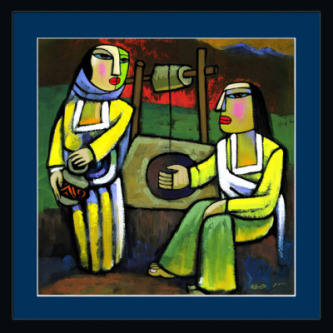
Samaritan Woman at the Well by He Qi

When a Samaritan woman came to draw water, Jesus said to her, “Will you give me a drink?” (His disciples had gone into the town to buy food.)

The Samaritan woman said to him, “You are a Jew, and I am a Samaritan woman. How can you ask me for a drink?” (For Jews do not associate with Samaritans.)

Jesus answered her, “If you knew the gift of God and who it is that asks you for a drink, you would have asked him, and he would have given you living water.”

“Sir,” the woman said, “you have nothing to draw with and the well is deep. Where can you get this living water? Are you greater than our father Jacob, who gave us the well and drank from it himself, as did also his sons and his livestock?”

Jesus answered, “Everyone who drinks this water will be thirsty again, but whoever drinks the water I give them will never thirst. Indeed, the water I give them will become in them a spring of water welling up to eternal life.”

The woman said to him, “Sir, give me this water so that I won’t get thirsty and have to keep coming here to draw water.”

He told her, “Go, call your husband and come back.”

“I have no husband,” she replied.

Jesus said to her, “You are right when you say you have no husband. The fact is, you have had five husbands, and the man you now have is not your husband. What you have just said is quite true.”

“Sir,” the woman said, “I can see that you are a prophet. Our ancestors worshiped on this mountain, but you Jews claim that the place where we must worship is in Jerusalem.”

“Woman,” Jesus replied, “believe me, a time is coming when you will worship the Father neither on this mountain nor in Jerusalem. You Samaritans worship what you do not know; we worship what we do know, for salvation is from the Jews. Yet a time is coming and has now come when the true worshipers will worship the Father in the Spirit and in truth, for they are the kind of worshipers the Father seeks. God is spirit, and his worshipers must worship in the Spirit and in truth.”

The woman said, “I know that Messiah” (called Christ) “is coming. When he comes, he will explain everything to us.”

Then Jesus declared, “I, the one speaking to you—I am he.” (New International Version)

Jesus and the Samaritan Woman by He Qi

Many years ago, I was the pastor of a small congregation north of Detroit, Michigan. Many of the people in the community viewed the big city as a place of disrepute. So, they avoided going into the heart of the great city as much as possible.

The locale of Samaria was viewed much the same way by many Jews back in Christ’s day. Samaritans were seen as untrustworthy, a mongrel people with a mix of Jewish and ancient Assyrian blood. And their religion was most suspect of all – an amalgam of Jewish and Gentile practices.

Jesus, however, didn’t avoid the territory. He confidently walked through Samaria and had no problem stopping to rest on his journey in a foreign area. That’s because Jesus didn’t class people into groups, nor did he attach adjectives to people, such as “those” Samaritans.

Jesus had no obstacles between himself and others.

Which is why an organic conversation happened between Jesus and a Samaritan woman. Christ simply saw a human being who happened to be a woman and a Samaritan. He acknowledged both her gender and her ethnicity without those being a problem. Not even Christ’s knowledge of her string of husbands was a problem in conversing with her.

Every time I read this narrative of Jesus interacting with the Samaritan woman, I wonder and use my imagination about all the non-verbal communication. I am sure the conversation was as much about Christ’s affect, gestures, and tone of voice, as it was his well placed words. I fully believe his verbal and non-verbal communication was perfectly congruent with each other, giving the woman a compelling sense that her ultimate needs could be met with the living well of a person in front of her.

Water gives life. And Jesus, as living water, gives new life. A bunch of failed relationships testified to the woman’s dissatisfaction. Even though we hear no more about her after this story in the Bible, we as readers get the overwhelming sense that the woman finally found satisfaction. The love which kept slipping through her fingers now had staying power.

I am sure the Samaritan woman discovered true worship, in spirit and in truth.

I still remember my first encounter, at least my first aware experience, with the living Christ. I am quite sure Jesus was near me for a long time, without me knowing his presence. Words will never truly capture the overwhelming sense of love, acceptance, mercy, kindness, and deep satisfaction – a contentment and gratification which has stuck with me now for decades.

Messiah, “Savior,” is an apt term for Jesus. He certainly saved me from myself. And Christ has never left me nor forsaken me – always there, always available, always loving with both tender love and tough love.

I’m glad that Jesus didn’t consider this earth like the city of Detroit – a place to avoid – but willingly came to encounter people like the Samaritan woman, and me. And this is the basis of true worship.

“Have faith in me, and you will have life-giving water flowing from deep inside you, just as the Scriptures say.” (John 7:38, CEV)

Lord Jesus, Son of God, Savior of humanity, there is a river flowing straight from your heart into mine — replenishing, renewing, sustaining. May you, as Living Water, be persistent in me, breaking through every barrier in its path. Send this hydro-power through the dark crevices of my heart like a mighty flood overcoming and pushing everything out of the way that blocks its path. I want my heart to be washed clean of any debris cluttering and blocking your life-giving flow. May your love overflow onto your people — your grace, your mercy — into the lives of those we encounter, to your glory and honor, in spirit, and in truth. Amen.

Psalm 84 – The Joy of Worship

Every now and then I like taking a psalm and doing my own loose contemporary translation of the text (just so you know, I’ve had training in the Hebrew language, so this isn’t weird for me, or for you!). I find this exercise to be exhilarating and helpful for my own soul. I hope you find this to be useful for you, as well. 

Today’s psalm talks about the temple. I have contemporized it for the Christian who enjoys fellowship with God in the many places where the Lord can be found. I encourage you to read it over once, then carefully read it again, prayerfully. Do it both times out loud. The psalms are meant to be prayed, and they are meant to be said aloud with flavor!

How lovely are all the places where you dwell,
    powerful and mighty God of the numerous heavenly forces!

The depths of my soul long, even yearn,
    for the intimate backyard gatherings where Yahweh dwells.
My heart and my body, my whole self
    shout out loud for joy to the living God!

Yes, the lowly insignificant mother sparrow has also found a home with God;
    the swallow has, too, found herself a homey nest
    where she can lay her young beside your divine activity.
    Immense Lord of the numerous heavenly forces, my king, my God,

    You are so big that the lowliest of creatures find shelter in you!
Those who live within your sacred space are genuinely happy;
    they can’t stop praising you constantly and incessantly!

Those who put their energy in you are truly content;
    a one-way road to you is in their hearts.
As they walk through all kinds of dry hard circumstances
    they end up making them like a spring of living water.
    Yes, even problems become like a gentle rain of blessing.
The biggest of dilemmas become manageable,
    as they see the supremacy of God in it all.
Mighty Lord God of the numerous heavenly forces,
    hear my prayer to you;
    listen closely, O ancient God of my spiritual ancestors!

You are our great protective shield, God;
    pay close attention to your chosen one!

Better is one single solitary day in your backyard gathering
    than a billion days anywhere else!
I would prefer to park cars out in the front yard of God’s house
    than live comfortably in the palatial hangouts of the ungodly!
The Lord is like the brightness of a warm summer day,

and even the suntan lotion protecting me; God is all that!
    God is full of crazy grace and unspeakable glory.
The Lord gives— and doesn’t withhold — good things
    to those who walk with integrity of heart beside him.
Powerful Lord of the numerous heavenly forces,
    those who trust in you are truly giddy with joy!

Divine presence makes all the difference in the world. To be with God, to sense the Lord’s company, and to enjoy Divine favor brings deep satisfaction and contentment within a world of great dissatisfaction and discontent.

True beauty is found with the Author of the beautiful. Love motivates the pilgrimage toward God. The non-judgmental presence of the Lord provides us with a place of security, peace, and rest. Indeed, the nearness of God changes everything. It transforms our present circumstances from drudgery and despondency to opportunities for God to show up and show off divine power.

God, the heavenly king, and commander of heavenly forces chooses to dwell among us. The Lord’s ear is attentive to each person. The connection between God and God’s people is inseparable. This, then, is the very place where trust is engendered. Placing faith in a God who cares, listens, and acts blesses everyone.

Today, God abides with us because of the indwelling Spirit of Jesus. God’s presence has the effect of bringing people together and calming all fears. God’s eye is on the sparrow, which means the Lord is always watching with care and concern for all creation, especially humanity.

Almighty God, merciful heavenly Father, we give you humble thanks for all your goodness, kindness, and steadfast love to us and to all whom you have made. We bless you for our creation, preservation, and all the blessings of this life. Above all, we are grateful for your immeasurable love shown through the redemption of the world by our Lord Jesus Christ. Give us such an awareness of your divine presence, that with truly thankful hearts our lives might be an offering of praise in both speech and action. We trust you, gracious God, and give ourselves to your service. We choose to walk with you in holiness and righteousness all the days of our lives, through Jesus Christ our Lord, to whom with you and the Holy Spirit, be honor and glory forever. Amen.

His Eye Is On the Sparrow, sung by Selah

Psalm 126 – Sorrow and Joy

When the Lord restored the fortunes of Zion,
    we were like those who dreamed.
Our mouths were filled with laughter,
    our tongues with songs of joy.
Then it was said among the nations,
    “The Lord has done great things for them.”
The Lord has done great things for us,
    and we are filled with joy.

Restore our fortunes, Lord,
    like streams in the Negev.
Those who sow with tears
    will reap with songs of joy.
Those who go out weeping,
    carrying seed to sow,
will return with songs of joy,
    carrying sheaves with them. (NIV)

Likely none of us awake in the morning, sit up on the edge of the bed and say to ourselves, “Well, let’s see, I think I’ll cry and be sorrowful today.” We might do that with joy, not with sadness. It can be easier to gravitate toward the fulfillment of dreams, laughter, and happiness than tears and weeping.

If we want to experience authentic joy, the path is through crying because it is our tears which find a better way.

Whether it comes from a certain denominational tradition, ethnic background, or family of origin dynamics, there are many Christians who love to emphasize Jesus as Victor and camp in resurrection power – while eschewing Christ as the man of sorrows, acquainted with grief and sadness.

It is from this place of continually viewing only one dimension of Christ’s redemptive work that pastoral care often falls far short of true help. Trying to engineer cheerfulness and create solutions to a person’s genuine grief is, at best, not helpful, and at worst, damaging to their soul. Such attempts will only lead to cheap joy.

Coming to the place of sincerely singing spontaneous songs of joy with a sense of abundant satisfaction comes through suffering and sorrow.

There must be a crucifixion before there is a resurrection. In the agrarian culture of ancient Israel, the metaphor of sowing a reaping connected well to the importance of planting tears and allowing them to flower later into an abundant harvest of joy.

Perhaps in American culture, a more apt metaphor would be financial investing and cashing out. The investment we put into attending to our grief with expressions of lament through tears, will eventually get a return, and we shall be able to cash out with a rich bounty of joy.

All good things in life are realized through a lot of blood, sweat, and tears. “Blessed are those who mourn,” said Jesus, “for they shall be comforted” (Matthew 5:4, NIV). Just as it takes both field crops and economic investments time to grow and mature, so the believer’s life is a process of spiritual development which is watered through tears and experiences the up-and-down sorrows of a market economy.

There is coming a day when our joy will be realized in full measure. The season of Advent reminds us that we must wait, and that we must suffer many things before we enter the kingdom of God and enjoy unending fellowship with our beloved Savior and King.

Great God almighty, with expectant hearts we await the coming of Christ. As once he came in humility, so now may he come in glory so that he may make all things perfect in your everlasting kingdom. For Christ is Lord forever and ever. Amen.

John 6:25-35 – The Bread of Life

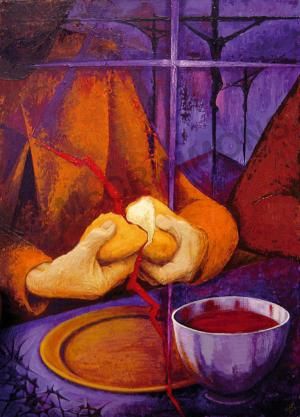
The Breaking of the Bread by Sr. Mary Stephen

When they found him on the other side of the lake, they asked him, “Rabbi, when did you get here?”

Jesus answered, “Very truly I tell you, you are looking for me, not because you saw the signs I performed but because you ate the loaves and had your fill. Do not work for food that spoils, but for food that endures to eternal life, which the Son of Man will give you. For on him God the Father has placed his seal of approval.”

Then they asked him, “What must we do to do the works God requires?”

Jesus answered, “The work of God is this: to believe in the one he has sent.”

So, they asked him, “What sign then will you give that we may see it and believe you? What will you do? Our ancestors ate the manna in the wilderness; as it is written: ‘He gave them bread from heaven to eat.’”

Jesus said to them, “Very truly I tell you, it is not Moses who has given you the bread from heaven, but it is my Father who gives you the true bread from heaven. For the bread of God is the bread that comes down from heaven and gives life to the world.”

“Sir,” they said, “always give us this bread.”

Then Jesus declared, “I am the bread of life. Whoever comes to me will never go hungry, and whoever believes in me will never be thirsty. (NIV)

Christians everywhere hold to Jesus as the Son of God, Lord of the universe, and Savior of all. However, for most people who were following Jesus around in the first century, this was not their understanding of Christ.  In his earthly ministry, Jesus spoke in ways that introduced people to who he really was and sought to bring them to a point of following him based on his identity. 

Jesus wanted the crowds to him for who he really is – themselves for what they really needed – and follow him based on the deepest needs of their lives. I believe Jesus is the hope of all nations and all people, and in him humanity’s most basic and profound needs are met for forgiveness, love, and purpose in life. To address this, I ask three basic philosophical and theological questions of life:

What should human beings seek the most and work the hardest for in life?

The responses in history are legion. The ancient Greek philosopher Aristotle thought a proper appreciation for an ethical and virtuous life found in practical wisdom was where people’s most concerted efforts should be.  Karl Marx, the father of communism and socialism believed the proletariat should use their heads and their hands to rise above their economic conditions and oppression. In the late 1960’s, Bobby Kennedy said we ought to be working the hardest to achieve justice and not advance ourselves on the misfortunes of others. In more recent times, the Harvard Business Review is continually on the lookout for the best ways of being efficient, productive, and making the most of time because work itself is paramount.

Jesus said people are not to work for food that spoils, but for food that endures to eternal life.

He said this coming off one of his most famous miracles of all, the feeding of the five thousand.  Afterward, Jesus withdrew overnight to a place of solitude and prayer. He did another miraculous event by walking on water out to his disciples in a boat. In the morning, he and they were on the other side of the lake. The crowd did not know where he was and went looking for him.

Jesus knew the crowd of people wanted more. What they got was perhaps unexpected. Jesus told them to put their efforts into getting the bread that keeps on feeding. Jesus wanted the people to pursue and follow him not only for the things he could do for them, but to seek him for who he is. 

Jesus had further aspirations for the people beyond providing a supper – he desired the people to feast on himself – to ingest him, to take him into their lives in a deep and profound way as the fulfillment of all the hope and promises of the Old Testament. 

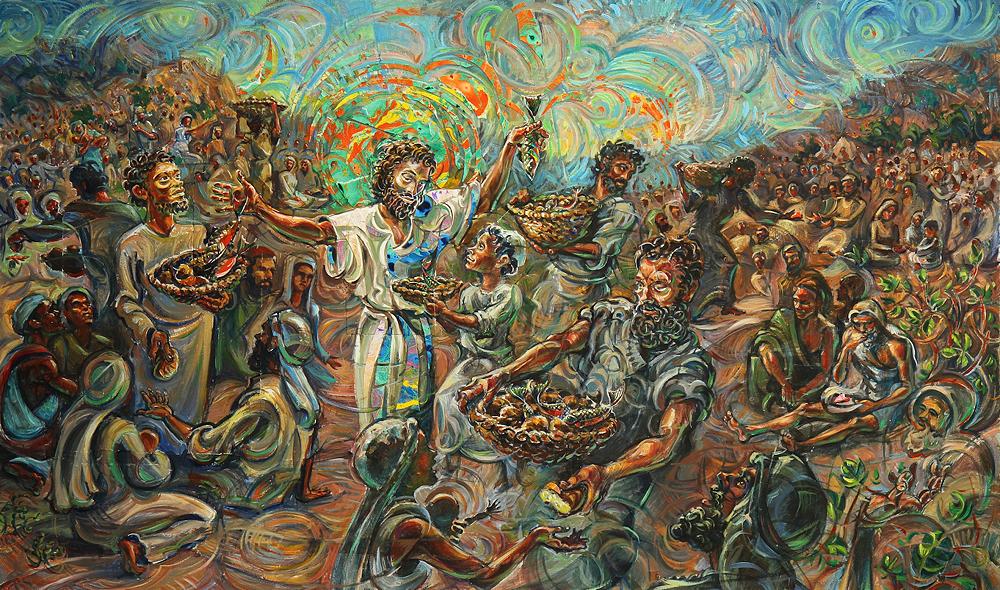
Jesus Feeds the Crowd by American artist Eric Feather

Jesus is the bread, the basic staple of life, that meets the cravings and needs of all people everywhere. Starving people, both in body and spirit, find in Jesus a meal which keeps on giving, a feast of grace that is both delectable and unending.

The answer to my own question is that, for me, one’s highest pursuit and greatest quest is Jesus. Apart from Christ, I will starve. Furthermore, Jesus is not some cheap fast food off a value menu; he is real soul food to be ingested and enjoyed with others.

I believe people need Jesus. A passionate seeking of Jesus, to follow him, live for him, center life around him, is my most ardent desire. I do not simply desire Jesus for what he can do for me; I vigorously chase after him because if I do not have Jesus, I will die, I will starve to death. 

For me, Jesus is so much more than a nice addition to my life, like a new puppy; Jesus is Lord and Savior. I must consume him, or I will be completely undone, and I will not survive! Jesus is my bread, my food, my life!  I cannot survive on a daily crumb, but I feast on every word that comes from the mouth of Jesus because in Christ there is the life that is truly life.

What should human beings be doing to do the works of God?

The short answer: believe. To have and keep faith in the One God has sent, Jesus, is the primary “work” that pleases God. Jesus communicated to the crowd that they can do so much more than follow him for another earthly meal – they can place their faith and hope in him for food that will last, food that will transcend the three-dimensional world.

Faith is more than an intellectual recognition to some facts about Christianity. And belief is not about always having clarity and certainty to every facet and loci of Christian doctrine. No, Christian faith is complete trust in Jesus as our hope and our life. Education, economic uplift, political stability, and institutional peace and justice are important activities for this world. For the Christian, the accomplishment of these and so much more comes from the grace of God in Christ. As people come to the end of themselves with their homebrewed and half-baked attempts at being satisfied, Jesus stands at the door and knocks, the Living Bread who offers himself for humanity’s deepest needs.

Giving kudos to Jesus might be nice, yet Christ himself cares about folks placing their trust in him for grace, forgiveness, and hope in their world. Jesus longs to reconnect people with God through giving himself as the means of making that happen. All the works we do in this life, every good deed we accomplish, and each positive action we do are all helpful and necessary… and they all pale in comparison to the greatest work of all, to believe in Jesus Christ as the hope of this world, the hope of your family, the hope of the church, and the hope of your life and mine. And it is all accessed by faith in the Son of God who loved me and gave himself for me.

Who really does the will of God?

Answer: Those who come to God through Christ. The person who comes to Jesus will never go hungry, and the one who believes in Christ will never be thirsty. Such persons do the will of God. They do not settle for signs of Jesus but desire him and find their ultimate satisfaction in him.

Yet far too many people settle for signs of Jesus rather than Jesus himself. It would be silly if I drove to a sign on Interstate 94 that said, “Milwaukee” and sat there under it, believing I was really in the city of Milwaukee. And it would be weird if I looked around for the art museum or other places underneath the sign.

Church buildings and furniture, stained-glass windows, pews, and even the Bible are not Jesus – they are simply and hopefully signs which point to him. They are all designed to lead us to Christ so that we may come to him. And coming to Christ is what the Lord’s Supper, Holy Communion, the Eucharist, and any other description you want to give about ingesting Jesus is about. The elements of bread and cup bring us to Christ so that we can experience Jesus and be joined to him by faith in a mystical union of human and divine in the unseen heaven.

Conclusion

Where will you find true satisfaction and hope? Probably not in the clearance aisle at Wal-Mart. Likely not in conforming to cultural Christianity or embracing generic forms of Jesus as merely good teacher and moral example. Furthermore, life’s ultimate satisfaction and hope are not to be found in a spotless house and perfect kids; in working more hours and making more money. Nor will we find contentment and peace in the radical independence of doing things my way.

Jesus is the Bread of Life. Through ingesting him, passionately pursuing him, believing in him, and coming to him in everything, we find the life that is truly life. Do not settle for any substitutes to Jesus. Come to the real person.

Lord God, you said that when we seek you with all our hearts, you will be found.  As the deer pants for streams of water, so we, your people, long for you in a dry and weary land.  We hunger and thirst for your righteousness.  We deeply desire your presence in all things. So, we die to ourselves and surrender to your will and way for us, by faith trusting you will come into our lives and completely take over. May your blessing rest upon us as we seek Jesus. Amen.

By Forever Be Sure