James 2:14-26 – Faith Works

What good is it, my brothers, and sisters, if someone claims to have faith but has no deeds? Can such faith save them? Suppose a brother or a sister is without clothes and daily food. If one of you says to them, “Go in peace; keep warm and well fed,” but does nothing about their physical needs, what good is it? In the same way, faith by itself if it is not accompanied by action, is dead.

But someone will say, “You have faith; I have deeds.”

Show me your faith without deeds, and I will show you my faith by my deeds. You believe that there is one God. Good! Even the demons believe that—and shudder.

You foolish person, do you want evidence that faith without deeds is useless? Was not our father Abraham considered righteous for what he did when he offered his son Isaac on the altar? You see that his faith and his actions were working together, and his faith was made complete by what he did. And the scripture was fulfilled that says, “Abraham believed God, and it was credited to him as righteousness,” and he was called God’s friend. You see that a person is considered righteous by what they do and not by faith alone.

In the same way, was not even Rahab the prostitute considered righteous for what she did when she gave lodging to the spies and sent them off in a different direction? As the body without the spirit is dead, so faith without deeds is dead. (NIV)

Genuine authentic faith is more than mere sentiment and head knowledge. Faith without works does not work. Strong robust faith is active and can withstand adversity.

The rhetorical questions the Apostle James asked were meant to awake his readers to the reality that true faith is always active. In other words, inactive faith is not really faith at all. In his letters to the churches, the Apostle Paul typically talked about the relationship between faith and works before a person converts to Christ, whereas the Apostle James emphasized the role of works after a profession of faith in Christ.

St. James was getting at the heart of how a believer in Jesus ought to live. And he did this by giving an illustration of the relationship between faith and works: If someone is in need and a person expresses a sentimental feeling, even if that feeling is sincere, without backing it up with action – the expression is merely an expression, nothing more. 

I once came home after a long day at work on a Valentine’s Day several years ago. I had picked up some flowers at a drive through flower shop. I walked into the door and handed my wife the flowers with an “I love you.”  Then, I sat down in a heap and turned on the television. My dear wife’s response was not so favorable to my sentimental overtures. I did not really put any thought or action behind Valentine’s Day, and she knew it. My words of “I love you” just did not sync with my actions. 

Just so you know, I redeemed myself the next year by winning a contest on a local radio station for a spouse’s best love note, and it got read on the air several times throughout the day for my lovely wife to hear. My commitment and actions were were nicely aligned so that when I said “I love you” at the end of that workday, there was no doubt about it.

Faith requires that actions sync with words. For example, when we say “I will pray for you” it needs to be more than an expression of concern – we need to spend the time and commitment it takes in praying for them.

Faith involves emotions yet ought not be limited by them. Faith can neither exist nor survive without deeds. Christian works are not an added extra to faith any more than breathing is an added extra to the body. Both faith and action is needed for the Christian life.

True faith is shown as the genuine article by how it acts in real life situations. Faith is more than a checklist of right beliefs to sign-off on, as if it were some fire insurance policy against hell. Frankly, as a Pastor, I have heard some pretty lame justifications over the decades for failing to help others, give to the poor, be involved in justice work, and just plain serve in the church, like, “I’m not wired that way,” “That’s not my gift,” “That’s what we pay you to do,” and the ever-prolific, “This church is not meeting my needs.”

Those in the habit of complaining without an intent to boots-on-the-ground helping do not yet have an active faith. Each person is to do their part in serving the common good of all. And we all suffer when that does not happen. Bifurcating faith and action leave us with a false faith. 

If faith without action is okay, then so is the entire demonic realm. The glimpses of Satan we get in the Bible leads me to think that the devil has the entire thing memorized and knows it well from Genesis to Revelation. Yet, knowledge puffs up but love builds up. Information by itself is useless unless it is accompanied by gracious and loving action. (1 Corinthians 8:1)

Salvation is a term Christians are familiar with. In the Christian tradition, it refers to being saved from sin, death, and hell. Sanctification is another term most Christians recognize. It means “to become holy,” or, “to be set apart” for God. Sanctification is not an event but a process. Whereas saving faith is a gift given without works, sanctifying faith requires a great deal of effort. A lot of energy is expended to live the Christian life. The late Dallas Willard used to often say, “Grace is not opposed to effort, it is opposed to earning. Earning is an attitude. Effort is an action.” 

The Apostle James dealt primarily with the sanctifying faith every Christian needs to exhibit. It is as if we have been graciously granted a full-ride scholarship to a university (salvation) but now the real work begins (sanctification) to learn, grow, and obtain the degree. And, just as a student will surely become discouraged at some point throughout their education and wonder if they ought to drop out, so the Christian will face tremendous adversity and challenge. Indeed, a lot of blood-sweat-and-tears goes into our spiritual studies so that our faith will be strengthened for a lifetime of active loving service.

For example, the Old Testament character Abraham was saved from an empty way of life in a pagan country and given a gift of grace to move to the country God would show him. Abraham did nothing to earn this favor.  God just chose him (Joshua 24:2-3). Abraham sojourned as a pilgrim throughout the land God gave him, which mirrored his spiritual sojourning and learning to be a follower of God. Abraham faced a monumental test of faith when asked to sacrifice his son Isaac (Genesis 22:1-19).

Abraham’s faith was made complete by what he did. Testing of faith is necessary so that we become mature and complete, not lacking anything (James 1:3-4). The way for authentic faith to develop and grow is in the fiery trial of adversity and hardship. Spiritual maturation, holiness, and a well-rounded faith come by means of difficult life circumstances.

Rahab and the Two Spies by Unknown artist

To press the significance of faith and works, the example of the Old Testament character Rahab is highlighted. Rahab was a prostitute who lived in the red-light district of Jericho. St. James was doing something profound and important – he took two extreme examples, one a giant of the faith, and the other an almost overlooked example of faith, to demonstrate we all are candidates for real faith.

Rahab’s faith and actions worked harmoniously. She genuinely believed the city of Jericho was going to be overcome by God’s judgment, and, so, she housed the visiting Israelite spies (Joshua 2:1-11). Methinks we must expand our understanding of faith to include persons others might exclude. Some may be quick to judge those with dubious lives and backgrounds, as well as the poor and needy. The bald fact of the matter is that we cannot sanitize Rahab as something other than what she was – and because of her faith she ended up being an ancestor of Jesus himself (Matthew 1:5).

From the standpoint of faith, Abraham and Rahab are on the same level. In Christ’s new egalitarian society, all are welcome, all are equal. Together, we work on our sanctifying faith by submitting to adversity as our teacher; finding solace in God’s Holy Word and Spirit; praying for and with others; worshiping God like there is no tomorrow; leaning into faithful relationships; keeping our eyes open to what God is doing; being patient with the process of sanctification; and embracing unwanted change as our friend.

Faith works, my young Padawan. Embrace it. Enjoy it. Energize it.

Psalm 83:1-4, 13-18 – Against Evil

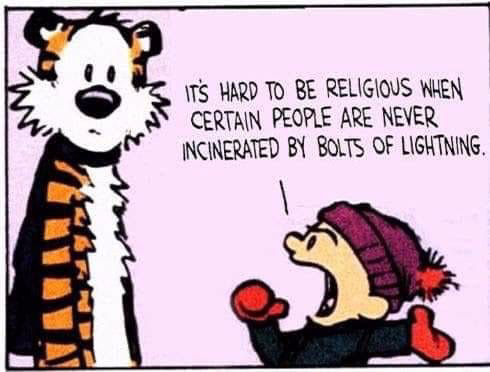
Calvin and Hobbes - imprecation

O God, do not be silent!
Do not be deaf.
Do not be quiet, O God.
Don’t you hear the uproar of your enemies?
Don’t you see that your arrogant enemies are rising up?
They devise crafty schemes against your people;
they conspire against your precious ones.
“Come,” they say, “let us wipe out Israel as a nation.
We will destroy the very memory of its existence….”

O my God, scatter them like tumbleweed,
like chaff before the wind!
As a fire burns a forest
and as a flame sets mountains ablaze,
chase them with your fierce storm;
terrify them with your tempest.
Utterly disgrace them
until they submit to your name, O Lord.
Let them be ashamed and terrified forever.
Let them die in disgrace.
Then they will learn that you alone are called the Lord,
that you alone are the Most High,
supreme over all the earth. (NLT)

The psalms are the church’s prayer book.  Many of the psalms are laments and many of them are worshipful songs of praise. Then there are the “imprecatory” (pronounced im-PRECK-a-tory) psalms.  To “imprecate” means to invoke evil upon someone; it is to pronounce a curse.  The reason for the imprecatory psalm is that it is not any person’s place to engage in revenge or retaliation.  Instead, for people who are genuinely caught in the cross-hairs of evil and have sinful persons dogging them, prayer is their most effective recourse.

Sometimes you must tell it like it is.  There is a time to do your best in putting up a good face and dealing with people who do not ever stop gossiping, slandering, and trying to get their way.

There is also a time to call such behavior “evil” and cry out to God for help.

There are many folks who consider imprecatory psalms a problem because of their detailed expressions of imprecation. Yet, such psalms refuse to put a positive spin on malevolent motives, wicked words, and destructive actions. Desperate people utter desperate prayers. Their unflinching sense of injustice will not allow them to sugarcoat the villainous plans of corrupt people. Evil is never toppled with tepid prayers from wimpy worshipers. Rather, nefarious agendas are thwarted in the teeth of specific, focused, and intense prayers directed with spiritual precision to the very core of diabolical forces.

We need not be shy about being real with God, even with praying imprecatory prayers.  There really are people in this world, maybe even in your own life, that have malicious intent against you or others.  Our job is not personal revenge, but to entrust ourselves to the God who fights for the poor, the oppressed, and the needy against the arrogant and the powerful.

Let your prayers reflect your life.

Along with psalms of praise lifted during times of celebration, so imprecatory psalms are not to be ignored but need to be uttered equally loud as prayers to almighty God in seasons of desperate evil. If you have a gut feeling deep down that wicked people are running amok, then use this psalm as a prayer against the darkness which seeks to envelop the earth.

Jesus Christ will build his church and the gates of hell shall not overcome it (Matthew 16:18). The picture Jesus portrayed is one of faithful believers equipped with righteousness and justice storming the gates of hell, not shying away from it. Baked within the Lord’s words were the promise that evil atrocities will not have the day – that God’s people will not be destroyed or overwhelmed because of demonic and satanic power.

There is a time to flee and then there is a time to engage. I am suggesting that the chief way of mitigating evil is to punch it in the mouth with imprecatory psalms prayed with righteous flavor and focused directly against the powers of this present darkness. Why prayer of all things in dealing with evil?…

For we do not wrestle against flesh and blood, but against principalities, against powers, against the rulers of the darkness of this age, against spiritual hosts of wickedness in the heavenly places. (Ephesians 6:12, NKJV)

Spiritual problems require spiritual implements to solve. And the tool of imprecatory psalms is a major way of not only pushing back the dark forces of this world but is the means of spiritual assertiveness against all forms of heinous acts and acerbic words from depraved people and evil systems.

God’s wrath is an expression of God’s love.

God is not okay with evil taking root in the lives and institutions of humanity. Prayer is our privilege of coming to the God who upholds justice and righteousness. For if God is for us, who can be against us?

God Almighty, may you hear me in the day of my trouble and send help from your holy sanctuary and strengthen my faith. Breathe your Holy Spirit into me and inspire me with a passion for goodness and truth, justice, and righteousness. Lord Jesus be present with me in your risen power and protect me from harm and from all that would hinder your healing presence in this world. You overcame the forces of Satan, redeemed the world, then ascended to the Father. May you be with me and within me; before me and behind me; on my right and on my left; above me and beneath me; and around me always. Amen.

Matthew 16:21-28 – The Need for Sacrifice

Welcome, friends. Simply click the video below and let us consider together the words of Jesus.

You may also view this video at TimEhrhardtYouTube

For a response in song, click Take My Life and Let It Be arranged by Hymn Charts.

And, also click Jesus, I My Cross Have Taken sung by RYM Worship.

May the Lord bless you
    and keep you.
May the Lord smile down on you
    and show you his kindness.
May the Lord answer your prayers
    and give you peace. Amen.

The Need for Sacrifice

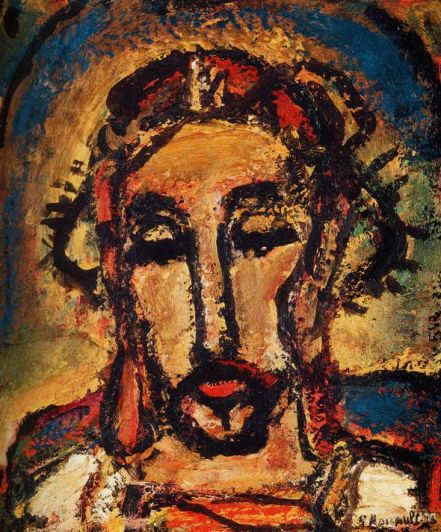
Man of Suffering by Georges Rouault, 1942
Ecce Homo by French artist Georges Rouault, 1942

Christ’s Church is not so much made up of saints or sinners as it is made up of saintly sinners and sinning saints.  The Church is at the same time both beautiful and ugly, holy, and wicked, full of faith and full of fear.  The Body of Christ is the place of spiritual sensitivity as well as a den of depravity.  So, anyone searching for a squeaky-clean church on a nice upward path of success with everything done to perfection and where no one ever gets hurt or unhappy… it does not exist; and, it never did.

Jesus stands alongside his imperfect people, despite their faults and egotism.  Jesus intimately knows our damaged emotions and our open putrid spiritual abscesses.  Yet, he treats us with mercy because he never tires of rehabilitating and reforming his Church.

Christ’s disciple, Peter, is the poster child for all the mixed motives and imperfect following of God we experience. For example, Peter stepped out of the boat in great faith and walked on the water, only to begin sinking because of his great fear. It was Peter who made a bold and right confession of faith, and then turned around here in our story for today and bought into Satan’s agenda. And Jesus was right there next to Peter all the way. Christ both rebukes and loves, all the while never abandoning us, but always working in and through us to accomplish his kingdom purposes.

Here is what we need to know or be reminded of today: Following Jesus involves pain and sacrifice because we live in a broken mixed-up world, and, on top of it, Christ’s Church is still imperfect and in the process of becoming holy.  If we will admit it, we are all like Peter – a little devil who needs to get in line behind Jesus. (Matthew 16:21-28)

Peter Admonishes Jesus
Peter Admonishes Jesus by Unknown artist

We all, at times, get frustrated and/or disgusted with the whole church thing.  We can whine and complain and even avoid it.  Or, we can commit to taking up our cross, and give our lives for Jesus Christ.  We can choose to put love into the church where love is not, even when we do not feel loved. Priest and professor, Ron Rollheiser, once gave the following analogy about staying together around Jesus:

Imagine that the family is home for Christmas, but your spouse is sulking, you are fighting being tired and angry, your seventeen year old son is restless and doesn’t want to be there, your aging mother isn’t well and you are anxious about her, your uncle Charlie is batty as an owl… and everyone is too lazy or selfish to help you prepare the dinner.  You are ready to celebrate but your family is anything but a Hallmark card.  All their hurts and hang-ups are not far from the surface, but you are celebrating Christmas and, underneath it all, there is joy present.  A human version of the messianic banquet is taking place and a human family is meeting around Christ’s birth….

In the same way, here we are, the community of the redeemed. We gather in our imperfect way, a crazy mix of sinner and saint.  But we gather in and around Jesus – and that makes all the difference.  There is a reason we are here on this earth, a reason much bigger than all our dysfunctional ways and dyspeptic attitudes. Jesus Christ is building-up the people of God and he will keep doing it until the end of the age. In other words, Jesus is not quite finished with us yet; we still have some things to learn about the need for sacrifice.

The need for sacrifice by Jesus. (Matthew 16:21-23)

Jesus stated openly and in detail what must happen.  It was necessary for Christ to suffer deeply and die a cruel death; it was God’s will and plan. Yet, good ol’ Peter was not down for this plan, at all.  He took Jesus aside and rebuked him, believing him to be off his rocker for even suggesting such a terrible scenario.  Jesus, however, turned the tables on Peter and rebuked him right back.  Essentially, what Jesus said is that being Christ-centered without being cross-centered is satanic.

The error of Peter was that he presumed to know what was best for Jesus. He believed the suffering of the cross would “never” happen. Peter’s perceptions were dim and limited; he did not clearly see how broken the world really is and how much it would take to heal it. Jesus needed to offer himself as a sacrifice for the sins of the entire planet.

Crucifixion of Christ by Georges Rouault, 1936

Sometimes, like Peter, we might think that the way I see and the way I perceive is the way things really are, or, at least, how they should be. Peter had been walking with Jesus for a few years, watching and enjoying his ministry of teaching, healing, and extending compassion.  It was all good for Peter, and, therefore in his mind, it should not change. Peter wanted to hold this moment forever. After all, why try and fix something that is not broken? Oh, but broken the world is – so much so that it required the ultimate sacrifice.

Just because it was good for Peter did not mean it was good for everybody or should always be this way.  If Peter were to have his way, we would all be in hell right now; it would not have been good for us.  We, like Peter, are finite humans with limited understanding and perceptions.  We can easily slip into a satanic mode of believing that because something is going fine for me that everyone else is doing okay, too.  I like it, I want it, so what is the problem?

The problem is that we too easily look at life through narrowly selfish lenses, and then cannot see other people’s needs; cannot perceive the lost world around us with any sense of reality; cannot see that Jesus has an agenda very different from our own.  Our limited perceptions come out in saying things like, “Oh, she is just depressed because she is avoiding responsibility.”  “People on government welfare are lazy.”  “He’s addicted because he doesn’t want to help himself.”  “They’re demonstrating on the streets because they are a bunch of malcontents.” These, and a legion of statements like it, betray a satanic worldview devoid of grace and a compulsive need to find blame, believing that if there is personal suffering there must be personal sin.

In truth, we are all part of one human family, and we are all in this together; one person’s joys are our joys; one person’s struggles are our struggles. We really are our brother’s keeper. The detachment we can have toward other human beings is completely foreign to the words of Jesus.  The Christian life involves suffering, and Jesus invites us to follow him in his way of sacrifice.

The need for sacrifice by the followers of Jesus. (Matthew 16:24-28)

There is a way to reverse demonic thinking.  Jesus issues an invitation to practice self-denial, to fall in line behind him, and walk with him in his suffering.  Self-denial is not so much doing something like giving up sweets for Lent as it is giving up on ourselves as our own masters.  It is the decision to make the words and ways of Jesus the guiding direction for our lives.  It is the choice to quit holding onto the way I think things ought to be, and to take the time to listen to Jesus.

The logic of Jesus is relentless.  Life comes through death, so, we must give up our lives to find them.  It does us no good to adulterate our lives by serving the gods of success and perfectionism.  Jesus invites us to quit our moonlighting job with the world and go all in with him.  Only in this way will we truly find life.

Jesus was saying more than just submitting to suffering – we are to embrace it. In doing so, we will find reward and joy.  For those familiar with this path, they can tell you that suffering is a blessing because they have found the true purpose and meaning of life.

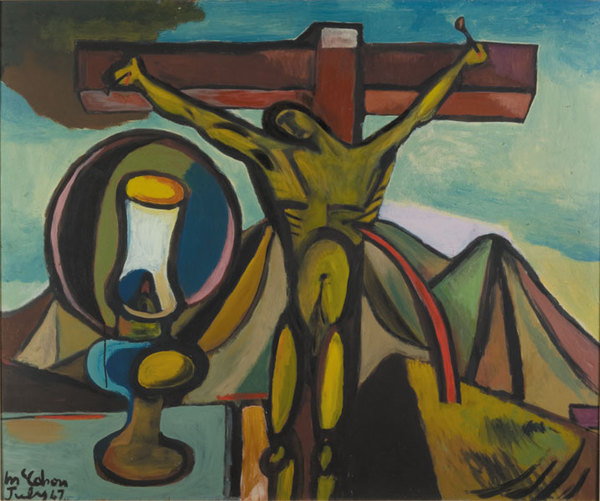
Crucifixion with Lamp by Colin McCahon 1947
Crucifixion with Lamp by New Zealand artist Colin McCahon, 1947

Few people have suffered as much as the nineteenth-century missionary medical doctor to Africa, David Livingstone.  He was a pioneer explorer who opened the interior of Africa to the outside world.  He had two reasons for doing so: To be able to take the good news of Christ’s suffering to the African people; and, to open Africa to legitimate trade so that the illicit slave trade would end.

Dr. Livingstone’s hand was once bitten and maimed by a lion; his wife died while on the mission field; he was most often alone on his travels; the one house he built was destroyed in a fire; he was typically wracked with dysentery and fever, or some other illness in the jungle.  Someone once commented to him that he had sacrificed a lot for going in the way of Jesus. Livingstone’s response was, “Sacrifice? The only sacrifice is to live outside the will of God.”  When asked what helped him get through so much hardship, he said that the words of Jesus to take up his cross were always ringing in his ears.

We may believe we must watch out for ourselves; that we need to push for our personal preferences; that if I accept this invitation to follow Jesus in the way of self-denial I will be miserable and people will walk all over me. Such thoughts are demonic whispers in our ears.

There are two ways of thinking and approaching the Christian life: There is the way which believes success, perfection, and a pain-free life is the evidence of God’s working; while the other way believes that suffering is right and necessary to connect with God and to be in solidarity with those who suffer.

Suffering, rejection, and execution did not fit into Peter’s church growth plan or factor into his view of Messiah. So, I will say it plainly: We do not exist only for ourselves. We do not exist to be a spiritual country club.  We do exist to follow Jesus in his path of sacrifice and suffering for a world of people who desperately need to know the grace of forgiveness and the mercy of Christ. Jesus died.  We are to die to ourselves. Christ lives; so, we are to live a new life.  In God’s upside-down kingdom, joy comes through suffering. We are to follow Jesus as the mix of sinners and saints that we are.

Peter eventually learned his lesson from Jesus. After Christ’s resurrection and ascension, Peter caught fire with courage and boldness – which landed him in hot water with the Jewish ruling council. As a result, he was severely whipped and flogged and told to keep in line. Peter’s response demonstrates how far he had come. He left the experience rejoicing that he had been counted worthy of suffering disgrace for the Name of Jesus Christ. (Acts 5:41)

May dear old Peter’s spiritual tribe increase.