Luke 13:10-17 – Healing on the Sabbath

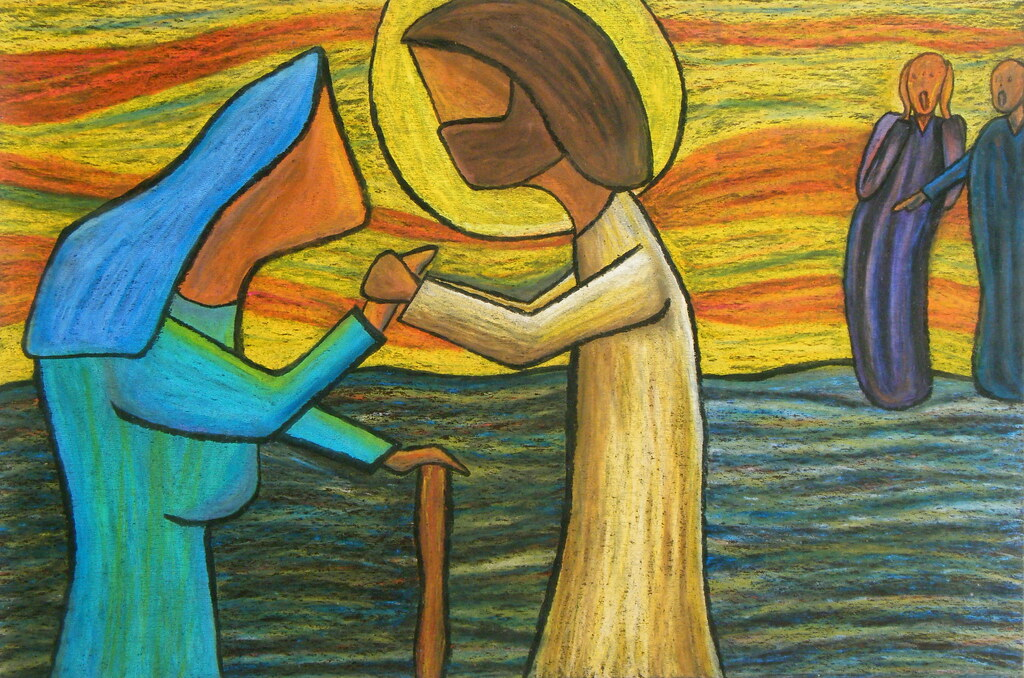
Jesus Healing the Bent-Over Woman by Glenda Skinner-Noble

On a Sabbath Jesus was teaching in one of the synagogues, and a woman was there who had been crippled by a spirit for eighteen years. She was bent over and could not straighten up at all. When Jesus saw her, he called her forward and said to her, “Woman, you are set free from your infirmity.” Then he put his hands on her, and immediately she straightened up and praised God.

Indignant because Jesus had healed on the Sabbath, the synagogue leader said to the people, “There are six days for work. So come and be healed on those days, not on the Sabbath.”

The Lord answered him, “You hypocrites! Doesn’t each of you on the Sabbath untie your ox or donkey from the stall and lead it out to give it water? Then should not this woman, a daughter of Abraham, whom Satan has kept bound for eighteen long years, be set free on the Sabbath day from what bound her?”

When he said this, all his opponents were humiliated, but the people were delighted with all the wonderful things he was doing. (New International Version)

The way in which we interpret events says a lot about who we are and what we need. The story sounds different, depending upon which person(s) are viewing it….

The Crippled Woman

She had gotten used to looking at people out of the corner of her eye, by looking up and sideways.

After eighteen years, she could hardly remember any other way of seeing the world. On this particular Sabbath, there was a special excitement at the synagogue, where she regularly went to worship. A Galilean preacher and prophet, Jesus of Nazareth, had arrived in town and would be teaching there.

She and the others in town had heard reports about Jesus–how he talked about God’s reign arriving soon and how he healed sick people. She was not sure how many of the rumors to believe, but she was trying not to get her hopes up. Her life already had too many disappointments to count.

When she entered the synagogue, the place was abuzz. As Jesus began to teach, however, the room was hushed. Moments later, his words turned from teaching to invitation. He had caught her eye–no mean feat, given that he had to lean over and incline his head to do so. “Come here,” he said to her. She slowly made her way to the front of the assembly.

Jesus and the Bent-Over Woman by Marg Mowczko

What happened next amazed the whole congregation. “Woman, you are set free from your ailment.” When this man, Jesus, spoke those words and put his hands on her broken, bent body, she felt power surge through her. Without hesitation, she straightened her once crooked back. She stood tall and praised her God . . .

The Synagogue Leader

He has come to the synagogue every Saturday. Each Sabbath day the synagogue leader stands and faithfully reads the Torah. On this particular Sabbath, a Galilean preacher is coming. Some say his is a prophet, even Messiah. The leader has seen his share of would-be messiahs come and go, claiming to speak for God. He doubts anything will come of this. Just another man.

But what is this? A synagogue full of people! And just as the leader thought this may just be good for the people, getting them to pay attention to the law and the prophets, this preacher calls a woman forward, and of all things, heals her!? This is not good. This is not how things are to be done!

In the Torah, the seventh day was set aside by God for Israel’s rest. Work is prohibited. Non-life-threatening illnesses and conditions can be treated on the other six days. The synagogue leader is not opposed to healing. In fact, he welcomes it. But at an appropriate time, on the right day. He says to himself, “This all must be done decently and in order. Who does Jesus think he is? We cannot have such insubordination amongst the people, and in the synagogue, of all places!”

And so, the synagogue leader is beside himself with both anger and fear that the Law will not be properly upheld, and that God will be displeased and take away their place of worship.

Coptic Church depiction of Jesus healing the crippled woman, 12th century

Jesus

Jesus comes, looking forward to being with the people in the synagogue on the Sabbath. He understands that since the Sabbath law commemorates and celebrates Israel’s liberation, it ought to be a day for enacting — not inhibiting — the present-day liberation of Israelites. Yes, it is a good day for a healing. Every day is a good day for healing.

As Jesus enters the synagogue, it is full of people, charged with the atmosphere of anticipation. During the service, Jesus sees a woman. Although he rightly discerns that the synagogue leader and some of the congregants will not be happy about this, he calls her forward, intent on freeing her from her satanic bondage. And also knowing that placing his hands upon this woman will appear scandalous, he does it anyway.

Sure enough, the synagogue leader is livid. The leader feels the need to correct Jesus. Yet, Jesus unmoved by this, calmly retorts, without budging an inch, that given the custom of providing water for thirsty livestock on the Sabbath, it is surely appropriate to heal a long-suffering Israelite on the Sabbath.

In none of this does Jesus abolish the Sabbath commandment. Rather he follows it faithfully. Jesus enters an ongoing Jewish debate about how to interpret the Sabbath law, locating himself at the less stringent end of the opinion spectrum.

Jesus is determined to uphold the spirit of the Law, to practice compassion, to do what leads to human betterment. He is doing God’s will. He is allowing the Sabbath to serve this old woman, rather than letting the woman serve the Sabbath as a bent over crippled person.

The People

They come, as they do each Sabbath, to gather and listen to Torah read, to pray to God, and to strengthen one another in their common faith. Yes, the synagogue leader can be a bit tedious. The synagogue service can be a bit boring. But he is a good man doing good work.

Today, however, is different. Jesus, the one they have heard so much about, is there. And what a synagogue service it is! Jesus teaches us, and with authority! But, to our astonishment, he calls one of our women forward. And he touches her! Then heals her! This is the woman who has been tortured with such crippling pain and bent over all the time!

Oh, my, the synagogue leader is upset! We are so full of joy for our healed sister, yet also confused. This is a good thing that Jesus did – God’s kingdom breaking into this world. Yet, here is the synagogue leader and Jesus debating Torah. Does freedom from Satan only come on six days, not seven? Surely, God is especially honored on such a holy day as the Sabbath to do such important work. But work, it is. And Jesus did it. Is this really a good thing, or not?
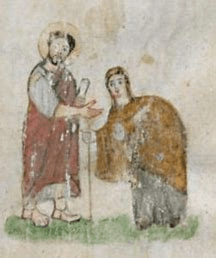
Syrian Church depiction of Jesus and the crippled woman, 6th century

Conclusion

This is a story about the role and function of our religious traditions, our claims about what could and should be practiced, when and where it ought to take place, and who is allowed within the walls of our faith communities. Special religious practices may become hindrances to including folks. We must be diligent to recognize what theological ideas we hold dear that disallow full participation from others.

Jesus was no Sabbath breaker. He operated well within Jewish tradition of the day. At the same time Christ is also not one to allow the tradition to exclude people from access to the community and the potential for their healing. Even though the synagogue leader and some others disagreed, many in the crowd agreed.

Today’s story is about the community and addresses questions such as, “What kind of community do we want to be?” “Do our religious traditions help us to become that kind of community or do they hinder it?” “If we want to be a healing community, how can we make that happen?”

O God the Father, whose will for us and for all your people is health and salvation, O God the Son, who came that we might have life and have it in abundance, O God the Holy Spirit, whose indwelling makes our bodies the temples of your presence, have mercy on us.

O Triune God, we pray you to hear us, and that you will grant your grace to all who stand in need of healing of both of body and spirit, and lead them to look with confidence in you;

That you will grant patience and perseverance to all who are disabled by injury or illness, and increase their courage;

That you will grant peace to all who are troubled by confusion or pain, and set their minds at rest;

That you will grant relief from suffering to all sick children, and give them a sure sense of your tender love and care;

That you will grant rest to all whose increasing years bring weariness, distress, or loneliness, and give them the abiding comfort of your presence;

That you will grant confidence to all about to undergo surgery or difficult procedures, and keep them free from fear;

That you will grant purpose to the church as it seeks to carry on Christ’s ministry of healing to suffering humanity, and keep it always true to the gospel of Christ;

That you will grant skill and compassion to doctors, nurses, technicians, aides, and all who are called to  practice medical arts, and make strong their dedication to help others;

That you will grant to all people the peace of quiet sleep and the joy of resting in your everlasting arms, that we may rejoice in your care while we are on earth, and in the world to come, have eternal life.

O God, who in Jesus Christ called us out of darkness into your marvelous light; enable us always to declare your wonderful deeds, thank you for your steadfast love, and praise your with heart, soul, mind, and strength, now and forever. Amen.

Revelation 2:8-11 – Spiritual Endurance

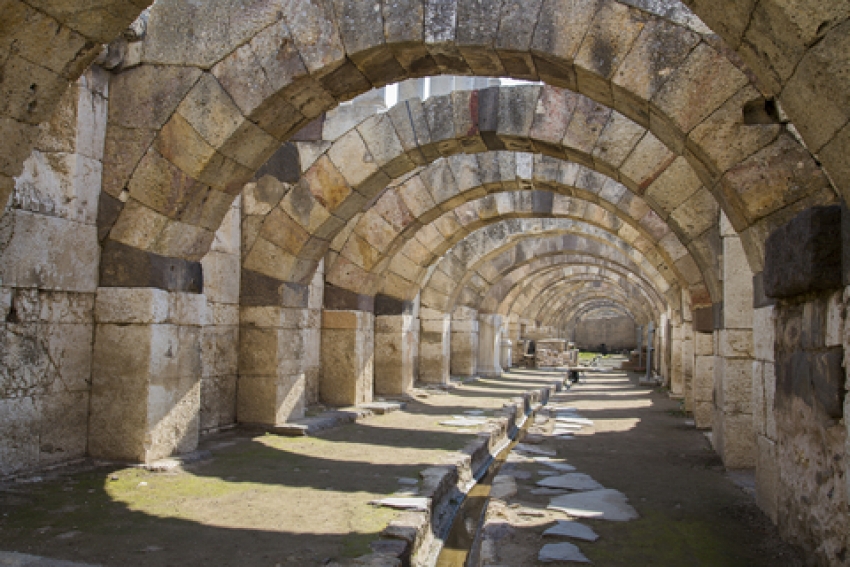
The remains of ancient Smyrna in Izmir, Turkey

This is what you must write to the angel of the church in Smyrna:

I am the first and the last. I died, but now I am alive! Listen to what I say.

I know how much you suffer and how poor you are, but you are rich. I also know the cruel things being said about you by people who claim to be Jews. But they are not really Jews. They are a group that belongs to Satan.

Don’t worry about what you will suffer. The devil will throw some of you into jail, and you will be tested and made to suffer for ten days. But if you are faithful until you die, I will reward you with a glorious life.

If you have ears, listen to what the Spirit says to the churches. Whoever wins the victory will not be hurt by the second death. (Contemporary English Version)

Jesus not only speaks in the four Gospels of the New Testament; Christ also speaks in the final biblical book of Revelation to seven different churches.

In today’s New Testament lesson, Jesus addresses the church at Smyrna – a large and beautiful port city in the ancient world, on the eastern coast of the Aegean Sea (present day Turkey). 

Jesus was letting the believers in Smyrna know they were about to experience severe persecution. However, they need not be fearful and can remain faithful because their Lord knows all about suffering. 

The church’s perseverance under such trouble would result in the crown of life, given to them by Jesus himself. Words coming directly from their Lord and Savior must surely have been an encouragement to the believers as they underwent extreme difficulty.

The congregation at Smyrna was facing imprisonment and, for some, even death for their faith. The heart of the message by Jesus is to remain faithful. 

The seven churches of Revelation which Jesus addressed

There will always be those who are faint of heart with weak faith, giving up when the going gets tough. Yet, persecution and hardship have a way of purging the soul, as well as the church, of its dross. Suffering is inevitable; how we handle adversity when it comes is completely under our own control.

Few of us will likely never face a hardship that could result in martyrdom. Knowing there are brothers and sisters in the faith throughout the world who do face daily hardship for devotion and beliefs puts our own troubles in a different light.

The daily irritations and trials that God puts in our way to refine us and shape our faith certainly seem small compared to imprisonment and martyrdom. Yet, no matter who we are and where we are located on this earth – whether facing uncommon hardship or banal difficulty – the afflictions of both body and soul come to us as opportunities to lean into faith and love Jesus to the end.

Jesus is not looking for perfect people – just faithful followers willing to endure suffering with the truth that our Lord stands with us. 

Whatever our current circumstances may be, Jesus offers us his perspective on it. He knows precisely what is going on and understands the spiritual resources you and I possess for each adverse situation we encounter.

In fact, few of us really discern the largess of internal resources within us because of Christ’s redemptive work and the Spirit’s abiding presence – not to mention the very personhood God graciously gave us in the womb before we were even born.

Even though it seems, at times, we lack the strength, wisdom, and courage for what is ahead – Jesus has supreme confidence in us to maintain faith and endure through our afflictions.

Life is not a sprint; life is a marathon. And to finish the race we need to be in good spiritual health. The perseverance of the saints will happen as we run – step by step, stride by stride – with boldness, despite fear of the unknown future around the bend.

Spiritual endurance requires becoming comfortable with risk, vulnerability, accountability, and the steadfast love which is both received and given.

Perhaps, most of all, it requires keeping our heads up and running toward the promise of reward at the finish. The crown of life is an image of both congratulation and celebration of a race well-run and the enjoyment of unending fellowship with our Lord for whom we have endured so much.

After all is said and done, and the end of the age has occurred, we will be able to look back in hindsight and see that it was really Jesus who all along was fortifying us to keep standing and keep going. Christ is so vested in us that he continually ensures our ultimate victory through a constant presence of help and encouragement. The heritage of both the Reformation and Holy Scripture testify to this truth:

“All our progress and perseverance are from God.”

John Calvin (1509-1564)

“I’m sure about this: the one who started a good work in you will stay with you to complete the job by the day of Christ Jesus.” (Philippians 1:6, CEB)

May the grace of Jesus sustain you; the love of God surround you; and the encouragement of the Spirit surprise you, today and every day. Amen.

Grant, O God, That we may never lose the way through our self-will, and so end up in the far countries of the soul; that we may never abandon the struggle, but that we may endure to the end, and so be saved; that we may never drop out of the race, but that we may ever press forward to the goal of our high calling; that we may never choose the cheap and passing things, and let go the precious things that last forever; that we may never take the easy way, and so leave the right way; that we may never forget that sweat is the price of all things, and that without the cross, there cannot be the crown.

So keep us and strengthen us by your grace that no disobedience and no weakness and no failure may stop us from entering into the blessedness which awaits those who are faithful in all the changes and chances of life down even to the gates of death; through Jesus Christ our Lord. Amen

William Barclay, Prayers for the Christian Year

Job 1:1-22 – A Better Way Through Impossible Suffering

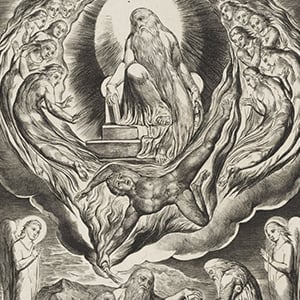
Satan Going Forth from the Presence of the Lord by William Blake, 1825

In the land of Uz there lived a man whose name was Job. This man was blameless and upright; he feared God and shunned evil. He had seven sons and three daughters, and he owned seven thousand sheep, three thousand camels, five hundred yoke of oxen and five hundred donkeys, and had a large number of servants. He was the greatest man among all the people of the East.

His sons used to hold feasts in their homes on their birthdays, and they would invite their three sisters to eat and drink with them. When a period of feasting had run its course, Job would arrange for them to be purified. Early in the morning he would sacrifice a burnt offering for each of them, thinking, “Perhaps my children have sinned and cursed God in their hearts.” This was Job’s regular custom.

One day the angels came to present themselves before the Lord, and Satan also came with them. The Lord said to Satan, “Where have you come from?”

Satan answered the Lord, “From roaming throughout the earth, going back and forth on it.”

Then the Lord said to Satan, “Have you considered my servant Job? There is no one on earth like him; he is blameless and upright, a man who fears God and shuns evil.”

“Does Job fear God for nothing?” Satan replied.“Have you not put a hedge around him and his household and everything he has? You have blessed the work of his hands, so that his flocks and herds are spread throughout the land. But now stretch out your hand and strike everything he has, and he will surely curse you to your face.”

The Lord said to Satan, “Very well, then, everything he has is in your power, but on the man himself do not lay a finger.”

Then Satan went out from the presence of the Lord.

One day when Job’s sons and daughters were feasting and drinking wine at the oldest brother’s house, a messenger came to Job and said, “The oxen were plowing and the donkeys were grazing nearby, and the Sabeans attacked and made off with them. They put the servants to the sword, and I am the only one who has escaped to tell you!”

While he was still speaking, another messenger came and said, “The fire of God fell from the heavens and burned up the sheep and the servants, and I am the only one who has escaped to tell you!”

While he was still speaking, another messenger came and said, “The Chaldeans formed three raiding parties and swept down on your camels and made off with them. They put the servants to the sword, and I am the only one who has escaped to tell you!”

While he was still speaking, yet another messenger came and said, “Your sons and daughters were feasting and drinking wine at the oldest brother’s house, when suddenly a mighty wind swept in from the desert and struck the four corners of the house. It collapsed on them, and they are dead, and I am the only one who has escaped to tell you!”

At this, Job got up and tore his robe and shaved his head. Then he fell to the ground in worship and said:

“Naked I came from my mother’s womb,
    and naked I will depart.
The Lord gave and the Lord has taken away;
    may the name of the Lord be praised.”

In all this, Job did not sin by charging God with wrongdoing. (New International Version)

Much of life is a mystery. We simply do not know why some things happen. And it’s likely we won’t have answers to many of our vexing questions, this side of heaven. From our limited human perspective, **** happens, and that’s about all we can say about it. 

There are times in Holy Scripture, however, when the veil between heaven and earth is peeled back long enough for us to catch a glimpse of mystery. Today’s Old Testament lesson is such a story. 

Job was a wealthy man and had everything this earthly life could offer. What’s more, he was a pious godly person of faith. It was commonly understood that those two things always went together. So, when we see behind the curtain and are privy to a conversation between God and Satan, the devil himself points this out – that Job only praises God because of how good he has it.  Even with this understanding of what was behind Job’s misery, we still see the mysterious God allowing Satan to operate with only God-knows reasons why.

Whenever calamity strikes, or bad news causes us to slump in our chairs, or adversity hits unexpectedly, or trouble smacks us upside our life like a sledgehammer, it’s only human to begin wondering what we did wrong or what we did to bring on such a terrible set of circumstances. 

But the truth is this: We just don’t always know. 

Yes, I fully understand that statement is hard to swallow; it even sucks. For example, no amount of understanding why my grandson has a rare form of epilepsy will make the pain go away. All my wonderings about his future isn’t going to help my daughter. It’s an impossible emotional place to be. It’s sad and it’s frustrating.

Yet, there is a better way.

Although there is so much we don’t know, we do know Job’s inconceivable response to the mystery of God. He made an incredible confession of faith, despite the most awful of circumstances. Job made the affirmation:

“When I was born into this world,
    I was naked and had nothing.
When I die and leave this world,
    I will be naked and have nothing.
The Lord gives,
    and the Lord takes away.
Praise the name of the Lord!”

Job 1:21, ERV

Rather than spending all of our emotional energy trying to figure out an answer to our “why” questions, perhaps the more sage response is to confess our faith in a radical trust of God. 

Using these actual words from Job can be a necessary start to navigating the troubled waters of evil which swirl around us, even if we have to say them over and over again to believe them.

I know I do.

Almighty God, every good thing I have in my life comes from you. It is your prerogative whether I continue to have those things, or not. Whatever happens, whether it causes heartbreak or happiness, is completely known to you. I trust that you know what you are doing, and I completely throw myself upon your mercy through Jesus Christ, my Savior. Amen.

James 2:17-26 – Faith Works

Isn’t it obvious that God-talk without God-acts is outrageous nonsense?

I can already hear one of you agreeing by saying, “Sounds good. You take care of the faith department; I’ll handle the works department.”

Not so fast. You can no more show me your works apart from your faith than I can show you my faith apart from my works. Faith and works, works and faith, fit together hand in glove.

Do I hear you professing to believe in the one and only God, but then observe you complacently sitting back as if you had done something wonderful? That’s just great. Demons do that, but what good does it do them? Use your heads! Do you suppose for a minute that you can cut faith and works in two and not end up with a corpse on your hands?

Wasn’t our ancestor Abraham “made right with God by works” when he placed his son Isaac on the sacrificial altar? Isn’t it obvious that faith and works are yoked partners, that faith expresses itself in works? That the works are “works of faith”? The full meaning of “believe” in the Scripture sentence, “Abraham believed God and was set right with God,” includes his action. It’s that weave of believing and acting that got Abraham named “God’s friend.” Is it not evident that a person is made right with God not by a barren faith but by faith fruitful in works?

The same with Rahab, the Jericho harlot. Wasn’t her action in hiding God’s spies and helping them escape—that seamless unity of believing and doing—what counted with God? The very moment you separate body and spirit, you end up with a corpse. Separate faith and works and you get the same thing: a corpse. (The Message)

True faith is shown as the genuine article by how it acts and responds in real life situations. 

Christians are saved for a purpose. Christian faith is much more than mere intellectual knowledge of Jesus Christ. We are to take our knowledge of Christ’s redemptive events and put it into daily practice.

There were folks in today’s New Testament lesson who were justifying a lack of action with statements such as, “I’m not wired that way,” “That’s not my gift,” “We pay our pastor to do the ministry,” “This church is not meeting my needs,” “Let the next generation deal with change.”

Anyone in the habit of complaining without doing anything to be part of the solution needs to get an active faith. Every believer in Jesus Christ is called to ministry. All Christians are gifted by God for service. And God expects us to use those gifts to build up the Body of Christ. The church suffers when we do not all participate with the abilities God has provided.

Faith apart from action is impossible. It’s like saying I can bench press 400lbs. just because I read about it in a muscle magazine; or, that I can produce corn just because I saw a farmer in a field. 

There are no atheistic demons. The glimpses of Satan we get in the Bible lead me to think he likely has the entire Bible memorized and knows it quite well. Knowledge, however, by itself, is useless.

The Great Blondin, walking a tightrope across Niagara Falls, 1859

In the nineteenth century, a famous tightrope walker from France, Charles Blondin, once strung a cable across Niagara Falls from the American side all the way to the Canadian side. Thousands of people watched him do his theatrics across the falls.  He walked back and forth, people applauding wildly. Then to further wow the crowds, he put a blindfold on and went back and forth. He also rode a bicycle back and forth, and then pushed a wheelbarrow back and forth.

As the story goes, while pushing the wheelbarrow back and forth, he called out to the crowd on one end, inquiring whether or not they thought he could successfully push the wheelbarrow across with a human being riding in the wheelbarrow. The crowd went berserk: “Sure you can. You’re remarkable. We believe in your abilities. You are the greatest.” On and on they went, to which Blondin responded, “Then someone volunteer. You come right up here, single file, form a line, and get in the wheelbarrow to prove your trust in my ability.” A deafening silence overtook the crowd. There were no takers.

Intellectual belief is one thing. It is quite another thing to place complete trust in Jesus Christ. Knowledge without an active commitment is about as helpful as a backseat driver.

Faith is a big word in Scripture and life. It encompasses the totality of how we come to Jesus Christ and how we live for him. So, when talking about faith, it is important to distinguish between saving faith and sanctifying faith. 

If we are fuzzy on our understanding and application of these two spiritual realities of salvation and sanctification, we will sleepwalk through life as zombies living in two different worlds of the living and the dead.

“Salvation” is a term used a lot in the church. In Christianity, it means to be delivered from sin, death, and hell.  Through the death and resurrection of Jesus, a person is “saved” by knowing about the work of Christ on the cross and trusting this has taken care of the sin issue once for all. 

Through repentance and faith in Jesus, there is salvation. A person cannot earn it, accomplish it, or buy it. Salvation is a gift that comes by faith in the person and work of Jesus. It is a one-time event of trust.

“Sanctification,” on the other hand, begins when we become believers in Jesus. The word means “to become holy,” or, “to be set apart for God.” Sanctification is not a singular event; it is a lifelong process. Whereas saving faith is a gift given to us without effort, sanctification requires much effort. We work, struggle, and expend lots of energy to live the Christian life. 

“Grace is not opposed to effort; it is opposed to earning. Earning is an attitude. Effort is an action. Grace, you know, does not just have to do with forgiveness of sins alone.”

Dallas Willard

When a student receives a college scholarship, it is a one-time event, granted to the student. She now possesses it and is able to attend school without trying to earn the money to pay for it. Yet, the scholarship was given for a reason – so that the student can now focus entirely on their studies and/or sport. The work is just beginning.  More blood, sweat, and tears will take place living into that scholarship than the student could ever imagine. It won’t be easy. It will consume the student’s waking hours for the next four years.

When the Apostle James talks about faith, he is primarily referring to sanctifying faith, to believers who already professed saving faith in Jesus. They were granted a full-ride scholarship in the kingdom of God. Now the work begins. And, just as a student will surely become discouraged at points throughout their education, wondering if they ought to drop out, so the Christian will face tremendous adversity and challenge in living the Christian life.  There is a lot of spiritual training and studies to do so that faith will be strengthened for a lifetime of service.

Abraham was saved from an empty way of life and given a gift of grace to move to a better country. Abraham did nothing to earn this favor. God just chose him, period. Abraham sojourned as a pilgrim throughout the land God gave him, which mirrored his spiritual sojourning and learning to be a follower of God.

Abraham’s faith was demonstrated by what he did. The way genuine faith develops and grows is in the fiery trial of adversity and hardship.

Christianity is not a matter of continual upward triumph; it is a downright hard work of faith development as we learn to be followers of Christ. Spiritual maturity happens through sanctifying faith by means of difficult life circumstances.

Rahab, a completely different person than Abraham, was a prostitute who lived in the red light district of Jericho. Abraham is a recognized giant of faith. Rahab is an almost overlooked example of faith. All of us likely fall somewhere in between these two people – graced and called by God to live into our sanctifying faith through continual spiritual exercise.

Rahab’s faith and actions worked together. She honestly believed the city of Jericho would experience God’s judgment, and, so, she housed the visiting Israelite spies.

Maybe we need to expand our understanding of faith to include people we might typically exclude. 

No one is outside the realm of faith. So, let’s not be quick to judge those with dubious lives and backgrounds, as well as the poor and needy. If we do not know their stories, or why and how they ended up in this station in life, we may make unwarranted assumptions, and turn our backs on the needy.

We must not sanitize Rahab as someone other than who she was – and because of her faith she ended up being an ancestor of Jesus himself.

Needy people are not dumb, clueless, helpless, or ignorant; they are resourceful and resilient. They need Jesus, too. Yes, people make choices, often bad ones. Yet, nobody says to themselves, “When I grow up I want to be a prostitute or maybe a porn star and live in a red light district with a pimp who abuses me and gets high on heroin.” 

People too often back into behaviors due to a lack of positive relational connections and just trying to survive whatever crisis is going on in their lives.  The church can be a social connection for them to become grounded in something other than their past experience.

God grants faith scholarships to the rich and the poor, from every race, ethnicity, and background imaginable across the entire earth.

From the standpoint of faith, Abraham and Rahab are on the same level. Neither of them did anything to receive God’s grace. And God does not grit his teeth to show favor – the Lord genuinely loves us – and sincerely loves and likes all kinds of people.

Saving faith means life is just beginning. True salvation produces good works. Both Abraham and Rahab, along with all God’s people throughout the ages, exhibit sanctifying faith by persevering through hardship and allowing God to grow their faith.

Therefore, submit to hardship. Find solace in God and Scripture. Pray and worship like you mean it. Lean into community. Keep your eyes of faith open to what the Lord is doing around you.

Faith works. So, embrace it. Enjoy it. Live into it and with it always.