Wednesday of Holy Week (Psalm 70)

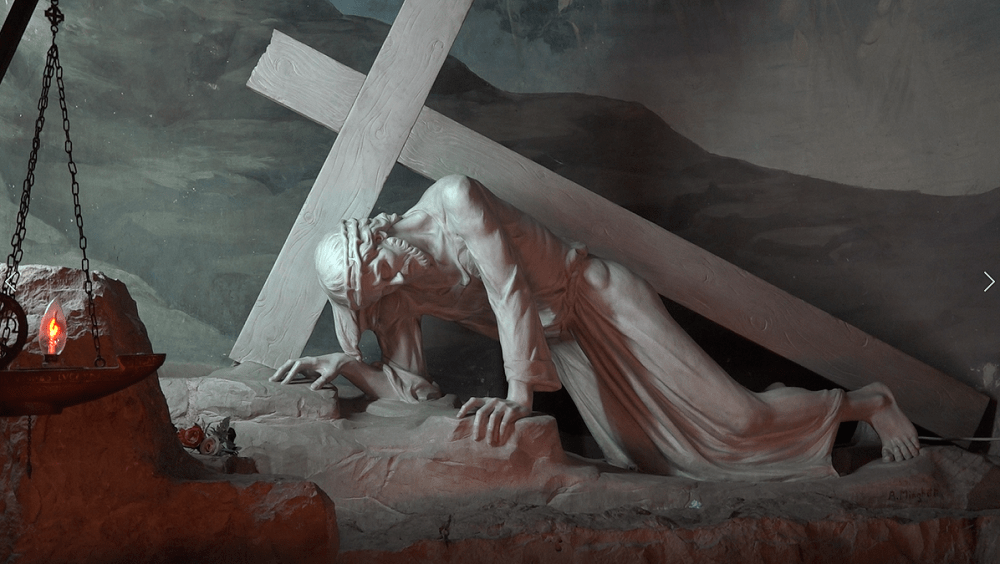
Ninth Station of the Cross, Jesus falls the third time, by Théophile Marie François Lybaert, c.1886

Be pleased, O God, to deliver me.
    O Lord, make haste to help me!
Let those be put to shame and confusion
    who seek my life.
Let those be turned back and brought to dishonor
    who desire to hurt me.
Let those who say, “Aha, Aha!”
    turn back because of their shame.

Let all who seek you
    rejoice and be glad in you.
Let those who love your salvation
    say evermore, “God is great!”
But I am poor and needy;
    hasten to me, O God!
You are my help and my deliverer;
    O Lord, do not delay! (New Revised Standard Version)

We all need help. Even Jesus.

As we journey with Jesus, and walk with him along the Via Dolorosa, we learn to set aside our illusions and delusions of radical independence, and to adopt his sense of dependence upon the heavenly Father. We come around to saying that we need divine help.

Continuing with a deliberate Christological view of the psalms, we are reminded that there was a time that Jesus felt desperation, just like we do. We go with him to the Garden of Gethsemane. And even though, in our own stressed out souls, we end up falling asleep and failing to pray as we ought, nevertheless we remember that the Lord Jesus sweat great drops of blood and agonized over what he was about to face.

There are times when the help we need isn’t for next week or tomorrow, but immediately, now!

I don’t know if you have ever been in such a stressful and dangerous situation in which all you could say is “Help, help me!” The abject feeling is helplessness is palpable and just plain awful. The sense there is nothing you can do to improve your circumstance other than some sort of merciful divine intervention is more than unnerving. It’s downright hard to breathe, let alone cry-out to be rescued.

In today’s psalm, it seems there were people getting a twisted sense of joy over the misfortune of others. It’s as if they were delighting in the confusion and vulnerability of those unable to stop what is happening.

In the throes of such stress and danger, the help we need is to have the evil turned back on the wicked. The psalmist wants such persons off his back – to have God hunt them like they are hunting the poor and needy who have no ability to resist.

It makes sense this psalm is short, just a few verses. Long prayers aren’t necessarily better than short ones, especially when it’s a frantic cry for God’s help. There is nothing in Holy Scripture that dictates how long or short prayer ought to be.

“Help!” just might be one of the best prayers we can pray. One little word. That’s all it takes.

It makes sense to me that this is an honest prayer. When in the throes of some horrible situation, all pretension goes out the window. Honest heartfelt prayers are the best kind of prayer.

If we are hurting badly enough, boldness comes quickly to the tip of our tongues. I once had a kidney stone and walked, doubled over in pain, into the Emergency Department of a hospital. I yelled at the first staff person I encountered, saying, “I need help, NOW!

To confess our great need to a God who listens might just be the best kind of theology we could ever express.

In such a terrible place of agony – of either body, soul, or both – there’s no thought to keeping up appearances, but only an unfiltered expression of need. Our prayers can, and need to be, earnest and urgent.

Prayer can be short, honest, and urgent because emergent situations require it. So, what do you do when you feel desperate? How do you handle your emotions? Where do you go for help?

In this Holy Week we are reminded that Jesus looked to the Father for help. In the worst of circumstances – facing ridicule, torture, and a horrible death – the Lord Jesus let the psalms shape his own prayers of desperation while under severe stress and duress:

“The one who ate my bread has lifted his heel against me.” (John 13:18; Psalm 41:9)

“They hated me without a cause.” (John 15:24; Psalm 69:4)

“I am deeply grieved, even to death; remain here, and stay awake with me.” (Matthew 26:38; Psalm 42:5-6)

“My God, my God, why have you forsaken me?”

Jesus (Matthew 27:46; Psalm 22:1)

Then Jesus, crying with a loud voice, said, “Father, into your hands I commend my spirit.” Having said this, he breathed his last. (Luke 23:46; Psalm 31:16)

There is a God who understands our plight. Jesus, the pioneer of our salvation, has gone before us in the way of suffering. He knows what it’s like to experience the agony and anguish of evil’s weight. He is our great high priest, the one who can intercede effectively and compassionately for us in our great times of need:

Now that we know what we have—Jesus, this great High Priest with ready access to God—let’s not let it slip through our fingers. We don’t have a priest who is out of touch with our reality. He’s been through weakness and testing, experienced it all—all but the sin. So, let’s walk right up to him and get what he is so ready to give. Take the mercy, accept the help. (Hebrews 4:14-16, MSG)

May you find in Jesus the help you so desperately need. Amen.

Tuesday of Holy Week (Psalm 71:1-14)

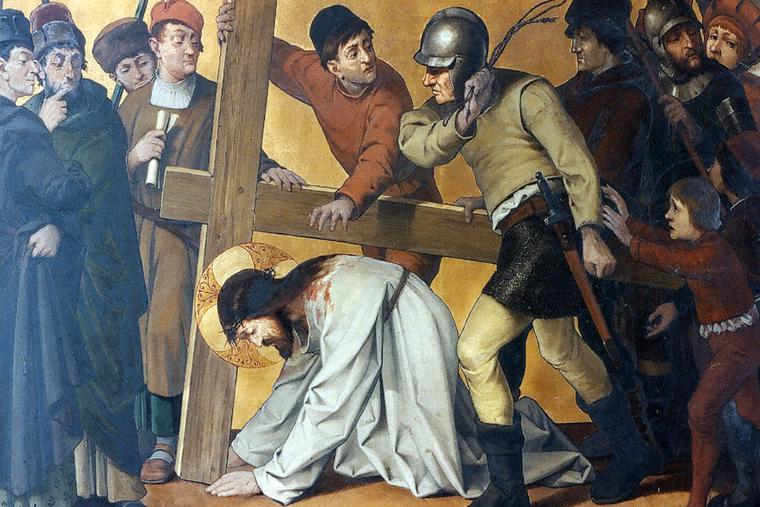
Station 3 of the Stations of the Cross, along the Via Dolorosa in Jerusalem

In you, O Lord, I take refuge;
    let me never be put to shame.
In your righteousness deliver me and rescue me;
    incline your ear to me and save me.
Be to me a rock of refuge,
    a strong fortress to save me,
    for you are my rock and my fortress.

Rescue me, O my God, from the hand of the wicked,
    from the grasp of the unjust and cruel.
For you, O Lord, are my hope,
    my trust, O Lord, from my youth.
From my birth I have leaned upon you,
    my protector since my mother’s womb.
My praise is continually of you.

I have been like a portent to many,
    but you are my strong refuge.
My mouth is filled with your praise
    and with your glory all day long.
Do not cast me off in the time of old age;
    do not forsake me when my strength is spent.
For my enemies speak concerning me,
    and those who watch for my life consult together.
They say, “Pursue and seize that person
    whom God has forsaken,
    for there is no one to deliver.”

O God do not be far from me;
    O my God, make haste to help me!
Let my accusers be put to shame and consumed;
    let those who seek to hurt me
    be covered with scorn and disgrace.
But I will hope continually
    and will praise you yet more and more. (New Revised Standard Version)

Christians take a decided interpretation of seeing Christ in the psalms. For us, we can envision Jesus saying these words of lament in the last days of his earthly life and ministry.

Why lament?

Lament is a significant piece of Lent, and is especially present in these final days of the season, Holy Week. To lament is to offer a public and passionate expression of grief. And it’s not optional but necessary and vital to the Christian experience, not to mention the human condition.

Without lamenting our great losses, our grief comes out sideways, inevitably harming others with our snarky vitriol. Lament gives expression to our deep grief. It enables us to come to grips with what has happened in the past, or happening to us in the present, and within us.

What does it mean to lament?

  • A lament is an expression of personal grief, due to any significant change or loss; it is the normal emotional, spiritual, physical, and relational reaction to that loss.
  • Lamenting is an intentional process of letting go. Relationships, dreams, plans, and people all die. We cannot get them back. Lament helps us find and live into a new identity after the loss or change.
  • Expressing grief through lament is intensely personal; there is no one-size-fits-all. No one else can do our lamentation for us.

How do I lament?

There are many psalms of lament, including our psalm lesson for today. They all have a typical structure to them, including:

  • Addressing God: Crying out for help. Some psalms of lament expand to include a statement of praise or a recollection of God’s intervention in the past. (Psalm 71:1-3)
  • Complaint: Telling God (said with some flavor!) about our problem or experience through a range and depth of emotional, relational, and spiritual reactions to the change or loss. (Psalm 71:4)
  • Confession of Trust: Remaining confident in God despite the circumstances. Beginning to see problems differently. (Psalm 71:5-8)
  • Petition: Proclaiming confidence in God. Appealing to God for deliverance and intervention. Keep in mind that petitioning is not bargaining with God or a refusal to accept loss. Rather, it is a legitimate seeking of help. (Psalm 71:9-13)
  • Words of Assurance: Expressing certainty that the petition will be heard by God. (Psalm 71:14a)
  • Vow of Praise: Vowing to testify in the future to what God will do with praise. (Psalm 71:14b-24)

I encourage and urge you to consider the following spiritual practice in this Holy Week: Set aside some time and craft your own psalm of lament.

Choose an event from your past which created grief for you. It can be recent or from years ago. Using the structure of lament psalms, thoughtfully write out each element as I have outlined it. Then, read it aloud to God. Perhaps even take another step by reading your lament aloud to a trusted family member, friend, or faith leader.

Our grief needs the outlet of lament. Grief which is not expressed ends up sitting heavily in the soul. Eventually, over time, if not acknowledged and spoken aloud, it can easily become putrid and rancid, poisoning our spirit, and compromising our faith.

Sharing your story through lament is biblical, practical, and I insist, necessary. I regularly craft psalms of lament whenever I have events or people who keep sticking with me in my thoughts and in my heart. Here is one example from a few years ago, after a mass shooting in my city:

Lord, in our shock and confusion, we come before you.

In our grief and despair, in the midst of hate,

in our sense of helplessness in the face of violence,

we lean on you. How long, O Lord, must we keep facing this!?

For the families of those who have been killed, we pray.

For the family of the shooter—help us to pray, Lord.

For the communities that have lost members—their anger, grief, fear—we pray.

For the churches striving to be your light in darkness, beyond our comprehension, we pray.

In the face of hatred, may we claim love, Lord.

May we love those far off and those near.

May we love those who are strangers and those who are friends.

May we love those who we agree with and understand,

and even more so, Lord, those who we consider to be our enemies.

Lord, have mercy. Christ, have mercy. Lord, have mercy.

Heal our sin-sick souls, and grant us your peace.

Make these wounds whole, Lord, for you can do it. Amen.

Monday of Holy Week (Psalm 36:5-11)

The Via Dolorosa (Latin: the way of sorrows) is a narrow path through the streets of the Old Jerusalem, the final route traveled by Jesus of Nazareth on the way to his crucifixion.

Your steadfast love, O Lord, extends to the heavens,
    your faithfulness to the clouds.
Your righteousness is like the mighty mountains;
    your judgments are like the great deep;
    you save humans and animals alike, O Lord.

How precious is your steadfast love, O God!
    All people may take refuge in the shadow of your wings.
They feast on the abundance of your house,
    and you give them drink from the river of your delights.
For with you is the fountain of life;
    in your light we see light.

O continue your steadfast love to those who know you
    and your salvation to the upright of heart!
Do not let the foot of the arrogant tread on me
    or the hand of the wicked drive me away. (New Revised Standard Version)

The desert journey is almost over. The sojourn with Jesus in his life and ministry will soon culminate in the ultimate experience of sorrow and joy. The Christian season of Lent is nearly at the end. We are in it’s final days, known as Holy Week.

We have a Holy Week because of love. There is yet another journey we must take, along the Via Dolorosa to the hill of Golgotha, because of God’s steadfast love.

Love suffers. Every parent knows this. Because of a parent’s committed and faithful love toward a child, they feel not only the joys but also the sorrows and pain of their children. I can say that this feeling does not go away, even with adult children. And it’s compounded with grandchildren. Just as our love is big enough to hold multiple children and grandchildren, so our capacity for experiencing deep emotion for their welfare is equally large.

Holy Week reminds us that God’s committed parental love suffers. It is because of God’s immense and steadfast love that there is a road to the cross and a tortured death for Jesus. The cost of our salvation involves a very bloody affair. Deliverance comes at the price of horrible violence. Jesus Christ lived and died for us, because of love.

He suffered much because he loved much.

God’s people, walking in the way of love, quickly discover that it is simultaneously walking in the way of suffering. From Old Testament times through the New Testament era and into the present day, the faithful have always experienced suffering as a central part of their piety and devotion in showing steadfast love. 

The medieval mystics of the Church understood quite well the connection between suffering and love. They could not imagine a Christian life without hardship, difficulty, and persecution. Thomas à Kempis, a sort of pastor to pastors, wrote in the fifteenth century:

“Sometimes it is to our advantage to endure misfortunes and adversities, for they make us enter into our inner selves and acknowledge that we are in a place of exile and that we ought not to rely on anything in this world.  And sometimes it is good for us to suffer contradictions and know that there are those who think ill and badly of us, even though we do our best and act with every good intention….  When men ridicule and belittle us, we should turn to God, who sees our innermost thoughts, and seek His judgment….  It is when a man of good will is distressed, or tempted, or afflicted with evil that he best understands the overwhelming need he has for God, without whom he can do nothing….  It is in such times of trial that he realizes that perfect security and full peace are not to be found in this world.”

Thomas à Kempis, The Imitation of Christ

And yet, it is because of love that suffering is transformed and endured as something wholly other than sheer pain or hurt. Thomas à Kempis went on to say:

“Love is a mighty power, a great and complete good; Love alone lightens every burden and makes the rough places smooth. It bears every hardship as though it were nothing and renders all bitterness sweet and acceptable. The love of Jesus is noble and inspires us to great deeds; it moves us always to desire perfection. Love aspires to high things and is held back by nothing base. Love longs to be free, a stranger to every worldly desire, lest its inner vision become dimmed, and lest worldly self-interest hinder it, or ill-fortune cast it down…. Love knows no limits, but ardently transcends all bounds. Love feels no burden, takes no account of toil, attempts things beyond its strength; love sees nothing as impossible, for it feels able to achieve all things. Love therefore does great things; it is strange and effective; while he who lacks love faints and fails.”

Thomas à Kempis, The Imitation of Christ

Holy Week’s message is certainly one of suffering love. Jesus went to the greatest lengths possible to give Divine steadfast love to humanity. So, let us not shy away from the cross, but journey with Jesus to Golgotha, embracing the love of God for us. In so doing, we will find the inner resources needed to love the world, even in all its unloveliness.

Grant, we pray, almighty God, that, though in our weakness we fail, we may be revived through the Passion of your Only Begotten Son. Who lives and reigns with you in the unity of the Holy Spirit, God, for ever and ever. Amen.

Jesus Is Better (Hebrews 8:1-7)

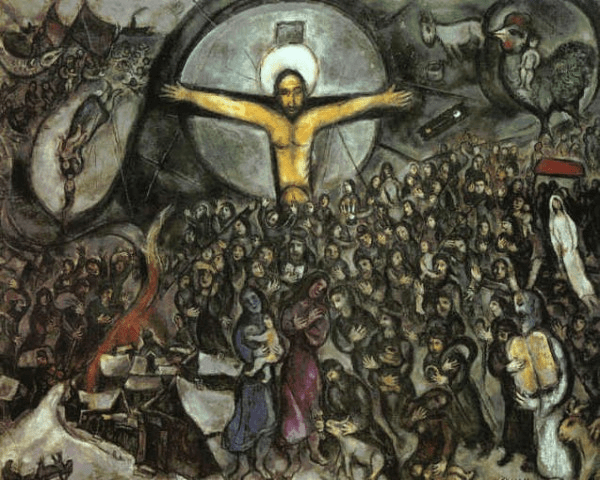
Exodus by Marc Chagall, 1952

Now the main point of what we are saying is this: We do have such a high priest, who sat down at the right hand of the throne of the Majesty in heaven, and who serves in the sanctuary, the true tabernacle set up by the Lord, not by a mere human being.

Every high priest is appointed to offer both gifts and sacrifices, and so it was necessary for this one also to have something to offer. If he were on earth, he would not be a priest, for there are already priests who offer the gifts prescribed by the law. They serve at a sanctuary that is a copy and shadow of what is in heaven. This is why Moses was warned when he was about to build the tabernacle: “See to it that you make everything according to the pattern shown you on the mountain.” But in fact the ministry Jesus has received is as superior to theirs as the covenant of which he is mediator is superior to the old one, since the new covenant is established on better promises.

For if there had been nothing wrong with that first covenant, no place would have been sought for another. (New International Version)

Jesus Christ is superior to everyone and everything – that is the overarching theme of the New Testament book of Hebrews. Jesus is above the angels, over Moses, and the great high priest of a new covenant. In Christ, the sin issue has been taken care of, once and for all.

Through Jesus, every good promise of God is fulfilled. Christ’s priesthood and intercessory ministry is permanent. His sacrifice for sin is thorough and complete. Jesus lives forever. He saves completely. Christ meets our need. He has been made perfect forever. (Hebrews 7:23-28). 

Frankly, these bold statements from the author of Hebrews are some audacious claims. In fact, they’re downright radical. And yet, say any of those statements in the typical church, and hardly an eyebrow gets raised – they almost seem ho-hum. Our blank affect testifies that we have lost a great deal of the original force and impact of Christianity.

In the first century, to have one sacrifice to end all sacrifices was unthinkable. Every ancient person understood that sacrifices were temporary; you had to keep offering them over and over again. 

Christianity, however, asked the world to have a new understanding of sacrifice. No longer would there be any sacrifice – no grain sacrifice; no offerings of first fruits; no animal sacrifices; no sacrifices, period. There was no longer any need for them because Jesus himself is the sacrifice to end all sacrifices. 

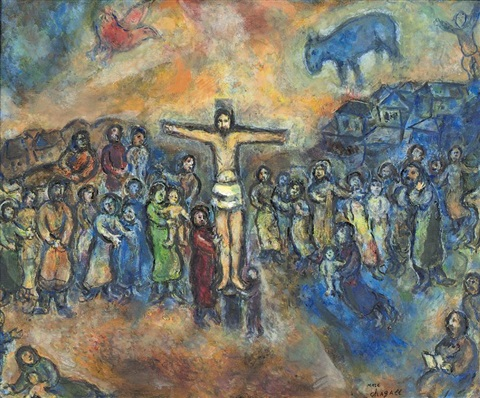
Crucifixion by Marc Chagall, 1966

This was such a ridiculous notion for so many people that they mocked Christians for it. Both Jews and pagans could barely wrap their minds around such a progressive idea. It would be like saying to us today that there is no longer any need for money because somebody just became the underwriter for everything everybody does.

Despite this incredible spiritual reality, we in the contemporary church sometimes go back to the old sacrificial system, not by physically offering animal sacrifices, but treating Christ’s finished work as if it were just too good to be true. 

We reason that we need to do something to help save ourselves. However, Jesus has not just saved us partially, but fully. Grace has always been scandalous, and so, we try to tone it down a bit, mitigate it’s actual force:

  • Church attendance can subtly be looked upon as a sacrifice to appease God, as if he needed to be soothed into not becoming angry at us. 
  • Giving can become a non-bloody sacrifice that is meant to satisfy God’s furrowed brow against us. 
  • Service can degenerate into a sacrifice to assuage our guilty conscience. 

In all these kinds of instances, and more, we go back to an old sacrificial system that is obsolete. Nonetheless, the biblical and theological truth is that Jesus has thoroughly saved us from our sin, and, so, has cleansed us from all guilt, including a guilty conscience. 

Jesus meets our need and has completely satisfied God’s wrath against the power and deceit of sin. 

Jesus is our mediator and intercedes for us as we come to God’s throne of grace. That means we do not need to try and get God’s attention with performing spiritual cartwheels or some incredible sacrifice that will somehow obligate him to take notice of us. That’s because there is never a time in which we lack attention from God.

Since we have been justified by faith in Jesus, we need not worry anymore about being good enough. Since Jesus is perfect, his work is made complete in us. A constant anxiety of feeling like we don’t measure-up does not come from God. Jesus is sufficient and has taken our place so that we can live in the freedom and joy of a complete deliverance from sin, death, and hell. There is no longer any necessary sacrifice to make!

“Well,” I have been told by some, “if everybody in the church believed that then nobody would ever do anything!” No, it is just the opposite. When we feel like we don’t measure up, we do less, not more. A low level discouragement sets in and we do nothing because we intuitively know it will never be enough. We do just enough to squeak by, never quite knowing if it is doing anything. 

In such a state, we may consider giving up because Christianity doesn’t work for us (which was the state of the believers in the book of Hebrews). But when we grasp the New Covenant of Christ’s sacrifice to end all sacrifices, and are overwhelmed by grace, then everything we do in the Christian life is a “thank you” with our life and our lips. 

It is the grace, and not the wrath, of God that teaches us to say “no” to ungodliness and worldly passions and to live upright and godly lives (Titus 2:11-12).

We are justified and made right by faith in Jesus Christ, and not by our own accomplishments, pedigree, or effort.  Trusting in our heritage, relying on our family’s faith, or believing our hard work gives us a leg-up toward heaven will only end in despair. 

But if we trust in Christ’s perfect sacrifice, then a whole new world of mercy opens before us. Because the grace of God in Christ is superior to everything.

Soli Deo Gloria