As you come to him, the living Stone—rejected by humans but chosen by God and precious to him—you also, like living stones, are being built into a spiritual house to be a holy priesthood, offering spiritual sacrifices acceptable to God through Jesus Christ. For in Scripture it says:
“See, I lay a stone in Zion, a chosen and precious cornerstone, and the one who trusts in him will never be put to shame.”
Now to you who believe, this stone is precious. But to those who do not believe,
“The stone the builders rejected has become the cornerstone,”
and,
“A stone that causes people to stumble and a rock that makes them fall.”
They stumble because they disobey the message—which is also what they were destined for.
But you are a chosen people, a royal priesthood, a holy nation, God’s special possession, that you may declare the praises of him who called you out of darkness into his wonderful light. Once you were not a people, but now you are the people of God; once you had not received mercy, but now you have received mercy. (New International Version)
The Apostle Peter describes Christians as “living stones” that form the temple of the Lord. In our worship we are like priests, carrying the sacrifices of praise and thanksgiving into the presence of God.
This is who we are; it is our identity. Christians belong to God in Jesus Christ through the power of the Holy Spirit. We have been formed – and continue to be formed – into the people of God as one, holy, catholic, and apostolic Church.
The word for stones in today’s text (Greek λίθος) specifically refers to large stones that have been hewn into shape. So Christians, as God’s holy people, have been set apart and shaped for the purpose of worshiping Jesus Christ. Instead of offering the blood of bulls and goats, like the select group of Old Testament priests did, we are all priests who now offer spiritual sacrifices because Jesus has taken care of the sin issue once for all.
Christians continually offer to God the worship of Christ, and a holy life, in grateful response to Christ’s sacrificial death on our behalf. Jesus Christ is the Christian’s cornerstone and center, and is to be the Church’s passion and priority. In worship, God builds us into a community of faith who dedicate ourselves to knowing Jesus and making him known.
All of life (and not just a Sunday worship service) is to be a daily rhythm of God’s revelation to us, and our response to God in faith, thanksgiving, and an obedient life.
We were chosen to serve God, and to exist for worship. Worship is grounded in the triune God and centered in Christ. Worship is the heart and life response to the revelation of God in Christ. Genuine encounters of God’s revelation to us, and our response to those experiences, form us into disciples of Jesus.
For those who refuse God’s perspective, Jesus Christ is experienced as an obstacle. He becomes the rock which causes them to stumble and fall. Although the early Christians for whom the Apostle Peter addressed were often humiliated and ostracized, they are nevertheless God’s elect, honored, and precious people.
Peter, who was named “Rock” by the Lord himself, wanted his audience to know that they, too, are known by God as rocks, as precious living stones. So, he explained their identity by pointing out the parallels between them and Christ:
Christ is the living cornerstone—Christians are living stones
Christ was rejected by humans—Christians are strangers in the world
Christ is God’s chosen One—Christians are God’s elect
Christ is venerated by God—Christians are esteemed by God
Jesus has so closely identified with us, God’s people, that we are in a vital union with him. On account of Christ’s rising from death, Christians are like living stones who are acceptable to God through Christ.
As the late salesman on television from decades ago, Ron Popeil, used to say, “But wait, there’s more!” Christians have been born again, experiencing rebirth into a new life. Our identity has given us great privilege as building blocks into the following:
Incorporation into a new community, a temple that shares in God’s honor and symbolizes God’s presence and power
Membership in a holy and royal priesthood, offering spiritual sacrifices of holiness and love (1 Peter 1:15, 22)
Inclusion into the chosen people—a disparate people who share together in common values, patterns of living, and redemption
Citizens of a holy nation who enjoy a covenant relationship with God and worship the Lord who brought them out of darkness and into light
God has created a community of people in Christ who did not previously exist. Together as Christians and people of God, we celebrate Jesus in worship and revel in his saving mercy, which has given us fresh hope and new life.
Therefore, I humbly and proudly adopt the identification of “Christian.” I am here because of Jesus Christ and all the faithful believers who came before me on the firm foundation of the apostles and prophets. I am part of the great stone structure called the Church. I know who I am. I know who my people are. And that sense of belonging no one can ever take from me.
Soli Deo Gloria
Lord of heaven and earth, we pray that you will bring justice, faith and salvation to all peoples. You chose us in Christ to be your people and to be the temple of your Holy Spirit; we pray that you will fill your Church with vision and hope. In the baptism and birth of Jesus, you have opened heaven to us and enabled us to share in your glory: the joy of the Father, the Son, and the Holy Spirit. May your whole Church, living and departed,
come to a joyful resurrection in your city of light. Amen.
Illustration of the parable of the vineyard workers, in the Codex Aureus of Echternach, c.1040 C.E.
“Listen to another parable: There was a landowner who planted a vineyard. He put a wall around it, dug a winepress in it and built a watchtower. Then he rented the vineyard to some farmers and moved to another place. When the harvest time approached, he sent his servants to the tenants to collect his fruit.
“The tenants seized his servants; they beat one, killed another, and stoned a third.Then he sent other servants to them, more than the first time, and the tenants treated them the same way. Last of all, he sent his son to them. ‘They will respect my son,’ he said.
“But when the tenants saw the son, they said to each other, ‘This is the heir. Come, let’s kill him and take his inheritance.’ So they took him and threw him out of the vineyard and killed him.
“Therefore, when the owner of the vineyard comes, what will he do to those tenants?”
“He will bring those wretches to a wretched end,” they replied, “and he will rent the vineyard to other tenants, who will give him his share of the crop at harvest time.”
Jesus said to them, “Have you never read in the Scriptures:
“‘The stone the builders rejected has become the cornerstone; the Lord has done this, and it is marvelous in our eyes’?
“Therefore I tell you that the kingdom of God will be taken away from you and given to a people who will produce its fruit. Anyone who falls on this stone will be broken to pieces; anyone on whom it falls will be crushed.”
When the chief priests and the Pharisees heard Jesus’ parables, they knew he was talking about them. They looked for a way to arrest him, but they were afraid of the crowd because the people held that he was a prophet. (New International Version)
I once saw a guide dog gently pressing on his blind owner to go a certain way. But the man didn’t go that way. The dog kept pressing until the blind man kicked his dog. And then, the guy walked smack into a parked car on the street.
We can sometimes think too much of ourselves; and tend to believe that what we say and do and think are right – until we walk into a parked car, looking like a fool. We need, of course, to listen to God. Yet, because we cannot see God, it’s too easy to treat the Lord as if he were an absentee landowner.
Today’s parable is about who will inherit the kingdom of God. The religious establishment of Christ’s day were not characterized by Christ’s Beatitudes. They thought they were okay. But they were really like a blind man kicking the guide dog, believing their way was right.
There are five truths illustrated in this parable that we need to grasp. The point of the parable is that Christ is looking for people who do God’s will and produce righteous fruit. Before we get into those truths, let’s get the cast of characters straight:
the landowner is God
the vineyard is Israel, God’s people
the tenants that the landowner put in charge are the religious leaders
the servants are the Old Testament prophets of God
the Son is Jesus
God is patient and longsuffering
God is like the guide dog who gently and lovingly keeps nudging, trying to get the person’s attention. In the parable, God’s people are likened to a vineyard. Jesus drew much of his teaching from the prophet Isaiah.
In Isaiah chapter 5, Israel is likened to a vineyard that God carefully takes care of, looking for fruit, but not getting any. For Jesus to tell the parable about a vineyard, gained the attention of people who knew the Scriptures.
Like Isaiah, Jesus pictured God as having a persistent, patient love for people, even when the tenants rebel and try and throw God out. The landowner, God, has:
planted
put in a wall
dug a winepress
built a watchtower
rented it out
sent the servants
All these verbs describe a God who put a lot of time and energy into the vineyard. Even today, God still fusses over the vineyard and is looking for people to produce fruit in keeping with a genuine sense of righteousness.
Humanity, especially the religious insiders, are sinful
In contrast to God’s love and care, is humanity’s persistent rebellion. The picture is of people who are hell-bent on rejecting the love of God. God’s patient love is met each time with a heightened hardness of heart on the part of the tenants. Jesus wanted the crowd to feel the situation of the landowner who goes beyond normal conventions in continuing to send servants; and the tenants’ violence in response.
God feels the weight of human sinfulness. Because the landowner is absent and we cannot see him, we may forget or not realize that God feels the full range of emotions. Each person who goes their own way and refuses God’s love; does not respond to God’s efforts to see fruit produced; and any system that is imposed contrary to God’s good order and care, all grieves God. Jesus later expressed his own grief and longing:
“Jerusalem, Jerusalem, you who kill the prophets and stone those sent to you, how often I have longed to gather your children together, as a hen gathers her chicks under her wings, and you were not willing.” (Matthew 23:37, NIV)
The Son was sent as the final act
Any “normal” landowner would throw the tenants out after the first sending of servants that didn’t go well. Yet God the landowner knew what he was doing. Jesus actually summarized the plot line of the Old Testament, and of our lives, as well. The history of salvation moves like this through Scripture:
God loves people
people keep rebelling against that love
God keeps pursuing peoiple
then, God does the unthinkable by becoming one of us
Jesus, stepped into this messy, bloody and violent world, full of hatred and hardness of heart. Then, the Son was killed and thrown outside.
God’s judgment is awful
Jesus drew his listeners into the story, and invited a response to what the landowner would do after all of the overtures to the tenants. The listeners responded that “he will bring those wretches to a wretched end.” And in a sense Jesus says, “You are them.”
Jesus invited them to remember and realize the Scripture by looking at it as the Son who was killed. He let the crowd know that rejection of the Son results in the Son becoming the most prominent person. Jesus wanted them to look at their bibles and see Christ. He was rejected by his own – which will result in a pulverizing judgment, like a stone falling on a person.
God replaces the whole crew
God is transferring the kingdom of God from the proud and hard-hearted religious insiders to the repentant, soft-hearted outsiders. The self-righteous people failed to accept Jesus because of their insistence on being right; the spiritual beggars accept Jesus and God’s love and are the true subjects of the kingdom. The supposedly spiritual people who had all the religious traditions failed to see what those traditions really point to.
We don’t own the kingdom; God does. God calls the shots, and has every right to expect people to produce the fruit of mercy, purity, and peacemaking in keeping with a humble heart that desires genuine righteousness.
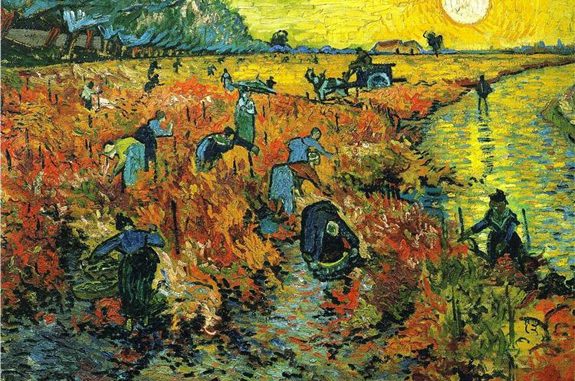
The Red Vineyard by Vincent Van Gogh, 1888
Maybe this parable seems a bit distant from us. To help us hear the story of Jesus as his original hearers heard it, I now restate the parable in a contemporary form:
Listen to another story about who is really a Christian. There was a landlord who built an upscale apartment building. The landlord spared no expense in creating apartments that were comfortable and homey. Everything he designed and built was with the care of someone who thought about what people would need and like most about a place to live. He included a host of amenities to his apartments because he really wanted the people to have as much joy living there as he did designing and building them.
The owner put a gate around the complex so that the apartment community would be safe and secure. He hired a security firm to keep watch over the apartment complex. Then, when every detail was in place, the landlord rented out his apartments. But he didn’t just rent them out; he wanted to see the joy on the faces of the renters when he made a contract with them that included an entire year’s free rent. After that first year, when it came time for the first rent to be due, the landlord did not receive a single rent check. He was puzzled about this, so he decided to send some of his employees to collect the rent in person.
While the renters were in one of the large common lounges enjoying being together, they saw the landlord’s employees coming from a distance. So, they hatched a devious plan. Over their year of living in the beautiful apartments, they began to think they were especially special, and not like other people who lived in places that weren’t as nice as where they lived. They gained such a twisted idea of their own importance that they believed they didn’t need to pay rent; and no one was going to tell them what to do. After all, they deserved to live where they did. They have a right to it. They don’t need to answer to anyone, including this supposed landlord who they have never seen in this last year, anyway.
Then the renters took the landlord’s employees and beat one, killed another, and took a baseball bat to a third. They took the bodies and threw them in the dumpster behind the building. Then the landlord, not wanting to evict his renters even after such a terrible experience, sent some other employees, more than the first time. But the renters had no guilt about what they had done, and did the very same thing to the second group of employees. Even after this, the landlord was reluctant to let the law take over and decided to send his own son to collect the rent so that the renters could keep living in his apartments.
But when the renters saw the son, they said to each other. “Look! The guy sent his son. If we kill him, then we can forget about the old man and claim the whole apartment complex for ourselves.”
After telling this story, Jesus asked all the church people listening, “When the owner of the apartment complex comes, what do you think he will do to those renters?” The crowd was into the story and replied, “He’s going to judge those ungrateful murderers, and replace the whole bunch of them with all new renters.”
Jesus then said to them, “Have you never read in your bibles that the son who was rejected and killed has become the most important person of all? The Scriptures are all about the Son.”
“So, I am telling you that even though you have been in the Church all your life, it isn’t yours. I’m going to replace the whole lot of you with people who are humble and sensitive to sin; people who know they don’t deserve the nicest place to live in the world. If you persist in ignoring the Son, all you have to look forward to is God’s judgment.”
When all the important church people heard Jesus’ stories, they knew he was talking about them. And, even though they saw themselves in the story, they still wanted to do their own thing. They didn’t change one bit. Instead, they decided to be sneaky and try and do away with Jesus in their lives without getting in trouble.
The kingdom of God and Christ’s Church is not an entitlement. And it does not inoculate us from God’s judgment. We must produce fruit in keeping with repentance. God is gently nudging us, like a guide dog. Will we respond in humility and turn where the Lord wants us to turn?
Now the Lord had said to Moses, “I will bring one more plague on Pharaoh and on Egypt. After that, he will let you go from here, and when he does, he will drive you out completely. Tell the people that men and women alike are to ask their neighbors for articles of silver and gold.” (The Lord made the Egyptians favorably disposed toward the people, and Moses himself was highly regarded in Egypt by Pharaoh’s officials and by the people.)
So Moses said, “This is what the Lord says: ‘About midnight I will go throughout Egypt. Every firstborn son in Egypt will die, from the firstborn son of Pharaoh, who sits on the throne, to the firstborn son of the female slave, who is at her hand mill, and all the firstborn of the cattle as well. There will be loud wailing throughout Egypt—worse than there has ever been or ever will be again. But among the Israelites not a dog will bark at any person or animal.’ Then you will know that the Lord makes a distinction between Egypt and Israel. All these officials of yours will come to me, bowing down before me and saying, ‘Go, you and all the people who follow you!’ After that I will leave.” Then Moses, hot with anger, left Pharaoh.
The Lord had said to Moses, “Pharaoh will refuse to listen to you—so that my wonders may be multiplied in Egypt.” Moses and Aaron performed all these wonders before Pharaoh, but the Lord hardened Pharaoh’s heart, and he would not let the Israelites go out of his country. (New International Version)
It takes a lot for the status quo to die, to let go of something that has been relied on for centuries. In the case of ancient Egypt, it took the deaths of every Egyptian first born son.
The Israelites had been slaves in Egypt for 400 years. The vast Egyptian Empire was literally built on the backs of Jews. After so long, their cry about being in bondage was heard by God – who sent Moses to deliver them. But Pharaoh, the King of Egypt, was not about to let go of this large labor force.
So, a series of 10 plagues came upon the Egyptians from God. Today’s Old Testament lesson is the tenth and final plague – the one most devastating to Egypt. Although Pharaoh was determined to keep the Israelites in bondage, not even mighty Egypt could keep it’s grip on the people when God was determined to free them and bring them to the Promised Land.
God graciously informed Moses that this was the final plague. After nine others, and hearing Pharaoh say he would let the people go multiple times, it must have been a relief to hear that this would not keep going any longer.
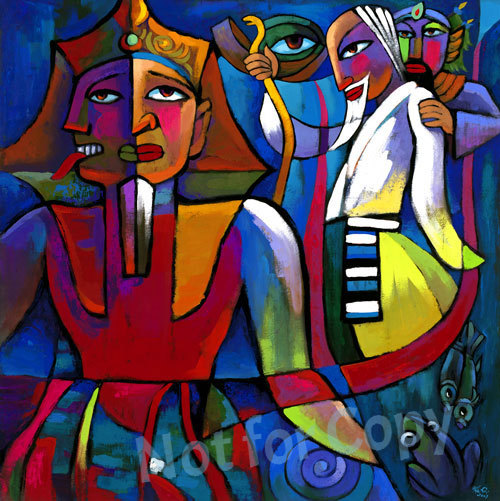
Moses and Aaron debating with Pharaoh, by He Qi
What’s more, the Lord added that not only would Pharaoh finally change and not hinder the people from leaving, but also that they should ask the Egyptians for what they needed when going. Indeed, the people of Egypt became so eager to have the Israelites away from them that they would give them anything to get them out.
The Israelites had worked hard and labored intensely for hundreds of years without any compensation. Now, they would leave the world of slavery and receive the riches of Egypt from which they were defrauded. Whereas Pharaoh’s heart became exceedingly hard, the Egyptians hearts became disposed to give – even though it was to be rid of the Israelites once and for all.
And so, God would deliver the Jews from their bondage and enrich them with many needed possessions, as if they were carrying away plunder from an enemy. The Lord both frees and empowers; God delivers from one situation and enables for another. When God closes a door, then another door is opened.
Indeed, the first will be last, and the last shall be first. In God’s upside-down kingdom, the oppressors eventually become the oppressed, and the poor become rich.
With this last and final plague, there would be no next generation to rise up and take back the Israelites into slavery again. A distinction was made between the first born of the Egyptians and the Israelites. Only the Egyptians experienced the awful deaths of so many.
After four centuries of keeping the Jews enslaved, maybe the Egyptians thought it would always be this way. Perhaps they even believed what they were doing was perfectly acceptable and right. So, when Moses comes along, speaking on behalf of God to Pharaoh, the great king of the empire thought things will not change; the Israelites ought to always be in subservience to Egyptians.
Why is it so hard to let go? Why do people keep holding on, even when it costs them nearly everything?
Whenever we cannot envision a different world or an alternative to what we are currently experiencing, then we hold on – even if it hurts to keep grasping it. Just because there was no divine judgment in hundreds of years, does not mean that God was okay with the situation in ancient Egypt. So, when the Egyptians experienced the judgment, it was absolutely devastating.
If ever we need to control other people in order to realize or maintain our own happiness or contentment, then we are in a very unhealthy place and need immediate help – before the providence of God steps in and pries that control from your clenched fists.
Conversely, if we have been in a place of oppression for a long time, it will not last forever. God sees the injustice. And God hears the cries which are uttered to heaven. A time is coming when all things will be made right.
Also, there are various sorts of traumas that people have endured. Sometimes, people don’t want to talk about any of it, and never do. But eventually, it overwhelms them. Without help, they will be in bondage. None of us can change on our own. We need others. Not everyone is going to harm us or shame us. There are people that God is ready to use in order to extend hope, healing, wholeness, and help. We should let them in, and keep the slave masters out.
Gracious and merciful God, help us to overcome the menace of evil in this world, and to be a part of freeing those weighed down with sinful oppression to realize a future of health and hope.
From famine and war, deliver us.
From hatred and from the demeaning of the dignity of others, deliver us.
From every kind of injustice in the life of society, both national and international, deliver us.
From the loss of awareness of good and evil, deliver us.
Accept our cry on behalf of the sufferings of all humanity, and of entire societies of people.
Empower us by your Spirit to resist evil in all its insidious manifestations.
May the saving grace and the redemption of Jesus put a stop to cruel bondage everywhere; and may hope be kindled in every heart. Amen.
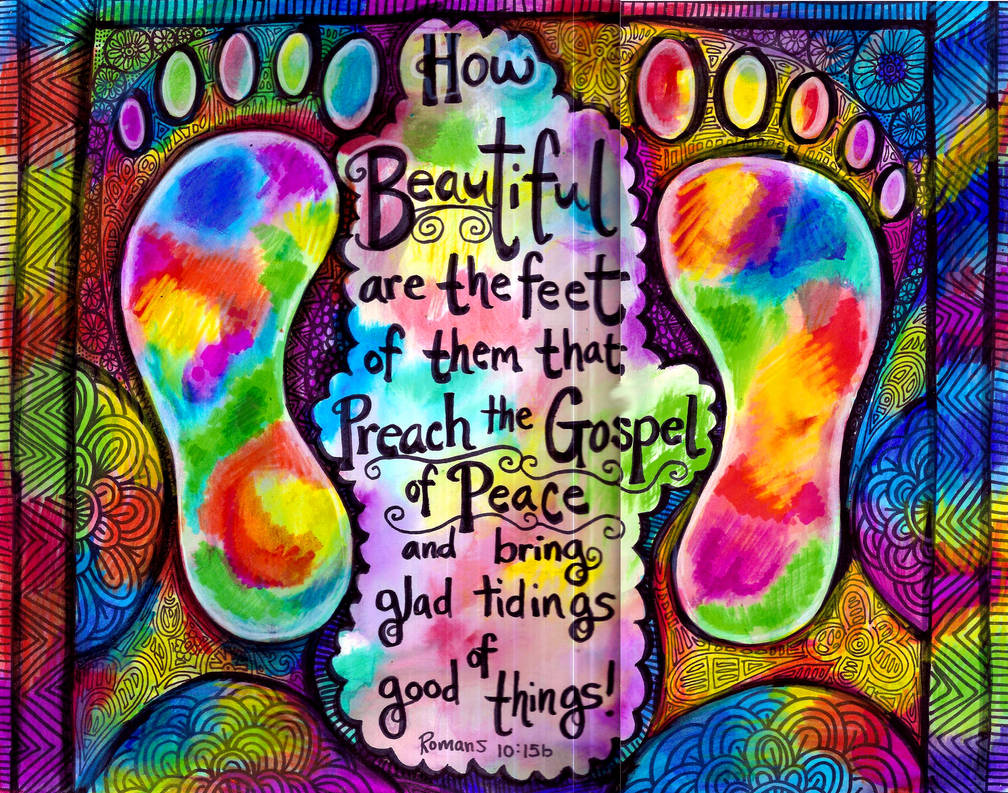
As it is written: “How beautiful are the feet of those who bring good news!”
But not all the Israelites accepted the good news. For Isaiah says, “Lord, who has believed our message?” Consequently, faith comes from hearing the message, and the message is heard through the word about Christ. But I ask: Did they not hear? Of course they did:
“Their voice has gone out into all the earth, their words to the ends of the world.”
Again I ask: Did Israel not understand? First, Moses says,
“I will make you envious by those who are not a nation; I will make you angry by a nation that has no understanding.”
And Isaiah boldly says,
“I was found by those who did not seek me; I revealed myself to those who did not ask for me.”
But concerning Israel he says,
“All day long I have held out my hands to a disobedient and obstinate people.” (New International Version)
“Beautiful” is not a typical description of anybody’s feet. That’s because feet are kind of gross. Feet stink. They get dirty and itchy; they’re often calloused and downright nasty looking. And no one comments that their feet feel good. People’s feet rarely feel that way.
It seems to me that feet are an apt metaphor for the bringing of salvation, of good news.
The Christian good news is this: There is salvation – forgiveness of sins – through Jesus Christ; and it is accessed by faith.
“Salvation” is a term which perhaps gets overused by Christians to the point that it becomes misunderstood and/or taken for granted. When that happens, it only becomes “meh” news and is no longer good news. For some, it’s a bit like feet – they’re there, but they hurt too much. We don’t think much about our feet until the corns, the bunions, or the toenails bother us. There’s a “meh” relationship to the foot.
In Christianity, the triune God has conspired within himself to bring us salvation. The good news is that God the Father has mercifully sent God the Son for the rescue of the entire world from sin, death, and hell; and Father and Son have further sent God the Holy Spirit to help us respond and live by faith.
Even back in the Old Testament, with the prophet Isaiah, such a merciful deliverance was predicted. Isaiah’s description of the life and rejection of the Suffering Servant wondered if faith would happen in response to salvation. Would they really see it as “good” news? Can feet really be beautiful?
Who has believed our message and to whom has the arm of the Lord been revealed? (Isaiah 53:1, NIV)
The Apostle Paul, knowing a thing or two about suffering, walking a lot of missionary miles with his feet, was confident that, indeed, faith is awakened in the hearing of the message. The message is good news, and it will be received. Good news has to be proclaimed before it can take hold.
So faith comes from what is heard, and what is heard comes through the word of Christ. (Romans 10:17, NRSV)
Good news has to be announced up-close and personal. It takes getting on our two feet, walking across the street, across the room, or across the world to bring it. That’s because salvation is relational. The message of salvation is there amongst people; it has always been deep within them, as those created in the image and likeness of God.
The heavens are telling the glory of God, and the firmament proclaims his handiwork. Day to day pours forth speech, and night to night declares knowledge. There is no speech, nor are there words; their voice is not heard; yet their voice goes out through all the earth and their words to the end of the world. (Psalm 19:1-4, NRSV)
In the book of Romans, we see Jewish Christians and Gentile Christians together in one church. Historically, the Jews were God’s people – the insiders – and the Gentiles were not a people, the outsiders. Now the Gentiles are included and are no longer outsiders. Not all the insiders were okay with this situation.
In the Old Testament, Moses predicted insider Israel’s overall response to this situation of feet walking amongst the Gentiles and announcing the good news of salvation.
They have roused my jealousy by worshiping things that are not God; they have provoked my anger with their useless idols. Now I will rouse their jealousy through people who are not even a people; I will provoke their anger through the foolish Gentiles. (Deuteronomy 32:21, NLT)
The prophet Isaiah also spoke of Gentile inclusion into God’s saving activity; and the Jewish response to salvation for them:
I was ready to respond to those who didn’t ask. I was ready to be found by those who didn’t look for me. I said, “I’m here! I’m here!” to a nation that didn’t call on my name. I extended my hands all day to a rebellious people walking in a way that isn’t good, following their own plans.” (Isaiah 65:1-2, CEB)
This in no way is meant to be hard on ancient Israelites and the Jewish people. It is really a commentary on including others who are different, what God thinks about it, and the challenge this poses to those holding onto the status quo.
Throughout all of biblical history, into the past two thousand years of church history, and even today, those who consider themselves as God’s people, the insiders, tend to be blinded by the privileges bestowed on them by a gracious God. And they usually think of only one thing: To preserve their status and their spiritual monopoly by excluding others who are different.
It is a hardening of the heart – or maybe the calloused feet – that does not want to recognize that certain persons and people groups can be saved and included as God’s people alongside the rest.
Fortunately, the Apostle Paul, a Jewish Christian, longed for all to be saved and to come to a knowledge of God. He himself wanted to know Christ and “be found in him, not having a righteousness of my own that comes from the law, but that which is through faith in Christ—the righteousness that comes from God on the basis of faith.” (Philippians 3:19)
Salvation is neither attained through strict observance of the rules, nor by being a good or nice person. It is graciously given by the God who came and whose feet walked amongst us. Deliverance comes through an acceptance by faith in the Son of God who loved us and gave himself for us – including people who others might consider as outsiders or unworthy of it.
From my vantage point, the feet that bring a gracious message of good news for all are truly beautiful.
Almighty God, Father of all mercies, we give you humble thanks for your goodness and steadfast love to all kinds of people. We thank you especially for your immeasurable love in the redemption of the world by our Lord Jesus Christ. And, we pray, give us such an awareness of your mercies, that with truly thankful hearts we may show forth your praise, not only with our lips, but in our lives, by giving ourselves to your service, and by walking before you in holiness and righteousness all our days. Amen.