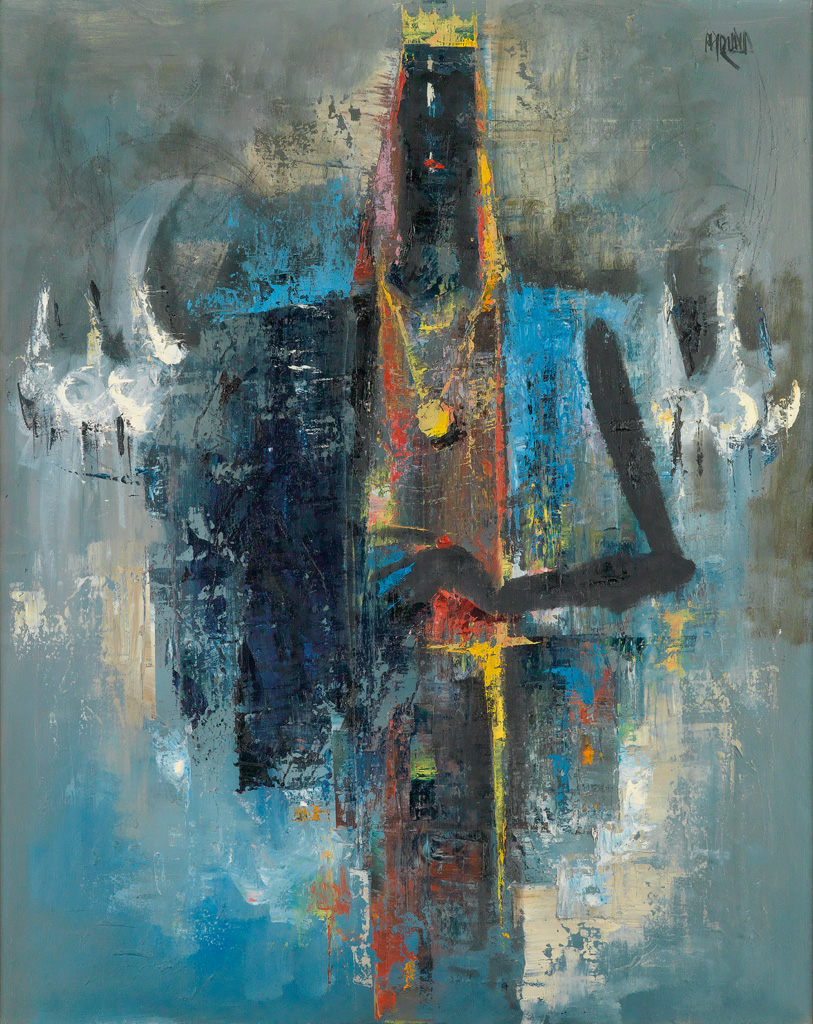
Lady Wisdom Is Speaking (Proverbs 8:1-31)

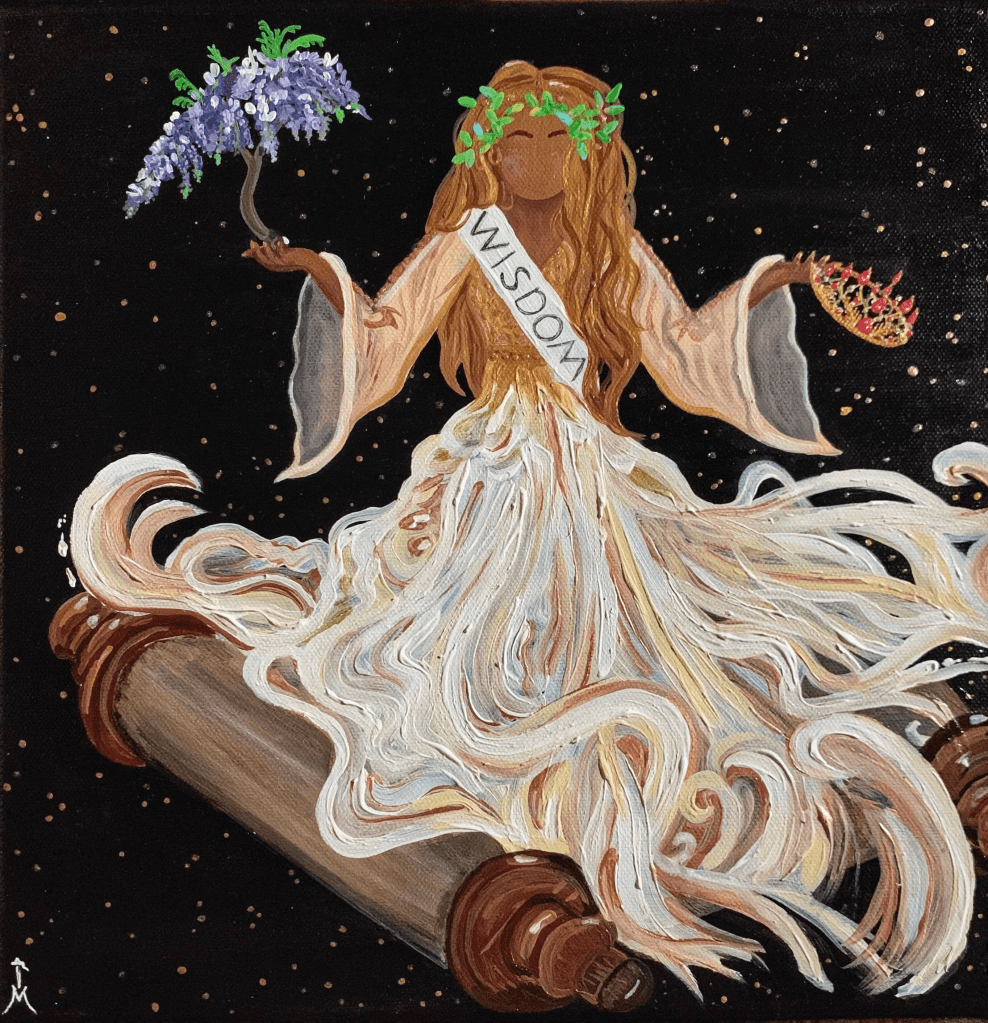
Lady Wisdom, by Mikayla Ragsdale

Doesn’t Wisdom cry out
    and Understanding shout?
Atop the heights along the path,
    at the crossroads she takes her stand.
By the gate before the city,
    at the entrances she shouts:

I cry out to you, people;
    my voice goes out to all of humanity.
Understand skill, you who are naive.
    Take this to heart, you fools.
Listen, for I speak things that are correct;
    from my lips comes what is right.
My mouth utters the truth;
    my lips despise wickedness.
All the words of my mouth are righteous;
    nothing in them is twisted or crooked.
All of them are straightforward to those who understand,
    and upright for the knowledgeable.
Take my instruction rather than silver,
    knowledge rather than choice gold.
Wisdom is better than pearls;
    nothing is more delightful than she.

I, Wisdom, dwell with prudence;
    I have found knowledge and discretion.
To fear the Lord is to hate evil.
    I hate pride and arrogance,
        the path of evil and corrupt speech.
I have advice and ability,
    as well as understanding and strength.
By me kings rule,
    and princes issue righteous decrees.
By me rulers govern,
    and officials judge righteously.
I love those who love me;
    those who seek me will find me.
Riches and honor are with me,
    as well as enduring wealth and righteousness.
My fruit is better than gold, even fine gold;
    my crops are better than choice silver.
I walk on the way of righteousness,
    on the paths of justice,
    to provide for those who love me
        and to fill up their treasuries.

The Lord created me at the beginning of his way,
    before his deeds long in the past.
I was formed in ancient times,
    at the beginning, before the earth was.
When there were no watery depths, I was brought forth,
    when there were no springs flowing with water.
Before the mountains were settled,
    before the hills, I was brought forth;
    before God made the earth and the fields
    or the first of the dry land.
I was there when he established the heavens,
    when he marked out the horizon on the deep sea,
    when he thickened the clouds above,
    when he secured the fountains of the deep,
    when he set a limit for the sea,
        so the water couldn’t go beyond his command,
    when he marked out the earth’s foundations.
I was beside him as a master of crafts.
    I was having fun,
    smiling before him all the time,
    frolicking with his inhabited earth
    and delighting in the human race. (Common English Bible)

Statue of Sophia (Wisdom), Sofia, Bulgaria

Wisdom is available. Wisdom is speaking to us. Wisdom lives with prudence. Wisdom enjoys God. And wisdom is personified as a woman (think about that before you have a round table discussion with all men).

To seek, cultivate, and teach wisdom is a worthy pursuit, in and of itself. The benefits of wisdom are great and profound, better than any earthly material thing, like silver or gold.

Actually, wisdom is quite an abstract ideal to pursue, which is likely why it helps to have it presented as a beautiful woman.

Proverbs are wise sayings; they are short pithy statements of experiential truth. This means that wisdom is less universal than it is situational. In other words, the Book of Proverbs is not a textbook or a manual on wisdom; it is rather something to be familiar with when we are facing difficult situations and thorny problems.

If there is a constant universal to all of the wisdom, it is to acknowledge and respect the presence of God in the world. All things change, except God. The Lord is the ever-present Being who is consistently right, just, and good all the time.

This may be why wisdom seems elusive. We can get to know God better and better for an eternity, and yet never exhaust getting to know God completely or fully.

Wisdom is like that. It’s too big, too variegated. There is no such thing as “Wisdom For Dummies,” that is distilled into a neatly bound book.

Truly, wisdom is rather slippery. It is not something to be mastered, but a grand sage presence to be mastered by. We must let Lady Wisdom have her way in our lives.

Lady Wisdom is in opposition to the temptress, the foolish one, who lures people into evil, and young men into the trap of misconduct that will alter their lives forever.

Just because Lady Wisdom has been around a long time – as old as the world – her beauty only increases over time; and her compelling message winsome.

The wise Lady still maintains a childlike wonder amongst God’s creative work. She revels in this world of delight and discovery. It’s fun to be alongside God and enjoy such a large and expansive playground of wonder.

Joy and levity are just as much at the heart of wisdom as brevity and seriousness. If Lady Wisdom can delight in the humans God has created, then we have much to learn from her in discovering how to frolic and play with our fellow creatures in good and wholesome ways.

The metaphorical image of wisdom as a beautiful woman who beckons us, is in competition with other voices that tempt us with quick and tidy happiness. Those other voices, however, never get around to mentioning the cost of their so-called solutions.

To court with foolishness is to make the devil’s bargain. It will only result in regret.

The best and straightest road to wisdom is by loving God and honoring God’s instructions. We get some help in this worthy endeavor through the wise sayings of Proverbs, and by means of Lady Wisdom’s sound advice.

We are called to keep up a pursuit of wisdom throughout the duration of our earthly lives – which means there is a lot of mystery to Lady Wisdom yet to discover; and there is much more to know about her.

Blessed God, help me to pay attention to your good friend, Lady Wisdom, so that in all my words and ways I may live into mercy, purity, and peace; and so, glorify You and enjoy this life you have given me. Amen.


Consider Wisdom (Proverbs 1:1-19)

By Peter Max, 2008

The proverbs of Solomon, son of David and king of Israel.

Here are proverbs that will help you recognize wisdom and good advice, and understand sayings with deep meaning. They can teach you how to live intelligently and how to be honest, just, and fair. They can make an inexperienced person clever and teach young people how to be resourceful. These proverbs can even add to the knowledge of the wise and give guidance to the educated, so that they can understand the hidden meanings of proverbs and the problems that the wise raise.

To have knowledge, you must first have reverence for the Lord. Stupid people have no respect for wisdom and refuse to learn.

My child, pay attention to what your father and mother tell you. Their teaching will improve your character as a handsome turban or a necklace improves your appearance.

My child, when sinners tempt you, don’t give in. Suppose they say, “Come on; let’s find someone to kill! Let’s attack some innocent people for the fun of it! They may be alive and well when we find them, but they’ll be dead when we’re through with them! We’ll find all kinds of riches and fill our houses with loot! Come and join us, and we’ll all share what we steal.”

My child, don’t go with people like that. Stay away from them. They can’t wait to do something bad. They’re always ready to kill. It does no good to spread a net when the bird you want to catch is watching, but people like that are setting a trap for themselves, a trap in which they will die. Robbery always claims the life of the robber—this is what happens to anyone who lives by violence. (Good News Translation)

“To educate a man in mind and not in morals is to educate a menace to society.”

Theodore Roosevelt

A proverb is a short pithy statement of experiential truth. Proverbs are meant to teach one how to live a good life. This sort of education requires a lifetime of learning. There is always wisdom to be gained.

In order to have true understanding and wisdom, there needs to be a balance of intellectual knowledge, affective feeling, and intuitive knowledge. Only possessing some of these elements makes one nothing more than a half-wit.

A commitment to virtue, morality, and ethics is a must in the acquisition of wisdom, and thus, a good life. Physical, mental, emotional, and spiritual maturity all take time. Marinading over a long period of time in the wisdom of biblical proverbs will prove to be a life saver. At the end of one’s life, they can look back with gratefulness and satisfaction, instead of sorrow and regret.

So, from the very outset of approaching the Book of Proverbs, the mindset and heart stance must not be one of popping a few proverbial pills in order to achieve a self-centered goal or gain an immediate solution.

Rather, proverbial wisdom demands daily immersion in its wise sayings. It requires implementation and experimentation every single day. There needs to be decisive action, coupled with contemplative reflection. Anything short of this truncates and stunts one’s growth.

There is yet one more necessary prerequisite toward the sagacious and good life. Without this, nothing is possible. But with this, all things are possible: Acknowledgment, awareness, and adoration of the Lord.

A fool is one who stubbornly refuses to take in the full range of epistemic knowledge. Being only book smart is to actually be stupid. To be only a walking heart of emotional intelligence is foolish. And to live only by gut instinct alone is to cut off yourself from wisdom’s teaching.

A wise life includes the head, the heart, and the gut – and to have them all aligned together as an integral whole. To live other than this is to live as a fool who believes they already have the answers and the key to knowledge and understanding.

Furthermore, this means that to take God and transcendent things off of the table, to begin with, is the most foolish decision a person can make. Conversely, to forsake the intellectual life and believe that all one needs is the spiritual, is to betray a woefully foolish approach to the good life.

There are also those who distance themselves from family, especially parents. On some level, this makes sense, if one had a childhood full of traumatic memories and difficult relationships.

However, learning to honor even these parents is to place oneself on the path of wisdom, and to learn what the good life truly entails. And this approach allows the person to see the good, and strain out the bad.

In other words, we discover that good and bad, wise and foolish, smart and stupid, exists within everyone and in every place. Wholesale jettisoning of persons and/or institutions gains us little to nothing.

This distancing from family and/or God is an attempt to assert some control, to effect one’s willpower upon life. But this will lead us away from the true path of wisdom.

That’s because wisdom is not something to be mastered. Wise sayings don’t exist to be collected, and their sagacity harnessed for one’s personal goals.

Yes, we are to avail ourselves of wisdom, yet perhaps not as we may believe or think. We do not capture wisdom, but are captured by it.

The importance of this mental, emotional, and spiritual stance must not be undervalued. We only learn wisdom by means of humility and reverence before powers greater than ourselves. Any vestige of pride in us shall cause wisdom to disappear and slip from our grasp.

Only until we both intellectually and experientially recognize that the essential operations of the universe are beyond us, shall anyone begin to trust and risk in a wisdom greater than our own.

“Without humility, all shall be lost.”

St. Teresa of Avila

Put another way, if we refuse to learn from God and from our parents, then we won’t.

Only by accepting this can anyone discern what to do and don’t do, say and don’t say, when faced with competing voices.

For there is continually a voice of foolishness, of wickedness, enticing us to get what we want quickly, selfishly, without any thought to the consequences or the effect upon others. A group of such voices becomes a gang who tries outdoing each other in competitive evil.

There is also a voice of wisdom, which admonishes us to avoid the fast, fun, and friendly gang of evil speech and behavior. The wise person discerns that what the wicked person does to another, comes back upon them.

The patient and powerful voice of wisdom communicates prudence in all things, that is, to do today what will lead to a better tomorrow.

So then, my friend, what is the thing – the decision, the action, the words – that you can and will do today which will help you accomplish a good, right, and just life for yourself (and others) for tomorrow?

Great God of all wisdom, help me to trust You and follow Your precepts in every twist and turn of my life. Grant me good understanding and guide my steps, so that Your will is done on earth, as it is always done in Your heaven. Amen.

Wisdom (1 Kings 4:29-34)

King Solomon, by Helen Zarin

God gave Solomon wisdom and very great insight, and a breadth of understanding as measureless as the sand on the seashore. Solomon’s wisdom was greater than the wisdom of all the people of the East, and greater than all the wisdom of Egypt. 

He was wiser than anyone else, including Ethan the Ezrahite—wiser than Heman, Kalkol and Darda, the sons of Mahol. And his fame spread to all the surrounding nations. 

He spoke three thousand proverbs and his songs numbered a thousand and five. He spoke about plant life, from the cedar of Lebanon to the hyssop that grows out of walls.

He also spoke about animals and birds, reptiles and fish. From all nations people came to listen to Solomon’s wisdom, sent by all the kings of the world, who had heard of his wisdom. (New International Version)

Talking about King Solomon of old is, in many ways, like talking about any human being. That’s because Solomon was an odd combination of extremely gifted, and yet, deeply flawed.

Solomon’s reign was the greatest that Israel and Judah ever had; and perhaps the wealthiest and most impressive reign that there ever was in the world. Here we are, talking about it nearly 3,000 years later.

Yet, for all the accomplishments of Solomon, he failed to maintain faithfulness to God throughout his lifetime. His wealth and power were so vast that it was his downfall.

Although he died a great king, at his death there were many who were not sorry to see him go. And Jerusalem, the capitol, was occupied with other gods, and not the exclusive worship of Yahweh, as God’s law was so careful to warn against.

However, in today’s Old Testament lesson, we remember the unparalleled wisdom of Solomon. In this regard, there is no one like him in history.

The text of Scripture makes it plain as to where Solomon got his supreme wisdom: God gave it to him (1 Kings 3:1-15). Indeed, God is the source of wisdom, and the fount of knowledge.

Solomon was the son of King David and Bathsheba. He became king of Judah and Israel in 967 BCE, at age twenty, and reigned until his death in 928 BCE. King Solomon’s wisdom was both broad and deep. He was given to wise parables and poetry; sage insights into human nature; and a keen sense to political, social, and economic administration.

The editor of the books of the Kings compares Solomon to the eastern Babylonian sages who were famous in the ancient world; and to the sages of Egypt. Specifically, he is compared to four men: Ethan, Heman, Kalkol, and Darda – the wisest in Israel before Solomon.

Israel had its sages, well before Solomon came along, and possessed a body of wisdom for the people to learn from. The editor tells us that King Solomon surpassed them all in his wisdom, knowledge, understanding, and insight.

Even though there are sages and wise persons, wisdom is for everyone, all humans, without exception. From wisdom we learn to pay attention and observe. This is why Solomon was so wise – his powers of observation were second to none.

He took the time to pay attention to plants, animals, and all creation. He dedicated himself to looking into all the differing affairs of what humanity does. As a result of his efforts at observing humanity, we have the biblical wisdom books of Proverbs (short pithy sayings of experiential truth), Ecclesiastes (issues of ultimate meaning), and Song of Songs (an ode to Love).

King Solomon, by William Pajaub (1925-2015)

In short, Solomon’s wisdom teaches us that those who take the time to learn, listen, and mature have a happy life; and those who don’t, injure themselves and have a sad life.

Through wisdom, we discover the importance of respecting the poor, the value of creative and fulfilling work, helpful speech, handling money well, and virtuous friends. Each person’s wise conduct benefits the wellbeing of the community, whereas foolish conduct destroys a people.

Wisdom is attuned to morality and consequences (and not to moralism and judgmentalism). Our words and actions bring either connection and encouragement, or separation and duress. Good choices bring life and peace; bad decisions lead to death and division.

One might assume that wisdom is a moral code – but it is not. Rather, wisdom is a dynamic force which brings satisfaction and fulfillment to the world. Being a wise person means that one’s conduct and way of life is in sync with unity, harmony, integrity, and peace.

Foolishness, on the other hand, goes against the grain of a moral life. A fool assumes they can do what they want, whenever they want, without restraint. They think they are an autonomous being who answers to no one. A fool lives as if God is non-existent, and other people are no more valuable than insects on a sidewalk.

Solomon became king in Israel and Judah without a vote, and ruled without democracy. Yet, he recognized that wisdom was needed in order to rule. In reality, wisdom is still needed for any and every sort of leadership.

Our present American political campaign has all the markings of a foolishness that mocks wisdom. That’s why we get so much careless, unhelpful, and downright harmful speech. There is indifference to people in debt, and an overlooking of the poor. We have words and actions without any thought to others, and policies based in greed. Most of all, there is no moral coherence at all, even with cheap religious talk.

It appears that a large chunk of Americans have never taken the time to observe, listen, and pay attention. Their faith – if there is any faith at all – is shallow and disconnected from their fellow citizens. They fail to discern that society cannot be divided into classes of rich and poor.

Wisdom is about being connected, not divided. It has an understanding of all creatures, and that we are ethically and morally bound to the rest of creation. The wise person thus builds bridges, not walls; and does everything possible to turn away from violence, both physical and verbal.

There is no political party, no neighborhood association, no corporate board, and no church council who is all wise and immune to being foolish. We must not throw our ultimate allegiance to anything or anyone other than our all-wise Creator God. And we also must keep in mind that human institutions really can be brought into line with wisdom.

Unfortunately, foolishness is alive and well – not only in the United States of America, but also around the world. Foolish political candidates and leaders of all kinds promise us short-term selfish solutions to large communal and national issues.

Yet, the fool will not prevail. Sadly, King Solomon gave into some foolishness toward the end of his life. Yet, even despite that, Solomon could tell you that wisdom has always existed, and pre-dates foolishness.

Lady Wisdom calls to us, and we have the ability and the faculties to respond and learn from her. Please do so, hopefully, before election day.

Teach me to listen, O God, to those nearest me, my family, my friends, my co-workers. Help me to be aware of the inherent dignity and worth of every person I encounter, and to listen to their voice.

Teach me to listen, O God, to the despair of the hopeless, the plea of the forgotten, and the cry of the anguished.

Teach me to listen, O God, to myself. Help me to be less afraid to trust the voice inside — in the deepest part of me.

Teach me to listen, Holy Spirit, for your voice — in busyness and in boredom, in certainty and doubt, in noise and in silence.

Teach me, Lord, to listen.  Amen.

Make Wise Choices (Proverbs 3:5-12)

Trust in the Lord with all your heart. Never rely on what you think you know. Remember the Lord in everything you do, and he will show you the right way. 

Never let yourself think that you are wiser than you are; simply obey the Lord and refuse to do wrong. If you do, it will be like good medicine, healing your wounds and easing your pains. 

Honor the Lord by making him an offering from the best of all that your land produces. If you do, your barns will be filled with grain, and you will have too much wine to store it all.

My child, when the Lord corrects you, pay close attention and take it as a warning. The Lord corrects those he loves, as parents correct a child of whom they are proud. (Good News Translation)

“The choice to make good choices is the best choice you can choose. Fail to make that choice and on most choices you will lose.”

Ryan Lilly

The biblical book of Proverbs is a collection of short pithy statements based in experiential truth. That is, they are wisdom sayings.

Wisdom is a gradual accumulation of understanding, over time, with a combination of observation and practice.

The Teacher (the Collector of the proverbs) highlights the wisdom needed to navigate life. It’s a bit like learning the basic laws of the universe, such as respecting the force of gravity by not walking off the roof of your house.

Wisdom observes and pays attention; then applies the understanding gained to reality.

Failing to cultivate a wise life (foolishness) creates all kinds of problems.

Notice the realities we need to respect in our Old Testament lesson for today: God, God’s guidance, God’s honor, God’s discipline.

And then notice the verbs which tell us how to respond wisely: trust, remember, obey, honor, pay close attention. Submitting to reality, respecting others, and accepting situations as they are, and not as we want them to be, is evidence of a sage life.

In contrast to the sage response, foolish reactions are made up of pride, avarice, and hate.

Both wisdom and foolishness are evidenced by their outcomes.

The wise person, having been taught a respect for God and the ways of grace, will most likely have the experience of receiving guidance, health, abundance, and love. Conversely, the fool who ignores divine counsel will probably experience misplaced trust, health issues, short-sighted financial decisions, and cruddy attitudes.

“You can’t choose your potential, but you can choose to fulfill it.”

Theodore Roosevelt

All things being equal, the wise person who deliberately and carefully applies knowledge and understanding to life will have an abundant spirit full of satisfaction – whereas the fool who improvises everything will struggle to live in a small world of holistic poverty and want.

The gist of today’s verses is that one cannot live as an island. We all need to practice consultation and collaboration to achieve a good life. Instruction and correction are necessary to obtain the good life. To spurn both divine and human connections in favor of radical personal independence is plain old foolish; it leads to a lousy life.

In short, the fool incessantly airs opinions with useless sophistry to an empty room; and, the sage is an observant student to universal rhythms and has learned the timing of proper words and of silence.

I am going to state this all in a different way: Relying on God and others through making and keeping promises to one another is the basis of a solid community and a gratifying personal life. Relying merely on one’s self is a one-way road to spiritual pain and emotional damage, not to mention physical illness and financial scarcity.

Fools always think they know best. Sages always know better than that.

The collection of Proverbs we have in the biblical canon is a presentation, a dialectic, a contrast and a setting forth of two ways of approaching how to live in the world:

  • foolishness or wisdom
  • independence or interdependence
  • cognitive pride or mental humility
  • negligence of evidence-based research or consultation through books, literature, and reading
  • exploitation of resources or submission to the natural laws and rhythms of the land
  • holding-on with clenched fists or generosity with open hands
  • Grinch-like attitudes or God-like dispositions
  • incessant criticism or heartfelt tribute
  • blaming or recognizing other’s contributions
  • shame or vulnerability
  • bitterness or forgiveness
  • resistance to correction or acceptance of discipline
  • hate or love
  • judgment or grace

There is always a fork in the road. And standing at those intersections of life, we must choose whether to take the difficult path of wisdom, or amble down the broad highway of foolishness.

The two paths will lead to either life or death, joy or despair, hope or disappointment, faith or fear.

How will you choose? Which way will you go?

Choose wisely, my friend.

Almighty God, the fountain of all wisdom, you know our necessities before we ask and our ignorance in asking: Have compassion on our weakness, and mercifully give us those things which for our unworthiness we dare not, and for our blindness we cannot ask; through the worthiness of your Son Jesus Christ our Lord, who lives and reigns with you and the Holy Spirit, one God, now and forever. Amen.