Saints, Sinners, and Sacrifice (Mark 8:31-38)

Then he began to teach them that the Son of Man must undergo great suffering and be rejected by the elders, the chief priests, and the scribes and be killed and after three days rise again. He said all this quite openly. And Peter took him aside and began to rebuke him. But turning and looking at his disciples, he rebuked Peter and said, “Get behind me, Satan! For you are setting your mind not on divine things but on human things.”

He called the crowd with his disciples and said to them, “If any wish to come after me, let them deny themselves and take up their cross and follow me. For those who want to save their life will lose it, and those who lose their life for my sake, and for the sake of the gospel, will save it. For what will it profit them to gain the whole world and forfeit their life? Indeed, what can they give in return for their life? Those who are ashamed of me and of my words in this adulterous and sinful generation, of them the Son of Man will also be ashamed when he comes in the glory of his Father with the holy angels.” (New Revised Standard Version)

Saintly Sinners and Sinning Saints

People cannot be separated easily into the categories of saints or sinners. We are much more like saintly sinners or sinning saints. 

If we look closely, everyone is, at the same time, both beautiful and hideous; holy and depraved; full of faith and full of fear. And when it comes to the church, it is both the place of spiritual sensitivity toward others, as well as a den of decadent self-interested individuals. 

So, anyone searching for a church or a community that is a nice clean upward path of success with everything done to perfection with no one ever being hurt or unhappy, will be sorely disappointed. Such an organization or institution does not exist; and, it never did.

Yet, with that reality in mind, Jesus stands right alongside imperfect people, despite all their flaws, shallowness, and self-interest. Jesus is very well acquainted with people’s damaged emotions and open putrid spiritual abscesses. Yet, Christ treats everyone with mercy; Jesus never tires of rehabilitating and reforming.

Christ’s disciple, Peter, is the poster child for humanity’s mix of faith and failure. He stepped out of a boat in great faith and walked on the water, only to begin sinking because of his great fear. (Matthew 14:22-33)

It was Peter who made a bold and right confession of faith, and then turned around and bought into a satanic agenda. Yet, Jesus was right there, next to Peter all the way. Christ both rebukes and loves, all the while never abandoning us, but always working in and through us to accomplish good and right purposes.

The bald fact of the matter is that following Jesus involves pain and sacrifice. That’s the reality of living in a broken mixed-up world. What’s more, Christ’s Church is still imperfect and in the process of becoming holy. So, if we will admit it, we are all like Peter – a little devil who needs to get in line behind Jesus.

Everyone gets frustrated or disgusted with church, or really any consistent gathering of people. It’s easy to complain and even avoid others. It’s much harder to take up our cross and lose our life for the sake of Christ and others. We truly can choose to put love where love is not, even when we do not feel loved.

Imagine that your family has gathered for a holiday. Everyone is together. But you are struggling with tiredness and anger. Your spouse is sulking. Your teenage kids don’t want to be there. You worry about your aging parent. And you’re anxious about whether your crazy uncle is going to be nice or go on some weird political rant.

You want to be present, to celebrate the holiday. Your family is anything but a Hallmark card. Everyone’s hurts and hang-ups are not far from the surface. But you are together for a reason, to celebrate and experience joy. It may be a twisted human version of togetherness and spirituality, but it’s still a foretaste of the heavenly banquet that is to come. So, you deal with it all, and find some peace and satisfaction, transcending the carnal and experiencing the sacred.

In much the same way, the church gathers together in an imperfect way, a crazy mix of sinner and saint. But we gather in and around Jesus – and that makes all the difference. There’s a reason for doing this that is bigger than all our dysfunctional ways and dyspeptic attitudes. 

Jesus Christ is building his church, and he will keep it going until the end of the age. Fellow saints and sinners, Jesus isn’t finished with us yet!

The Sacrifice of Jesus Is Needed

Jesus openly stated openly that it is necessary for him to suffer deeply and die a cruel death. It’s God’s plan. But Peter didn’t like that plan, at all. So, he took Jesus aside and rebuked him, believing Jesus to be off his rocker for even suggesting such a terrible scenario. Jesus, however, turned the tables on Peter and rebuked him right back because being Christ-centered without being cross-centered is satanic.

Peter presumed to know what was best for Jesus. He believed the suffering of the cross would never happen. Peter’s perceptions were dim and limited. He did not the reality of how the world truly is; and that Jesus needed to offer himself as a sacrifice for the sins of the entire planet. 

Sometimes, like Peter, we may believe that the way I see and the way I perceive is the way things really are; or, at least, how I think they should be. 

Peter had been walking with Jesus for a few years, watching and enjoying him. It was all good. So, in his mind, it should never change; why try and fix something that isn’t broken? Oh my, but broken the world is!

Just because it was good for Peter did not mean it was good for everybody or should always be this way. If Peter had his way, we would likely be in hell. We, like Peter, are finite humans with limited understanding and perceptions.

One can easily slip into a satanic mode of believing that because something is going fine for me that everyone else is doing okay, too. I like it, I want it, so what’s the problem? 

The problem is that we too easily view life through selfish lenses. In such a state, we fail to:

  • see other people’s needs
  • perceive a lost world with any sense of reality
  • understand that Jesus has an agenda different from our own

Our limited perceptions come out in saying things such as:

  • “Oh, she’s just depressed because she is avoiding responsibility.” 
  • “People on government welfare are lazy.” 
  • “He’s addicted because he doesn’t want to help himself.” 
  • “They’re picketing because they’re a bunch of malcontents.”

Statements like those are legion, and betray a satanic worldview devoid of grace. It’s a compulsive need to find blame. It’s a belief that if there’s personal suffering, there must be personal sin. 

We belong to one human family, and therefore, we are all in this life together. One person’s joys are our joys; one person’s struggles are our struggles. The detachment we can have toward other humans is completely foreign to the words of Jesus. 

The Christian life always involves suffering, and Jesus invites us to follow him in his way of sacrifice.

The Sacrifice of Christ’s Followers Is Needed

There is a way to reverse a satanic agenda and demonic thinking: self-denial. Jesus issued an invitation to fall in line behind him and walk with him in his suffering. 

Self-denial is not so much doing something like giving up chocolate for Lent; rather, it’s giving up on ourselves as our own masters. It’s a decision to make the words and ways of Jesus the guiding direction for life. It’s the choice to quit holding onto the way I believe things ought to be, and take the time to listen to Jesus.

The logic of Jesus is relentless. Life comes through death. We give up our lives to find life. It’s unhelpful to adulterate our lives by serving the gods of success and perfectionism. Jesus invites us to quit our moonlighting job with the world, and go all in with him. In this way, we find abundant life. 

Jesus was encouraging not only submission to suffering, but also an embrace of suffering. In doing so, we find reward and joy. For those familiar with this path, suffering is a blessing. In walking this road, they find the true purpose and meaning of life. 
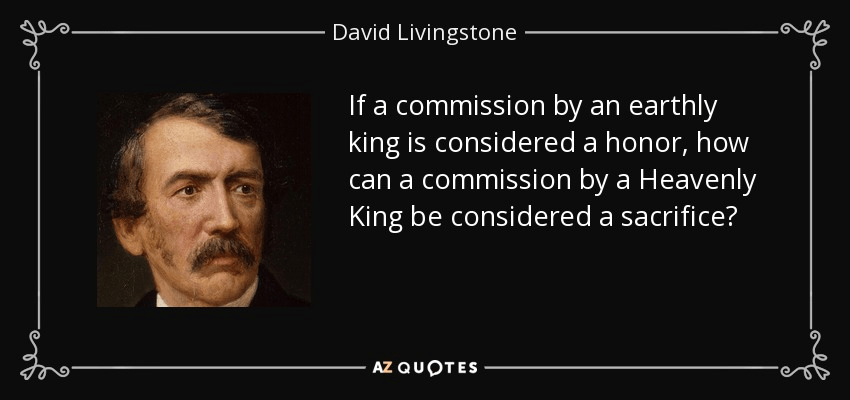
Few people suffered as much as the nineteenth-century missionary medical doctor to Africa, David Livingstone.  He was a pioneer explorer who opened up the interior of Africa to the outside world. He had two reasons for doing so: To take the good news of Christ’s suffering to the African people; and, to open Africa to legitimate trade, so that the illicit slave trade would end. 

Dr. Livingstone’s hand was bitten and maimed by a lion. His wife died while on the mission field. The one house he built was destroyed in a fire. He was often wracked with dysentery and fever, or some other illness in the jungle. 

Someone once commented to him that he had sacrificed a lot for following Jesus. His response: “Sacrifice? The only sacrifice is to live outside the will of God.” When asked what helped him get through the hardship, he said,  “The words of Jesus to take up my cross are always ringing in my ears.”

We may mistakenly believe that we must watch out for ourselves; push for our personal preferences; that if I accept the invitation to follow Jesus in the way of self-denial, I will be miserable and people will walk all over me. Those thoughts are merely demonic whispers in the ear.

There are two differing ways of thinking and acting: 

  1. The way of success, perfection, and a pain-free life as the evidence of God’s working. 
  2. The way of suffering as right and necessary in order to connect with God and be in solidarity with those who suffer. 

Suffering, rejection, and execution did not fit into Peter’s church growth plan. But according to Jesus, we do not exist only for ourselves, to be in some sort of spiritual country club. We exist to follow Jesus in his path of sacrifice and suffering for a world of people who desperately need to know the grace of forgiveness, and the mercy of Christ.

Since Jesus died, we are to die to ourselves. Since Christ lives, we are to live a new life. In God’s upside-down kingdom, joy comes through suffering. We follow Jesus as the mix of sinner and saint that we are. Amen.

The Love of God for You (Song of Songs 8:6-7)

God Is Love, by Voss Creative

Place me like a seal over your heart,
    like a seal on your arm;
for love is as strong as death,
    its jealousy unyielding as the grave.
It burns like blazing fire,
    like a mighty flame.
Many waters cannot quench love;
    rivers cannot sweep it away.
If one were to give
    all the wealth of one’s house for love,
    it would be utterly scorned. (New International Version)

Throughout most of church history, the Old Testament poem of Solomon’s Song of Songs has been interpreted allegorically as the love between God and God’s people.

A more literal hermeneutic views the Song as an actual relationship between a man and woman – which has it’s merits in that it acknowledges and affirms our bodily nature.

Yet, no matter what interpretive grid one uses for the Song, this wondrous and unique biblical book is an Ode to Love, lifting the centrality and power of Love as the greatest force in the world.

As for me, I believe it’s likely that the Song purposely has both the literal and allegorical in view. There are many places throughout Holy Scripture which have intended double and even triple meanings to the text. However one chooses to see the Song, love begins with God, and gives shape to our own human love for God, one another, and one’s lover.

“God carries your picture in his wallet.”

Tony Campolo

We learn a great deal of love from God. The Lord is a jealous God. That doesn’t mean the Lord is some weird stalker deity with insecurities about losing the devotion of worshipers. No, instead, divine jealousy is the positive quality of showing steadfast love and commitment, being completely devoted to following through with divine promises and presence.

The Song is far from the only place in Scripture which likens the relationship between God and God’s people as a marriage of lovers. In fact, God’s covenant relationship with people is at the heart of understanding the whole of Scripture.

In the prophecy of Hosea, God expressed a longing for Israel to remain faithful, because the Lord loves her. Hosea had an unfaithful wife, and throughout the book of Hosea the relationship between him and his wife Gomer mirrored the relationship between God and Israel. Just as Hosea kept showing faithful love to Gomer, even though she was brazenly unfaithful, so too, God looked at Israel with affection and steadfast love, not bearing to give her up.

“If you have never known the power of God’s love, then maybe it is because you have never asked to know it – I mean really asked, expecting an answer.”

Frederick Buechner, The Magnificent Defeat

The love of God shall always win the day, despite our own human love, which can wax and wane according to mood or circumstance. Grace, mercy, and love are deep in the nature of God; Love is who God is, not just what God does.

The one marrying you is the one who made you—
    the Lord of heavenly forces is his name.
The one redeeming you is the holy one of Israel,
    the one called the God of all the earth.
As an abandoned and dejected woman the Lord has summoned you;
    as a young wife when she is rejected,
        says your God.
For a brief moment I abandoned you,
    but with great mercy I will bring you back.
    In an outburst of rage,
    I hid my face from you for a moment,
    but with everlasting love I have consoled you,
    says your redeemer, the Lord.

These are like the days of Noah for me,
    when I promised that Noah’s waters would never again cover the earth.
    Likewise I promise not to rage against you or rebuke you.
The mountains may shift,
    and the hills may be shaken,
    but my faithful love won’t shift from you,
    and my covenant of peace won’t be shaken,
    says the Lord, the one who pities you. (Isaiah 54:5-10, CEB)

As the Old Testament draws toward the end, God’s love remains constant, desiring the people to hold fast to their Lord:

This is what the Lord All-Powerful says: “I have a very strong love for Jerusalem. My strong love for her is like a fire burning in me.” (Zechariah 8:2, NCV) 

Into the New Testament, the love of God continues to burn for God’s people. In the Gospels, Jesus showed committed love to all sorts of people, going so far as to be the ultimate martyr, giving himself as sacrifice of atonement on behalf of a world who mostly rejected him.

“Do you see this woman? I came into your house. You did not give me any water for my feet, but she wet my feet with her tears and wiped them with her hair. You did not give me a kiss, but this woman, from the time I entered, has not stopped kissing my feet. You did not put oil on my head, but she poured perfume on my feet. Therefore, I tell you, her many sins have been forgiven—as her great love has shown. But whoever has been forgiven little loves little.” (Luke 7:44-47, NIV)

One of Christ’s disciples, the Apostle John, learned to channel his passionate anger into passionate love. John knew that people’s needs are supremely and fully met through the Lord who loves them – and not through alternate avenues of love:

Do not love this world nor the things it offers you, for when you love the world, you do not have the love of the Father in you. For the world offers only a craving for physical pleasure, a craving for everything we see, and pride in our achievements and possessions. These are not from the Father, but are from this world. And this world is fading away, along with everything that people crave. But anyone who does what pleases God will live forever. (1 John 2:15-17, NLT)

God knows that going elsewhere to satisfy our needs, ultimately gets us nowhere, especially our need for love. God yearns, passionately, for us to find our pleasure and enjoyment in him. God waits with loving patience to show grace and compassion.

“The Love of God” by Frederick M. Lehman, 1917

The love of God is greater far
than tongue or pen can ever tell;
it goes beyond the highest star,
and reaches to the lowest hell.
The wand’ring child is reconciled
by God’s beloved Son.
The aching soul again made whole,
and priceless pardon won.


O love of God, how rich and pure!
How measureless and strong!
It shall forevermore endure—
the saints’ and angels’ song.

Maundy Thursday (Psalm 116:1-2, 12-19)

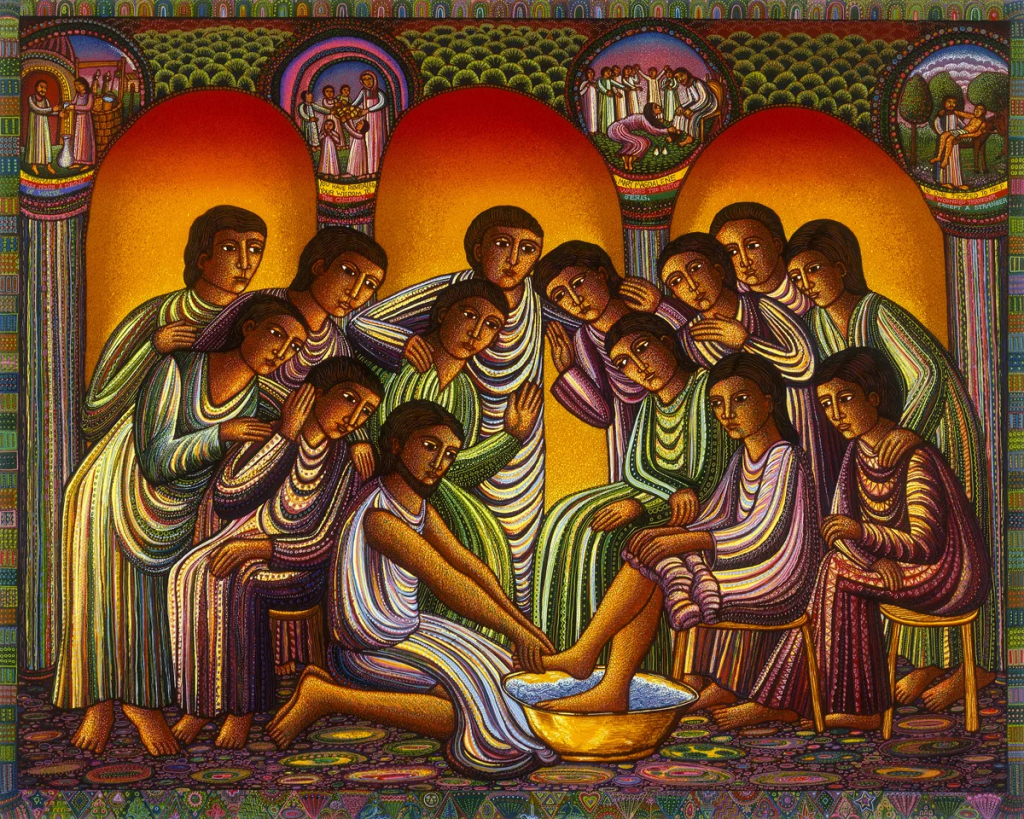
Washing of the Feet, by John August Swanson, 2000

I love the Lord because he has heard
    my voice and my supplications.
Because he inclined his ear to me,
    therefore I will call on him as long as I live….

What shall I return to the Lord
    for all his bounty to me?
I will lift up the cup of salvation
    and call on the name of the Lord;
I will pay my vows to the Lord
    in the presence of all his people.
Precious in the sight of the Lord
    is the death of his faithful ones.
O Lord, I am your servant;
    I am your servant, the child of your serving girl.
    You have loosed my bonds.
I will offer to you a thanksgiving sacrifice
    and call on the name of the Lord.
I will pay my vows to the Lord
    in the presence of all his people,
in the courts of the house of the Lord,
    in your midst, O Jerusalem.
Praise the Lord! (New Revised Standard Version)

“Pain and suffering have come into your life, but remember pain, sorrow, suffering are but the kiss of Jesus — a sign that you have come so close to Him that He can kiss you.”

Mother St. Térèsa of Calcutta (1910-1997)

There is more to the passion of Christ than sheer suffering and sorrow; the Via Dolorosa is, paradoxically, also the road to joy.

Yes, suffering is painful and unpleasant. Yet, since we all must suffer in some way, the real issue is whether our suffering is meaningless or has purpose to it. We are able to bear our suffering if we are confident that a redemptive outcome is at the end of it.

The Lord Jesus submitted to suffering because he knew that all the mockery, torture, and abuse was the pathway to deliverance for humanity.

Because of the joy awaiting him, he endured the cross, disregarding its shame. Now he is seated in the place of honor beside God’s throne. Think of all the hostility he endured from sinful people; then you won’t become weary and give up. (Hebrews 12:2-3, NLT)

Since Jesus has gone before us, enduring shame so that it could be put to death in us, we are able to live free from guilt and the ignominy of sin. What’s more, Christ’s suffering gives shape and meaning to our own suffering.

“I cannot but wonder at the virtue that lies in suffering; we are worth nothing without the cross. I tremble and am in an agony while it lasts, and all my conviction of its salutary effects vanish under the torture, but when it is over, I look back at it with admiration, and am ashamed that I bore it so ill.”

François Fénelon (1651-1715)

On this Maundy Thursday, we remember that in the midst of suffering there is the hope of glory, and in the center of pain there is the confident expectation that it will be used as the fertilizer to help love grow and bloom in the dormant places of this world.

“Love proves itself by deeds, so how am I to show my love? Great deeds have forbidden me. The only way I can prove my love is by scattering flowers and these flowers are every little sacrifice, every glance and word, and the doing of the least actions for love.”

St. Thérèse of Lisieux (1873-1897)

There cannot be love without suffering; to love is to sacrifice on behalf of another.

Because we live in a broken world full of pride and hubris, greed and avarice, hate and envy, we are victims of loveless systems and unjust actions. We need love to rescue and redeem us from the sheer muck of existential guilt and shame, evil and injustice.

Christians around the world are journeying through Holy Week, the most sacred time of the year for followers of Christ. When we think about Holy Week, we are familiar with Good Friday and certainly Easter, but Maundy Thursday? 

On this day, the Church remembers the final evening Jesus shared with his disciples in the upper room before his arrest and crucifixion. The experiences in the upper room were highly significant because this was the last teaching, modeling, and instruction Jesus gave before facing the cross. Jesus was careful and deliberate to communicate exactly what was important to him: to love one another.

“A new command I give you: Love one another. As I have loved you, so you must love one another.  By this everyone will know that you are my disciples if you love one another.” (John 13:34-35, NIV)

Maundy Thursday marks three important events in Christ’s Last Supper with his disciples: 

  1. The washing of the disciples’ feet (the action of loving service)
  2. The instituting of the Lord’s Supper (the remembrance of loving sacrifice)
  3. The giving of a “new” commandment to love one another (the mandate of a loving lifestyle)

The message of Maundy Thursday is this: Jesus Christ loves me just as I am, and not as I should be. He loves me even with my dirty stinky feet, my herky-jerky commitment to him, and my pre-meditated sin. 

Today is a highly significant day on the Church Calendar and in the Christian Year – one which deserves to be observed, and an opportunity to remember the important words and actions of Jesus on our behalf. Through Jesus Christ we are to live always in love, modeling our life and ministry after him. 

“I have found the paradox that if I love until it hurts, then there is no hurt, but only more love.”

Mother Térèsa

In Christ, love is to characterize our life together as we proclaim God’s love in both word and deed. A watching world will take notice and desire to lay down their hate and animosity if the followers of Christ are deeply and profoundly centered in the love of God.

God our Father, you invite us to participate in the life, suffering, death, and resurrection of your Son. Inspire us by his service, and unite us in his love; who lives and reigns with you, in the unity of the Holy Spirit, one God, now and forever. Amen.

Monday of Holy Week (Psalm 36:5-11)

The Via Dolorosa (Latin: the way of sorrows) is a narrow path through the streets of the Old Jerusalem, the final route traveled by Jesus of Nazareth on the way to his crucifixion.

Your steadfast love, O Lord, extends to the heavens,
    your faithfulness to the clouds.
Your righteousness is like the mighty mountains;
    your judgments are like the great deep;
    you save humans and animals alike, O Lord.

How precious is your steadfast love, O God!
    All people may take refuge in the shadow of your wings.
They feast on the abundance of your house,
    and you give them drink from the river of your delights.
For with you is the fountain of life;
    in your light we see light.

O continue your steadfast love to those who know you
    and your salvation to the upright of heart!
Do not let the foot of the arrogant tread on me
    or the hand of the wicked drive me away. (New Revised Standard Version)

The desert journey is almost over. The sojourn with Jesus in his life and ministry will soon culminate in the ultimate experience of sorrow and joy. The Christian season of Lent is nearly at the end. We are in it’s final days, known as Holy Week.

We have a Holy Week because of love. There is yet another journey we must take, along the Via Dolorosa to the hill of Golgotha, because of God’s steadfast love.

Love suffers. Every parent knows this. Because of a parent’s committed and faithful love toward a child, they feel not only the joys but also the sorrows and pain of their children. I can say that this feeling does not go away, even with adult children. And it’s compounded with grandchildren. Just as our love is big enough to hold multiple children and grandchildren, so our capacity for experiencing deep emotion for their welfare is equally large.

Holy Week reminds us that God’s committed parental love suffers. It is because of God’s immense and steadfast love that there is a road to the cross and a tortured death for Jesus. The cost of our salvation involves a very bloody affair. Deliverance comes at the price of horrible violence. Jesus Christ lived and died for us, because of love.

He suffered much because he loved much.

God’s people, walking in the way of love, quickly discover that it is simultaneously walking in the way of suffering. From Old Testament times through the New Testament era and into the present day, the faithful have always experienced suffering as a central part of their piety and devotion in showing steadfast love. 

The medieval mystics of the Church understood quite well the connection between suffering and love. They could not imagine a Christian life without hardship, difficulty, and persecution. Thomas à Kempis, a sort of pastor to pastors, wrote in the fifteenth century:

“Sometimes it is to our advantage to endure misfortunes and adversities, for they make us enter into our inner selves and acknowledge that we are in a place of exile and that we ought not to rely on anything in this world.  And sometimes it is good for us to suffer contradictions and know that there are those who think ill and badly of us, even though we do our best and act with every good intention….  When men ridicule and belittle us, we should turn to God, who sees our innermost thoughts, and seek His judgment….  It is when a man of good will is distressed, or tempted, or afflicted with evil that he best understands the overwhelming need he has for God, without whom he can do nothing….  It is in such times of trial that he realizes that perfect security and full peace are not to be found in this world.”

Thomas à Kempis, The Imitation of Christ

And yet, it is because of love that suffering is transformed and endured as something wholly other than sheer pain or hurt. Thomas à Kempis went on to say:

“Love is a mighty power, a great and complete good; Love alone lightens every burden and makes the rough places smooth. It bears every hardship as though it were nothing and renders all bitterness sweet and acceptable. The love of Jesus is noble and inspires us to great deeds; it moves us always to desire perfection. Love aspires to high things and is held back by nothing base. Love longs to be free, a stranger to every worldly desire, lest its inner vision become dimmed, and lest worldly self-interest hinder it, or ill-fortune cast it down…. Love knows no limits, but ardently transcends all bounds. Love feels no burden, takes no account of toil, attempts things beyond its strength; love sees nothing as impossible, for it feels able to achieve all things. Love therefore does great things; it is strange and effective; while he who lacks love faints and fails.”

Thomas à Kempis, The Imitation of Christ

Holy Week’s message is certainly one of suffering love. Jesus went to the greatest lengths possible to give Divine steadfast love to humanity. So, let us not shy away from the cross, but journey with Jesus to Golgotha, embracing the love of God for us. In so doing, we will find the inner resources needed to love the world, even in all its unloveliness.

Grant, we pray, almighty God, that, though in our weakness we fail, we may be revived through the Passion of your Only Begotten Son. Who lives and reigns with you in the unity of the Holy Spirit, God, for ever and ever. Amen.