John 12:20-36 – Tuesday of Holy Week

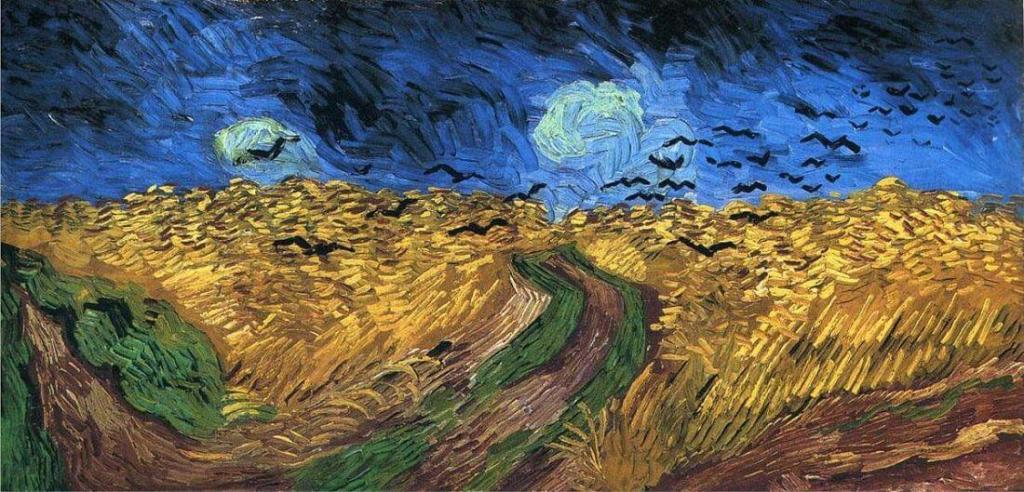
Wheatfield with Crows by Vincent Van Gogh, 1890

Some Greeks were among those who had gone to Jerusalem to worship during the festival. They went to Philip (he was from Bethsaida in Galilee) and said, “Sir, we want to see Jesus.”

Philip went and told Andrew, and the two of them went and told Jesus. Jesus answered them, “The hour has now come for the Son of Man to receive great glory. I am telling you the truth: a grain of wheat remains no more than a single grain unless it is dropped into the ground and dies. If it does die, then it produces many grains. Those who love their own life will lose it; those who hate their own life in this world will keep it for life eternal. Whoever wants to serve me must follow me, so that my servant will be with me where I am. And my Father will honor anyone who serves me.

“Now my heart is troubled—and what shall I say? Shall I say, ‘Father, do not let this hour come upon me’? But that is why I came—so that I might go through this hour of suffering. Father, bring glory to your name!”

Then a voice spoke from heaven, “I have brought glory to it, and I will do so again.”

The crowd standing there heard the voice, and some of them said it was thunder, while others said, “An angel spoke to him!”

But Jesus said to them, “It was not for my sake that this voice spoke, but for yours. Now is the time for this world to be judged; now the ruler of this world will be overthrown. When I am lifted up from the earth, I will draw everyone to me.” (In saying this he indicated the kind of death he was going to suffer.)

The crowd answered, “Our Law tells us that the Messiah will live forever. How, then, can you say that the Son of Man must be lifted up? Who is this Son of Man?”

Jesus answered, “The light will be among you a little longer. Continue on your way while you have the light, so that the darkness will not come upon you; for the one who walks in the dark does not know where he is going. Believe in the light, then, while you have it, so that you will be the people of the light.”

After Jesus said this, he went off and hid himself from them. (Good News Translation)

Today is another step in our journey together with Jesus. The path we are on together leads to a cruel cross. For the past six weeks the Christian has been on a Lenten walk. To keep the long sojourn going, believers focus on spiritual discipline, prayer, and repentance. 

Shadow

Along the way we come face-to-face with the shadow parts of ourselves. We discover that within us there is the pull to hold-on to unhealthy rhythms and habits of life. There is an inner push to arrange our lives with the fragmentation of disordered love.

Our reflexive response to things we do not like about ourselves might be to either use sheer willpower to change, or to try and manage our brokenness – as if we could boss our spiritual selves out of the darkness. However, the problem and the solution are much more radical than we often would like to admit.

While on this journey, Jesus invites us to die to ourselves. The pull and push of sin cannot be managed or willed away – it must be eradicated and completely cut out, like the cancer it is. Transformation and new life can only occur through death. 

A tiny little seed can grow, break the ground, and develop into something which provides sustenance for others.  It does no good to remain a seed in the ground. The little kernel must change beyond it’s current recognition if it is to reach for the sky and become food for the world.

Suffering

Christ is the ultimate example of the one who died to himself and for us. Only through suffering and death did he secure deliverance and freedom from sin, death, and hell. By his wounds we are healed. Through his tortuous death, new life became possible – because there must be a death if there is to be a resurrection; there must be suffering before there is glory.

Through dying to self and following Jesus, a transformative experience happens. As we change, mature, and produce a crop, we bring the kind of spiritual sustenance the world so desperately needs. Following Jesus, leaving all to walk with him, is true repentance and authentic discipleship.

Perhaps you protest, thinking I’m being too forceful or insistent about this Jesus stuff. Yes, you have perceived rightly. Within some corners of Christianity, a wrongheaded notion has developed that believes suffering is not God’s will.

Jesus, however, is insistent that dying to self is necessary. And it hurts like hell. It’s a hard teaching to absorb when you so desperately want things to be rainbows and unicorns. Suffering, whether we like it, or not, is the way of Jesus:

“In the days of his flesh, Jesus offered up prayers and supplications, with loud cries and tears, to the one who was able to save him from death, and he was heard because of his reverent submission.  Although he was a Son, he learned obedience through what he suffered; and having been made perfect, he became the source of eternal salvation for all who obey him.” (Hebrews 5:7-9, NRSV)

We are not above our Master. Christ’s life on this earth, before his crucifixion and death, was marked with suffering. Jesus learned obedience through struggle and adversity. The Lord himself did what he is now asking us to do.

Christ gave himself up to do the Father’s will. Jesus offered loud cries and tears and submitted to what the Father wanted. We must do no less. We don’t get to choose which parts of Christ’s life and teaching we will observe and which ones we won’t, as if Jesus were some spiritual buffet line. 

All who live for Jesus will follow him into the path of suffering, of death to self, and of new life through the power of his resurrection. In Christ’s own words: “Those who love their life will lose it, and those who hate their life in this world will keep it for eternal life.”  We must…

Surrender

We have hundreds, maybe thousands of small decisions every day with the use of our time, our money, our energy, and our relationships. If we have tried to fix what is broken inside of us, we will likely just try to hastily fix the problems and the people in our lives, then move on with getting things done on our to-do list. 

Instead, we have the invitation to surrender. We have the opportunity to create sacred space for solitude and silence, prayer and repentance. Take the time to (in person or virtually) sit with a person in pain and listen.  Reflect on how to use your money for kingdom values. See your life as a holy rhythm of hearing God and responding appropriately.

Sacrifice

Holding-on to our stuff and time is the opposite of sacrifice – it’s avarice. I understand that you and I are not Jesus – our sacrifice and suffering are not efficacious, that is, it doesn’t deliver other people from sin. Only Christ’s death does that. Yet, we are still called to sacrifice:

“I am now rejoicing in my sufferings for your sake, and in my flesh, I am completing what is lacking in Christ’s afflictions for the sake of his body, that is, the church.” (Colossians 1:24, NRSV)

Pleasure is not the summum bonum of life. Our lives are not meant to be lived solely for minimizing pain and maximizing comfort. Jesus has extended the call to view our workplaces, communities, neighborhoods, and families as our mission field of grace to a world in need of basic human kindness and attention – which takes sacrificial love on our part.

Christianity isn’t a religion that’s for people who have neatly packaged theological answers and certainties to all of life’s questions. Rather, Christianity is a dynamic religion of learning to follow Jesus, discovering how to die to self, and struggling to put Christ’s teaching and example into practice. 

The way of Christ is often characterized by a three-steps-forward, two-steps-backward sort of reality. The road is zig-zags with plenty of potholes. Those who don’t struggle are in big trouble. However, those who go through the pain of dying to self for the sake of their Lord, find that the harvest they produce leads to eternal life.

May you struggle well, my friend.

Almighty God, your dear Son did not ascend to joy until he first suffered pain; he did not enter glory before he was crucified. Mercifully grant that we, walking in the way of the cross, may find it as the true way of life and peace, through Jesus Christ, your Son, our Lord. Amen.


Leviticus 5:1-13 – The Problem of Guilt

“‘If anyone sins because they do not speak up when they hear a public charge to testify regarding something they have seen or learned about, they will be held responsible.

“‘If anyone becomes aware that they are guilty—if they unwittingly touch anything ceremonially unclean (whether the carcass of an unclean animal, wild or domestic, or of any unclean creature that moves along the ground) and they are unaware that they have become unclean, but then they come to realize their guilt;or if they touch human uncleanness (anything that would make them unclean) even though they are unaware of it, but then they learn of it and realize their guilt; or if anyone thoughtlessly takes an oath to do anything, whether good or evil (in any matter one might carelessly swear about) even though they are unaware of it, but then they learn of it and realize their guilt—when anyone becomes aware that they are guilty in any of these matters, they must confess in what way they have sinned. As a penalty for the sin they have committed, they must bring to the Lord a female lamb or goat from the flock as a sin offering; and the priest shall make atonement for them for their sin.

“‘Anyone who cannot afford a lamb is to bring two doves or two young pigeons to the Lord as a penalty for their sin—one for a sin offering and the other for a burnt offering. They are to bring them to the priest, who shall first offer the one for the sin offering. He is to wring its head from its neck, not dividing it completely, and is to splash some of the blood of the sin offering against the side of the altar; the rest of the blood must be drained out at the base of the altar. It is a sin offering. The priest shall then offer the other as a burnt offering in the prescribed way and make atonement for them for the sin they have committed, and they will be forgiven.

“‘If, however, they cannot afford two doves or two young pigeons, they are to bring as an offering for their sin a tenth of an ephah of the finest flour for a sin offering. They must not put olive oil or incense on it, because it is a sin offering. They are to bring it to the priest, who shall take a handful of it as a memorial portion and burn it on the altar on top of the food offerings presented to the Lord. It is a sin offering. In this way the priest will make atonement for them for any of these sins they have committed, and they will be forgiven. The rest of the offering will belong to the priest, as in the case of the grain offering.’” (New International Version)

“Indifference is the sign of sickness, a sickness of the soul more contagious than any other.”

Elie Wiesel

Guilt comes in two forms: overt speech or action which wrongs another person; or the failure to speak or act when it was necessary to do so.

Oftentimes we think of sin as exclusively wrongdoing – an overt act of disobedience or evil. Yet, sin primarily manifests itself through indifference. The sinner is mostly one who doesn’t get involved. He walks on the other side of the road to avoid unwanted entanglements.

What’s more, sins of the tongue are much more common and prolific than sins of the body. Although hurtful words abound in this fallen world, it is also the absence of speaking up and naming falsehood for what it is that is an egregious sin before God.

The Lord will hold responsible those who are silent in the face of observing injustice.

And, if later, someone becomes aware they were complicit with an injustice through a failure to speak up, they are also guilty.

The Old Testament book of Leviticus is all about maintaining the purity and holiness of God’s people. So, the book is filled with detailed prescriptions on how to handle guilt. Going through a specific and laborious process of dealing with guilt, communicated to the people that this is important. It’s a big deal.

We need, however, to ensure we aren’t using the terms guilt and shame interchangeably.

Guilt is a function of our conscience. It lets us know when we have said or done something wrong or hurtful, or failed to provide help. It’s specific to a particular action or lack of action.

Shame, however, is a function of the “inner critic.” It interprets bad words or actions as we ourselves being bad. It focuses not on actions but on our very personhood in the form of judgmentalism leveled at myself.

Whereas guilt says, “I have done something bad,” shame says, “I am bad.” Guilt serves a redemptive purpose through alerting us that we need to deal with a wrong. Shame, however, damages our spirits through telling us we are flawed and unworthy of love and connection with others.

Because guilt and shame are not the same, they need to be dealt with in different ways:

  • Guilt, if not faced and dealt with, becomes gangrene of the soul. Over time it festers and poisons our spirits, leading to significant emotional and sometimes physical problems. Forgiveness is the primary tool in dealing with guilt. It begins with self-forgiveness and then offering an apology to another and asking for forgiveness.
  • Shame is a vampire that lives in the shadows and feeds on secrets. If shame persists, we withdraw from others and experience grinding loneliness. Therefore, the path out of shame is to openly name our shame and tell our stories. This takes power away from shame and gives it to yourself. In other words, the practice of vulnerability erases shame.

For the Christian, Jesus is the once for all sacrificial offering which forever takes away both our guilt and our shame.

Since we have a great High Priest who rules over God’s house, let us go right into the presence of God with sincere hearts fully trusting him. For our guilty consciences have been sprinkled with Christ’s blood to make us clean, and our bodies have been washed with pure water. (Hebrews 10:21-22, NLT)

We must never stop looking to Jesus. He is the leader of our faith, and he is the one who makes our faith complete. He suffered death on a cross. But he accepted the shame of the cross as if it were nothing because of the joy he could see waiting for him. And now he is sitting at the right side of God’s throne. (Hebrews 12:2, ERV)

“See, I lay a stone in Zion,
    a chosen and precious cornerstone,
and the one who trusts in him
    will never be put to shame.” (1 Peter 2:6, NIV)

Guilt and shame are not erased by either ignoring them or by dismissing them as negative emotions. They are handled through the person and work of Jesus Christ. It is grace which grants us amnesty from shortcomings, failures, and sins.

Thanks be to God! Believe this gospel and live in its peace.

Holy and merciful God, in your presence we confess our sinfulness, our shortcomings, and our offenses against you. You alone know how often we have sinned in wandering from your ways, in wasting your gifts, in forgetting your love. Have mercy on us, O Lord, for we are sorry for all we have done to displease you. Forgive our sins, and help us to live in your light and walk in your ways, for the sake of Jesus Christ, our Savior. Amen.

Hebrews 9:24-28 – Forgiveness Is Real

Photo by Pixabay on Pexels.com

For Christ did not enter a sanctuary made with human hands that was only a copy of the true one; he entered heaven itself, now to appear for us in God’s presence. Nor did he enter heaven to offer himself again and again, the way the high priest enters the Most Holy Place every year with blood that is not his own. Otherwise Christ would have had to suffer many times since the creation of the world. But he has appeared once for all at the culmination of the ages to do away with sin by the sacrifice of himself. Just as people are destined to die once, and after that to face judgment, so Christ was sacrificed once to take away the sins of many; and he will appear a second time, not to bear sin, but to bring salvation to those who are waiting for him. (New International Version)

Jesus is the central figure of the Bible. I could preach on the finished work of Christ every Sunday and never exhaust the immensely rich implications of his death for us. 

Maybe today’s verses seem like a re-hashing of things we already know. Yet, it is important to keep plumbing the depths of Christ’s once for all sacrifice because it is through continually examining Jesus that we will experientially know our forgiveness is real. Having this reality sink deep into our souls enables us to extend forgiveness to others.

The original recipients of Hebrews were experiencing spiritual fatigue due to their difficult circumstances. The believers were so tired from swimming upstream that they considered quitting and giving up on Christianity (or at least the Church). 

The author of Hebrews truly believed that the way to combat this tiredness was through a robust understanding of Christ.  So, he sought to demonstrate that Jesus is superior to the old sacrificial system and has even superseded it. 

There are three main distinctions between the old sacrificial system and the new way of Christ. They are meant to encourage us so that we will know our forgiveness is real. This awareness will help us persevere and live for Jesus in all we say and do, until he returns.

First Distinction: Reality versus a Simulated Copy

The Old Testament sacrificial system, and its worship rituals in dealing with the sin issue, were only a copy and a shadow of the real sacrifice, which is Christ. The Temple sacrifices, in other words, were merely a facsimile of the real thing.

When my girls were small, they always enjoyed going to our local large grocery store. At that store they had a row of mechanical horses that only cost a penny to ride for one minute.  Riding the horses was always the highlight of shopping for them. Their Aunt once came for a visit and brought a coffee can full of pennies and took them to the grocery store just to ride the horses for an afternoon. 

All three of my girls are now grown adult women. They do not ride mechanical horses anymore. They now ride real live horses. My daughters, as excited as they were to ride mechanical horses as small girls, now have no desire to do so because those horses were only a simulation of the real thing.

As Christians, since Christ has come as the true and real sacrifice for sin, we are no longer to be content with simulations and copies of the real deal.  And we are to know the difference between them. Our forgiveness is neither a simulation nor a copy because Christ is the real thing. 

As my girls were growing up, my wife and I had a certain process we went through with them when they did something wrong toward one another. We would talk about the offense, and then they would need to say the words, “I am sorry.” 

However, the matter was never over until they hugged each other and told each other they loved the other. If they could do that, it was the real deal. You see, they could mouth the words to get us off their backs, but to hug and express love was the reality.

“To be a Christian means to forgive the inexcusable because God has forgiven the inexcusable in you.”

C.S. Lewis

Jesus did not just mouth words of forgiveness to us. He secured it through his death on a cross. It is not a cheap imitation kind of forgiveness. It is real. Christ died a violent death. The emphasis in Scripture on blood and sacrifice can be upsetting for many people.

Yet, we need to understand that the brokenness of this world is so bad that it requires drastic action. Christ’s death reflects the horrible sin of humanity. Since Jesus has secured forgiveness for us at such a steep price, we are to receive it with great humility and joy that God loves us that much.

Second Distinction: Once versus Endless Repetition

Jesus Christ came to deal with the sin issue once for all through his blood. He came to do away with sin, not just veneer over it. The old sacrificial system was like whitewashing a barn – it took care of the issue for a while, but it would need to be done over and over again.

We are familiar with temporary arrangements. For example, annual fees need to be paid and renewal stickers have to be put on a car’s license plate every year. Christ’s atonement, however, is no temporary arrangement. The forgiveness Jesus offers is permanent. 

There is no need to keep offering sacrifices over and over because Christ is the sacrifice to end all sacrifices. The forgiveness we possess is not like paying an annual fee and getting a forgiveness sticker for the year. In Jesus Christ, we are forgiven! And this forgiveness was purchased with Christ’s own blood.

Author Henri Nouwen once told a story of a family he knew in Paraguay. The father, a doctor, spoke out against the military regime there and its human rights abuses. Local police took their revenge on him by arresting his teenage son and torturing him to death. Enraged townsfolk wanted to turn the boy’s funeral into a huge protest march, but the doctor chose another means of protest.

At the funeral, the father displayed his son’s body as he had found it in the jail—naked, scarred from electric shocks and cigarette burns, and beatings. All the villagers filed past the corpse, which lay not in a coffin but on the blood-soaked mattress from the prison. It was the strongest protest imaginable, for it put injustice on grotesque display.

“Forgiveness means that I continually am willing to forgive the other person for not being God.”

Henri Nouwen

The cross that held Christ’s naked and marred body exposed the violence and injustice of this world. The cross revealed what kind of world we have and what kind of God we have: a world of gross unfairness, and a God of sacrificial love. Because Jesus was willing to do this on our behalf, we have forgiveness once and for all through his blood.

This world needs forgiveness – not a cheap sentimental forgiving but a real forgiveness that lasts forever. 

Third Distinction: Salvation versus Judgment

A lot of religious energy can be spent trying to figure out how to make ourselves acceptable to God. Part of the good news is that, in Christ, we do not need to fear the future.  We have been made right with God through the death of Jesus. Through Christ’s sacrifice the doors to heaven and earth get flung wide open. The way has been secured, the trail has been blazed, and the road has been made smooth to come to God.

Jesus, unlike any Levitical priest, has entered God’s presence, providing access to the living God. Christ did not need to offer sacrifice for his own sins but offered himself solely on our behalf. Jesus did more than offer the sacrifice; he himself became the sacrifice. It was a sacrifice to bring deliverance to humanity, not judgment.

Either to justify or to judge is God’s business, not ours. Our concern is to believe in the once for all sacrifice of Jesus that brings a permanent forgiveness; and, to share that life-giving message with others so that they, too, can experience deliverance from sin, death, and hell.

We can have such a hard time forgiving others because we struggle with experiencing our own forgiveness. The path to extending grace to others is in deepening our knowledge, understanding, and awareness of God’s grace in Christ.

Conclusion

The author of Hebrews meant for the Christian life to be an exciting and abundant adventure following Jesus, the pioneer of our salvation. And yet, many Christians do not know anything about this kind of life. They only see the Christian life as a duty and a chore, a kind of cross to bear. 

It is important we recognize it is our Lord and Savior, Jesus Christ, the object of our faith, who has delivered us so that we can live a new life of freedom enjoying our forgiveness and inviting others on the journey.

There was once an immigrant that booked passage on a ship with just enough money to buy a ticket, a block of cheese and some crackers for a long voyage. The first few days at sea the crackers and cheese tasted good, but eventually they became stale.

As he watched the porters carry large steaks, lobsters, chicken, beautiful salads and many other delicious foods to the other guests, he became so hungry that he finally stopped one of the porters. “I’II do anything to get one of those steaks,” he said. “I’II wash dishes, clean rooms, even mop the deck.” The porter replied, “You bought a ticket, didn’t you? The meals come with the ticket.”

Too many people today are cheese and cracker Christians—missing out on all of God’s steak dinners. All the resources of God are available to us, yet far too many of us live in self-imposed spiritual poverty. 

For he has rescued us from the dominion of darkness and brought us into the kingdom of the Son he loves, in whom we have redemption, the forgiveness of sins. (Colossians 1:13-14, NIV)

Jesus did not die on the cross and rise from the dead so that we could live ho-hum Christian lives. He has granted us forgiveness so that we will eagerly enjoy the Word of God; enjoy laboring together in the Gospel; and look forward to how the Spirit will transform lives through Christ’s forgiveness. 

Real forgiveness opens our minds, hearts, and our energies to live for Jesus, the pioneer of our salvation.

Hebrews 7:23-28 – Jesus Is Better

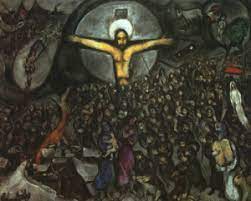
“Exodus” by Marc Chagall, 1952

Now there have been many of those priests, since death prevented them from continuing in office; but because Jesus lives forever, he has a permanent priesthood. Therefore, he is able to save completely those who come to God through him, because he always lives to intercede for them.

Such a high priest truly meets our need—one who is holy, blameless, pure, set apart from sinners, exalted above the heavens. Unlike the other high priests, he does not need to offer sacrifices day after day, first for his own sins, and then for the sins of the people. He sacrificed for their sins once for all when he offered himself. For the law appoints as high priests men in all their weakness; but the oath, which came after the law, appointed the Son, who has been made perfect forever. (New International Version)

Several years ago, I enjoyed serving communion with a retired minister in the church for which I was serving at the time. When we were in the middle of it, I leaned over to him and gave him a bit of instruction on what we were about to do. After I finished, he leaned over to me with a smile and said, “I didn’t hear a thing you just said, but I’ll figure it out!”

When it comes to the Christian life, I think we can learn something from the old Pastor. We are neither always going to hear well everything which is in the Bible, nor are we going to understand everything which is happening around us as Christians. 

The Jewish Christians, for which the book of Hebrews was originally preached, had a difficult transition from Judaism to Christianity. In Judaism, they knew what was happening. The sacrificial system was detailed and meticulously planned. The priesthood was clearly observed with men from the tribe of Levi. Worship was predictable.

However, becoming a Christian changed a lot of things. Being a Christian meant relying on the wild and unpredictable Spirit of God. There was no longer a tangible sacrificial system. Jesus is the high priest, but the believers never see him. 

There was so much living by faith, and so little understanding of what was going to happen, that the Hebrew Christians’ resolve began to break down. They became discouraged and started to lose patience with Christianity.

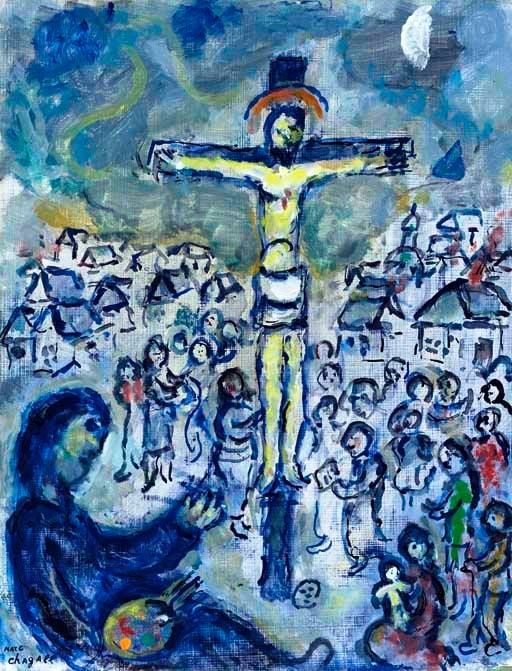
“The Painter and the Christ” by Marc Chagall, 1975

Today’s New Testament lesson is in the middle of an extended discussion by the author of Hebrews about the priesthood and sacrificial system. The Christian Jews were thinking about reneging on their commitment to Jesus and returning to their previous way of life in Judaism. 

So, central to the author’s exhortation is to demonstrate that Jesus is superior to everything in Judaism. Jesus is better than any Old Testament priest. Jesus is the once-for-all sacrifice for sins. Jesus is better because his priesthood is permanent, and his sacrifice is perfect.

In the ancient world, sacrifice was at the center of everyone’s belief system. Every pagan religion had some sort of sacrificial practice to satisfy the god(s) and ensure deliverance and/or prosperity. Jews, of course, had an elaborate sacrificial system of their own with detailed prescriptions of how to go about it.

We need to feel something of the original force of Christianity. It was a radical idea to have one sacrifice to end all sacrifices.

Everyone understood that sacrifices were temporary; you had to keep offering them over and over again. Christianity, however, asked the world to have a new understanding of sacrifice. No longer would there be any sacrifice – no grain sacrifice; no offerings of first-fruits; no animal sacrifices; no physical sacrifices whatsoever. 

In Christianity, Jesus as the once-for-all sacrifice to end all sacrifices was such a crazy notion for so many people that they mocked Christians for it. Both Jews and pagans could barely wrap their minds around such a progressive idea. It would be like saying to us today that there is no longer any need for money because some individual became the underwriter for everything everybody does.

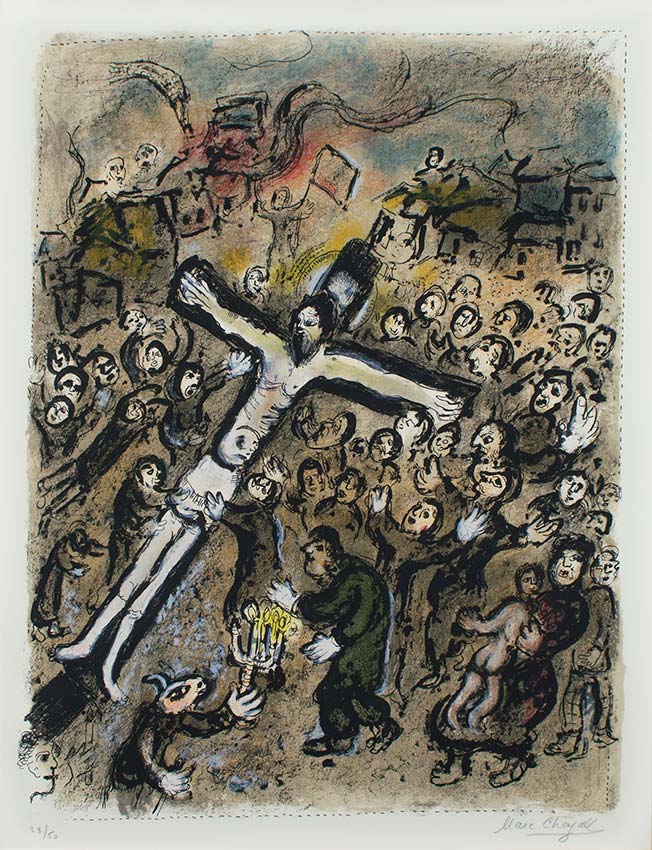
“The Martyr” by Marc Chagall, 1970

All the things the old sacrificial system did for worshipers are now completely fulfilled in the person of Jesus.  Condensed in just a few verses of Scripture, we have a very rich picture of Jesus:

  • Jesus is not a temporary priest, but a permanent priest, the one who is able to intercede continually on our behalf without us having to perform a ritual sacrifice.
  • Jesus lives forever, which enables him to never cease his intercessory work.
  • Jesus saves completely.
  • Jesus meets our need.
  • Jesus has been made perfect forever.

Yet, sometimes Christians go back to the old sacrificial system, not by physically offering animal sacrifices, but treating Christ’s once-for-all finished work as if it were just too good to be true. We reason that we need to do something to help save ourselves. Although Jesus has saved us fully, and therefore, there is no longer any need for sacrifice, yet we still try:

  • To appease God through church attendance or other works, as if the Lord needs to be soothed into not becoming angry at us.
  • To satisfy God through our giving so that the Lord will not have a furrowed brow against us.
  • To assuage our guilty conscience through Christian service, believing this will give us some leverage with God.

In all these kinds of instances, it is going back to an old sacrificial system that is obsolete.

The biblical and theological truth is that Jesus has thoroughly saved us from our sin, and, so, has cleansed us from all guilt, including a guilty conscience.

Jesus meets our need and has completely satisfied God’s wrath against sin. Jesus is our mediator and intercedes for us as we come to God’s throne of grace. That means we do not need to try and get God’s attention with some incredible sacrifice that will somehow obligate him to take notice. 

There is no longer ever a situation where we must run to some spiritual liquor store to pick up a Captain Morgan because the Captain of our souls, Jesus Christ, has already given us everything we need.

Since Jesus has been made perfect forever; is our great high priest; and is the once-for-all sacrifice to end all sacrifices, we have all the grace we need. 

We need not worry anymore about being good enough because Jesus is perfect. Christ’s work is made complete in us. The constant anxiety of feeling we don’t measure-up is not from God. The person and work of Jesus is sufficient to deliver us from guilt and shame.

“Well,” you might say, “if everybody believed that, then nobody would ever do anything.” No, it’s just the opposite. When we feel like we don’t measure up, we do less, not more. A low level discouragement sets in, and we do nothing because we intuitively know it will never be enough. We do just enough to squeak by, never quite knowing if it is doing anything. 

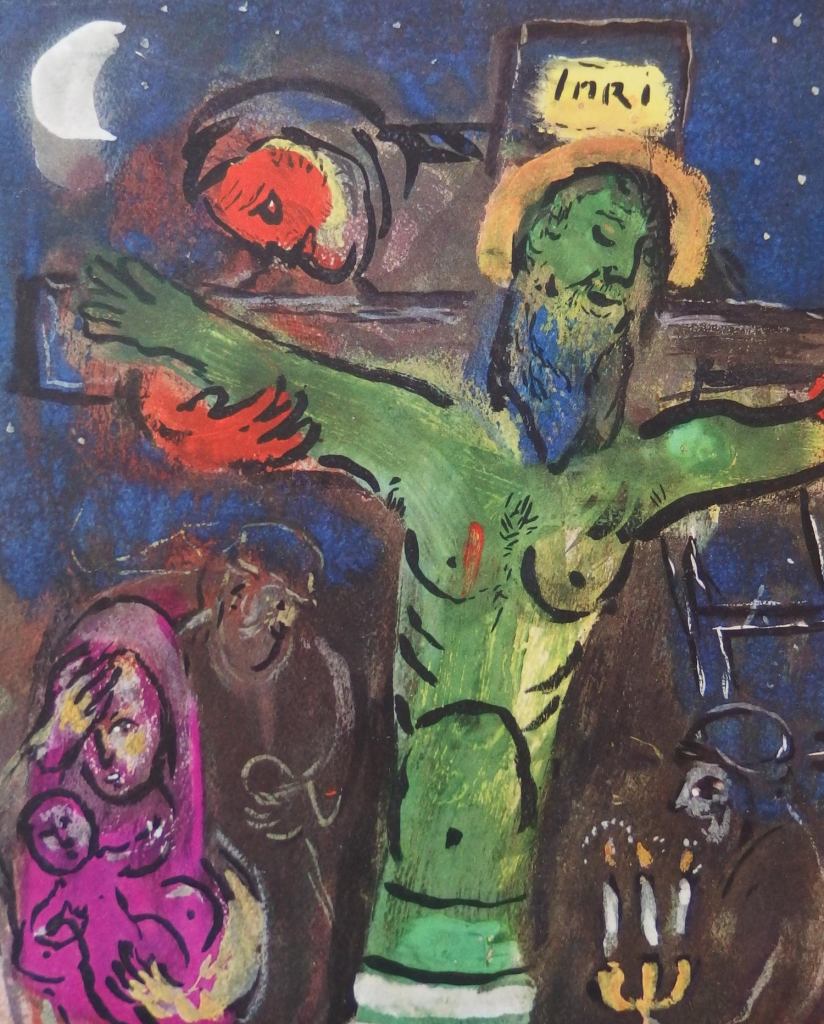
“Crucifixion” by Marc Chagall, 1961

Just like the Hebrew Christians of the first century, we consider giving up because Christianity doesn’t work for us. Yet, when we grasp Christ’s sacrifice to end all sacrifices, and are overwhelmed by grace, then everything we do in the Christian life is a simple desire to say “thank you” with our life and our lips. 

It is the grace, and not the wrath, of God that teaches us to say “no” to ungodliness and worldly passions and to live upright and godly lives (Titus 2:11-12).

The old system wasn’t bad. It served a purpose. Now, however, the old has given way to the new, and there is a better hope by which we draw near to God. The sacrificial system pointed forward to a perfect sacrifice by a permanent priest that would bring us to God forever.

Going back to the old system is like living permanently in a tent, and believing you are home.

Therefore, we must choose what is better. The options are not so much between what is bad and what is good, but between what is good and what is better than good. It is possible to do all kinds of good things and miss the better thing God is doing. 

So, how do we choose the better thing? How do we embrace the new, which is Christ, and not the old, which is the sacrificial system?

  1. Learn to say “no” to the treadmill going nowhere. Since we do not need to impress God, we have the freedom to say “no” to keeping up with the spiritual Jones’s; “no” to cajoling God’s favor, approval, or attention.
  2. Learn to say “yes” to engaging in spiritual practices which remind us of Christ. Say “yes” to the new way of the Spirit, which is by faith and not by sight. This present spiritual age is often intangible, ethereal, and unseen. It requires a new set of spiritual eyes to see.
  3. Let Christianity be about Jesus, and not about us. Resist the allure to rescue others, or have others rescue you. The work of rescue has already been done. Christ saves, we don’t.
  4. Know the better thing over the good thing. Pause before acting or re-acting. Are we expecting someone else to do what Christ has already done? Are we looking to do something we think will make God like us better? Remind yourself of Jesus and his redemption every day in small ways through Scripture reading and prayer, fellowship, and loving service.

Good people can love God, and yet, miss the opportunity to see they are already justified through Christ’s blood. We do not need to justify ourselves. We need to live into the justification we possess by grace through faith.

May it be so to the glory of God.