Showing Kindness (Ruth 2:10-14)

Calling in the Gleaners, by Jules Breton, 1859

Then she fell prostrate, with her face to the ground, and said to him, “Why have I found favor in your sight, that you should take notice of me, when I am a foreigner?” But Boaz answered her, “All that you have done for your mother-in-law since the death of your husband has been fully told me, how you left your father and mother and your native land and came to a people that you did not know before. May the Lord reward you for your deeds, and may you have a full reward from the Lord, the God of Israel, under whose wings you have come for refuge!” Then she said, “May I continue to find favor in your sight, my lord, for you have comforted me and spoken kindly to your servant, even though I am not one of your servants.”

At mealtime Boaz said to her, “Come here and eat some of this bread and dip your morsel in the sour wine.” So she sat beside the reapers, and he heaped up for her some parched grain. She ate until she was satisfied, and she had some left over. (New Revised Standard Version)

Ruth and her mother-in-law Naomi were widows, living in the land of Moab. But Naomi decided to go back to Judah, to her hometown of Bethlehem. She and her husband had originally left because of a great famine.

Naomi had encouraged Ruth to remain in her own country, among her own people. But Ruth insisted on remaining and being with Naomi. But just because the two of them had each other, and they were in Naomi’s native land, it did not mean things were going to be easy or better.

The truth was that that Ruth and Naomi had next to nothing. It was common that during the harvest, the less fortunate folk would walk a ways behind the workers who were gleaning the fields, in order to pick up what was left behind.

Picking up after the workers in the field is precisely what Ruth went out to do. Naomi was too old for the work, so it was up to Ruth. The field that Ruth ended up walking, belonged to a man named Boaz.

Depending upon the owner of the land, the poor folk who came to walk the fields were treated either with kindness or contempt. Boaz was the sort of person who was attentive to God’s law, and sought to do what was right. He knew what Torah said:

“‘When you reap the harvest of your land, do not reap to the very edges of your field or gather the gleanings of your harvest. Leave them for the poor and for the foreigner residing among you. I am the Lord your God.’” (Leviticus 23:22, NIV)

Boaz had taken notice of Ruth. He approached her and told her to remain in his field and stay close to his workers. Boaz also commented to Ruth that he instructed the young men working for him to leave her alone and not bother her. He let Ruth know that she could drink from the vessels appropriated for his laborers.

This was a kindness which was overwhelming to Ruth. As a foreigner and a widow, she was not expecting anything from anyone in Judah. And yet, here is this man extending mercy to her.

One of the reasons Boaz showed kindness to Ruth is because he had heard about her commitment to Naomi, and admired her courage and spunk in coming to a land which was not her own.

Indeed, the picture we gain is that Ruth was a modest and faithful person, upright, diligent, and full of kindness. She understood who she was, where she was, and she was willing to do whatever she could for the sake of her dear mother-in-law.

Ruth had faith that Naomi would lead her well, and to a life of commitment to both God and God’s people. Ruth’s bravery and willingness to submit to Naomi is a beautiful portrayal of faith, hope, and love.

We can be inspired from such courage. For we, too, must take risks and allow ourselves to venture out into places we aren’t familiar with.

We will do well to understand that it was Ruth’s willingness to act, and her commitment to the life she chose, that helped bring about a family and an adopted community which she did not think possible.

It would be good for each of us to take the time to get a long look at our own lives. We must decide what risks we will take, and which things to avoid, and then go out in faith and perform those actions to the best of our ability, and with the grace which God grants us.

In stepping out and acting with kindness and commitment, Ruth discovered God’s care when she and Naomi were in poverty.

The blameless spend their days under the Lord’s care,
    and their inheritance will endure forever.
In times of disaster they will not wither;
    in days of famine they will enjoy plenty. (Psalm 37:18-19, NIV)

Boaz eventually found the blessing of family through his own act of kindness toward Ruth. He was well-off and had plenty, yet he used his privilege to bless others.

Command those who are rich in this present world not to be arrogant nor to put their hope in wealth, which is so uncertain, but to put their hope in God, who richly provides us with everything for our enjoyment. Command them to do good, to be rich in good deeds, and to be generous and willing to share. In this way they will lay up treasure for themselves as a firm foundation for the coming age, so that they may take hold of the life that is truly life. (1 Timothy 6:17-19, NIV)

So, whether we are poor or rich, underprivileged or privileged, we all can find ways to show kindness and live on this earth in peace and goodwill.

How, then, will you live?

O Lord, give me strength today to show kindness in all that I do. Help me to open my arms to those less fortunate and extend my hand to those who may need it, so that they may see You in my kind words and actions. Amen.

The Almighty Has Dealt Bitterly with Me (Ruth 1:18-22)

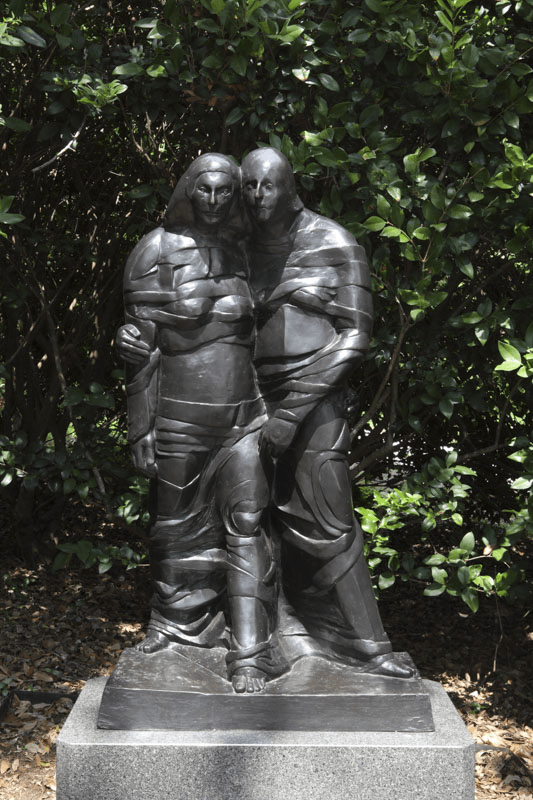
Statue of Ruth and Naomi, by Leonard Baskin (1922-2000)

When Naomi saw that she was determined to go with her, she said no more to her.

So the two of them went on until they came to Bethlehem. When they came to Bethlehem, the whole town was stirred because of them, and the women said, “Is this Naomi?” She said to them,

“Call me no longer Naomi;
    call me Mara,
    for the Almighty has dealt bitterly with me.
I went away full,
    but the Lord has brought me back empty;
why call me Naomi
    when the Lord has dealt harshly with me
    and the Almighty has brought calamity upon me?”

So Naomi returned together with Ruth the Moabite, her daughter-in-law, who came back with her from the country of Moab. They came to Bethlehem at the beginning of the barley harvest. (New Revised Standard Version)

A famine in Judah had brought Naomi and her husband Elimelech to the country of Moab. While there, they had two sons who eventually married two Moabite women: Orpah and Ruth. Over time, each of the husbands died, leaving Naomi and her two daughters-in-law as widows.

Naomi heard that things were finally better in her native Judah. So, she decided to go there, alone. Naomi encouraged her daughters-in-law to remain with their own people and remarry. Orpah did so. Ruth, however, wasn’t having it.

Ruth was determined to stay with her mother-in-law – which meant that she would enter Judah as a foreigner. Despite Naomi’s insistence that Ruth do what is best for herself, Ruth stuck with Naomi.

Once they arrived, the people of Naomi’s hometown were surprised to see the two of them. Naomi was not shy about communicating her bitterness in losing a husband and two sons. She commented that God had turned against her and made her life hard and bitter.

In saying that the Lord had emptied her and brought calamity, Naomi was not speaking against God. Rather, Naomi was expressing some significant theology that has become lost to many modern day Christians around the globe.

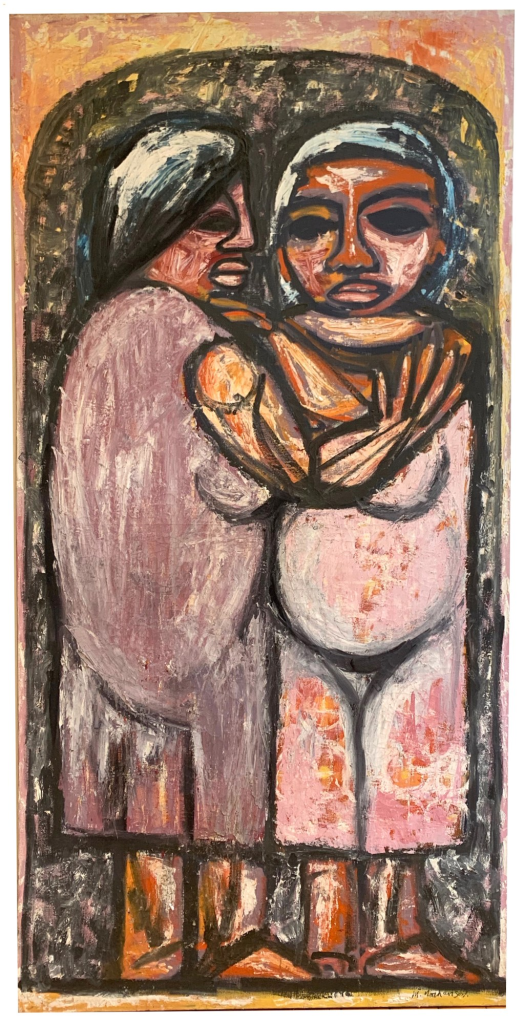
Ruth and Naomi, by Morris Nathanson (1927-2022)

I believe that Ruth was not expressing something malevolent about God, but rather made a statement of faithful recognition, not unlike what Job had to say when he lost his family and his health:

“Naked I came from my mother’s womb, and naked shall I return there; the Lord gave, and the Lord has taken away; blessed be the name of the Lord.” (Job 1:21, NRSV)

No one can escape the dark side of life. Yet, we can deal with that darkness intelligently. It is most necessary to be aware that light creates a shadow that was not there before. The bigger and brighter the light, the bigger and darker the shadow.

There is a centuries old idiom which says, “You can’t have your cake, and eat it, too!” This is a proverbial way of saying that we cannot expect everything to always be good in this life; we must also accept that we cannot always have our way, and that we will go without, experiencing loss.

Whether we want to acknowledge it, or not, an integral part of life is receiving some bad things from God. The Lord does not just go around dispensing everyone’s wishes and making everything a utopia of unicorns and butterflies.

God is most certainly benevolent; yet God also brings darkness to people. We cannot have the Light of the world without experiencing the world’s darkness. Another way of stating this is that a very big God creates quite a large shadow.

In Christianity, the predominant symbol is the cross. The Cross of Christ is both light and dark. Christians may reflexively associate the cross with salvation from sin, while forgetting that the cross is an instrument of torture and death, a tool of execution, like an electric chair.

We must honor the axis crossing at the center of the cross. It is the place of equilibrium, the place of wholeness, where we have the opportunity of integrating all of that unwanted grief and loss into our lives. Failing to do this, let alone neglecting to acknowledge the shadowy places of our hearts, brings harm and hurt to ourselves and to the world.

Naomi acknowledged the shadow. She accepted the darkness, which enabled her to return to her homeland of Judah, the very place where the God of light and dark is worshiped.

I’m not talking about the sort of darkness that is malevolent and mean-spirited, the darkness which comes from Satan. I’m talking about the darkness which weans us away from all things and the ways that hinder us from knowing God.

This is what St. John of the Cross was referring to in naming the dark night of the soul. In our quest to experience union with God, we journey through the darkness, and learn that purification isn’t simply putting something impure away. Purity of heart comes through joining with the God who is pure love itself.

“In the dark night of the soul, bright flows the river of God.”

St. John of the Cross

God loves us so much as to be nailed to a cross and suffer darkness. The Christian is to take up their cross and follow Jesus. That is, we embrace the darkness with an honest engagement of God and God’s world, and through a vulnerable assessment of our own shadow.

For if we fail to acknowledge our shadow, we shall fail to be in union with God.

Not only do many people disown the parts of themselves they don’t like, but they do the same with God – thus making God into their own image of how God should be, instead of taking God as God is.

If you have ears to hear, take this to heart: To accept and honor your own shadow is a profound and necessary spiritual discipline. By “shadow” I mean all of the characteristics of myself that I withhold from others, so that they will only see what I want them to see.

We often put a false self out into the world, for others to see. It is a sort of psychological clothing we wear, much as we have actual clothing. Whether the clothes are real or metaphorical, we dress ourselves in the particular way we want to be seen.

Naomi was a true Israelite, showing her honest true self. There was no separation or division between the inner self and the self she presented to others.

I tend to think that Naomi knew something about God that many don’t know today – and was therefore able to be faithful to both her people and her God.

It is no wonder, then, that Ruth wanted to remain with her mother-in-law Naomi, who was a real person acknowledging the real God.

Almighty God and Father, maker of heaven and earth, of all that is seen and unseen: You are the God of light who illumines our way. And You are the God of darkness who is shadowed in mystery. In knowing You, may I know myself; and in knowing myself, may I more fully know You. Amen.

How You Are Matters (Ruth 4:13-17)

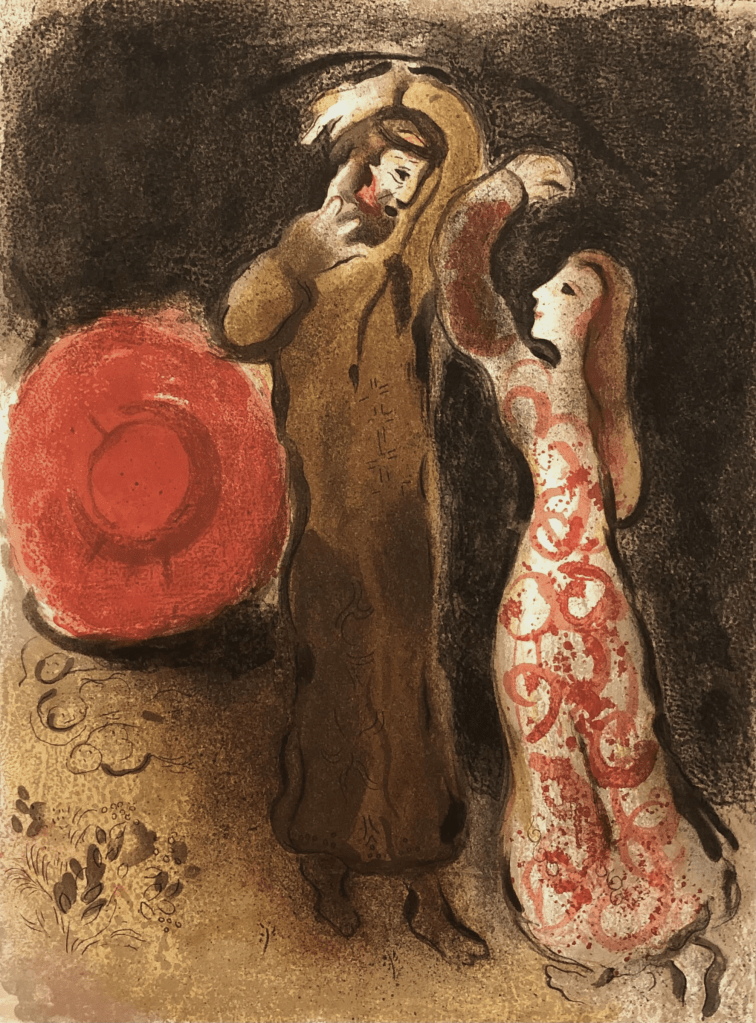
The Meeting of Ruth and Boaz by Marc Chagall, 1960

So Boaz took Ruth home as his wife. The Lord blessed her, and she became pregnant and had a son. The women said to Naomi, “Praise the Lord! He has given you a grandson today to take care of you. May the boy become famous in Israel! Your daughter-in-law loves you and has done more for you than seven sons. And now she has given you a grandson, who will bring new life to you and give you security in your old age.” Naomi took the child, held him close, and took care of him.

The women of the neighborhood named the boy Obed. They told everyone, “A son has been born to Naomi!”

Obed became the father of Jesse, who was the father of David. (Good News Translation)

Your Commitment Matters

Ruth, although not a Jew, committed herself fully to her Jewish mother-in-law and to the Jewish people. Her faithfulness mattered and eventually realized the blessing of family and community.

It wasn’t an easy path for Ruth to enjoy such blessing. She and her mother-in-law, Naomi, came to Bethlehem as two poor widows. Even though Bethlehem today is known around the world, back then there wasn’t much to it – just a small non-descript village in Judah a few miles south of Jerusalem.

Your History Matters

The Bible contains a lot of genealogies. Bible readers often skip over those portions of Holy Scripture to get to the more meaty and interesting stuff. But there’s a lot there.

Genealogies serve to remind us of who we are, where we have come from, and thus, what direction we are headed. Each and every human life has an historical context, a past which informs the present and can help guide for the future.

Naomi had a long history as part of the Jewish community. Ruth was a Moabite. Moab was an ancient kingdom which was located in the present day nation of Jordan. The original ancestor of the Moabites was Moab, a son of Lot. Lot was a nephew of the Jewish patriarch Abraham.

Moabites and Israelites didn’t get along. Moab had their own god, Chemosh, and did not serve Israel’s Yahweh. The person, Moab, was conceived under difficult and dubious circumstances – and it seems this context set the tone for the entire nation of people. (Genesis 19:30-38)

Our genealogical histories can bog us down or they can inspire us. Yet, the unseemly parts of our past family can actually serve to reveal something wonderful.

Your Receiving of Grace Matters

All genealogies are filled with less than stellar characters. But they’re also testaments to grace.

Both Ruth and her husband Boaz were recipients of the Lord’s grace.

Boaz, having a long history of the covenant as a Jew, nonetheless also had a difficult family past. Much like the conception of the ancient character of Moab, one of the ancestors of Boaz, Tamar, and one of the Jewish patriarchs, Judah, had a rather twisted experience. (Genesis 38:1-30)

Both Boaz and Ruth became great grandparents to King David. And they both are listed together in the opening genealogy of Matthew’s Gospel as ancestors to Jesus the Messiah, known as the son of David.

Grace changes history. If Jesus can have a genealogy, much like us, filled with both faithful committed people and dubious characters, then I believe we can give ourselves, and each other, a bit of slack on our shared human condition.

Your Spiritual Family Matters

For the Christian, there is an historical continuity across the millennia with our ancient spiritual forebears. The drama of redemption unveiled throughout the whole of Scripture connects us with Father Abraham, to the deliverance out of Egyptian slavery, to the saving events of Christ’s life, death, resurrection, and ascension, and beyond into the union of Christ and the Church.

A Moabite widow is redeemed into a new community. She marries a Jewish man and conceives a child in grace, born in the humble village of Bethlehem. Centuries later, another woman, Mary, experiences a conception of grace and gives birth to a child in the very same place – Christ the Lord, our Immanuel, God with us.

Jesus was born of David’s genealogical line, from ordinary people, just like Ruth and Boaz. Because it is only from humility that greatness can arise.

Your Faith Matters

Your faith and my faith grows in the context of an ordinary life. We live and move and have our being within the grace and providential care of God. Our faith is rooted in the soil of grace, anchored and moored in the deep of faithful servants who have gone before us.

Like Ruth, we humbly attach ourselves to a larger community and seek to give ourselves for the life of the world. Like Mary, we willingly confess to the angelic messenger:

“I am the Lord’s servant. May your word to me be fulfilled.” (Luke 1:38)

Our Father in heaven, you hold all that you have made within your gracious and merciful hand. Help us in all things to see your loving providence working out a good plan for the earth. Just as Ruth from Moab became one of your people, so you call us by name and hospitably invite us to your Table.

In Jesus Christ, our Redeemer, you meet us in the ordinary routines of our lives. You have graciously taken our pains, fears, sorrows, bitterness, guilt, shame, and sins upon yourself and given us a new life and a new community.Turn our suffering to glory, and our tears into joy.

Holy Spirit, giver of life, you guide us into grace and truth through generous love. As Boaz went out of his way to provide abundance for a poor widow, let us be generous with both our speech and our actions. Teach us to be alert to the needs of others so that everyone may have their daily bread.

Blessed Holy Trinity – Father, Son, and Spirit – the God whom we serve, you are our past, present, and future. We give you praise and commit ourselves to the words and ways of Jesus, in whose name we are bold to pray. Amen.

Your People Will Be My People (Ruth 1:6-18)

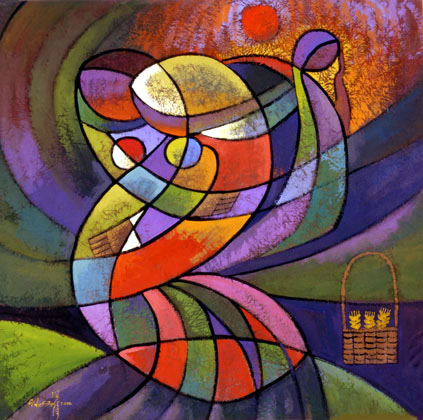
Naomi and Ruth by Chana Helen Rosenberg, 2017

When Naomi heard in Moab that the Lord had come to the aid of his people by providing food for them, she and her daughters-in-law prepared to return home from there. With her two daughters-in-law she left the place where she had been living and set out on the road that would take them back to the land of Judah.

Then Naomi said to her two daughters-in-law, “Go back, each of you, to your mother’s home. May the Lord show you kindness, as you have shown kindness to your dead husbands and to me. May the Lord grant that each of you will find rest in the home of another husband.”

Then she kissed them goodbye, and they wept aloud and said to her, “We will go back with you to your people.”

But Naomi said, “Return home, my daughters. Why would you come with me? Am I going to have any more sons, who could become your husbands? Return home, my daughters; I am too old to have another husband. Even if I thought there was still hope for me—even if I had a husband tonight and then gave birth to sons—would you wait until they grew up? Would you remain unmarried for them? No, my daughters. It is more bitter for me than for you, because the Lord’s hand has turned against me!”

At this they wept aloud again. Then Orpah kissed her mother-in-law goodbye, but Ruth clung to her.

“Look,” said Naomi, “your sister-in-law is going back to her people and her gods. Go back with her.”

But Ruth replied, “Don’t urge me to leave you or to turn back from you. Where you go I will go, and where you stay I will stay. Your people will be my people and your God my God. Where you die I will die, and there I will be buried. May the Lord deal with me, be it ever so severely, if even death separates you and me.” When Naomi realized that Ruth was determined to go with her, she stopped urging her. (New International Version)

Every time I read this account of Naomi and her daughters-in-law I’m reminded of my Dad because this was his favorite Old Testament story.

Dad was a lifelong farmer, and so, always related to the agrarian society of ancient Israel. But what really resonated for him in Scripture was Ruth’s response to her mother-in-law: “Your people are my people and your God my God. Where you die I will die, and there I will be buried.”

My father did not want to be a farmer. He wanted to go to college and become an engineer. In fact, without my grandfather’s knowledge, he was accepted to a university and secured an on-campus job. Yet, when Grandpa found out, he was less than pleased because Dad was needed on the farm during the depression era.

So, Dad, although he could have went to college, decided to stay on the farm. And the reason he decided to do so was not because he got his arm twisted, but because of the story of Ruth. He made the decision to stick with farming and never looked back. My Dad died ten years ago and is buried in the same cemetery as his father.

Ruth and Naomi by He Qi, 2001

The biblical character of Ruth is a solid example of one who was cognizant that she was part of a larger whole – that, although she was indeed an individual with personal choices, the decisions she made impact a much wider community. I believe Ruth discerned that the Israelite community understood this truth, and she wanted to be a part of it.

It is rare, in this age of extreme individualism, that people willingly give themselves to do what is best for the group, the family, the neighborhood, the faith community, the nation, and the world. There is a tendency to view things very narrowly in terms of what’s in it for me and ignore the rest.

So, I invite you to consider becoming ever more aware and connected to the communities around you. Discover the issues, problems, joys, sorrows, celebrations, and challenges they hold. And give yourself to the great struggles of that place. Jesus said:

If any of you want to be my followers, you must forget about yourself. You must take up your cross and follow me. If you want to save your life, you will destroy it. But if you give up your life for me, you will find it. (Matthew 16:24-25, CEV)

The One who is concerned to save the entire world only tolerates disciples who share his care for the entire human family.

Therefore, we ought neither to participate in nor support causes, activities, or speech that is harmful to others. Instead, we should find ways of using our particular gifts and abilities to serve the common good of all persons. We need more commitment and love, and a lot less anger, divisiveness, and hatred.

Grace and humility will always serve us, and others, very well. Judgment and pride, not so much.

Tell them to do good, to be rich in the good things they do, to be generous, and to share with others. (1 Timothy 6:18, CEB)

How, then, shall we live?

Your people will be my people.

Can you imagine a world in which all persons ascribe to this?

May it be so, to the glory of God.

We pray to you, Lord God, for all people everywhere:

For all people in their daily life and work;
For our families, friends, and neighbors, and for those who are alone.

For our community, the nation, and the world;
For all who work for justice, freedom, and peace.

For the just and proper use of your creation;
For the victims of hunger, fear, injustice, and oppression.

For all who are in danger, sorrow, or any kind of trouble;
For those who minister to the sick, the friendless, and the needy.

For the peace and unity of the Church;
For all who proclaim and seek the Truth.

Hear us, Lord; For your mercy is great. Amen.