Overwhelming Victory in Overcoming Suffering (Romans 8:31-39)

What shall we say about such wonderful things as these? If God is for us, who can ever be against us? Since he did not spare even his own Son but gave him up for us all, won’t he also give us everything else? Who dares accuse us whom God has chosen for his own? No one—for God himself has given us right standing with himself. Who then will condemn us? No one—for Christ Jesus died for us and was raised to life for us, and he is sitting in the place of honor at God’s right hand, pleading for us.

Can anything ever separate us from Christ’s love? Does it mean he no longer loves us if we have trouble or calamity, or are persecuted, or hungry, or destitute, or in danger, or threatened with death? (As the Scriptures say, “For your sake we are killed every day; we are being slaughtered like sheep.”) No, despite all these things, overwhelming victory is ours through Christ, who loved us.

And I am convinced that nothing can ever separate us from God’s love. Neither death nor life, neither angels nor demons, neither our fears for today nor our worries about tomorrow—not even the powers of hell can separate us from God’s love. No power in the sky above or in the earth below—indeed, nothing in all creation will ever be able to separate us from the love of God that is revealed in Christ Jesus our Lord. (New Living Translation)

There is a way to overcome suffering; there’s a path you can follow, leading to the overcoming of your struggle.

That struggle with suffering comes in many forms:

  • Wrestling with guilt and shame;
  • Dealing with the meanness of others
  • Chronic physical pain
  • Continual financial trouble
  • Ongoing estranged relationships
  • Past bad decisions that keep coming up to bite you in the present
  • Constant feelings of angst about the state of the world’s great needs and problems
  • A crippling Anfechtung (spiritual oppression and depression)

These and a hundred other reasons for suffering in this broken old world can discourage and debilitate us.

I invite you to consider that the road ahead will likely be counter-intuitive to how you may currently be thinking about overcoming suffering. In fact, it might be so far off your radar that you might simply discard what I’m about to say to you.

But before I get to that, I’ll say first, that suffering is endemic to the human condition. Everyone suffers. Since we live in a fallen world, there is not one person who hasn’t suffered in some way, whether it is physical, spiritual, mental, or emotional. 

None of us will ever be immune to affliction. There is no way to insulate yourself from pain. If you are not currently suffering in some way, it means that you are either coming off a time of hardship or are about to enter a new period of distress.

Holiness and godliness don’t keep suffering at bay. Just the opposite. The Lord Jesus promised us that following him will involve suffering: 

“While you are in this world, you will have to suffer.” (John 16:33)

The Apostle Peter, who was part of Christ’s inner circle of followers, came to understand the reality of suffering. Peter understood that all Christians are not above their Lord.  If Christ suffered, his followers shall suffer, as well.

“Dear friends, don’t be surprised or shocked that you are going through testing that is like walking through fire. Be glad for the chance to suffer as Christ suffered.” (1 Peter 4:12-13, CEV) 

James, the Lord’s brother, wisely discerned that suffering could become a teacher for the Christian; all the adversity the believer faces are the means of producing maturity, strengthening faith, and developing patience.

“My friends, be glad, even if you have a lot of trouble. You know that you learn to endure by having your faith tested.” (James 1:2-3, CEV) 

The Apostle Paul was more acquainted with suffering than any follower of Jesus; he continually faced terrible circumstances. His reflections on the matter are sage and true:

“Anyone who belongs to Christ Jesus and wants to live right will have trouble from others.” (2 Timothy 3:12, CEV) 

“Suffering helps us to endure. And endurance builds character, which gives us a hope that will never disappoint us.” (Romans 5:3-5, CEV)

“It has been granted to you on behalf of Christ not only to believe in him, but also to suffer for him.” (Philippians 1:29, NIV)

The New Testament writers have a perspective on suffering which is very different than how we typically think of it. Although suffering is a part of being in the world, yet Jesus said:

“In this world you will have trouble. But take heart! I have overcome the world” (John 16:33, NIV)

Now, let’s wheel back around to the overcoming of suffering. Here is the truth and the practice we must adopt when it comes to suffering: 

The truth about overcoming suffering comes not from us, but through Christ; and the practice of overcoming suffering doesn’t come from fighting against it but by sitting with it and learning from it.

Stated a different way: Jesus has overcome the world through his death, resurrection, and ascension. On the cross, he absorbed all the sin and suffering of everyone. Your suffering, then, may hurt and it might be senseless; yet no matter it’s source, that suffering will always rule over you unless you invite it to take a seat with you and have a conversation with it.

More pointedly: Quit fighting against your suffering. Stop kicking and screaming long enough to look your suffering square in the face and learn from it.

Your suffering is trying to tell you something. 

If you keep taking the stance of a pugilist trying to punch it away, it will just keep moving forward at you. You can’t beat suffering. You can only learn from it. And you’ll only learn from it, even overcome it, when you embrace it. 

So, here’s the counter-intuitive, counter-cultural practice that you might not like and might think I’m off my rocker for suggesting: Submit to suffering.

Don’t hear what I’m not saying. I’m not trying to sanitize your troubles or trauma. Evil is evil, and no amount of saying otherwise will change the leopard’s spots. However, only through submitting to the process of what suffering teaches us will we ever have power over it.

Perhaps an illustration is in order. Let’s liken suffering to encountering a bear in the wilderness. The National Park Service gives us this advice if facing a bear while out hiking:

“Once a bear has noticed you and is paying attention to you, these strategies can help prevent the situation from escalating:”

  • Identify yourself by talking calmly so the bear knows you are a human and not a prey animal. Remain still; stand your ground but slowly wave your arms. Help the bear recognize you as a human. It may come closer or stand on its hind legs to get a better look or smell. A standing bear is usually curious, not threatening.
  • Stay calm and remember that most bears do not want to attack you; they usually just want to be left alone. Bears may bluff their way out of an encounter by charging and then turning away at the last second. Bears may also react defensively by woofing, yawning, salivating, growling, snapping their jaws, and laying their ears back. Continue to talk to the bear in low tones; this will help you stay calmer, and it won’t be threatening to the bear. A scream or sudden movement may trigger an attack. Never imitate bear sounds or make a high-pitched squeal.
  • Hike and travel in groups. Groups of people are usually noisier and smellier than a single person. Therefore, bears often become aware of groups of people at greater distances, and because of their cumulative size, groups are also intimidating to bears.
  • If the bear is stationary, move away slowly and sideways; this allows you to keep an eye on the bear and avoid tripping. Moving sideways is also non-threatening to bears. Do not run, but if the bear follows, stop and hold your ground. Bears can run as fast as a racehorse both uphill and down. Like dogs, they will chase fleeing animals. Do not climb a tree. Both grizzlies and black bears can climb trees.

Fighting suffering is about as useful as taking on a bear. Both bears and suffering can be dangerous. We don’t blame bears if they act like bears. Likewise, we ought not be surprised when suffering hurts. But we can learn a lot about suffering and even come to the point of oddly admiring it for its large ability to teach us things we would not learn otherwise.

Face suffering like facing a bear in the wilderness of trouble. Calmly identify yourself. Talk in low tones to your suffering. Speak to it. Remember who you are. You belong to God. Treat suffering as if it is curious about you. Stay calm. Freaking-out only encourages suffering to attack. 

If you’re alone, that’s not good. Walking with others in Christian community is one of the best practices of the Christian life. Suffering is intimidated by groups of people encouraging one another and showing hospitality to each other. Keep your eye on suffering. Don’t ignore it, or pretend it isn’t there. 

Don’t run. The Lord is with you. Face suffering. Keep it in front of you. It will pass, but you must be patient and calm. Once it is gone, then you can reflect on what happened and debrief with others about the experience.

The path to overcoming suffering is to acknowledge it, respect it, submit to it, and let it pass. Then, you will be able to consider it joy whenever you face various struggles, knowing that your faith is being exercised, and perseverance developed. (James 1:2-4)

Stop fighting. Stop going it alone. Don’t be a martyr. Be silent. Listen. Change suffering from an adversary to fight to a companion to learn from.

You and I have nothing to lose. For nothing can separate us from the love of God in Christ Jesus our Lord. Amen.

Get Along with Each Other (Romans 3:1-8)

So, what difference does it make who’s a Jew and who isn’t, who has been trained in God’s ways and who hasn’t? As it turns out, it makes a lot of difference—but not the difference so many have assumed.

First, there’s the matter of being put in charge of writing down and caring for God’s revelation, these Holy Scriptures. So, what if, in the course of doing that, some of those Jews abandoned their post? God didn’t abandon them. Do you think their faithlessness cancels out his faithfulness? Not on your life! Depend on it: God keeps his word even when the whole world is lying through its teeth. Scripture says the same:

Your words stand fast and true;
Rejection doesn’t faze you.

But if our wrongdoing only underlines and confirms God’s right-doing, shouldn’t we be commended for helping out? Since our lies don’t even make a dent in his truth, isn’t it wrong of God to back us to the wall and hold us to our word? These questions come up. The answer to such questions is no, a most emphatic No! How else would things ever get straightened out if God didn’t do the straightening?

It’s simply perverse to say, “If my lies serve to show off God’s truth all the more gloriously, why blame me? I’m doing God a favor.” Some people are actually trying to put such words in our mouths, claiming that we go around saying, “The more evil we do, the more good God does, so let’s just do it!” That’s pure slander, as I’m sure you’ll agree. (The Message)

The Apostle Paul’s letter to the Roman Church is a hefty sixteen chapters of dense material and extended arguments of intense reasoning. Likely,

Likely, Paul felt compelled to be so verbose because of the church’s situation.

The Roman Church, at the time of Paul’s writing, was made up of both Jewish and Gentile believers in Jesus. Jews and Gentiles have a complicated history together, to say the least.

The Roman Empire was firmly in control of Palestine and did not always treat the Jewish people well. In addition, the religious backgrounds of Jew and Gentile were as different as you can get.

Whereas the Jewish Christians had a long and rich history with God and the Old Testament, the Gentile Christians were green believers, fresh from centuries of paganism and esoteric rituals. Now, the two of them were together in one place, worshiping Jesus together.

Jews and Gentiles together made for a potentially combustible situation.

Throughout the letter to the Romans, Paul goes back and forth addressing the two groups of Jews and Gentiles. The overarching problem was this:

  • The Jewish believers tended to look down on the Gentile Christians and thought they needed to become Jewish to really be the kind of Christians God was looking for.
  • The Gentile believers tended to dismiss their Jewish brothers and sisters as backward and stuck in tradition.

Each group thought the other must become like them. So, Paul, bless his apostolic heart, had a hot mess in the making with these believers.

In our New Testament lesson for today, Paul is directing his comments toward the Gentile Christians. He wanted them to gain some appreciation for the Jewish people. After all, they were chosen by God to become a nation of priests and prophets for the world. Discounting that history would be to neglect and even invalidate their shared salvation.

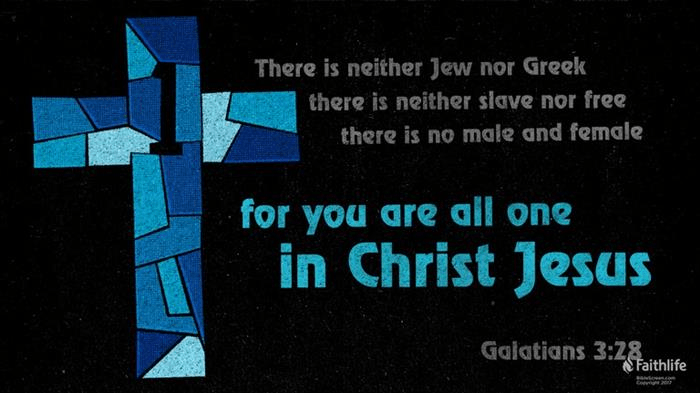
For Paul, to have two churches, one Jew and the other Gentile, would be a complete travesty of Christ’s redemption for humanity.

Jesus sought to bring disparate peoples together and not keep them divided. The cross freed us by eliminating the barriers which separate us. The Roman Church needed to work together at being one people under the lordship of Christ.

There was to be no ethnic, religious, or political one-upmanship on Paul’s watch.

Truth be told, both Jew and Gentile did not always do so well with their respective histories. So, there is no ground for boasting or trying to argue for their own way. In fact, the unfaithfulness of people simply shows the incredible faithfulness of God in greater relief. 

If there were no sin, grace would not be needed; no cross would have existed. Just because the foulness and degradation of sin brings out the gracious, faithful, and forgiving character of God in Christ, does not mean that sin is okay or that we can flippantly wave it off with uttering some mumbo-jumbo cheap grace which devalues the majesty of God.

For example, when antebellum southern slaveholders in nineteenth-century America argued for their peculiar institution by saying that snatching black Africans from their homes was a good thing so that they could get out of their religious animistic worldview and be exposed to Christianity, I am positively sure that the Apostle Paul rolled over in his grave and begged Jesus to resurrect him early and send him to tackle such an affront to the cross of Christ!

Sin is never to be excused through twisted human mental gymnastics.

Paul worked laboriously to unite the churches he established and bring differing people groups together under Christ.

  • This does not mean is that all cultural and personal distinctions are ignored or erased.
  • This does mean that we value one another’s differences and gather around the shared value of knowing Jesus Christ.

The Church was neither going to become Jewish nor Gentile but something altogether new – one new people out of the two. Paul framed the matter this way to the Ephesian Church:

Therefore, remember that formerly you who are Gentiles by birth and called “uncircumcised” by those who call themselves “the circumcision” (which is done in the body by human hands)— remember that at that time you were separate from Christ, excluded from citizenship in Israel and foreigners to the covenants of the promise, without hope and without God in the world. But now in Christ Jesus you who once were far away have been brought near by the blood of Christ.

For he himself is our peace, who has made the two groups one and has destroyed the barrier, the dividing wall of hostility, by setting aside in his flesh the law with its commands and regulations. His purpose was to create in himself one new humanity out of the two, thus making peace, 16 and in one body to reconcile both of them to God through the cross, by which he put to death their hostility. He came and preached peace to you who were far away and peace to those who were near. For through him we both have access to the Father by one Spirit. (Ephesians 2:11-18, NIV)

Solitary righteousness is an oxymoron. Righteousness can only be truly lived and expressed with other people.

Yes, there is freedom in Christ. Yet, that freedom must be continually applied through making every effort to keep the unity of the Spirit through the bond of peace.

So, get along with one another.

O God, the Father of our Lord Jesus Christ, our only Savior, the Prince of Peace: Give us grace to seriously lay aside all unhappy divisions. Take away all hatred and prejudice, and whatsoever else may hinder us from godly union and harmony: that, as there is but one Body, and one Spirit, and one hope of our calling, one Lord, one faith, one baptism, one God and Father of us all; so, may we be forever all of one heart, and of one soul, united in one holy bond of truth and peace, faith and love, with one mind and one mouth, glorify Jesus Christ our Lord. Amen.

Romans 7:14-25 – Our Existential Angst

We know that the law is spiritual; but I am unspiritual, sold as a slave to sin. I do not understand what I do. For what I want to do I do not do, but what I hate I do. And if I do what I do not want to do, I agree that the law is good. As it is, it is no longer I myself who do it, but it is sin living in me. For I know that good itself does not dwell in me, that is, in my sinful nature. For I have the desire to do what is good, but I cannot carry it out. For I do not do the good I want to do, but the evil I do not want to do—this I keep on doing. Now if I do what I do not want to do, it is no longer I who do it, but it is sin living in me that does it.
 
So, I find this law at work: Although I want to do good, evil is right there with me. For in my inner being I delight in God’s law; but I see another law at work in me, waging war against the law of my mind and making me a prisoner of the law of sin at work within me. What a wretched man I am! Who will rescue me from this body that is subject to death? Thanks be to God, who delivers me through Jesus Christ our Lord!
 
So then, I myself in my mind am a slave to God’s law, but in my sinful nature a slave to the law of sin. (New International Version)
 
We can relate to the Apostle Paul. We, along with him, have many times said to ourselves, “I don’t understand why I act the way I do. I don’t do what I know is right. I do the things I hate.” 
 
Paul’s existential angst is a timeless description of our common human condition. There are times we seem completely unable to follow our conscience and do what’s right. It can be maddening, even to the point of experiencing a continual low-level discouragement and/or depression which underlies almost everything we do.
 
The prescription for dealing with this mental, emotional, and spiritual malady does not include the law. That’s right. Putting our willpower and effort into obeying commands gets us nowhere. Even if we obey laws and rules and commands for a time, our efforts eventually break down. We fail to do what we want and do just the opposite.
 
The law isn’t bad. It just doesn’t have the capacity to transform us. The law’s purpose is to show us how bad off we really are in this world, to give us an awareness of our true condition so that we will seek help. 
 
We humans are a bundle of contradictions, doing good, then bad, and flip-flopping back and forth – all with great frustration.
 
In our abject misery, what then, shall we do? Who will help us? Is there anyone to save us from our plight?
 
Sheer willpower and obedience will not help us; it won’t work. It will only give us a false hope. Any success in using such willpower only deludes one into believing they have the answer… until they yet fall again into the abyss of their own inner darkness.
 
The good news is that there is a Savior, a Redeemer, a Rescuer who has the will and the power to deliver us from our predicament.
 
The grace of God in Christ is the operative power that changes lives, not the law. Freedom from the tyranny of our “should’s” and our misplaced desires comes from Christ’s forgiveness through the cross. 
 
Like a lover enamored with his beloved, our desires become oriented toward Jesus for his indescribable gift to us. That is the strength of grace. Transformation is relational; it is found in a person, not a program. And the only person and relationship which has the ability to change us is, I believe with all my heart and mind, the Lord Jesus Christ.
 
Why? Because I myself have been transformed and changed by such a relationship with Christ. I, along with the hymn writer John Newton, can say, “I once was lost but now am found, was blind but now I see.”
 
“Self-help” for all the good it really can do, is in many ways an oxymoron. There is no Bible verse which states that God helps those who help themselves.
 
Yes, we have an incredible capacity for good and vast internal resources within us which we lack awareness of for which we can tap into. Yet, when it comes to an outright metamorphosis, we need a new heart – and we can no more simply decide to change our lives any more than we can perform heart transplant surgery on ourselves.
 
People need the Lord.
 
Whenever the foundation of a house is about to crumble, it won’t do to rearrange the living room furniture and do a bit of spruce up painting. And we deceive ourselves if we believe that all our efforts at landscaping the property and having a great curb appeal will do the trick.
 
If the foundation crumbles, the house implodes, and nothing else will matter.
 
Jesus is our cornerstone. Without him, we are at risk, about to fall and without hope. With him, true restoration and renewal happens. And then, when the house is repaired and in order, we set about the task of being good stewards and maintaining and caring for the wonderful changes which were made.
 
If we want freedom from self-loathing and to experience peace and contentment, calmness and confidence, satisfaction and settled peace, then we will grow ever closer to the Savior who exudes all those qualities, and more.
 
For the Lord not only saves and delivers; he also sanctifies and encourages. And the existential angst becomes forgotten.
 
Saving God, I thank you for delivering me from sin, death, and hell through your Son, the Lord Jesus. May your Holy Spirit apply the work of grace to my life every day so that I can realize practical freedom from all that is damaging and destructive in my soul. Amen.

Romans 5:1-5 – Maybe There Can Be Peace…

Therefore, since we have been justified through faith, we have peace with God through our Lord Jesus Christ, through whom we have gained access by faith into this grace in which we now stand. And we boast in the hope of the glory of God. Not only so, but we also glory in our sufferings, because we know that suffering produces perseverance; perseverance, character; and character, hope. And hope does not put us to shame, because God’s love has been poured out into our hearts through the Holy Spirit, who has been given to us. (New International Version)

Today, there are millions, perhaps billions, of people without peace in this world.

Maybe…

Maybe there isn’t much peace in your life. Because of that unsettled icky sense of agitation, your mind is somewhere else. It could be that you are upset about something that has happened or are worried about something that is going to happen. 

Maybe the lack of peace has to do with another person. They did or said something, and it’s been grinding on you. So, you are having conversations with that person in your head for which you will probably never say aloud. 

Maybe you have to deal with someone else who doesn’t have peace, and it’s creating stress for you. And you are wondering when things will settle down.

Maybe the lack of peace runs much deeper than your immediate circumstances and plans. 

Maybe every day, day-in-and-day-out, you are not quite sure about where you stand with a person or a group of people.

Maybe you aren’t sure about how you stand with God. You wonder whether God is really pleased with you, or not. 

Maybe you aren’t even in touch with your lack of peace because you are an expert at pushing whatever feelings you have so far down that you think you’re fine. But you really aren’t.

Maybe you are a perfectionist…

Perfectionists are never at peace. The specter of perfectionism always hangs in the air. There’s a steady stream of “should have’s,” and “could have’s” making noise in your head. Your work, no matter how good, is never good enough. “I should have done better.”  “I ought to do better.”  “I must be better.” 

Instead of viewing life’s opportunities as challenges to be welcomed, the perfectionist sees life as one unending mountain to climb, never quite reaching the top. 

The constant companions of perfectionistic people are disappointment, condemnation, frustration, and perceived failure. There is, for them, an internal world of self-loathing based on the lie that I am not enough – I have to be perfect. Peace, for the perfectionist, is a pipe dream.

Maybe we could focus a bit on God…

The Christian God is a triune God, existing in three persons – Father, Son, and Spirit – the great Three-in-One. The Trinity is the basis for all we are and all we do.

All of life is grounded in the triune God. God exists in perfect unity and harmony. God is God’s own community of glorious love. God’s glory is primarily seen on this earth through creation, through us, God’s creatures.

Glory is revealed as we reflect the image of God stamped on us in creation. Since God is love, God’s people are to be characterized by love – loving God, loving one another, and loving neighbor. God’s people are meant to exist together in unity and harmony, reflecting the very nature of the Holy Trinity. 

Yet, after the creation of the world and humanity, man and woman fell into guilt and shame through bucking God’s design for people. Ever since, God has been on a mission to reclaim the lost glory.

Maybe we need to focus on the Son… 

The ultimate expression of God’s mission was the sending of the Son to this earth. It is through Christ’s life, death, resurrection, and ascension that the way has been opened to a renewed relationship with our triune God.

The way is now clear for us to experience real practical peace. It has been achieved through the cross of Jesus Christ.

Therefore, since God has initiated a rescue mission for us by sending the Son, since we have been justified through faith, we have peace with God. 

To be justified means God made us righteous – has made things right between us. God has also provided access for us to be right with each other and the rest of creation. To put this in a contemporary vernacular, we ask God, “Are we good?” and God responds, “We’re good.”

Since then, we’re good with God, we have peace with God. 

Since then, that is true, we cannot try and get peace by another way.

Peace does not come through doing the right things, and by being a good person. 

Peace does not come through trying to obtain feelings of peace.

Peace is not merely the absence of conflict – of just keeping people from strangling each other and harming one another. 

Peace cannot be achieved by trying to relieve anxiety through better effort. 

Maybe grace is the answer…

The antidote to perfectionism, the resolution to feeling a lack of peace is unconditional approval from God. 

Grace is the elixir of life. 

Grace is the thing a perfectionist cannot work to obtain, and the thing that truly helps. 

Grace is freely given; it is a gift.   

Grace (God’s loving unconditional acceptance of us) is the true way of peace.

Some folks have so tied themselves to impossible performances and conditional love that the gift of grace is hard to accept. 

Change won’t happen overnight, and that’s okay – because God deals with us according to grace, not by earning spiritual merit badges. 

The renewal that brings transformation is a process, not an event. In Scripture it’s called “sanctification.” So, it’s important to enjoy the process. 

When you’ve caught yourself going back to the pigsty of perfectionism, instead of beating yourself up, go ahead and laugh at yourself and your own fallibility. Perfectionists take themselves way too serious. Anytime they can lighten up, it lights up the face of God (in a non-performance sort of way!).

Maybe peace is possible…

Peace delivers us from our brokenness.  Again, let’s return to the triune God. There is perfect peace within Father, Son, and Spirit. God is perfect unity, harmony, and love.

Peace means living, working, and playing together. 

Peace means experiencing wholeness, integrity, and contentment, even in the midst of hard circumstances. 

Peace means being a peacemaker.

The late Fred Rogers, from Mister Rogers’ Neighborhood, got into television because he didn’t like TV. During spring break of his senior year in seminary he encountered television for the first time. What he saw repulsed him because he saw people demeaning each other and not having peace.  

Fred Rogers worried that TV programming would create a generation of emotionally-bankrupt children. Faced with the decision to either sour on television itself or work to restore the medium, he chose the latter. He dropped out of seminary and began pursuing a career in broadcasting. Fourteen years later, he created a television show that shaped entire generations of children, running on PBS from 1968-2001.

Mr. Rogers was a devout Christian who rarely talked about his faith on the air. Yet, his show infused our society with beauty and grace. “You’ve made this day a special day by just your being you,” he’d famously sign off. “There is no person in the whole world like you, and I like you just the way you are.” 

In many ways, the lasting legacy of Mr. Rogers will not only be the greater emotional stability of generations of children, but also his wonderful example of peace and how to restore the world through basic human kindness.

Maybe the path of peace is different than I believed…

Having all our circumstances like we want them is not the basis of experiencing peace. That’s being delusional. Peace doesn’t happen whenever everything goes our way.

Instead, we are to rejoice in all our circumstances, even the ones which cause suffering – because they the Holy Spirit’s means of teaching us to experience the peace we long for.

Suffering is our triune God’s way of weaning us off all that divides and antagonizes so that we can attach ourselves to God’s peace. 

One of the most read Christian books of all time was written in the 1500’s by a French woman known as Madame Guyon. She saw the disunity of the world and the lack of peace in our individual lives as stemming from our lack of practicing God’s ways. 

Much of the world doesn’t know what to do with suffering, and does not accept it, because people want their own way with everything.

War and Peace by U.S. Air Force Staff Sgt. Jamal D. Sutter

To know God’s peace, we must practice just the opposite – by refusing all personal desires we have, whether good or bad. Why? Because the practice of refusing our own will breaks it free so it can attach to God’s will.  

We need our brains to be rewired in saying “no” to ourselves.

The other part of Madame Guyon’s practice is to accept every circumstance, even difficulty and suffering, with joy and thanksgiving. 

We can learn to say “yes, thank you” for each hard circumstance, whether good or bad. As in the case of Mr. Rogers, the evil we observe can spur us toward making peace in this world. We detach from personal desires so we can attach to what God wants to do.

Peace, on the practical level, comes from persevering under suffering and rejoicing in it. Why rejoice? Because suffering produces character and character hope. There cannot be hope without suffering. 

God the Father called God the Son to suffer; and God the Spirit leads us into suffering so that we might know peace and hope on a daily basis.

Conclusion

Abandon everything to God. Let it go – every dream, every personal desire, everything you have so that you are free to know God’s will for your life. 

Accept each circumstance you face with joy and thanksgiving. The Trinitarian love of God is poured into our hearts through every circumstance of life, even if it is difficult and hard. 

When we practice abandonment of our wills and acceptance of our circumstances, the result gives us hope, the confident expectation that nothing in our lives happens in vain. 

Every situation can lead us to know God and experience peace. This is very different from simply believing in the Trinity; it is to daily experience the Trinity. 

Glorious God, make your presence known through our worship, our prayer, and our reading of your Word. Father, Son, and Holy Spirit, within you lies unity, love, justice, peace, and power.

Fill our outstretched hearts with your Spirit and encircle us with your love. Make yourself known to us in new and challenging ways. Empower us to forsake every will but your own.  Inspire us toward your peace. Do with us what you will, through Christ our Lord in the power of the Holy Spirit. Amen.