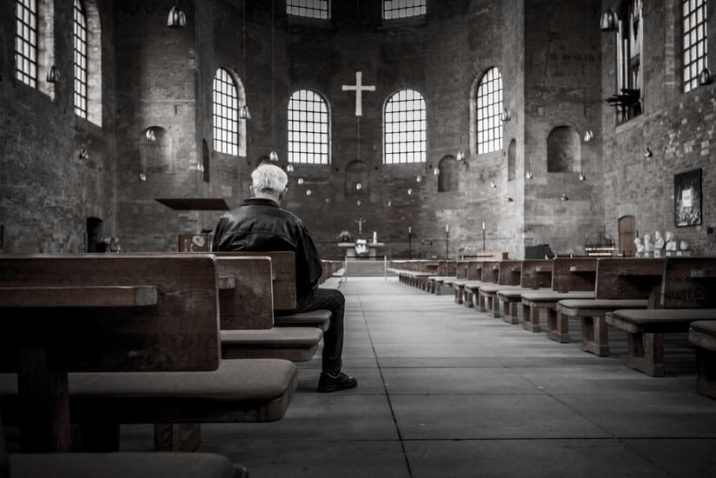
Keep On Praying For What’s Important (Romans 15:22-33)

Together We Pray, by Jerome White

This is why I have often been hindered from coming to you.

But now that there is no more place for me to work in these regions, and since I have been longing for many years to visit you, I plan to do so when I go to Spain. I hope to see you while passing through and to have you assist me on my journey there, after I have enjoyed your company for a while. 

Now, however, I am on my way to Jerusalem in the service of the Lord’s people there. For Macedonia and Achaia were pleased to make a contribution for the poor among the Lord’s people in Jerusalem. They were pleased to do it, and indeed they owe it to them. For if the Gentiles have shared in the Jews’ spiritual blessings, they owe it to the Jews to share with them their material blessings. 

So after I have completed this task and have made sure that they have received this contribution, I will go to Spain and visit you on the way. I know that when I come to you, I will come in the full measure of the blessing of Christ.

I urge you, brothers and sisters, by our Lord Jesus Christ and by the love of the Spirit, to join me in my struggle by praying to God for me. Pray that I may be kept safe from the unbelievers in Judea and that the contribution I take to Jerusalem may be favorably received by the Lord’s people there, so that I may come to you with joy, by God’s will, and in your company be refreshed. The God of peace be with you all. Amen. (New International Version)

Paul’s Intentions

It always had been the Apostle Paul’s intention to preach Christ in places where the name of Jesus was not known. He wanted all people everywhere to hear the good news of grace, forgiveness, and new life in Jesus Christ as the fulfillment of all God’s good promises.

Paul wrote a rather complicated historical and theological letter to the Roman Church. He specifically addressed their situation of both Jew and Gentile Christians worshiping together in one church. They were often divided and critical of one another.

Throughout his letter, the Apostle provided a solid apologetic for staying together on clear biblical and theological grounds. Paul also wanted them to work side-by-side in practical matters of ministry, which would help them learn to appreciate each other.

So, Paul intended on visiting them – hopefully sooner than later – to encourage them in the faith, and as a stop on the way to Spain. He longed to get to the farthest geographic point of the continent and make Christ known.

To that end, Paul made a concluding personal statement and emotional appeal to the entire Roman Church – Jew and Gentile alike – for their abiding prayerful support of his ministry and intentions.

Paul’s Prayer

For Paul, and from a New Testament perspective, prayer is the most necessary activity a believer can do. Prayer connects the divine and the human in meaningful dialogue, as well as connecting people to each other in a common purpose of seeking the Lord and knowing Christ.

The Apostle practiced what he preached. Paul continually prayed for the Roman Church and wrestled in prayer for all the believers. (Romans 1:9-12)

He specifically asked the believers to pray that he be rescued from unbelievers; and that his ministry in Jerusalem might be good and acceptable to the believers in that place. Paul took great pains to gather a collection throughout many of the churches he established, so that he could bless the needy persons in Judea.

Paul’s Longing

The Apostle Paul constantly sought and worked toward solidarity between the Christian Jews and converted Christian Gentiles. They were ancient enemies, and at the time of Paul’s writing the Roman Empire and their occupation created even more animosity between the two groups of people.

Paul longed for the world to see an alternative to such enmity. The Church is to be the one place on earth where there are no walls, no separations, no divisions. The Body of Christ is to be a place of unity, mutual encouragement, and sincere love for one another, without prejudice or favoritism.

Unity and the ability to work together in a shared purpose of gospel proclamation was a high value to the Apostle Paul. That’s because it was important to Jesus.

Christ’s Prayer of Unity

Stained glass of Jesus praying

My hope is that Christians will never lose sight of their Lord’s high priestly prayer, as recorded by the Apostle John:

“Holy Father, protect them by the power of your name, the name you gave me, so that they may be one as we are one…My prayer is not for them alone. I pray also for those who will believe in me through their message, that all of them may be one, Father, just as you are in me and I am in you. May they also be in us so that the world may believe that you have sent me. I have given them the glory that you gave me, that they may be one as we are one—I in them and you in me—so that they may be brought to complete unity. Then the world will know that you sent me and have loved them even as you have loved me.” (John 17:11, 20-23, NIV)

If this is the heartbeat of Jesus, then I submit that Christians everywhere ought to also pray this prayer, and work toward that which is important to Christ himself.

I am also keeping in mind that there is nothing automatic about prayer. Paul did not get all of his prayers answered the way he wanted. In fact, so far, neither has Jesus. Two-thousand years later, we are living in a fragmented and polarized world more than ever, even in Christianity between all sorts of different Christian traditions.

On the one hand, we can and ought to bemoan the situation of disunity and even outright animosity between people who confess the name of Christ. This needs to impel us forward by embracing the values of both Jesus and Paul.

On the other hand, there is reason to hope, knowing that the good news can and is making a difference throughout the world. We can be encouraged to keep on praying and to continue persevering in prayer.

The Apostle Paul envisioned a new society in which old enemies would become friends and co-workers around building a community of persons who are redeemed by Jesus and seek to live into his words and ways.

May it be so, to the glory of God. Amen.

Why Not Women? (Romans 16:1-16)

I commend to you our sister Phoebe, a deacon of the church in Cenchreae. I ask you to receive her in the Lord in a way worthy of his people and to give her any help she may need from you, for she has been the benefactor of many people, including me.

Greet Priscilla and Aquila, my co-workers in Christ Jesus. They risked their lives for me. Not only I but all the churches of the Gentiles are grateful to them.

Greet, also, the church that meets at their house.

Greet my dear friend Epenetus, who was the first convert to Christ in the province of Asia.

Greet Mary, who worked very hard for you.

Greet Andronicus and Junia, my fellow Jews who have been in prison with me. They are outstanding among the apostles, and they were in Christ before I was.

Greet Ampliatus, my dear friend in the Lord.

Greet Urbanus, our co-worker in Christ, and my dear friend Stachys.

Greet Apelles, whose fidelity to Christ has stood the test.

Greet those who belong to the household of Aristobulus.

Greet Herodion, my fellow Jew.

Greet those in the household of Narcissus who are in the Lord.

Greet Tryphena and Tryphosa, those women who work hard in the Lord.

Greet my dear friend Persis, another woman who has worked very hard in the Lord.

Greet Rufus, chosen in the Lord, and his mother, who has been a mother to me, too.

Greet Asyncritus, Phlegon, Hermes, Patrobas, Hermas and the other brothers and sisters with them.

Greet Philologus, Julia, Nereus and his sister, and Olympas and all the Lord’s people who are with them.

Greet one another with a holy kiss.

All the churches of Christ send greetings. (Romans 16:1-16, NIV)

The reason we have the “Captain Obvious” people in our lives, is that they simply point out something that is right under our noses we might miss. I’m playing the role of Captain Obvious. In today’s New Testament lesson are a group of women. Paul names, greets, thanks, and encourages several church leaders, and they are not all men:

  1. Phoebe is a deacon. She’s actually the representative who was sent to take Paul’s letter to the church at Rome and read it to the congregation.
  2. Priscilla is co-equal with her husband Aquila. Together they co-pastored a house church. She helped teach and mentor Apollos in Corinth.
  3. Mary
  4. Junia is an apostle. Paul states that she’s outstanding amongst them, of which also he is one.
  5. Tryphena and Tryphosa
  6. Persis is a dear friend of Paul.
  7. Julia

In the earliest church, within the New Testament Scriptures, women are mentioned as serving in every sort of capacity. And yet, women are the greatest and largest untapped resource in the church today.  

You might wonder why I would say such a thing, being that more women attend church than men. However, still in this day and age – removed 2,000 years from the biblical text – the reality for many churches around the world is that only men can hold positions of authority.  

The reasoning goes something like this: “The Bible says women can’t serve over men, so women can’t hold those positions.” Really?

So, a woman can serve as a CEO of a Fortune 500 company, can be elected as governor of a state, and can manage men on a factory floor, but that same woman cannot serve as an elder in many churches? I once asked a pastor that very question, and he answered with “Yes, because the Bible says so.”

I guess he never read Romans 16.

If you are of the belief that a church office is based on gender instead of the calling and gifting of the Spirit, then, methinks, it behooves us to ask these questions of the biblical text:

  • If women are not to exercise authority over men in the church, how do we account for actual women leaders in the Bible, such as Deborah, Huldah, Philip’s daughters, Priscilla’s role in Apollos’ life, not to mention the list of women leaders in Romans 16?  If our impulse is to say that these are exceptions because there were no men to “step up,” then what does that say about our theology? Is God not big enough to find a man to put into a position of leadership?
  • If we insist that women ought not to teach and be silent based on Paul’s letter to Timothy (1 Timothy 3:11-15) then why do we ignore Paul’s instruction that women are to publicly prophecy and pray? (1 Corinthians 11:5; Acts 21:9)
  • Doesn’t the prominence of women in the ministry of Jesus and Paul suggest something different than just having women tag along to teach children?
  • Just when does a boy become too old for a woman to legitimately teach him?  If women can’t teach men, why in the world would we ever think that they are the best teachers for boys?
  • How can we apply Galatians 3:26-28 (there is no male or female in Christ)? Are women the exception?
  • Does the Reformation doctrine of the priesthood of all believers only apply to men?  Doesn’t the absence of women in church leadership go against this?
  • Isn’t it weird and confusing that women have an equal vote in congregational decisions, even when a male leader is being elected and/or disciplined, when they aren’t supposed to exercise authority?

I could go on, but I think you get the picture; the absence of women in leadership is problematic, at best. It’s a problem because there are actually women leaders in the Bible. So, here is my unabashed, dogmatic, and biblical belief:  

All individuals are equally created in God’s image, and, therefore, have equal worth, privilege, and opportunity in Christ’s Church without any limitation, including gender.

In some churches and Christian denominations today, there are far too many wonderful Christian women who are exhausted and depressed because they are trying to live up to a certain expectation of being someone they are not. They suppress their gifts and calling because they believe they must prop-up the fragile male egos around them.  

They aren’t free to serve in leadership positions; and it’s eating them from the inside-out. These women think there is something wrong with them, but the reality is that there is something wrong with the whole system of male-only authority. And, what’s more, we are missing out on the blessing of God. It is high time we value all women, even those with gifts of leadership, by allowing them to serve without limitation.

I have a wife and three daughters. All of them are more intelligent, more gifted, and better leaders than me, the lone family male. To have them using their superior talents in the church by leading and serving is the least threatening thing to me on this earth. I love it that they can outdo me; it is my joy!  

Even more than that, I believe it is Christ’s joy, as well. We must be proactive in cultivating and nurturing the gifts and calling we see in women. They don’t need to be put in their place; instead, the good-old-boy system of the church needs to be put in its place so that men are practicing a leadership that sacrifices on behalf of making women’s leadership a priority.

Lord God, bless all women who daily strive to bring peace to their communities, their homes and their hearts. Give them strength to continue to turn swords into ploughshares. We pray for all women who face prejudice, inequality and gender disparities. Help us to see and to face the discrimination against women in all the many forms it may take.

Forgive all women and men who let differences breed hate and discrimination. Let your example of valuing all of creation help us to see that we are equal partners in the stewardship of your world. Help us to see the strength and goodness in all women and men. Amen.

Stop Passing Judgment on Each Other (Romans 14:13-5:2)

Therefore let us stop passing judgment on one another. Instead, make up your mind not to put any stumbling block or obstacle in the way of a brother or sister. I am convinced, being fully persuaded in the Lord Jesus, that nothing is unclean in itself. But if anyone regards something as unclean, then for that person it is unclean. If your brother or sister is distressed because of what you eat, you are no longer acting in love. Do not by your eating destroy someone for whom Christ died. Therefore do not let what you know is good be spoken of as evil. For the kingdom of God is not a matter of eating and drinking, but of righteousness, peace and joy in the Holy Spirit, because anyone who serves Christ in this way is pleasing to God and receives human approval.

Let us therefore make every effort to do what leads to peace and to mutual edification. Do not destroy the work of God for the sake of food. All food is clean, but it is wrong for a person to eat anything that causes someone else to stumble. It is better not to eat meat or drink wine or to do anything else that will cause your brother or sister to fall.

So whatever you believe about these things keep between yourself and God. Blessed is the one who does not condemn himself by what he approves. But whoever has doubts is condemned if they eat, because their eating is not from faith; and everything that does not come from faith is sin.

We who are strong ought to bear with the failings of the weak and not to please ourselves. Each of us should please our neighbors for their good, to build them up. (New International Version)

It’s one thing to have opposing views with each other; it’s another thing altogether to pass judgment on the person(s) for whom you have a difference of opinion, practice, or theology.

I once had a man come to me about his daughter. She was getting married, and this father told me he was not going to her wedding. The issue? The father had raised his daughter a Christian, yet she had become a Wiccan and was going to have a pagan ceremony.

What would you do if you were the father? What would you say to him if you were the pastor?

I’m confident what most of my fellow Christian pastors would say – they would affirm the man’s position. Me, however, sensed some judgmentalism emanating from my parishioner. So, I asked him some questions:

What do you know about Wicca?

Why did your daughter convert to being a Wiccan?

Do you have a decent relationship with her?

How much do you love your daughter?

Do you think you could find a way of being with her when she gets married that doesn’t compromise your convictions?

As I asked the questions to the father, it quickly became evident that he was condemning her without a shred of evidence or accurate information to support such a judgment.

He believed that Wiccans were blatant devil worshipers (which they are not). So, I simply invited him to learn some basics of Wicca. I pointed him to some resources that might be helpful for him – ones that I believed he could be okay with reading. (Note: The resources were not written by Christians. If one wants to know what a particular group or individual believes, then you must go to the source)

The man had no idea why his daughter turned Wiccan. It turns out, he had never even asked her, or was at all curious as to why she would make such a different religious decision from her upbringing. I simply suggested that he just ask her, then not talk, and listen to the answer.

This father had an estranged relationship with his daughter because he had pulled away from her. She had actually continued to try and remain connected to her dad. But the man thought he was doing the right thing by ostracizing her and refusing to go to her wedding. He believed he needed a separation, to both teach her a lesson and to keep away from evil.

My parishioner, whom I had never seen cry, did so when I asked if he loved his daughter. The problem was that she didn’t know that.

There was a lot of internal struggle with the man in the next weeks and months. To his credit, he took me up on learning about his daughter and connecting with her, rather than cutting her off. And he ended up attending her wedding, albeit in the very back of the gathering.

The father discovered a lot of things he didn’t know, things which he made assumptions about in the past which were untrue and unfounded. He and his daughter’s relationship didn’t change overnight, but they were in a much better position than when the man first came to see me.

So, here is my question for you, my friend: If a Christian and a Wiccan can find a way to be together and love one another, despite their religious views and practices, then how much more can we, as Christians together, find ways to connect with each other, love one another, and stop passing judgment on the other?

It’s time for us to make up our minds and settle in our hearts whether we are going to create separations with other people, or whether we are going do what we can to foster relational connections with others.

Perhaps if we seek to embody today’s New Testament lesson, the ripple effect might just change the world.

O Holy God, we know we have fallen short.
We turn our backs when we could embrace.
We remain silent when we could speak.
We speak when we could listen.
We judge when we could seek understanding.
We cling when we could give.
Forgive us, O God, for focusing solely on ourselves and help us to continue to grow into the people you created us to be, through Christ our Lord. Amen.

Dealing with Opposing Views (Romans 14:1-12)

Accept the one whose faith is weak, without quarreling over disputable matters. One person’s faith allows them to eat anything, but another, whose faith is weak, eats only vegetables. The one who eats everything must not treat with contempt the one who does not, and the one who does not eat everything must not judge the one who does, for God has accepted them. Who are you to judge someone else’s servant? To their own master, servants stand or fall. And they will stand, for the Lord is able to make them stand.

One person considers one day more sacred than another; another considers every day alike. Each of them should be fully convinced in their own mind. Whoever regards one day as special does so to the Lord. Whoever eats meat does so to the Lord, for they give thanks to God; and whoever abstains does so to the Lord and gives thanks to God. For none of us lives for ourselves alone, and none of us dies for ourselves alone. If we live, we live for the Lord; and if we die, we die for the Lord. So, whether we live or die, we belong to the Lord. For this very reason, Christ died and returned to life so that he might be the Lord of both the dead and the living.

You, then, why do you judge your brother or sister? Or why do you treat them with contempt? For we will all stand before God’s judgment seat. It is written:

“‘As surely as I live,’ says the Lord,
‘every knee will bow before me;
    every tongue will acknowledge God.’”

So then, each of us will give an account of ourselves to God. (New International Version)

Within the church at Rome were Jewish believers who had come to faith in Christ from their background steeped in the Old Testament. They had a rich two-thousand year history of a covenant with God that included ritual food laws, the keeping of certain feast days, and observing a calendar of events, especially the Sabbath.

Also within the Roman church were Gentiles (non-Jewish people) having come to faith in Christ from a background of paganism. They had no history with the God of the Bible. There were no previous generations of faithful believers in God. They were first generation Christians and basked in their newfound freedom.

The Apostle Paul’s vision was for one church, unified together around Jesus. And this unity would need to be worked on. Jew and Gentile were very different from one another; and here they were in the same church together, not understanding each other. 

The Jewish believers were appalled at Gentile thinking and behavior. Even though the Jewish Christians had come to embrace Jesus, they did not abandon their two-thousand year history of being with God. They still held to their food laws and special days. The Jewish members believed the Gentiles should be like them; the Jews wanted the Gentiles to embrace the same ritualistic behavior that they had done for centuries.

But the Gentiles did not comply. So, the Jewish believers passed judgment and condemnation on them for not being sensitive to the things of God.

On the other hand, the Gentile believers felt no compulsion to have such rules and regulations concerning their Christian lives. They ate what they pleased and saw no need to hold to special days. They could not understand why the Jewish Christians were so stuck in their traditions. So the Gentiles looked down on the Jews as hopelessly misguided. This was a potentially explosive situation that Paul was deeply concerned about.

The Apostle Paul’s message was to accept the person whose faith is weak without passing judgment on disputable matters. Sounds like easy counsel to follow. But the problem was that the people did not distinguish between what is a non-negotiable matter and what was a disputable matter. 

The guiding principle is that Christ died and returned to life so that he might be the Lord of both the dead and the living. The non-negotiable matter is Jesus Christ, his person and work.  Jesus is our core belief. Nothing else is to be in the center except him.

Therefore, we are to celebrate our unity around Jesus, our center. Anything outside of that center is a “disputable matter” and not worthy of Christians condemning each other or looking down on one another.

The root problem of any church conflict is the de-throning of Jesus and setting up our particular views as the center of Christianity.

The church has struggled with this teaching for its long two-thousand year history. Every church I have served had their particular issues that they felt so strongly about that it crowded Jesus out of the center. 

In one church, education was the big issue. Some believed in Christian schools as the only way to educate their kids. Others felt that home-schooling was the way to go because of the culture. Yet others thought public education needed the light of Christians participating in it, and sent their kids to public schools. The problem was that each group sincerely believed they were right and everyone else was wrong.

In another church I served, there were hard feelings about the place of men and women in the church who had been divorced and remarried. In yet another church, the issue was about whether church members could drink alcohol or not. And yet another church’s issue dealt with how we dress and what our attire is at church. 

I still remember one lady in that church talking with a woman who had recently given her life to Christ out of a life of prostitution. The woman was wearing jeans and a t-shirt. The church lady was giving her a lecture about how she should be “dressing up for Jesus.” As I heard this, I thought to myself, “Lady, I’m not sure you are going to like the woman’s idea of dressing up for Jesus….”

Whenever we want to place disputable matters on people’s “must-do” list, then there will be trouble. We will judge others who do not think as we think, and do as we do, because of the mistaken notion that our way is equal to the death and resurrection of Christ. If it isn’t done my way, the church will be lost.

We do not necessarily need to change our views on disputable matters; but we do need to change our attitude and our behavior toward those we disagree with.

Intolerance of others’ views and behaviors causes a lack of dialogue, to create special interest groups and cabals against others, to stereotype others, and to seek to get their way no matter what. Such intolerance moves church members from a concern for the Great Commission of Jesus to the Great Commode of Satan’s bathroom.

For the Apostle Paul, the issues that divide Christians are very important, not because he championed one over the other, but because the church’s identity was at stake. Paul was concerned for two questions:

  1. Will the church be, at its core, a community of redeemed persons by the grace of God who center all their lives around the person and work of Jesus?
  2. Or will the church be a community of opinionated individuals and groups all jockeying for position to have their way on how they believe things should go?

This is really a heart issue: humility versus pride, and gentleness versus stubbornness. You can tell what a person’s identity is by their “identity markers.”

For the Jewish Christians, Sabbath-keeping, circumcision, food laws, and holding to certain days on the calendar marked their identity as God’s people. Those issues were so important that if you took them away, there would be an identity crisis; the people felt totally lost without their traditions.

For Gentile Christians, their identity was built around being more free-thinking. So, if you take away their freedom and ability to choose, the Gentiles will go nuts and have an identity meltdown. 

Paul’s answer was for both Jew and Gentile to accept each other and build their unity around Jesus, period. They needed to be sensitive to one another and focus on their shared identity of Jesus as the center of the Christian life.

Both the church and the society need some civility. In a nation where we feel free to say whatever we want, we do. In doing so, we elevate self-expression and our opinions over self-control and the mission of the church.

We need some generous spaciousness which allows room for us to discuss issues and disputable matters in an atmosphere of generosity, hospitality, and acceptance, seeking to first listen and understand, before responding. 

The goal of the Christian is not to win an argument or have our way, but to uphold Jesus as Lord of everything and maintain our center in him. On that basis alone, we will be held accountable by God. So, let us live wisely and well, knowing and pursuing Jesus with heart, soul, mind, and strength.

Gracious God, it’s both settling and centering to focus on the assurance of your acceptance. You know everything about us, and despite our failures, fickleness, foolishness, and faithlessness, yet still we are fully and eternally accepted. As you have accepted us, help us to accept others. Grant us grace to love those whom we disagree with.

Merciful and mighty God, enlarge our hearts. Enable us to show kindness without compromising our convictions. Teach us the difference between essential and non-essential matters. Free us from the limitations of our individual perspectives, the prejudices of our heritage, the insecurities of our comfort zone, insincere niceness,and the need to be right. 

Blessed Holy Spirit, burn your holy Word indelibly into us so that we accept all things and everyone you give us, through Jesus Christ our Lord. Amen.