The Illness of Our Era: What Is It?

Anxiety, by James Callaghan

Our contemporary society focuses primarily on a functional existence. In our pragmatism, we care a great deal about production, the things we can do and produce; and we are attentive of how we appear to others. Western culture is enamored with all things of the outer person that others can see, touch, hear, smell, and taste with physical senses.

The outer person is important. The way in which we present ourselves to the world does have meaning and significance. Yet, so does the inner person.

The Inner Person

I believe the inner person, the true self, the soul, is just as vital, if not more, than the outward displays we give to others. On the inside is where our motives and intents come from. The core of self is of utmost importance; it is the place where our inherent worth is found.

Being aware of this inner person (which I use interchangeably with “soul” and “true self”) gives us a guide for ordering our outer self – our activities, work, and relationships.

If we are unaware of what’s happening deep within us, or pay little to no attention to the soul, our outer person becomes a false self. A gross disconnect then occurs between how we think and feel within, and what we choose to display for everyone.

In paying attention to the inner person, we will likely find that there is a lot of anxiety within us. Anxiety may even transform itself into a despair of self and/or the world.

The Anxiety Within

This anxiety, however, is not all bad. It certainly can lead us to a struggle with life, an experience of strained relationships, and a crippling fear of what will happen. Yet it can also help us become in touch with the soul, and enable us to gain an awareness of what is happening within and what to do about it.

It is my firm understanding and unshakable conviction that if we are to learn anything at all about healthy functioning in this world, it must begin with learning about one’s self – the true self, the inner person, the soul.

Knowing Ourselves

“Without knowledge of self, there is no knowledge of God.”

John Calvin, Institutes of the Christian Religion, Vol.1

As we commit ourselves to the journey within, we come to discover our place in the cosmos, and the image of God that is inherent in us. We come to know ourselves as integral to creation.

If we never gain this sense of humanity and of the divine, then we lose our special perspective on reality, and of the vital interconnectedness we have with God and others. Separateness then replaces the unity and oneness which exists. As a result, the person lives without a sense of their true place or function in this world.

Feelings of isolation and estrangement take over. This profound experience of disconnection with God, people, and even self creates a powerful sense of anxiety. Fear becomes a dominant theme. Unconscious emotions and desires drive the anxious person. A belief that my conscious self is all there is to me is a path of denial that leads to abject misery.

Knowing ourselves – before we know anything else – must be our pursuit. Failure to do this is perhaps why we live in such an era of worry, pessimism, and fear.

Addressing Our Fears

Have you ever felt that there is no one to whom you could turn to in your time of loneliness and despair?

Is there a time when you felt as if you were in a deep dark hole of quiet anxiety?

Did you ever brood over your situation in life so much that all of your courage melted like ice cream on a 100 degree day?

Was there a season in your life where you felt the world could not understand your grief?

Has God ever felt aloof to you, with your prayers seeming as if they were bouncing off the ceiling?

Depending upon who we are, the self believes that if I am right enough, help enough, achieve enough, unique enough, know enough, plan enough, party enough, lead enough, or withdraw enough, then I will relieve this bothersome anxiety and fear within me and can get on with life.

Others may seek solace in the finite things of this world. But that approach only exacerbates the existing problem. Believing that freedom from an ethereal illness can come by having more of something you can see only increases the despairing feelings.

Any sickness of the soul must be addressed by means of infinite resources.

The Need For Integration

If we lose ourselves, we are fragmented and in need of integration. The work needed is to bring our spiritual internal parts into a unified whole. This then puts us in a position to experience the grace and peace of God. Indeed, the process itself becomes the divine mercy and settled rest.

We tend to hold onto what we are afraid of experiencing. This very problem often becomes the solution. Our anxiety has the potential to lead us toward the grace of God, or away from it by self-conjured solutions and/or coping mechanisms.

Rather than holding our anxieties and fears close so that we can keep an eye on them, we need to let go of them. This is accomplished by actually feeling our feelings. By holding our emotions loosely, they can express themselves and then fly away.

If we never experience anxiety, worry, discouragement, fear, depression, or despair, then we internally see no reason whatsoever to pursue transformation of life – to go after that which is immortal and invisible.

The Apostle Paul’s Struggle

At the end of a frustrating litany of anxiety over his inability to control the trajectory of his inner self, the Apostle Paul concluded:

So I find it to be a law that, when I want to do what is good, evil lies close at hand. For I delight in the law of God in my inmost self, but I see in my members another law at war with the law of my mind, making me captive to the law of sin that dwells in my members. Wretched person that I am! Who will rescue me from this body of death? Thanks be to God through Jesus Christ our Lord! (Romans 7:21-25, NRSV)

Sin presupposes itself through anxiety. And anxiety awakens the awareness of needing freedom and deliverance. Worry is not our master. Anxiety has no authority over us. Fear merely exists for us to pay attention to something.

In Christianity, that something is a someone: Jesus. Christ is the Deliverer from sin, death, and hell. The oblivious and lonely darkness we find ourselves trapped within has a way out, or rather, up. A divine hand reaches from above to snatch us from our inky hole.

If humanity never had a need of God, people would not know themselves. They would fail to realize that there is immortality in their very souls.

Taking the Journey Within

It takes bravery to engage in a journey within, down into the core of one’s being. It’s neither a vacation nor a weekend adventure. The path unfolds slowly over time; it is circuitous, and often frustrating. Yet, when we find the incredibly bright blue diamond at the center, we immediately know every part of the journey was worth it.

The illness of our era is that we are soul-sick with anxiety, even despair, and most of us don’t know it. But why?

Like a cancer lurking unaware within the body, the years of ego construction has smothered the image and likeness of God within.

Anxiety becomes the initial symptom that something is askew with us. We’d better get checked out and find what the root problem is.

Are you up for the discovery of yourself, and thus, of God?

The Struggle Within (Romans 7:15-25)

I do not understand what I do. For what I want to do I do not do, but what I hate I do. And if I do what I do not want to do, I agree that the law is good. As it is, it is no longer I myself who do it, but it is sin living in me. For I know that good itself does not dwell in me, that is, in my sinful nature. For I have the desire to do what is good, but I cannot carry it out. For I do not do the good I want to do, but the evil I do not want to do—this I keep on doing. Now if I do what I do not want to do, it is no longer I who do it, but it is sin living in me that does it.

So I find this law at work: Although I want to do good, evil is right there with me. For in my inner being I delight in God’s law; but I see another law at work in me, waging war against the law of my mind and making me a prisoner of the law of sin at work within me. What a wretched man I am! Who will rescue me from this body that is subject to death? Thanks be to God, who delivers me through Jesus Christ our Lord! So then, I myself in my mind am a slave to God’s law, but in my sinful nature a slave to the law of sin. (New International Version)

We can relate to the Apostle Paul. We, along with him, have said to ourselves many times, “I don’t understand why I act the way I do. I don’t do what I know is right. I do the things I hate.” 

Paul’s experience of uneasiness, his existential angst because of the struggle within, is a timeless description of our common human condition. There are times we seem completely unable to follow our conscience and do what’s right. It can be maddening, even to the point of experiencing a continual low-level discouragement or depression which underlies almost everything we do.

The prescription for dealing with this mental, emotional, and spiritual malady does not include the law. That’s right. Putting our willpower and effort into obeying commands gets us nowhere. Even if we obey laws and rules and commands for a time, our efforts eventually break down. We fail to do what we want, and end up doing just the opposite.

In all fairness, the law is good, not bad; it just doesn’t have the capacity to transform us. The law’s purpose is to show us how bad off we really are in this world, to give us an awareness of our true condition, so that we will seek help. 

We humans are a bundle of contradictions, doing good, then bad, and flip-flopping back and forth – all with great frustration. In such a miserable condition, what then shall we do? Who will help us? Is there anyone to save us from our plight?

Sheer willpower and obedience will not help us; it won’t work. It will only give us a false hope. Any success in using willpower only deludes one into believing they have the answer… until they yet fall again into the pit of their own inner darkness. But the good news is that there is a Savior, a Redeemer, a Rescuer who has the will and the power to deliver us from our predicament.

The grace of God in Christ is the operative power that changes lives, not the law. Freedom from the tyranny of our “should’s” and our misplaced desires comes from Christ’s forgiveness through the cross. 

Like a lover enamored with his beloved, our desires become oriented toward Jesus for his indescribable gift to us. That is the strength of grace. Transformation is relational; it is found in a person, not a program. And the only person and relationship which has the ability to change us is, I believe with all my heart and mind, the Lord Jesus Christ.

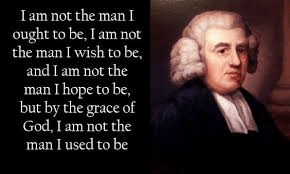
Why? Because I myself have been transformed and changed by such a relationship with Christ. I, along with the hymn writer John Newton, can say, “I once was lost but now am found, was blind but now I see.”

“Self-help” for all the good it really can do, is in many ways an oxymoron. We need a Savior to help us, and we need a community of people who encourage us. And even if we can do it ourselves today, that may not (and eventually will not) be true of us tomorrow. None of you got this far in life on your own – and you will continue to need God and others going forward.

Love must be completely sincere. Hate what is evil, hold on to what is good.Love one another warmly as Christians, and be eager to show respect for one another. Work hard and do not be lazy. Serve the Lord with a heart full of devotion. Let your hope keep you joyful, be patient in your troubles, and pray at all times. Share your belongings with your needy fellow Christians, and open your homes to strangers. (Romans 12:9-13, GNT)

We have an incredible capacity for good and vast internal resources within us. And yet, we too often lack awareness of this reality, for which we can tap into. When it comes to an outright metamorphosis, we need a new heart – and we can no more simply decide to change our lives any more than we can perform heart transplant surgery on ourselves.

People need the Lord.

Whenever the foundation of a house is about to crumble, it won’t do to rearrange the living room furniture and do a bit of spruce up painting. We deceive ourselves if we believe that all our efforts at landscaping the property and having a great curb appeal will do the trick. If the foundation crumbles, and the house implodes, all efforts at curb appeal won’t matter.

Jesus is our cornerstone. Without him, we are at risk, about to fall and without hope. With him, true restoration and renewal happens. And then, when the house is repaired and in order, we set about the task of being good stewards and maintaining and caring for the wonderful changes which were made.

Freedom from a dilapidated soul and misplaced energies to consistent times of peace and contentment, calmness and confidence, satisfaction and settled peace, comes by growing ever closer to the Savior who exudes all those qualities, and more. For the Lord not only saves and delivers; he also sanctifies and encourages.

In Christ, the uneasiness and unsettling experience – the existential angst – becomes a thing of the past because of the grace of merciful deliverance and continual help.

Saving God, I thank you for delivering me from sin, death, and hell through your Son, the Lord Jesus. May your Holy Spirit apply the work of grace to my life every day so that I can realize practical freedom from all that is damaging and destructive in my soul. Amen.

People Are a Bundle of Contradictions (Romans 7:7-20)

“Contradictions” by Michael Lang, 2015

But I can hear you say, “If the law code was as bad as all that, it’s no better than sin itself.” That’s certainly not true. The law code had a perfectly legitimate function. Without its clear guidelines for right and wrong, moral behavior would be mostly guesswork. Apart from the succinct, surgical command, “You shall not covet,” I could have dressed covetousness up to look like a virtue and ruined my life with it.

Don’t you remember how it was? I do, perfectly well. The law code started out as an excellent piece of work. What happened, though, was that sin found a way to pervert the command into a temptation, making a piece of “forbidden fruit” out of it. The law code, instead of being used to guide me, was used to seduce me. Without all the paraphernalia of the law code, sin looked pretty dull and lifeless, and I went along without paying much attention to it. But once sin got its hands on the law code and decked itself out in all that finery, I was fooled, and fell for it. The very command that was supposed to guide me into life was cleverly used to trip me up, throwing me headlong. So sin was plenty alive, and I was stone dead. But the law code itself is God’s good and common sense, each command sane and holy counsel.

I can already hear your next question: “Does that mean I can’t even trust what is good [that is, the law]? Is good just as dangerous as evil?” No again! Sin simply did what sin is so famous for doing: using the good as a cover to tempt me to do what would finally destroy me. By hiding within God’s good commandment, sin did far more mischief than it could ever have accomplished on its own.

I can anticipate the response that is coming: “I know that all God’s commands are spiritual, but I’m not. Isn’t this also your experience?” Yes. I’m full of myself—after all, I’ve spent a long time in sin’s prison. What I don’t understand about myself is that I decide one way, but then I act another, doing things I absolutely despise. So if I can’t be trusted to figure out what is best for myself and then do it, it becomes obvious that God’s command is necessary.

But I need something more! For if I know the law but still can’t keep it, and if the power of sin within me keeps sabotaging my best intentions, I obviously need help! I realize that I don’t have what it takes. I can will it, but I can’t do it. I decide to do good, but I don’t really do it; I decide not to do bad, but then I do it anyway. My decisions, such as they are, don’t result in actions. Something has gone wrong deep within me and gets the better of me every time. (The Message)

“Contradictions in human character are one of its most consistent notes.”

Muriel Sparks, “Loitering with Intent”

The Apostle Paul’s vulnerable expression of his dilemma resonates deeply with many people. There are times when we say things to ourselves such as:

“I told myself I wasn’t going to be like my mother, and here I am responding just like she would.”

“I know better than to drive by the liquor store on my way home and pick up a pint of vodka, yet, I still did it.”

“I don’t want to die, but my thoughts keep racing about a plan for suicide.”

There are many situations in which we are both frustrated and befuddled by doing the things we do not want to do, and not doing the things we want to do.

Yes, indeed, Paul’s existential angst is a timeless description of our common human condition. We all can relate to the seeming inability to do what is right in so many situations. It can drive us nuts, even to a constant and never-ending low-level discouragement that underlies almost everything we do.

Paul’s prescription for dealing with this does not rely on law. He understood that putting our willpower and effort into obeying commands gets us nowhere, because we will eventually fail. Neither our brains nor our spirits work that way. Our willpower was never designed to be the driver of what we do and do not do. If anything, willpower, and the lack thereof, demonstrates just how much we are climbing the ladder on the wrong wall.

People are a bundle of contradictions, doing good, then bad, and flip-flopping back and forth with great frustration.

God’s law was not crafted to transform us from the inside-out. The law has three solid purposes, none of which are meant to bring deep personal transformation:

  1. Attention to the law works to restrain sin in the world
  2. Use of the law provides us with a helpful guide for grateful living in response to divine grace
  3. Reflection on the laws show us how bad off we really are in this world, and how much we are in need of forgiveness

We need a change of habits, and this is different than adopting a list of laws.

Habits are developed from our desires, our affections. In other words, we do what we love – more specifically, our ultimate love(s) drive us to do what we want. To put it in a more straightforward way:

We sin because we like it. And the path to overcoming any besetting sin is to have an ultimate love surpass the lesser sin which we like.

For example, I have developed daily habits or rituals of faith which enable me to commune with God. I love God with all my heart, soul, mind, and strength, and this ultimate love enables me to push out all competing gods who want my devotion. I also love my wife with all my heart. We work on developing habits of a marital relationship which reinforce our love for each other. Love is what drives me to do right and good by her.

So, what do we do when we mess up? For the Christian, no matter what the question is, the answer is always grace.

God’s grace in the finished work of Jesus Christ applied to us by the Holy Spirit is the operative power that changes lives. The law has no power to do that kind of work. Freedom from the tyranny of our misplaced desires and disordered loves comes from Christ’s forgiveness through the cross. Like a lover enamored with his beloved, our desires become oriented toward Jesus for his indescribable gift to us. That is the strength of grace.

Saving God, I thank you for delivering me from sin, death, and hell through your Son, the Lord Jesus. May your Holy Spirit apply the work of grace to my life every day so that I can realize spiritual healing and practical freedom from all that is damaging and destructive in my soul. Amen.

Free to Live a New Life (Romans 7:1-6)

You shouldn’t have any trouble understanding this, friends, for you know all the ins and outs of the law—how it works and how its power touches only the living. For instance, a wife is legally tied to her husband while he lives, but if he dies, she’s free. If she lives with another man while her husband is living, she’s obviously an adulteress. But if he dies, she is quite free to marry another man in good conscience, with no one’s disapproval.

So, my friends, this is something like what has taken place with you. When Christ died he took that entire rule-dominated way of life down with him and left it in the tomb, leaving you free to “marry” a resurrection life and bear “offspring” of faith for God. For as long as we lived that old way of life, doing whatever we felt we could get away with, sin was calling most of the shots as the old law code hemmed us in. And this made us all the more rebellious. In the end, all we had to show for it was miscarriages and stillbirths. But now that we’re no longer shackled to that domineering mate of sin, and out from under all those oppressive regulations and fine print, we’re free to live a new life in the freedom of God. (The Message)

The goal of salvation is to be delivered from oppressive bondage so that we are free to live a true and beautiful life – a holy life, set apart for good.

Romans chapters 6-8 are the Apostle Paul’s pointed discussion of how we become holy in a real and practical way. The theological word we typically use for this is “sanctification,” which means “to become holy,” and “set apart” for God. To be delivered from sin, death, and hell through the person and work of Jesus Christ is not the end of the story; it is just the beginning.

Becoming holy and good in our everyday lives boils down to this: identity and belonging.

One of the healthiest ways of looking at the entirety of the Bible’s message is that we belong to God. Our identities are thoroughly wrapped around Jesus. The process of realizing this, and coming to grips with it, is how we grow as people in holiness and righteousness.

Because of Christ’s finished work on the cross, we have been delivered from the realm of sin. Our change in status from condemned to accepted provides us the awareness to make daily affirmations of faith and live a new life.

Yet, the sinful nature (flesh) or the old person is still there. Although it is now toothless, our past can, and may often, exert a powerful influence on us. Even though there is a medium-rare T-bone steak on the table for us to enjoy, there are times we go back to the old bologna sandwich with stale white bread.

We no longer need to fall short of our true humanity. That’s because we belong to God. We are adopted into God’s family, having been orphaned by sin’s cruel influence.

However, just because we have been saved from the power of sin, sin itself is not extinct. We still must deal with it. We are alive to God and need to take up this great spiritual reality and live into it, for the force of sin still exerts a powerful influence in the world.

We deal with sin’s continued presence (the world, the flesh, and the devil) through embracing God’s grace versus trying to overcome it with the law.

Paul used an illustration from marriage to expand our understanding of grafting grace into our daily lives. By law, a married woman is bound to her husband (keeping in mind this sense of belonging was the predominant view of marriage in the Apostle’s day). But if the husband dies, the wife is released from the legal marriage. If she were to give herself to another man while her husband is still alive and they are married, then she becomes an adulteress. However, if she is a widow, then marries again, she is not an adulteress.

Paul applies this understanding to our relationship with the law. Death has separated us from the law. We died with Christ. Therefore, we have been set free from the law and have become alive to grace. As believers in Jesus, God’s grace and love changed our lives:

  • We now “belong to another, to him who was raised from the dead.” (Romans 7:4)
  • “When Christ’s body hung upon the cross, when God spared not his own Son but gave him up for us all.” (Romans 8:32)
  • “Christ took on himself for us all the curse of the law which inflicted all of us.” (Galatians 3:13)
  • We died to the law. God’s grace has made the death of Jesus the death of all from the realm of sin. (2 Corinthians 5:14)

As a married man, let me use Paul’s illustration to get down to the gist of his teaching. Yes, I am legally married and belong to my wife. I made vows to my wife on our wedding day which bind me legally to do what I said I would do. Yet, if I fulfill those vows in a strictly legalistic manner, I can vouch for my wife that this would not qualify as an acceptable situation for her. You see, my wife (and, me, too!) are freely bound to one another in love and grace. I care for my wife because I love her deeply, and not because it is my legal duty to do so.

The Christian life was neither designed nor meant to serve as a bare legal contract or covenant between us and God. God forbid such a thought! Jesus died to clear us from all the legality stuff so that we could freely love and serve God with joyful abundance and gratitude.

I am follower of Jesus because I love him deeply. What impels and motivates me is God’s grace. The law is there and has its place. However, it is not the law that causes me to be a Christian; it is the love of Christ which saved me from myself and compels me to live like Jesus.

May the God of peace make you pure, belonging only to him. May your whole self—spirit, soul, and body—be kept safe and blameless when our Lord Jesus Christ comes. The one who chose you will do that for you. You can trust him. Amen.