Accept One Another (Romans 15:7-13)

Christian Unity, by Gisele Bauche

Accept one another, then, just as Christ accepted you, in order to bring praise to God. For I tell you that Christ has become a servant of the Jews on behalf of God’s truth, so that the promises made to the patriarchs might be confirmed and, moreover, that the Gentiles might glorify God for his mercy. As it is written:

“Therefore I will praise you among the Gentiles;
    I will sing the praises of your name.”

Again, it says,

“Rejoice, you Gentiles, with his people.”

And again,

“Praise the Lord, all you Gentiles;
    let all the peoples extol him.”

And again, Isaiah says,

“The Root of Jesse will spring up,
    one who will arise to rule over the nations;
    in him the Gentiles will hope.”

May the God of hope fill you with all joy and peace as you trust in him, so that you may overflow with hope by the power of the Holy Spirit. (New International Version)

Anyone who desires to follow the pattern of Christ, actively seeks and promotes the acceptance of one another.

Jesus is the Christian’s model: Christ did not seek to be served, but to serve, and give himself for the benefit of others. The ministry of Christ was meant for the whole world, and not just for some persons. Christ’s mission and ministry included non-Jews, and not only his own Jewish people.

The person and work of Jesus Christ confirmed the promises made to the original Jewish patriarchs of Abraham, Isaac, and Jacob. Jesus did nothing brand new; he was simply upholding and actively seeking to accept Gentiles and bring them to God. This has always been true of God’s plan and purpose – which is why the Apostle Paul cited four different Old Testament passages.

All four references are to the Gentiles, to non-Jewish persons. And this is why Paul himself had a ministry to Gentiles. The biblical verses mentioned by the Apostle include Gentiles who offer praise to God; Gentiles engrafted alongside Jews as God’s people; and Gentiles who put their hope in the root of Jesse, the Messiah.

The good news of Jesus Christ is an inclusive – not exclusive – message. Thus, Christian ministry is designed to include others, to bring them into the fold of those who are redeemed by God.

Christian community is made up of all kinds of people from every race and ethnicity – without exception, and without favoritism.

The Apostle Paul made it clear to the Roman Church of both Jew and Gentile that his bedrock Christian ethic was one of inclusion and care for others. He supported his ethical understanding from Holy Scripture.

Paul was concerned that the Church include all sorts of Christ followers who may have some differing understandings and practices in living out their own Christian faith.

The Body of Christ is designed and meant to be big enough, strong enough, and resilient enough to handle all sorts of people who together want to follow Christ and serve others, like Jesus did.

The Apostle’s prayer is one of hope, having everyone in the church be accepting of one another. Paul wanted all Christians to work and worship together as the one people of God who live according to the pattern of Christ.

The Christian model of living is based not upon dietary laws or special days; it instead has it’s foundation in the example of Christ’s earthly ministry. All Christians are to:

  • glorify God together for the divine mercy shown to them
  • rejoice together as a unified voice expressing faith, hope, and love
  • share together in the hope that God’s promises are and will be fulfilled completely in Christ

God fills us with joy and peace, and causes us to overflow with hope by the power of the Holy Spirit – made possible because of the person and work of Jesus Christ.

Since God grants faith to whomever God wants to grant faith; and since the Holy Spirit fills whomever the Spirit wants to fill, we are, therefore, to accept those whom God has already accepted – without exception, and without prejudice.

For the Apostle Paul, the church’s identity was at stake. Paul was concerned for two questions:

  1. Will the church be, at its core, a community of redeemed persons by the grace of God who center all their lives around the person and work of Jesus?
  2. Or will the church be a community of opinionated individuals and groups all jockeying for position to have their way on how they believe things should go?

You can tell what a person’s identity is by their “identity markers.”

For the Jewish Christians, Sabbath-keeping, circumcision, food laws, and holding to certain days on the calendar marked their identity as God’s people. Those issues were so important that if you took them away, there would be an identity crisis; the people felt totally lost without their traditions.

For Gentile Christians, their identity was built around being more free-thinking. So, if you take away their freedom and ability to choose, the Gentiles will go nuts and have an identity meltdown. 

Paul’s answer was for both Jew and Gentile to accept one another and build their unity around Jesus, period. They needed to be sensitive to each other and focus on their shared identity of Jesus as the center of the Christian life.

It is very difficult to have hope, peace, and spiritual power, whenever there is disunity. The lack of acceptance is typically like a cancer which invades the Body and destroys it, unless there is a spiritual intervention.

Acceptance of others is more than a nice idea; and it doesn’t mean that we overlook differences of convictions or dogma. It just means that we choose to focus on what is most important. And for the Apostle Paul, that meant having a unity around the pattern of Christ.

Loving Lord, you came not to be served but to serve. Empower us to bless one another and our neighbors, so that your spirit of generosity, compassion, and selfless action transform us and the people in our midst. We pray together, as the one people of God, that you will guide us in your way; through Jesus Christ our Savior, in the strength of the Holy Spirit. Amen.


Keep On Praying For What’s Important (Romans 15:22-33)

Together We Pray, by Jerome White

This is why I have often been hindered from coming to you.

But now that there is no more place for me to work in these regions, and since I have been longing for many years to visit you, I plan to do so when I go to Spain. I hope to see you while passing through and to have you assist me on my journey there, after I have enjoyed your company for a while. 

Now, however, I am on my way to Jerusalem in the service of the Lord’s people there. For Macedonia and Achaia were pleased to make a contribution for the poor among the Lord’s people in Jerusalem. They were pleased to do it, and indeed they owe it to them. For if the Gentiles have shared in the Jews’ spiritual blessings, they owe it to the Jews to share with them their material blessings. 

So after I have completed this task and have made sure that they have received this contribution, I will go to Spain and visit you on the way. I know that when I come to you, I will come in the full measure of the blessing of Christ.

I urge you, brothers and sisters, by our Lord Jesus Christ and by the love of the Spirit, to join me in my struggle by praying to God for me. Pray that I may be kept safe from the unbelievers in Judea and that the contribution I take to Jerusalem may be favorably received by the Lord’s people there, so that I may come to you with joy, by God’s will, and in your company be refreshed. The God of peace be with you all. Amen. (New International Version)

Paul’s Intentions

It always had been the Apostle Paul’s intention to preach Christ in places where the name of Jesus was not known. He wanted all people everywhere to hear the good news of grace, forgiveness, and new life in Jesus Christ as the fulfillment of all God’s good promises.

Paul wrote a rather complicated historical and theological letter to the Roman Church. He specifically addressed their situation of both Jew and Gentile Christians worshiping together in one church. They were often divided and critical of one another.

Throughout his letter, the Apostle provided a solid apologetic for staying together on clear biblical and theological grounds. Paul also wanted them to work side-by-side in practical matters of ministry, which would help them learn to appreciate each other.

So, Paul intended on visiting them – hopefully sooner than later – to encourage them in the faith, and as a stop on the way to Spain. He longed to get to the farthest geographic point of the continent and make Christ known.

To that end, Paul made a concluding personal statement and emotional appeal to the entire Roman Church – Jew and Gentile alike – for their abiding prayerful support of his ministry and intentions.

Paul’s Prayer

For Paul, and from a New Testament perspective, prayer is the most necessary activity a believer can do. Prayer connects the divine and the human in meaningful dialogue, as well as connecting people to each other in a common purpose of seeking the Lord and knowing Christ.

The Apostle practiced what he preached. Paul continually prayed for the Roman Church and wrestled in prayer for all the believers. (Romans 1:9-12)

He specifically asked the believers to pray that he be rescued from unbelievers; and that his ministry in Jerusalem might be good and acceptable to the believers in that place. Paul took great pains to gather a collection throughout many of the churches he established, so that he could bless the needy persons in Judea.

Paul’s Longing

The Apostle Paul constantly sought and worked toward solidarity between the Christian Jews and converted Christian Gentiles. They were ancient enemies, and at the time of Paul’s writing the Roman Empire and their occupation created even more animosity between the two groups of people.

Paul longed for the world to see an alternative to such enmity. The Church is to be the one place on earth where there are no walls, no separations, no divisions. The Body of Christ is to be a place of unity, mutual encouragement, and sincere love for one another, without prejudice or favoritism.

Unity and the ability to work together in a shared purpose of gospel proclamation was a high value to the Apostle Paul. That’s because it was important to Jesus.

Christ’s Prayer of Unity

Stained glass of Jesus praying

My hope is that Christians will never lose sight of their Lord’s high priestly prayer, as recorded by the Apostle John:

“Holy Father, protect them by the power of your name, the name you gave me, so that they may be one as we are one…My prayer is not for them alone. I pray also for those who will believe in me through their message, that all of them may be one, Father, just as you are in me and I am in you. May they also be in us so that the world may believe that you have sent me. I have given them the glory that you gave me, that they may be one as we are one—I in them and you in me—so that they may be brought to complete unity. Then the world will know that you sent me and have loved them even as you have loved me.” (John 17:11, 20-23, NIV)

If this is the heartbeat of Jesus, then I submit that Christians everywhere ought to also pray this prayer, and work toward that which is important to Christ himself.

I am also keeping in mind that there is nothing automatic about prayer. Paul did not get all of his prayers answered the way he wanted. In fact, so far, neither has Jesus. Two-thousand years later, we are living in a fragmented and polarized world more than ever, even in Christianity between all sorts of different Christian traditions.

On the one hand, we can and ought to bemoan the situation of disunity and even outright animosity between people who confess the name of Christ. This needs to impel us forward by embracing the values of both Jesus and Paul.

On the other hand, there is reason to hope, knowing that the good news can and is making a difference throughout the world. We can be encouraged to keep on praying and to continue persevering in prayer.

The Apostle Paul envisioned a new society in which old enemies would become friends and co-workers around building a community of persons who are redeemed by Jesus and seek to live into his words and ways.

May it be so, to the glory of God. Amen.

Stop Passing Judgment on Each Other (Romans 14:13-5:2)

Therefore let us stop passing judgment on one another. Instead, make up your mind not to put any stumbling block or obstacle in the way of a brother or sister. I am convinced, being fully persuaded in the Lord Jesus, that nothing is unclean in itself. But if anyone regards something as unclean, then for that person it is unclean. If your brother or sister is distressed because of what you eat, you are no longer acting in love. Do not by your eating destroy someone for whom Christ died. Therefore do not let what you know is good be spoken of as evil. For the kingdom of God is not a matter of eating and drinking, but of righteousness, peace and joy in the Holy Spirit, because anyone who serves Christ in this way is pleasing to God and receives human approval.

Let us therefore make every effort to do what leads to peace and to mutual edification. Do not destroy the work of God for the sake of food. All food is clean, but it is wrong for a person to eat anything that causes someone else to stumble. It is better not to eat meat or drink wine or to do anything else that will cause your brother or sister to fall.

So whatever you believe about these things keep between yourself and God. Blessed is the one who does not condemn himself by what he approves. But whoever has doubts is condemned if they eat, because their eating is not from faith; and everything that does not come from faith is sin.

We who are strong ought to bear with the failings of the weak and not to please ourselves. Each of us should please our neighbors for their good, to build them up. (New International Version)

It’s one thing to have opposing views with each other; it’s another thing altogether to pass judgment on the person(s) for whom you have a difference of opinion, practice, or theology.

I once had a man come to me about his daughter. She was getting married, and this father told me he was not going to her wedding. The issue? The father had raised his daughter a Christian, yet she had become a Wiccan and was going to have a pagan ceremony.

What would you do if you were the father? What would you say to him if you were the pastor?

I’m confident what most of my fellow Christian pastors would say – they would affirm the man’s position. Me, however, sensed some judgmentalism emanating from my parishioner. So, I asked him some questions:

What do you know about Wicca?

Why did your daughter convert to being a Wiccan?

Do you have a decent relationship with her?

How much do you love your daughter?

Do you think you could find a way of being with her when she gets married that doesn’t compromise your convictions?

As I asked the questions to the father, it quickly became evident that he was condemning her without a shred of evidence or accurate information to support such a judgment.

He believed that Wiccans were blatant devil worshipers (which they are not). So, I simply invited him to learn some basics of Wicca. I pointed him to some resources that might be helpful for him – ones that I believed he could be okay with reading. (Note: The resources were not written by Christians. If one wants to know what a particular group or individual believes, then you must go to the source)

The man had no idea why his daughter turned Wiccan. It turns out, he had never even asked her, or was at all curious as to why she would make such a different religious decision from her upbringing. I simply suggested that he just ask her, then not talk, and listen to the answer.

This father had an estranged relationship with his daughter because he had pulled away from her. She had actually continued to try and remain connected to her dad. But the man thought he was doing the right thing by ostracizing her and refusing to go to her wedding. He believed he needed a separation, to both teach her a lesson and to keep away from evil.

My parishioner, whom I had never seen cry, did so when I asked if he loved his daughter. The problem was that she didn’t know that.

There was a lot of internal struggle with the man in the next weeks and months. To his credit, he took me up on learning about his daughter and connecting with her, rather than cutting her off. And he ended up attending her wedding, albeit in the very back of the gathering.

The father discovered a lot of things he didn’t know, things which he made assumptions about in the past which were untrue and unfounded. He and his daughter’s relationship didn’t change overnight, but they were in a much better position than when the man first came to see me.

So, here is my question for you, my friend: If a Christian and a Wiccan can find a way to be together and love one another, despite their religious views and practices, then how much more can we, as Christians together, find ways to connect with each other, love one another, and stop passing judgment on the other?

It’s time for us to make up our minds and settle in our hearts whether we are going to create separations with other people, or whether we are going do what we can to foster relational connections with others.

Perhaps if we seek to embody today’s New Testament lesson, the ripple effect might just change the world.

O Holy God, we know we have fallen short.
We turn our backs when we could embrace.
We remain silent when we could speak.
We speak when we could listen.
We judge when we could seek understanding.
We cling when we could give.
Forgive us, O God, for focusing solely on ourselves and help us to continue to grow into the people you created us to be, through Christ our Lord. Amen.

Romans 12:17-21, 13:8-10 – Let Love Be Your Only Debt

Don’t mistreat someone who has mistreated you. But try to earn the respect of others and do your best to live at peace with everyone.

Dear friends, don’t try to get even. Let God take revenge. In the Scriptures the Lord says,

“I am the one to take revenge
    and pay them back.”

The Scriptures also say,

“If your enemies are hungry,
    give them something to eat.
And if they are thirsty,
give them something
    to drink.
This will be the same
as piling burning coals
    on their heads.”

Don’t let evil defeat you but defeat evil with good….

Let love be your only debt! If you love others, you have done all that the Law demands. In the Law there are many commands, such as, “Be faithful in marriage. Do not murder. Do not steal. Do not want what belongs to others.” But all of these are summed up in the command that says, “Love others as much as you love yourself.” No one who loves others will harm them. So, love is all that the Law demands. (Contemporary English Version)

Not everybody is likable. We all have others that drive us crazy on the inside with their annoying habits or ungodly ways of life. 

Sometimes we might experience much more than being irritated. Raging vitriol that results in verbal persecution; becoming the targets of evil intent; and, in some cases, finding ourselves victims of violence done to us or a loved one can stretch our Christian sensibilities to their maximum. It is understandable that in such cases we would be upset, angry, in grief, and desire justice.

As we reflect back on Reformation Day and the great truth that we are justified apart from any work of our own but by grace alone through faith, this helps to give understanding as to why we do not take vengeance into our own hands. 

We are clearly exhorted in today’s New Testament lesson to repay no one evil for evil because vengeance belongs to God alone, not us. 

If justification is a work of God to rescue and redeem sinners from their plight, then wrath is also a work of God. Just as justification is initiated and made possible through Christ by faith, so vengeance belongs to God, as well. Our part in the whole affair is to trust God to take care of judging the world. Judgment is way above our pay grade.

Our responsibility is showing love, even to those whom we consider enemies. If we are to love our neighbors as ourselves, then we will leave plenty of room for God to do what God does best: either show mercy to sinners or execute judgment upon them. It’s all God’s business what happens with humanity. Our business is coming under the lordship of Christ and allowing God’s new creation to work itself out through us. 

We are to work for the kind of justice that provides others with what they need, not what they deserve. The world cannot become a better place if we keep insisting on playing judge, jury, and executioner. Sometimes the best way to show love is to sincerely pray for the person for whom we have such difficulty loving. 

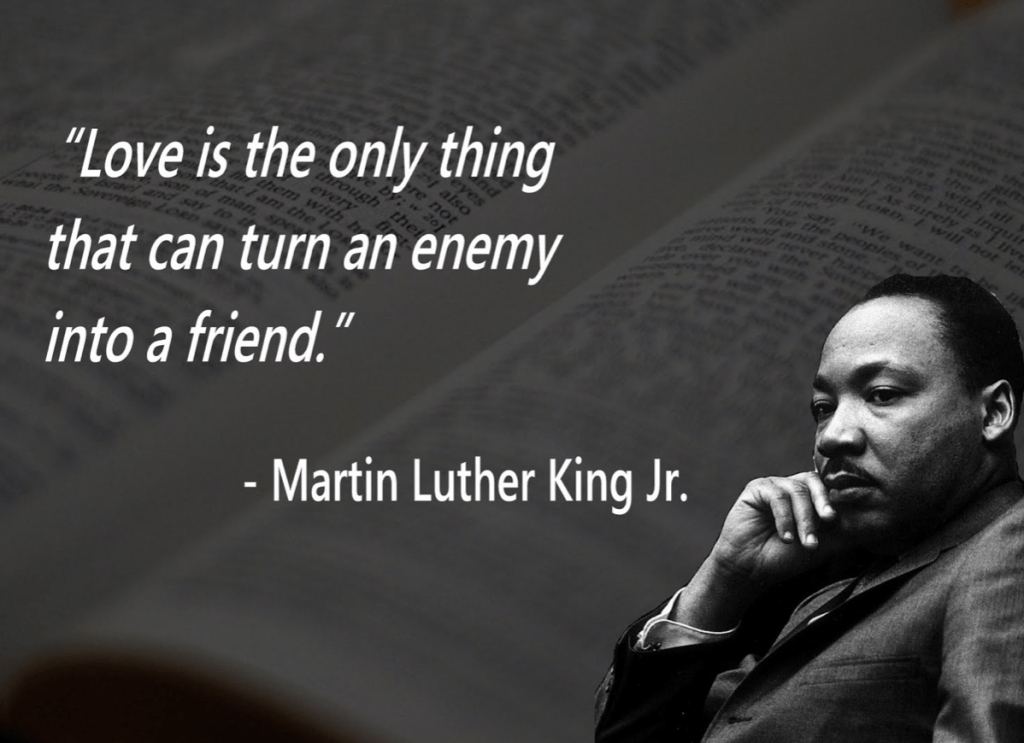
Who do you need to love today? Here is an excerpt from a sermon by Dr. Martin Luther King Jr., delivered at the Dexter Avenue Baptist Church, Montgomery, Alabama, on November 17, 1957:

“Love has within it a redemptive power. And there is a power there that eventually transforms individuals. That’s why Jesus says, ‘Love your enemies.’ Because if you hate your enemies, you have no way to redeem and to transform your enemies. But if you love your enemies, you will discover that at the very root of love is the power of redemption. You just keep loving people and keep loving them, even though they’re mistreating you.

Here’s the person who is a neighbor, and this person is doing something wrong to you and all of that. Just keep being friendly to that person. Keep loving them. Don’t do anything to embarrass them. Just keep loving them, and they can’t stand it too long. Oh, they react in many ways in the beginning. They react with bitterness because they’re mad because you love them like that. They react with guilt feelings, and sometimes they’ll hate you a little more at that transition period, but just keep loving them.

And by the power of your love, they will break down under the load. That’s love, you see. It is redemptive, and this is why Jesus says love. There’s something about love that builds up and is creative. There is something about hate that tears down and is destructive. So, love your enemies.”

Just and merciful God, you are the rightful Judge of all the earth. Help me to trust in you so that I can give room for you to do whatever you want to do in others’ lives. I pray you will grace many people with the repentance that leads to new life in Jesus. Amen.