Who Is Your Master?

oversize backpack

We all carry an invisible backpack. Sometimes it is light, sometimes heavy. At other times, the backpack becomes a crushing load. We are unable to carry it because we kept adding things to it and did not take the time to unload anything. Every day, many people lug such an invisible backpack around everywhere they go. Over time, the backpack begins to smell because unacknowledged grief, unawareness of emotions, and the pile up of life’s difficulties become like a pair of stinky gym socks that got tossed in the backpack with hard feeling after hard feeling caked on top of it.

Something unfortunate then happens: The backpack becomes our Master. It begins to influence the way we talk, what we do, and do not do. It becomes a heavy and even crushing load because rather than Christ, the Spirit, and the Scriptures informing and influencing what we say and do, the invisible backpack calls the shots. It is the weight of sin.

The dominate word for “sin” throughout the New Testament means to miss the mark or to fall short.

It is not a word meaning some terrible egregious wrong committed against another. Rather, it is the most common form of sin there is – simply failing to deal with what humanity needs to deal with – and so, out of sight, out of mind. Unfortunately, those items are never out of the heart’s view.

The Apostle Paul’s way of framing this situation is this: Do not offer our lives to wickedness but offer ourselves to God (Romans 6:12-23). When we have become so accustomed to the invisible backpack as our master that we cannot imagine life without carrying it around, we must take it off. We need to carefully unpack each item we have stuffed into it and allow ourselves to face the pain and hurt and take up Christ’s easy backpack, his yoke.

Since we are redeemed people, baptized into the death of Jesus Christ, we no longer need nor ought to carry a load of sin any longer.

We were meant to have a Master and to carry a backpack – just not the backpack of our shortcomings and failures. Instead, we are to throw over our shoulders the backpack of mercy and righteousness and follow the Master, Jesus Christ. Who is your Master? is not meant to be a scolding question. It is an encouraging question, an invitation to unburden ourselves.

Jesus Christ, by his grace, took the backpack of sin that you and I were carrying and took it upon himself.  He took the crushing weight of our backpacks of sin for us.  Jesus took out those stinky gym socks; they were then nailed with him to the cross. We no longer need to carry this smelly load of sin any longer because Jesus already carried it for us and took care of it. Yet, so many of us still insist on taking up the invisible backpack and keep putting stuff in it.

Therefore, we must deliberately and intentionally take off that invisible backpack. Since the backpack is invisible, most of us would never guess that another carries such a heavy load. Instead, what we do see is the backpack causing another to work himself into the ground so as to continue ignoring the hurt, to keep everything completely clean and in control on the outside because on the inside it is emotional chaos.

What appears on the outside may not be true of the inside.  

For example, when you see my ten-year-old grandson you would never know on the outside that his brain is having immense struggles with epilepsy and seizures on the inside.  And when we look at one another in the church and the world, we cannot assume that just because everything may seem okay on the outside that the inside is fine.  Our stronghold of secrecy and invisibility needs to be broken and pulled down in Jesus’ name!

Brothers and sisters, Jesus took on your backpack for you – you need no longer carry it.  Take it off, unpack it, and let the healing of Christ’s cross bring you freedom from your weight. It is time to put off the backpack of sin and put on Christ’s righteousness.  It is time to say with some flavor, “I will not carry you any longer, old Master, because I belong to God!”

light backpack

Often our struggle is with opposing forces operating within us: righteousness opposed to sin; freedom opposed to slavery; and, a gift opposed to wages. The main point is one of mastery: Who is your Master? The hard work we must do is the ongoing work of confession and offering our lives to God:

  • “I will not carry a load of ignored items any longer because I belong to God.”
  • “I will not carry an unresolved load of pain any longer so that I continue using my tongue to gossip and slander and backbite another, because my tongue is not my own. My tongue belongs to God.”
  • “I will not be burdened by the clock and let it control my life, because my time is not my own. My time belongs to God and I will steward it wisely.”
  • “I will not carry the troubles of my job with me by working myself into the ground, because my job belongs to God and my Master calls me to a Sabbath rest.”
  • “I will unload this backpack of pain and deal so that I do not keep compulsively spending my money, because my money belongs to God.”
  • “The invisible backpack no longer has any power over me because I have unloaded it, grieved my hurts and losses, and have moved to taking on Christ’s backpack. I belong to Jesus Christ!”

Show me a miserable Christian, and I will show you a Christian who is carrying the crushing weight of an invisible backpack that informs and influences every decision and each action.

So, take up Christ’s backpack of grace, without trying to serve two masters: law and grace. There is always a temptation to try and make deals with God – to unload some of the backpack but not all of it. We might also have a kind of spiritual Stockholm Syndrome which has affinity with the old master, even it was abusive. Holy Scripture never advocates an attitude adjustment or behavior modification; it talks of doing away with the backpack completely because Christ has already taken care of it.

Watchman Nee was a twentieth-century Chinese Christian leader and a contemporary of Chairman Mao in China. In exhorting his fellow Chinese to live for Christ, he said,

“The trouble with many Christians today is that they have an insufficient idea of what God is asking of them.  How glibly they say: ‘Lord, I am willing to do anything for you.’  Do you know that God is asking of you your very life?  There are cherished ideals, strong wills, precious relationships, much-loved work, that will have to go; so, do not give yourself to God unless you mean it.  God will take you seriously, even if you did not mean it seriously.”

We are meant to deal with the pain and the hurts we have accumulated but have not lamented over. There is no spiritual growth and development apart from doing this. We cannot have Christ as our Master until we get rid of all competing masters first. In fact, what has the backpack every really done for you?  What benefit do you receive from lugging it around everywhere?  The wages of continually carrying the non-confessed load on our backs will eventually catch up to us. But the gift of God is freedom from sin and a life under the new management of Jesus Christ.  Praise be to God!

Matthew 5:1-12 – The Beatitudes of Jesus

Sermon-on-the-Mount
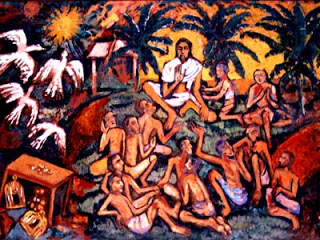
A Bengali depiction of Christ’s Sermon on the Mount

Now when Jesus saw the crowds, he went up on a mountainside and sat down. His disciples came to him, and he began to teach them. He said: 

“Blessed are the poor in spirit, 
    for theirs is the kingdom of heaven. 
Blessed are those who mourn, 
    for they will be comforted. 
Blessed are the meek, 
    for they will inherit the earth. 
Blessed are those who hunger and thirst for righteousness, 
    for they will be filled. 
Blessed are the merciful, 
    for they will be shown mercy. 
Blessed are the pure in heart, 
    for they will see God. 
Blessed are the peacemakers, 
    for they will be called children of God. 
Blessed are those who are persecuted because of righteousness, 
    for theirs is the kingdom of heaven. 

“Blessed are you when people insult you, persecute you and falsely say all kinds of evil against you because of me. Rejoice and be glad, because great is your reward in heaven, for in the same way they persecuted the prophets who were before you. (NIV) 

Just as God’s Law was given on a mountain (The Ten Commandments) so the law was restated on a mountain by Jesus (Sermon on the Mount). I believe that arguably one of the most important and impacting portions of Holy Scripture are the Beatitudes of Jesus, which serve as the foundation to all of Christ’s teaching. These Beatitudes are not simply a random collection of pithy phrases from Jesus on what constitutes approval from God. They intentionally build upon each other and describe true righteousness.  

Blessed are the poor in spirit.   

This Beatitude is the spiritual base to the Christian life.  Most of the original crowd listening to Jesus thought they were on the outside of the kingdom, on the margins of true religion. Instead, Jesus told them they have a place as poor and pitiable people. To be “poor in spirit” means one is a spiritual beggar who recognizes they have nothing to offer God. It is seeing oneself, one’s sin, and one’s life as spiritually bankrupt apart from God. Beggars have no ability to strike deals; they have nothing to leverage with; and, realize they deserve nothing. Beggars do one thing continually: they beg. The proud person would never be caught begging for anything. Yet, the humble spiritual beggar constantly prays because they need God! They discern that without God there is no hope. The kingdom of heaven belongs to the penitent and not the proud. 

Blessed are those who mourn. 

This is the emotional response of acknowledging one’s spiritual poverty.  Grief and lament have a central place in Christian theology and life. To avoid it, work around it, or short-circuit its process is to refuse Christ because there is no righteousness apart from mourning over sin. Crying, weeping, and even intense tears are important and necessary. To experience personal grief over one’s sins and the sins of the church and the world is a Beatitude of Jesus. You neither need position, power, privilege, nor pedigree to be a mourner. All can mourn. This is the door by which we enter the kingdom of God. 

Blessed are the meek. 

A meek spirit is the result of realizing our poverty of spirit and practicing grief and lament. At the heart of what it means to be meek is a spirit of non-retaliation. When we are flat on our backs before God, there is no place to look but up. Thus, there is no ability to look down on others. To be meek is to be broken before God. A meek person takes personal responsibility for their attitudes and actions. The meek have no need to retaliate, even when egregiously wronged, because they fully entrust themselves to God alone who judges the living and the dead. Ironically, brokenness is the path to righteous wholeness. 

Blessed are those who hunger and thirst for righteousness. 

Only those who know their poverty of spirit, personally grieve over sin, and are truly humble/meek end up longing for righteousness. This is much more than just desire; this is the recognition that without God I will not make it. I cannot be righteous without Jesus. Simply put, righteousness is a right relationship with God and others. That is what happens when a person is meek. Such a person knows she cannot make things right by herself; she needs help, specifically, God’s help. If we ever have the thought that we can live most days of our lives without God, we do not yet know true righteousness. People who understand their great need for Jesus are easy to spot. They crave and devour God’s Word as their daily food; and they cannot stop blabbering on about Jesus. 

Sermon on the Mount
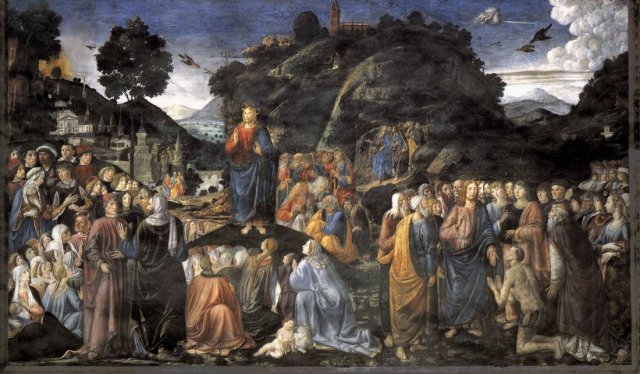
A fresco of the Sermon on the Mount on the northern wall of the Sistine Chapel.

There are three practices of living that arise from being filled with God’s righteousness.  They are the next three Beatitudes of mercy, purity, and peacemaking. These cannot be conjured up by our own will. They organically grow within us and are freely expressed because of what God is doing in our lives. You cannot force them any more than you can force a stalk of corn to grow on your terms. Instead, you work with the unforced rhythms of God’s grace and allow his righteousness to take root in you. Below the soil the activity of spiritual poverty, mourning, and humility takes place. Then, when the plant breaks the soil and flowers, it produces mercy, purity, and peace-making. 

Blessed are the merciful.  

Mercy begins with a disposition of the heart that seeks to be generous. Mercy is a loving response to someone or a group of people in misery. We accept them and help them because we ourselves have been there. Mercy looks for ways to come alongside others and help, rather than pile expectations and burdens on others without mentoring them in the ways of God. 

Blessed are the pure in heart. 

Purity also results from true righteousness. A stalk of corn might look good, but if you shuck it and it is filled with worms, it isn’t going to be worth much. Legalistic righteousness is concerned to look good, is obsessed with performance, perfection, and possessions. Conversely, the righteousness of God fills our hungry hearts and makes us pure and holy, set apart for his use. 

Blessed are the peacemakers.  

Peacemakers are people who find themselves caught in the middle and want to live righteously with the mercy and purity that God has provided for them. Peace is only realized through peacemakers. It seems we all desire peace, yet, peacemakers are hard to come by. It’s a tough gig. Peacemakers exist through being characterized by the earlier Beatitudes. To achieve peace, one must first be at peace with God and self – which is why we need the cross of Jesus Christ. 

Blessed are those who are persecuted because of righteousness.  

When a person lives in this righteousness as presented by Jesus, there will be persecution. Folks who are offended by even slight criticisms are usually the ones who are privileged and in power. They have not yet learned the ways of Jesus. Pettiness is nothing more than a sign of unrighteousness. Yoking up with Jesus, following him, and living into his words and ways has always been risky and dangerous. The Beatitudes of Jesus are not characteristics that lead to power, prestige, or possessions, but likely just the opposite. 

The former Pope Benedict XVI, explained Christ’s Beatitudes this way: “The Beatitudes, spoken with the community of Jesus’ disciples in view, are paradoxes – the standards of the world are turned upside down as soon as things are seen in their right perspective, which is to say, in terms of God’s values, so different from those of the world. It is precisely those who are poor in worldly terms, those thought of as lost souls, who are truly fortunate ones, the blessed, who have every reason to rejoice and exult in their suffering. The Beatitudes are promises resplendent with the new image of the world and humanity inaugurated by Jesus.” 

Those who are in Jesus Christ become living beatitudes, walking, talking blessings to the world.  Those who live with Jesus in his kingdom have a destiny to be witnesses to another subversive, yet wonderful, way of life, where the last are first and the greatest are the least. 

O Lamb of God, that takes away the sins of the world, have mercy upon me. 

O Lamb of God, that takes away the sins of the world, have mercy upon me. 

O Lamb of God, that takes away the sins of the world, grant me your peace. 

1 Peter 3:8-12 – To Suffer and To Bless

Light and Dark

Finally, all of you, have unity of spirit, sympathy, love for one another, a tender heart, and a humble mind. Do not repay evil for evil or abuse for abuse; but, on the contrary, repay with a blessing. It is for this that you were called—that you might inherit a blessing. For

“Those who desire life
and desire to see good days,
let them keep their tongues from evil
and their lips from speaking deceit;
let them turn away from evil and do good;
let them seek peace and pursue it.
For the eyes of the Lord are on the righteous,
and his ears are open to their prayer.
But the face of the Lord is against those who do evil.” (NRSV)

Its one thing to give blessing to folks when they seem worthy of it – quite another thing when you have stinkers in your life. Bless the very ones who are abusive toward me? Some might think the Apostle Peter was off his rocker to instruct believers to bless insufferable persons. Peter, however, was only passing on what he had learned from the Lord Jesus:

“You have heard that it was said: You must love your neighbor and hate your enemy. But I say to you, love your enemies and pray for those who harass you so that you will be acting as children of your Father who is in heaven. He makes the sun rise on both the evil and the good and sends rain on both the righteous and the unrighteous. If you love only those who love you, what reward do you have? Don’t even the tax collectors do the same? And if you greet only your brothers and sisters, what more are you doing? Don’t even the Gentiles do the same? Therefore, just as your heavenly Father is complete in showing love to everyone, so also you must be complete. (Matthew 5:43-48, CEB)

The instruction to bless the hateful ingrates in our lives only seems strange when the avoidance of suffering and experiencing a pain-free existence is the summum bonum of life. Yet, I get it. We don’t like to suffer. I don’t like to suffer. It hurts! I’m not really into pain. I’m not a high tolerance pain kind of guy. I have no problem taking a pain pill at the first sign of discomfort. Even so, I know there will be times I am going to have pain – physical, emotional, and spiritual – and there is no way around it.  To live in this broken world is to experience suffering. To suffer as a Christian, however, is different because we are following the way of our Lord Jesus Christ.

Just as Christ suffered, we can expect to suffer as his followers, as well.  We are not above our Master. The real issue is whether we will suffer because of our own foolishness and selfishness, or because of our devotion to Christ in being kind, humble, and gracious.  When insults come our way, we need not respond with insults.  Verbal cruelty is not the way of Christ.  Anger, slander, gossip, lies, manipulative words, and belligerent bullying have absolutely no place in the kingdom of God for any reason.

God has a zero-tolerance policy toward hate speech.

The consistent witness of the New Testament is to bless and do not curse, to love and not to hate, to use our tongues for spreading words of encouragement and not of condemnation. Peter’s instruction and Christ’s teaching also totally jives with the Apostle Paul:

Bless those who persecute you; bless and do not curse…. Live in harmony with one another…. Do not repay anyone evil for evil. Be careful to do what is right in the eyes of everyone. If it is possible, as far as it depends on you, live at peace with everyone. Do not take revenge, my dear friends, but leave room for God’s wrath, for it is written: “It is mine to avenge; I will repay,” says the Lord. On the contrary:

“If your enemy is hungry, feed him;
if he is thirsty, give him something to drink.
In doing this, you will heap burning coals on his head.”

Do not be overcome by evil but overcome evil with good. (Romans 12:14-21, NIV)

Church Light in Dark

Christians are to us their tongues exclusively for blessing, not cursing; for love, not hate; for truth, not lies; for building-up, not tearing-down; for proclaiming good news, not bad news laced with insults.  If we suffer because of love, we shall receive blessing from God. If we suffer for giving-in to retaliation and our base desires for revenge, then we will suffer the consequences of our own stupidity.

God has called us to bless the world, not condemn it.  Christians are to be on the front lines of spreading respect, civility, kindness, and the gospel. It is no problem showing love and respect to people we like. It is a whole other ballgame to do the same for those who treat us with disrespect and hate. Yet, God watches over all who obey him, and he listens to their prayers.  God will handle the hate-filled person, not you or me.  Our task is to have a deep concern for humanity, both the ones we like and the ones we don’t.

One of the spiritual practices I occasionally do is to read an entire book of the Bible in one sitting. 1 Peter is not a long letter. Depending on the pace of your reading, it can be done between 15-30 minutes. I encourage you to take some time today or this week to slowly read it. Pay attention to how adversity affords Christians the opportunity for hope and the encouragement to live well.

May it be so. Soli Deo Gloria.

Loving Lord Jesus, you suffered and died on my behalf.  It is a small thing for me to follow you and walk in the way of suffering.  I know and have the confident expectation that blessing awaits.  Keep me true to following you through all the adversity I face in this fallen broken world.  Even so, come Lord Jesus, you who lives and reigns with the Father and the Spirit, one God, now and forever.  Amen.

Romans 4:13-25 – Christianity 101

promise to abraham

“Against all hope, Abraham in hope believed and so became the father of many nations, just as it had been said to him, “So shall your offspring be.” Without weakening in his faith, he faced the fact that his body was as good as dead—since he was about a hundred years old—and that Sarah’s womb was also dead. Yet he did not waver through unbelief regarding the promise of God, but was strengthened in his faith and gave glory to God, being fully persuaded that God had power to do what he had promised. This is why “it was credited to him as righteousness.” The words “it was credited to him” were written not for him alone, but also for us, to whom God will credit righteousness—for us who believe in him who raised Jesus our Lord from the dead.  He was delivered over to death for our sins and was raised to life for our justification.” (New International Version)

Sometimes it’s easy to lose sight of why we are here and what we are really supposed to be doing.  There’s just so much stuff going on around us all the time that it seems like we have spiritual ADD and can’t focus on what’s most important.  Certain people irritate us, we scramble to making a decent living, there never seems to be enough time to accomplish everything, and there is adversity and obstacles all along life’s way.

There’s a lot going on in the book of Romans.  At first glance, like our lives, it seems complicated.  The Apostle Paul had all kinds of words for the Christians: hope; faith; righteousness; and, justification, just to name a few.  But all those ideas funneled to and pointed toward a singular focus: the Lord Jesus.  Everything in church and life comes down to Christ.

The church was losing sight of why they existed.  Within the church at Rome were both Jews and Gentiles together as one people of God.  They didn’t always see eye-to-eye on everything.  The Gentiles thought the Jews were stuck in tradition and needed to move on.  The Jews had centuries of history behind them of God working through them; they thought the Gentiles needed some solid Old Testament law to bolster their primitive spirituality.  Would the church take their cues on life from the Gentiles, or the Jews?

Paul essentially told the church that they were focused in the wrong direction.  The issues and problems of living the Christian life were to take a back seat to faith in God.  To prove his point, Paul went back to Abraham as Exhibit A of what it means to live with and for God.

It went down like this: God made a promise to Abraham of progeny in his old age; Abraham believed what God said; Abraham demonstrated his faith by having the confident expectation (hope) that God is good for his promise; and, God declared (justified) Abraham to have a right relationship with himself (righteousness).

In other words, the heart of Christian faith and practice is: God makes promises; people respond in faith, hope, and love.  Law and the willpower to keep it doesn’t even come into the equation.

Christians are the spiritual children of Abraham.  All God’s promises are fulfilled in Christ.  We respond to God by believing in Jesus. The redemptive events of Jesus make us just and right.  So, what does this mean for you and me?

We are not to get sidetracked with trying to make others like be like us.  Instead, we are to proclaim the promises of God in Christ so that others might respond by believing and embracing those promises.  Furthermore, we have no need to try and get God to like us, notice us, and/or listen to us.  God has already made and kept promises to us, demonstrating his love, mercy, and grace through his Son, the Lord Jesus.

Our lives are not to center in our abilities, or lack thereof, to live a godly life.  Rather, our lives are to revolve around the person and work of Jesus Christ through faith, with the hope that God will always hold to his promise to be with us, which frees us to love others.  This is Christianity 101.  This is the faith we embrace.

Righteous God, you have made and kept promises to me.  My ultimate deliverance from sin, death, and hell isn’t through my ability to keep the law, but in your Son’s life, death, and resurrection.  Help me to live by faith in Jesus who loved me and gave himself for me; in the strength of your Holy Spirit.  Amen.