From Adversaries to Allies (Isaiah 19:18-25)

In that day five cities in Egypt will speak the language of Canaan and swear allegiance to the Lord Almighty. One of them will be called the City of the Sun.

In that day there will be an altar to the Lord in the heart of Egypt, and a monument to the Lord at its border. It will be a sign and witness to the Lord Almighty in the land of Egypt. When they cry out to the Lord because of their oppressors, he will send them a savior and defender, and he will rescue them. 

So the Lord will make himself known to the Egyptians, and in that day they will acknowledge the Lord. They will worship with sacrifices and grain offerings; they will make vows to the Lord and keep them. The Lord will strike Egypt with a plague; he will strike them and heal them. They will turn to the Lord, and he will respond to their pleas and heal them.

In that day there will be a highway from Egypt to Assyria. The Assyrians will go to Egypt and the Egyptians to Assyria. The Egyptians and Assyrians will worship together. In that day Israel will be the third, along with Egypt and Assyria, a blessing on the earth. The Lord Almighty will bless them, saying, “Blessed be Egypt my people, Assyria my handiwork, and Israel my inheritance.” (New International Version)

Yahweh is so much more than an ancient local Israelite deity. This is the Lord God almighty, creator of heaven and earth. God is the Lord of the universe, and Israel is not just a sliver of land in the Middle East.

As such, all peoples belong to God. And God is concerned for all the nations. In the ancient world, the Lord was even concerned for places like Egypt and Assyria – two nations which historically treated Israel with contempt and oppression.

The Lord God, Yahweh, as the prophet Isaiah stated, will be revealed to the Egyptians, so that they, too, will worship the Lord with sacrifices and offerings. They will revere God with a monument to Yahweh’s saving power.

The Egyptians will make religious vows and fulfill them. And there will also be relations with Assyria. Israel will exist alongside – and literally geographically in the middle – the powers of Egypt and Assyria. And Israel will serve as a blessing between them.

In other words, God will choose to bless, bringing both religious and political balance and peace. It is rather extraordinary that the Lord speaks of Egypt as “my people” and Assyria as “my handiwork.” God’s vision is always much larger than our own puny human sight or imagination.

In a biblical book filled with sad visions of judgment and God’s wrath, today’s Old Testament lesson is a beautiful vision of hope and peace. This, my friends, is what can be! It doesn’t have to be a pipe dream that various peoples who are historical enemies of one another can walk together in the peace and wholeness of God’s blessing. This is no impossible, although it appears highly improbable.

It takes little effort to hold onto hate and enmity; but it takes a great deal of energy to work on peacemaking, and loving those who have harmed others so terribly.

The fact of the matter is that Yahweh responds to every people who cry out in their oppression – even those who were once oppressors themselves.

That is called “grace,” and it is why grace is so scandalous, because a lot of folks don’t want to see grace extended to those they dislike, hate, and even want dead.

God will do for other nations what God did for Israel, in delivering them from their harsh slavery. The Lord’s ears hear everyone on the earth, and not just some people.

All of the hard-hearted resistance of the past, personified so stubbornly in the Pharaoh who would not let go of Israel, is remarkably overcome and reversed.

This is how it always seems to operate throughout history, including today. People cry out and are delivered, then worship the God who granted them grace and freedom. We very often come to believe because we were in some sort of awful trouble, which caused us to cry out and acknowledge the God who saves.

God both strikes and heals, attacks and helps. God moves people from rancorous relationships to robust reconciliation.

People, however, are not passive in any of this process. Those who are already blessed and enjoy God must relinquish any sort of exclusive thoughts or practices and be willing to share their identity and privilege with others who were once enemies.

Unity, harmony, wholeness, and a true ecumenical spirit and vision will bring people together. The benefits are wonderful, yet let it also be acknowledged that reconciliation and relationships require giving up any sense of being better than the other, or holding on to primacy of positions and power.

Stated positively, it means that we embrace a diversity of people, including them in every way possible, because we discern them as being equals, and not so different from me.

God has other chosen people besides me and you. Can you accept that?

“Egypt comes home to its true self only as Israel opens its sense of privilege to its adversaries.”

Walter Brueggemann

The Lord opposes the arrogant and proud, but gives grace to the humble. God will gladly deliver and welcome all peoples.

If we have the spiritual eyes to see, we will notice and observe that the world is God’s chosen people.

O God, hear our humble prayer, so that we may serve you in holiness and faith, giving voice to your divine presence among us until the coming of your Son, Jesus Christ, who lives and reigns forever and ever. Amen.          

The Day Is Coming (Malachi 4:1-6)

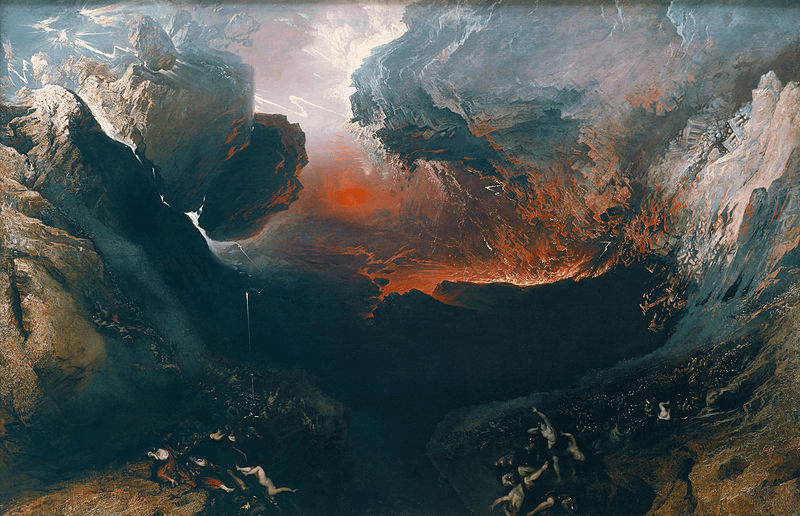
The Great Day of His Wrath, by John Martin, c.1851

“Surely the day is coming; it will burn like a furnace. All the arrogant and every evildoer will be stubble, and the day that is coming will set them on fire,” says the Lord Almighty. “Not a root or a branch will be left to them. But for you who revere my name, the sun of righteousness will rise with healing in its rays. And you will go out and frolic like well-fed calves. Then you will trample on the wicked; they will be ashes under the soles of your feet on the day when I act,” says the Lord Almighty.

“Remember the law of my servant Moses, the decrees and laws I gave him at Horeb for all Israel.

“See, I will send the prophet Elijah to you before that great and dreadful day of the Lord comes. He will turn the hearts of the parents to their children, and the hearts of the children to their parents; or else I will come and strike the land with total destruction.” (New International Version)

These are the final words of the Old Testament, the concluding message of the prophet Malachi.

Malachi’s vision of God’s future action describes a Day of Judgment, a time of utter destruction for all those who devoted themselves to wickedness. The faithful, however, will receive healing by means of bright righteousness. God will restore a good, right, and just order of things.

The divine restoration will cause joy and celebration. In their freedom, the faithful will ensure that the wicked shall not have power and authority ever again.

Therefore, the conclusion to the Book of Malachi – and of all the Old Testament – is a call to obedience, to observe the law. Finally, it is communicated that Elijah – one of the greatest prophets in Jewish history – will return in order to turn the hearts of family members toward one another. And without this change of heart and behavior within the family, there isn’t anything good to look forward to.

In other words, justice and righteousness, humility and gentleness, mercy and peace, all begin within the home. If we are to get things right out in the world, it will be because we have learned how to develop and maintain right relationships and provide for one another in our families.

So, how is that project going? (said in a sarcastic tongue-in-cheek sort of way).

And, how is the religious and spiritual progress going? (said in that same obnoxious sort of tone)

Furthermore, what are you and I doing to help the situation, and not to bring harm to it? (said in an actual serious tone)

It will not do for any of us to simply blame others – even though those others likely have a lot to answer for themselves. You and I cannot control others, especially family members (although some folks do their darndest to try and do it!).

Therefore, we must practice self-control, and do what is within our own power to do in order to help bring blessing – not judgment – to the earth.

All of us need to allow accountability into our lives, so that we may continue in living good and responsible lives.

Yet, that does not always happen. Graciously, the world is not presently spinning on its axis because of me or you. Our mistakes, foibles, screw-ups, and sins are not good, but they are also not going to stop the sun from coming up tomorrow.

It is terribly sad that there is so much war, death, destruction, harm, malevolence, disease, and disaster in this old world. It’s as if the earth is under a curse, which it is. But the world is also loved by God.

The faithful ultimately trust in the grace and mercy of God. The Christian, specifically, looks to Jesus to provide the righteousness and justice that we ourselves have not been able to accomplish.

The judgment of God exists, so that the justice and mercy of God can be fulfilled.

He himself bore our sins in his body on the cross, so that we might die to sins and live for righteousness; by his wounds you have been healed.

1 Peter 2:24, NIV

In union with Christ, the faithful know what a change of heart truly means. And they know what to do in order to affect that change in their lives today:

For we know that our old self was crucified with him so that the body ruled by sin might be done away with, that we should no longer be slaves to sin—because anyone who has died has been set free from sin.

Now if we died with Christ, we believe that we will also live with him. For we know that since Christ was raised from the dead, he cannot die again; death no longer has mastery over him. The death he died, he died to sin once for all; but the life he lives, he lives to God.

In the same way, count yourselves dead to sin but alive to God in Christ Jesus. Therefore do not let sin reign in your mortal body so that you obey its evil desires. Do not offer any part of yourself to sin as an instrument of wickedness, but rather offer yourselves to God as those who have been brought from death to life; and offer every part of yourself to him as an instrument of righteousness. (Romans 6:6-13, NIV)

So then, let us restore right relationships with others, and especially with family. Let us live as people who have been lifted from a curse, and are free from divine judgment.

Let’s get up each day and live into the freedom we possess from the power of guilt, shame, and plain old-fashioned sin.

Let’s be people who choose to look both backward and forward:

  • We look back at the redemptive events of Jesus, to his coming to this earth in a miraculous incarnation, and to his death, resurrection, and ascension.
  • We look forward to the return of Christ, a second advent, when he will save his people, judge all people, and restore all things.

We can do this, my friends. We can live as we ought to live, love as we ought to love, and give as we ought to give – because of the One who has gone before us, is with us, and is coming again.

The Day is coming. Make sure that when it does, we are found faithful.

“For even the Son of Man did not come to be served, but to serve, and to give his life as a ransom for many.”

Mark 10:45, NIV

To him who loves us and has freed us from our sins by his blood, and has made us to be a kingdom and priests to serve his God and Father—to him be glory and power for ever and ever! Amen. (Revelation 1:5b-6, NIV)

The Righteous and the Wicked (Malachi 3:13-18)

“You have spoken arrogantly against me,” says the Lord.

“Yet you ask, ‘What have we said against you?’

“You have said, ‘It is futile to serve God. What do we gain by carrying out his requirements and going about like mourners before the Lord Almighty? But now we call the arrogant blessed. Certainly evildoers prosper, and even when they put God to the test, they get away with it.’”

Then those who feared the Lord talked with each other, and the Lord listened and heard. A scroll of remembrance was written in his presence concerning those who feared the Lord and honored his name.

“On the day when I act,” says the Lord Almighty, “they will be my treasured possession. I will spare them, just as a father has compassion and spares his son who serves him. And you will again see the distinction between the righteous and the wicked, between those who serve God and those who do not. (New International Version)

The righteous and the wicked. Depending upon what sort of faith tradition you grew up in as a child; or by what belief system you currently adhere to, this may likely determine your understanding of those two words.

The terms “righteous” and “wicked” vary amongst differing groups of people. But however you understand those words, I want us to notice how the prophet Malachi understands them.

To be “righteous” means to have a right relationship with both God and others. It is to be close enough to knowing God to carry out what is important to God.

Righteous folk actually listen and talk to one another. They consult and collaborate with each other. They enjoy good relations because the righteous understand that relationships are a high value. They discern that people are important.

And so, God’s justice is very important to the righteous, because God wants everyone’s basic needs met. The Lord desires people to be treated well, with respect and dignity, in order to make a living and enjoy life.

To be “wicked” means to be arrogant, proud, and boastful. It is to have a string of messed up relationships with both God and others because they insist on their own way.

The wicked are far from God, and do whatever they want to do, regardless of how it may affect others. They view justice and righteousness as dispensable, and unnecessary, unless it can be used as leverage for selfish desires. Even though the wicked might be rich and powerful in this life, they will not be spared from God’s judgment.

Wicked persons – those who carry out injustice and seek to care only for themselves – are called to repent, to change, to amend their evil ways. Their negative statements about God, and their mistreatment of others, has not gone unnoticed.

A typical tactic of wicked persons is to blame others. In Malachi’s day, they were blaming God, and ironically, accusing the Lord of injustice. That’s because the wicked person’s understanding of God is that the Lord exists for their personal benefit.

So, if the wicked person is not receiving some benefit from God, then God isn’t being God, and then is accused and blamed as being the problem to any sort of adverse situation.

But in reality, the righteous are God’s treasured possession, because they consistently serve the Lord, no matter the circumstances. The righteous are faithful, and so, they will be spared on the day of God’s judgment.

So far, I have made this all seem quite black and white. But that was only to make clear the contrast between righteousness and wickedness. The truth is that all of us are a bit of both. We are not always completely right, nor are we always wrong.

We are in the middle of things. Most folks have not rejected God through a lack of belief. Yet, they also have not fully accepted God’s intentions for this world and are not fully living into them.

The prophet Malachi calls such persons (which is perhaps all of us?) to a day when trying circumstances will make the distinction between the wicked and the righteous much more clear.

Then, we will be able to change, fully convinced and knowing the difference between right and wrong, truth and error, faith and fear.

Charlatans will eventually be found out and known. And the consistently faithful people will eventually be noticed and held up by God for others to see and know.

If everything presently appears murky, shadowy, and unclear, please know that it will not always be this way for you.

I am assuming that there very few “wicked” persons actually reading or listening to this. Simply because they see no value in doing so. It doesn’t get them anywhere they want to go.

The wicked may seem to know what they’re doing, but they don’t. Life for them is very nebulous and unclear. They’re only spit-balling through life, trying to look out for number one, that is, themselves.

But you who are reading or listening to this likely want nothing to do with wickedness. You want to stay away from evil.

You are looking to make a difference on this earth, and to improve your little corner of the world. You desire good things for yourself and others. You seek to live as justly and rightly as you can.

Good for you! The Lord is noticing your faith and patience.

So do not throw away your confidence; it will be richly rewarded.

You need to persevere so that when you have done the will of God, you will receive what he has promised. For,

“In just a little while,
    he who is coming will come
    and will not delay.”

And,

“But my righteous one will live by faith.
    And I take no pleasure
    in the one who shrinks back.”

But we do not belong to those who shrink back and are destroyed, but to those who have faith and are saved. (Hebrews 10:35-39, NIV)

Eternal God, in whose perfect kingdom no sword is drawn but the sword of righteousness, no strength known but the strength of love: So mightily spread abroad your Spirit, that all peoples may be gathered under the banner of the Prince of Peace, as children of one Father; to whom be dominion and glory, now and forever. Amen.

I Am Responsible and Accountable (Ezekiel 18:1-32)

The word of the Lord came to me: “What do you people mean by quoting this proverb about the land of Israel:

“‘The parents eat sour grapes,
    and the children’s teeth are set on edge’?

“As surely as I live, declares the Sovereign Lord, you will no longer quote this proverb in Israel. For everyone belongs to me, the parent as well as the child—both alike belong to me. The one who sins is the one who will die.

“Suppose there is a righteous man
    who does what is just and right.
He does not eat at the mountain shrines
    or look to the idols of Israel.
He does not defile his neighbor’s wife
    or have sexual relations with a woman during her period.
He does not oppress anyone,
    but returns what he took in pledge for a loan.
He does not commit robbery
    but gives his food to the hungry
    and provides clothing for the naked.
He does not lend to them at interest
    or take a profit from them.
He withholds his hand from doing wrong
    and judges fairly between two parties.
He follows my decrees
    and faithfully keeps my laws.
That man is righteous;
    he will surely live,
declares the Sovereign Lord.

“Suppose he has a violent son, who sheds blood or does any of these other things (though the father has done none of them):

“He eats at the mountain shrines.
He defiles his neighbor’s wife.
He oppresses the poor and needy.
He commits robbery.
He does not return what he took in pledge.
He looks to the idols.
He does detestable things.
He lends at interest and takes a profit.

Will such a man live? He will not! Because he has done all these detestable things, he is to be put to death; his blood will be on his own head.

“But suppose this son has a son who sees all the sins his father commits, and though he sees them, he does not do such things:

“He does not eat at the mountain shrines
    or look to the idols of Israel.
He does not defile his neighbor’s wife.
He does not oppress anyone
    or require a pledge for a loan.
He does not commit robbery
    but gives his food to the hungry
    and provides clothing for the naked.
He withholds his hand from mistreating the poor
    and takes no interest or profit from them.
He keeps my laws and follows my decrees.

He will not die for his father’s sin; he will surely live. But his father will die for his own sin, because he practiced extortion, robbed his brother and did what was wrong among his people.

“Yet you ask, ‘Why does the son not share the guilt of his father?’ Since the son has done what is just and right and has been careful to keep all my decrees, he will surely live. The one who sins is the one who will die. The child will not share the guilt of the parent, nor will the parent share the guilt of the child. The righteousness of the righteous will be credited to them, and the wickedness of the wicked will be charged against them.

“But if a wicked person turns away from all the sins they have committed and keeps all my decrees and does what is just and right, that person will surely live; they will not die. None of the offenses they have committed will be remembered against them. Because of the righteous things they have done, they will live. Do I take any pleasure in the death of the wicked? declares the Sovereign Lord. Rather, am I not pleased when they turn from their ways and live?

“But if a righteous person turns from their righteousness and commits sin and does the same detestable things the wicked person does, will they live? None of the righteous things that person has done will be remembered. Because of the unfaithfulness they are guilty of and because of the sins they have committed, they will die.

“Yet you say, ‘The way of the Lord is not just.’ Hear, you Israelites: Is my way unjust? Is it not your ways that are unjust? If a righteous person turns from their righteousness and commits sin, they will die for it; because of the sin they have committed they will die. But if a wicked person turns away from the wickedness they have committed and does what is just, and right, they will save their life. Because they consider all the offenses they have committed and turn away from them, that person will surely live; they will not die. Yet the Israelites say, ‘The way of the Lord is not just.’ Are my ways unjust, people of Israel? Is it not your ways that are unjust?

“Therefore, you Israelites, I will judge each of you according to your own ways, declares the Sovereign Lord. Repent! Turn away from all your offenses; then sin will not be your downfall. Rid yourselves of all the offenses you have committed, and get a new heart and a new spirit. Why will you die, people of Israel? For I take no pleasure in the death of anyone, declares the Sovereign Lord. Repent and live! (New International Version)

Every single one of us is accountable to one another for what we say and how we conduct ourselves. Above all, we are accountable to God for our motives, words, and actions in this life.

The flipside to stating that we are accountable, is saying that none of us are responsible for another person’s intentions, words, or actions.

Other people may influence us. We may be either participants in or victims of another’s actions. Some folks might take credit for something another person said or did. Yet, ultimately, we are responsible for our own life.

Whatever I think, say, or do is on me, period.

What’s more, one’s past actions do not replace our current actions. The prophet Ezekiel emphasized individual responsibility and accountability. All of the other Old Testament prophets addressed whole nations, and not individuals. They denounced the social, economic, and political systems and institutions, upholding communal ideals of justice.

Ezekiel communicated that children shall not be punished for their parent’s sins. Only the person who sins will face judgment.

A person ought only to pay for their own sins; punishment should not carry forward to future generations. The prophet also insisted that each individual person has the opportunity to change their behavior, and so, avoid their deserved penalty.

Every individual has the opportunity to change their personal ways of injustice or unrighteousness. For those who refuse, there is a and right and just Judge who knows how to dispense what is needed for each person – whether it is judgment to the arrogant, comfort to a victim, or justice for the underprivileged.

God cares that every person on earth receives what they need to thrive and flourish in this life. And to those who don’t give a wit about others, the Lord gives an opportunity to turn from arrogance and change.

Refusing to change, however, will end badly for the stubborn person.

The prophet Ezekiel calls on individuals to speak and act in ways that are helpful, not harmful. And whenever one harms another, that one must acknowledge the irresponsibility, because I am held accountable for what I say and do.

All words and actions come with consequences. It would do us a lot of good to consider how what we say and do (or fail to say and do) impacts the next generation of people. Everyone leaves a legacy of some sort – whether good or bad – so we need to be aware of how we live.

Each person must take up the mantle to do good, not evil; and to live righteously, not wickedly. Living selfishly with impunity leads to divine judgment. Yet, mercy is always there, if we seek to amend our ways.

Conversely, living righteously, and then resting on my laurels and living however I want, does not inoculate me from divine judgment.

You and I must live one day at a time, trusting God and seeking the welfare of others. And when I mess up, I am to keep a short account with God by admitting my fault and receiving grace.

We humans have quite enough responsibility in our lives without taking on the extra job of exacting judgment on another person. If we live a righteous life to begin with, then there is no need for a new heart and life.

Yet, if I need it, a new existence is there, through a change of direction which humility grants us.

Almighty God, help me to prioritize your values, and put my faith into action. Enable me to use the talents, resources, and time with which I have been blessed. Empower me to serve my community and my world. May I serve you always, and pray with a joyful spirit. Amen.