Be Real, Not Fake (Titus 1:5-16)

The reason I left you in Crete was that you might put in order what was left unfinished and appoint elders in every town, as I directed you. 

An elder must be blameless, faithful to his wife, a man whose children believe and are not open to the charge of being wild and disobedient.Since an overseer manages God’s household, he must be blameless—not overbearing, not quick-tempered, not given to drunkenness, not violent, not pursuing dishonest gain. 

Rather, he must be hospitable, one who loves what is good, who is self-controlled, upright, holy and disciplined. He must hold firmly to the trustworthy message as it has been taught, so that he can encourage others by sound doctrine and refute those who oppose it.

For there are many rebellious people, full of meaningless talk and deception, especially those of the circumcision group. They must be silenced, because they are disrupting whole households by teaching things they ought not to teach—and that for the sake of dishonest gain. One of Crete’s own prophets has said it: “Cretans are always liars, evil brutes, lazy gluttons.” This saying is true.

Therefore rebuke them sharply, so that they will be sound in the faith and will pay no attention to Jewish myths or to the merely human commands of those who reject the truth. To the pure, all things are pure, but to those who are corrupted and do not believe, nothing is pure. In fact, both their minds and consciences are corrupted. They claim to know God, but by their actions they deny him. They are detestable, disobedient and unfit for doing anything good. (New International Version)

Everything in life needs some decency and order – including the church. The bulk of the Apostle Paul’s letter to Titus gives needed instructions about structuring the life of the church, along with some warnings about those who would attempt to disrupt that good order.

One of the most important aspects of church life and organization is to appoint competent persons with good character and sound doctrine to oversee and serve the congregation. The leaders of the church are to be mature, unselfish, concerned for the common good of all the parishioners, and able to handle Holy Scripture by strengthening the faithful and rebuking the faithless.

It takes solidly worthy leaders to counter people who are opposed to doing and believing things that are inconsistent with apostolic teaching. Paul had neither the tolerance nor the patience for rebellious folk who sought to deceive the faithful. So, he told Titus to silence, rebuke, and put a stop to such persons.
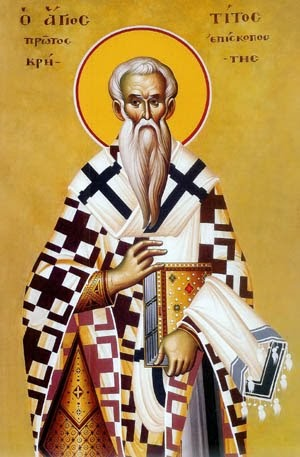
Orthodox icon of St. Titus the Apostle, the first Bishop of Crete

The rebellious persons, however, were not so easy to spot for many in the church – which is why Paul instructed Titus to deal with false teachers forcefully. They were not the real article, but came across as genuine.

Sometimes, you cannot tell a fake by the external appearance. In Christianity, and within the church, a person might give a good outward performance, but actually not be the real deal because they are full of bitterness and death on the inside with a heart far from God.

A sobering reality for devoted believers in God is that the church and Christianity can have people who are religious on the outside but not really Christ followers on the inside. Claiming to know God isn’t the same as actually knowing the Lord. It’s like putting perfume in a vase – it might smell like flowers but the flowers aren’t really there.  

The Apostle was pointed about how to handle those of the “circumcision group” because they were legalists who put heavy spiritual loads on people and were unwilling to help them carry those burdens. Paul, following the example of the Lord Jesus, was always laboring and challenging people into a genuine, real righteousness from the heart that would submit to God’s kingdom. 

And, much like Jesus before him, Paul kept having the Judaizers in the church undermining him, talking behind his back, and stirring up resentment against him. 

The rebellious people of the circumcision group were not helping believers know God better through active service, but only tried to talk a good line. Paul pointed them out to Titus because such persons were not strengthening the faith of others and enabling them to live a sound spiritual life.

The Judaizers did not practice what they preached – and even what they taught was neither gentle, nor had any grace. People need one another in the church to truly live for God; but if there are double standards, then heavy loads aren’t getting carried because some individuals think they are above helping, or think too little of themselves and believe God could not use them. 

In both cases the person declares, “Someone should do something!” Someone should give, someone should pray, someone should visit, someone should tell that person about Christ, someone should help. To which Paul (and Jesus) would say that someone is you.

We may believe we are genuine and think we are being helpful when we really are not. Whenever we plaster on fake smiles, only obey and serve when others are looking, and/or pretend like everything is just peachy keen when we are dying inside, then we are in the same category as the Judaizers. We have become in need of putting aside how we look to others and ask the God of grace to have mercy on us. 

It’s possible to be so obsessed about the right thing to say that we never say what is really on the inside because we think it isn’t spiritual enough and we fear looking bad. We then put up a spiritual façade, live into a false self, thereby and eventually becoming a false teacher.

The rebellious in the church are those who seek power, status, authority, and prestige. Respect and honor from others is everything to them, so they want the positions of prominence and insist on being recognized for whatever they say or do in the church.

But facades will not work for Christianity. The church is about integrity, mission, worship, and service – and not about acting with the spectator in mind, and seeking to elicit praise and respect from others. For such persons, it does not matter what’s on the inside as long as the outside looks good. 

Instead of being a liar (one whose outward actions and inner dispositions don’t match) and an evil brute (not acting with anyone else’s needs in mind or at heart) and a lazy glutton (always receiving but never giving) instead be a servant of others with a good character, a basic understanding of Holy Scripture, and a heart to know and love God. 

If there is a job that no one wants to do, I’ll do that job.

If there’s a lonely person, I’ll be with them.

If there’s a parking space up close, I’ll park in the back of the lot.

If there’s a need is someone’s life, I’ll meet that need.

If there’s a hardship someone has to endure, I’ll help carry that hardship.

If there’s a sacrifice to be made, I’ll make that sacrifice. Amen.

On the Importance of Hospitality (3 John 9-12)

A mosaic of the Apostle John, at the Monastery of St. John the Theologian, in Patmos, Greece

I have written something to the church, but Diotrephes, who likes to put himself first, does not welcome us. So if I come, I will call attention to what he is doing in spreading false charges against us. And not content with those charges, he refuses to welcome the brothers and sisters and even prevents those who want to do so and expels them from the church.

Beloved, do not imitate what is evil, but imitate what is good. Whoever does good is from God; whoever does evil has not seen God. Everyone has testified favorably about Demetrius, and so has the truth itself. We also testify for him, and you know that our testimony is true. (New Revised Standard Version)

I believe in an egalitarian world. Ideally, humanity is meant to live in equity with one another. Humility, meekness, and gentleness are to be the inner dispositions of a person’s life.

These virtues work themselves out in being concerned for the common good of all, laboring toward just and righteous ways of living for everyone and sharing our lives, as well as our resources, with each other. Viewing one another as equals inevitably leads to gracious hospitality.

However, in a world of power disparities, and privileged inequities, are attitudes of seeking attention, a perceived need to always win and be first, and tight-fisted control of authority and money. The common good of all persons is scaled back to be the concern for the common good of some. There is a failure to regard the weak, poor, and vulnerable as legitimate members of the community.

The Apostle John wrote his short succinct letter in a concern that the church may be following a leader who was taking them down a bad path – a road leading to injustice where power and privilege remain with a few, and perhaps even one. John’s plainspoken exhortation was to judge rightly between what is good and bad, and then imitate the good while forsaking the bad.

Hospitality is the true litmus test between the good and the bad.

An openness to the stranger, the immigrant, the migrant, the alien, the foreigner, the newcomer, and the outsider characterizes authentic fellowship.

Being closed to such persons and having a xenophobic bent to others who are different is the mark of unwelcoming and inhospitable people.

Hospitality serves others, whereas being inhospitable cajoles others to serve our needs.

Jesus, the Lord of all, did not come to this earth for people to serve him. Christ came to serve others, and to give his life to save many people (Matthew 20:28; Mark 10:45; John 13:1-17). We are to imitate the loving service and radical hospitality of the Lord Jesus. He is our example. We are to imitate Christ.

We must have both orthodoxy (right belief) and orthopraxy (right practice). Both go together like a hand in a glove. Good actions are the result of good and proper beliefs. The following are some thoughts about this nexus between belief and practice:

  • Hospitality (literally “love of the stranger”) is a way of life fundamental to orthodox Christianity, based in the person and work of Jesus
  • God is hospitable and loves the outsider, welcoming them into the dance of the Trinity, and provides for them; our human hospitality is to reflect this divine welcome
  • Hospitality means extending to another a kindness typically reserved for family or friends
  • The teaching of the New Testament emphasizes the practice of hospitality (Luke 14:12-14; Matthew 25:31-46)
  • The consistent witness of church history is to lift up and hold Christian hospitality.

“Whatever person you meet who needs your aid, you have no reason to refuse to help them.”

John Calvin

This was no mere theoretical advice for Calvin, whose ministry center of Geneva, Switzerland swelled with French Huguenot refugees fleeing persecution. Calvin, always the theologian, grounded his understanding of hospitality in the divine:

“We should not regard what a person is and what they deserve but we should go higher – that it is God who has placed us in the world for such a purpose that we be united and joined together. God has impressed the divine image in us and has given us a common nature, which should incite us to provide one for the other.”

John Calvin
  • Hospitality is a practice which integrates both respect and care. St. John Chrysostom warned his congregation to show “excessive joy” when offering hospitality to avoid shaming the recipient of care.
  • Biblical hospitality does not need to know all the details of someone’s life before extending care. If Christ forgave and healed those who injured him, how could we neglect even a starving murderer? 
  • True hospitality involves a face-to-face relationship of encouragement and respect – not just a distant giving of alms. Hospitable persons pay attention to others and share life with them.
  • The great twin concerns of hospitality are universalizing the neighbor and personalizing the stranger. One reason why many of the rich have little sympathy for the poor is because they seldom visit them. Hospitality depends on us recognizing our commonalities with strangers rather than our differences.
  • This is how we evaluate our hospitality: Did we see Christ in them? Did they see Christ in me?

Hospitable God:

Give us eyes to see the deepest needs of people.

Give us hearts full of love for our neighbors as well as for the strangers we meet.

Help us understand what it means to love others as we love ourselves.

Teach us to care in a way that strengthens those who are sick.

Fill us with generosity so we feed the hungry, clothe the naked, and give drink to the thirsty.

Let us be a healing balm to those who are weak and lonely and weary by offering our kindness to them.

May we remember to listen, smile, and offer a helping hand each time the opportunity presents itself. And may we conspire to create opportunities to do so.

Give us hearts of courage to risk loving our enemy.

Inspire us to go out of our way to include outsiders.

Help us to be welcoming and include all whom you send our way.

Let us be God’s hospitality in the world. Amen.

A Call to Truth and Justice (Exodus 23:1-9)

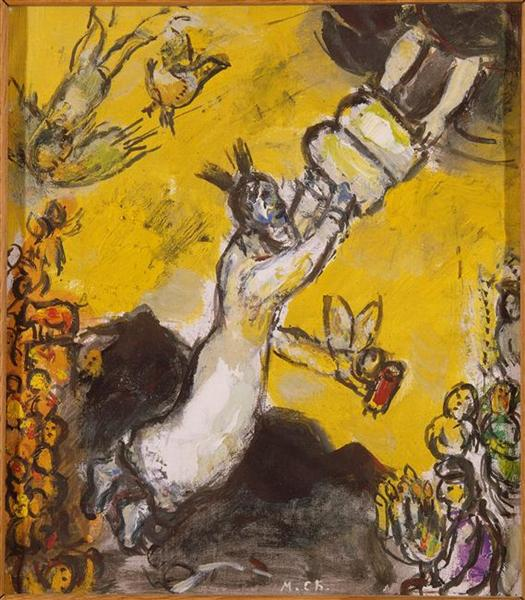
Moses Receives the Law, by Marc Chagall, 1963

“You must not pass along false rumors. You must not cooperate with evil people by lying on the witness stand.

“You must not follow the crowd in doing wrong. When you are called to testify in a dispute, do not be swayed by the crowd to twist justice. And do not slant your testimony in favor of a person just because that person is poor.

“If you come upon your enemy’s ox or donkey that has strayed away, take it back to its owner. If you see that the donkey of someone who hates you has collapsed under its load, do not walk by. Instead, stop and help.

“In a lawsuit, you must not deny justice to the poor.

“Be sure never to charge anyone falsely with evil. Never sentence an innocent or blameless person to death, for I never declare a guilty person to be innocent.

“Take no bribes, for a bribe makes you ignore something that you clearly see. A bribe makes even a righteous person twist the truth.

“You must not oppress foreigners. You know what it’s like to be a foreigner, for you yourselves were once foreigners in the land of Egypt. (New Living Translation)

On Mount Sinai, God gave Moses the Ten Commandments. These laws are basic ethical commands given to the people in their relationship to God and to one another. Following those Ten Words, the next several chapters of Exodus provide detailed instructions and commands for the Israelites in their own social, economic, and cultural context.

Today’s Old Testament lesson is part of this sequence of specific laws for the Israelites. These laws all have to do with being honest in legal matters. There is to be no perversion of justice through perjury, favoritism, bending to dishonest pressure, bribery, and false charges. What’s more, there must be no overlooking of the poor and powerless; and no disregard for the immigrant and foreigner.

All the sequences of commands – covering Exodus chapters 20-25 – are connected back to the basic Ten Commandments. The laws about justice and injustice are the fleshing-out of the ninth command to not testify falsely against your neighbor.

In other words, we are not to lie in public, especially when a person’s life or livelihood is at stake. We are to practice right relations with others; and do justice for all persons without prejudice or favoritism. We do this because God shows no favoritism and judges rightly with proper justice.

He will not judge by what he sees with his eyes,
    or decide by what he hears with his ears;
but with righteousness he will judge the needy,
    with justice he will give decisions for the poor of the earth. (Isaiah 11:3-4, NIV)

The Lord is a just God – it is inherent to the divine character. Therefore, our actions, as people created in the image of God, are to always be just, right, and truthful. There is a special place in God’s heart for the poor and powerless, and so, we ought also to consider their needs and treat them well and with respect – because true religion gives to those who we know cannot pay us back.

This, then, also is why immigrants and foreigners are mentioned. They need proper justice, and not negligence on our part to provide them with what they need. Throughout Holy Scripture we are admonished to not oppress the stranger from another place.

For through him [Christ] we both have access to the Father by one Spirit. Consequently, you are no longer foreigners and strangers, but fellow citizens with God’s people and also members of his household, built on the foundation of the apostles and prophets, with Christ Jesus himself as the chief cornerstone. (Ephesians 2:18-20, NIV)

The Lord watches over the foreigner
    and sustains the fatherless and the widow,
    but he frustrates the ways of the wicked. (Psalm 146:9, NIV)

Jesus picked up on the basic commands of God in his Sermon on the Mount – which, in many ways, is a restatement of the Ten Commandments by getting to the heart of them. Concerning the matter of giving false pledges, he said:

“Again you have heard that it was said to those who lived long ago: Don’t make a false solemn pledge, but you should follow through on what you have pledged to the Lord… Let your yes mean yes, and your no mean no. Anything more than this comes from the evil one. (Matthew 5:33, 37, CEB)

In court, we offer an oath, swearing that we will tell the truth and only the truth – and no lying. This is the only way that injustice can be avoided and justice can be established.

“I swear on a stack of Bibles I won’t…” “I will, if I get around to it….” These are a few of the caveats we give when making a promise or oath. Oaths communicate our truthful intentions of being above board with a high level of integrity.

It’s not okay when we bear false testimony concerning an event or incident that has taken place. There is no excuse for saying something is truthful when you know it isn’t quite true or all true. That makes us liars.

The Lord detests lying lips, but he delights in people who are trustworthy. (Proverbs 12:22, NIV)

Jesus wants us to clarify our values of right and wrong; make wise decisions; identify what we know is truth and error; and follow through on speaking the truth in love.

Any human society cannot stand unless it is committed to justice for all. People everywhere have a universal need for communities and nations which pursue truth, justice, benevolence, and integrity for everyone within their sphere of influence and responsibility.

Almighty God, who created us in your own image: Grant us grace to fearlessly contend against evil; and to make no peace with oppression, so that we may reverently use our freedom. Help us to employ that freedom in the maintenance of justice in our communities and among the nations, to the glory of your holy Name; through Jesus Christ our Lord, who lives and reigns with you and the Holy Spirit, one God, now and forever. Amen.

Good vs. Evil (2 Thessalonians 2:7-12)

For the mystery of lawlessness is already at work, but only until the one who now restrains it is removed. And then the lawless one will be revealed, whom the Lord Jesus will destroy with the breath of his mouth, annihilating him by the manifestation of his coming. The coming of the lawless one is apparent in the working of Satan, who uses all power, signs, lying wonders, and every kind of wicked deception for those who are perishing because they refused to love the truth and so be saved. For this reason God sends them a powerful delusion, leading them to believe what is false, so that all who have not believed the truth but took pleasure in unrighteousness will be condemned. (New Revised Standard Version)

There are two opposing forces which are operating in this world. One is the power of evil, manifested through lawlessness, selfishness, and wickedness. The other power is good, and it is seen wherever there is a concern for the common good of all people. Labors of love for all humanity and right relations with everyone are a demonstration of the peaceable fruit of righteousness existing in the world.

To put it succinctly, a spirit of merciful grace and a spirit of careless judgment both exist throughout the world.

Hate what is evil; cling to what is good.

The Apostle Paul (Romans 12:9, NIV)

The Apostle Paul wrote his letter to the church in Thessalonica because the believers there were confused. Somebody had told them that the end of the age already happened. Paul sought to set the record straight, that we are still anticipating the return of the Lord and the final judgment of all things.

The great Day of the Lord will not come until the faithless one, the person of lawlessness, the son of destruction, is revealed. Such a person opposes God and has the force of evil behind them. So, who is this person?

The person is not a single individual. Paul was helping the Thessalonian believers understand the actual situation by wrapping the abstract concept of evil into human form, so that they could visualize its reality and sinister nature. In truth, there will be lots of individual humans who manifest themselves through evil intent and actions, until the Lord’s return.

Grace is the operative power which restrains all the evil. A lot of people have questions about God and evil. Why is there so much evil? How come God doesn’t snuff it all out? Is the Lord not able to do anything? What’s going on?

Those are honest questions. And they come from a place of limited human perspective. Let’s turn this on it’s head. It’s not that God is impotent or isn’t doing anything about evil. Think of it this way: When you scoop up a bunch of sand in your hands, there are a lot of sand grains which fall to the ground. If the sand is evil, and the hands are God’s, the reality of the situation is that the Lord has most of the evil kept at bay.

In other words, if God were not involved in this world, at all, we would be living in a real dystopian society – people staying up at night to guard their homes with guns, and anxious folks attacking each other with impunity. As bad as some things are, it could be infinitely worse than it is.

The grace of God is active in restraining evil and providing believers with what they need to not only survive, but also to thrive in this world.

His divine power has given us everything needed for life and godliness, through the knowledge of him who called us by his own glory and excellence. Thus he has given us, through these things, his precious and very great promises, so that through them you may escape from the corruption that is in the world because of lust and may become participants of the divine nature. (2 Peter 1:3-4, NRSV)

A reversal occurs because of God’s grace. The wickedness which exists, especially within the human heart, is dealt with and transformed into a force for good in the world.

Once we, too, were foolish and disobedient. We were misled and became slaves to many lusts and pleasures. Our lives were full of evil and envy, and we hated each other. But—when God our Savior revealed his kindness and love, he saved us, not because of the righteous things we had done, but because of his mercy. (Titus 3:3-5, NLT)

Grace is wonderful for those who believe. However, for those who are faithless, grace is inoperative – simply because the wicked consider virtues like mercy and grace as weak and useless; they have no intention of either giving or receiving such drivel.

From a certain angle, it may seem that God is harsh. The Lord hardens hearts, sends powerful delusions, and entertains mysteries which some people will never discover. Yet, from another point of view, these are all necessary divine tools in dealing with unjust humanity and their systems of oppression.

Justice and righteousness are championed by God, and therefore, injustice and unrighteousness will not be put up with by the Lord. And that is a good thing. Love not only gives, but it also protects and withholds. Evil will be dealt with according to God’s good grace and in God’s good time – and not according to a limited human perspective or any person’s impatience.

The time is short, and the time is near; everything shall not continue, as it presently is, forever. This is why the author of Hebrews exhorted people to pay attention to “Today” with a capital “T.” Today won’t be here tomorrow. Tomorrow is the Day of the Lord. So, while it’s Today, we must be responsive.

My friends, watch out! Don’t let evil thoughts or doubts make any of you turn from the living God. You must encourage one another each day. And you must keep on while there is still a time that can be called “Today.” If you don’t, then sin may fool some of you and make you stubborn. (Hebrews 3:12-13, CEV)

We must encourage each other with continued faith and patience until the end of the age. We can do this. We are all in this life together, so let us keep on holding up one another and carrying each other’s burdens. In so doing, we will not be lawless, but fulfill the Law of Christ. (Galatians 6:2)

Keep on being brave! It will bring you great rewards. Learn to be patient, so you will please God and be given what he has promised. As the Scriptures say,

“God is coming soon!
    It won’t be very long.
The people God accepts
will live because
    of their faith.
But he isn’t pleased
with anyone
    who turns back.”

We are not like those people who turn back and get destroyed. We will keep on having faith until we are saved. (Hebrews 10:35-39, CEV)

May it be so, to the glory of God. Amen.