Speak To the Dry Bones (Ezekiel 37:1-14)

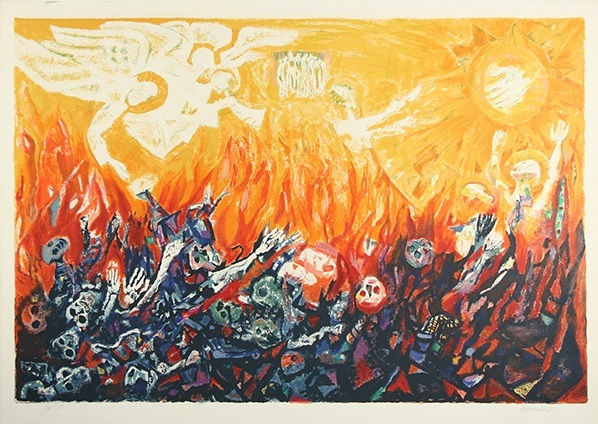
Valley of the Dried Bones, by Abraham Rattner (1895–1978)

The power of the Lord came over me. The Lord brought me out by his Spirit and put me down in the middle of a valley. The valley was filled with bones. He led me all around them. I saw that there were very many bones at the bottom of the valley, and they were very dry.

Then he asked me, “Son of man, can these bones live?”

I answered, “Only you know, Almighty Lord.”

Then he said to me, “Prophesy to these bones. Tell them, ‘Dry bones, listen to the Lord’s word. This is what the Almighty Lord says to these bones: I will cause breath to enter you, and you will live. I will put ligaments on you, place muscles on you, and cover you with skin. I will put breath in you, and you will live. Then you will know that I am the Lord.’ ”

So I prophesied as I was commanded. While I was prophesying, suddenly there was a rattling noise, and the bones came together, one bone attaching itself to another. As I looked, I saw that ligaments were on them, muscles were on them, and skin covered them. Yet, there was no breath in them.

Then the Lord said to me, “Prophesy to the breath! Prophesy, son of man. Tell the breath, ‘This is what the Almighty Lord says: Come from the four winds, Breath, and breathe on these people who were killed so that they will live.’ ”

So I prophesied as he commanded me, and the breath entered them. Then they came to life and stood on their feet. There were enough of them to form a very large army.

The Lord also said to me, “Son of man, all the people of Israel are like these bones. The people say, ‘Our bones are dry, and our hope has vanished. We are completely destroyed.’ So prophesy. Tell them, ‘This is what the Almighty Lord says: My people, I will open your graves and take you out of them. I will bring you to Israel. Then, my people, you will know that I am the Lord, because I will open your graves and bring you out of your graves. I will put my Spirit in you, and you will live. I will place you in your own land. Then you will know that I, the Lord, have spoken, and I have done it, declares the Lord.’ ” (God’s Word Translation)

Dry. It might be good for humor or a martini. Dry, however, doesn’t feel good when it’s a time of spiritual dryness.

Perhaps you are dry. It seems the entire world is dry. Wars, conflict, death, violence, uncertainty, unrest, and upset people everywhere is evidence that there is dryness across the earth. Many institutions, organizations, companies, and faith communities have become so withered and dry, that they have folded and died.

The hard circumstances of our world, stress in our families, and challenging personal lives may easily create anxiety, and, so, parch our souls and leave our spirits bone dry. There is, however, a God who can breathe new life into us and move us from old-worn ruts in our thinking, feeling, and behaving, to renewed ways of being in the world. 

The prophet Ezekiel’s vision is a promise and a hope of resurrection, revival, and new life. Regardless of who we are and the situations in front of us, we are all displaced people – cast out of Eden and in need of restoration. 

We, along with the ancient Israelites, are in exile and long to return to our true home with God. Along with St. Augustine we declare that our “hearts are forever restless until they find their rest in God.”

Maybe you are presently experiencing the dry bones of hopelessness and despondency. Perhaps you are in a dark night of the soul where all of life seems like one huge rut. It could be you are wondering if God is really listening, or is even there at all, because of the dry bones surrounding you.

In my work as a hospital chaplain I often encounter patients who are, ironically, bone dry from too much drinking. Their alcoholism is like a massive desert littered with thousands of dry bones. Attempting to reanimate themselves while dulling the pain of incredibly hard dry circumstances, they drink liter after liter of “spirits” to replace the dead spirit inside them. Some become so dry and dead inside their immaterial selves, that they seek to end their material lives through suicide.

But it need not be this way. We might believe we will be able to live life and pursue God better without danger or hardship – that somehow difficulty is not to be part of life. The dry bones exist, however, as an opportunity for God to give life. That’s why Alexander Solzhenitsyn’s reaction to his exile in a Soviet labor camp in Siberia was to bless it, because it was there he said:

“I discovered that the meaning of earthly existence lies not, as we have grown used to thinking, in prospering, but in the development of the soul.”

Alexander Solzhenitsyn

God not only gives life; God restores life. And this is an important truth to know and remember in the inevitable dry times of our lives. God is not only a helper; the Lord reanimates us from spiritual rigor mortis to lively resurrection through breathing on us. And this is done for a reason. Jesus came to his disciples after his resurrection and said:

God resuscitates us for a purpose, so that we might be a blessing to the world. Faith is not only a possession to keep, but a gift to give. We glorify God in loving one another and loving the world as Jesus did.  God could have resurrected the bones without Ezekiel. Instead, the Lord used Ezekiel and had him participate in the revival by speaking to the bones. 

Such a challenge to speak to the dry bones can seem overwhelming to us. What do you do when your life is upended, even shattered – when such a profound change comes to you that it is impossible for your life to be as it was? 

The questions and commands of God seemed totally absurd to Ezekiel, speaking to dead dry bones. Yet methinks we ought to operate more in the realm of the absurd than in the realm of the safe routine.

Perhaps we ought to expect our faith to be exercised and look for God to breathe new life into the dead and decaying. To believe that something, someone, or even myself can change is to have internalized this amazing story of dry bones living again. 

Our self-imposed graves cannot hold us because God is among us.

We need a genuine heaven-sent, Spirit-breathed, glorious reanimation in which God sends reviving grace and raises the dead. 

Lord of Resurrection, please be attentive to our prayers; and make what is impossible possible:

For those without hope – feeling dried up and cut off from you – open their graves and bring them back to the land of the living.

For those spiritually oppressed – held captive by sin – release them from their chains and let them go! For those who weep – lost and lifeless in a tomb of fear and shame – give them the peace of your presence, and show them what your love can do.

For those complacent – withering on the vine, and living a dull dry existence without any spiritual vigor – awaken them, O Lord! Breathe into them new life!

Pour out your Spirit, gracious God, and awaken all kinds of people to a revival of obedience, love, and courage.

May your people be so full of your Spirit that life comes rolling off our tongues and the strength of life empowers our hands for service. Amen.

The Transfiguration of Jesus (Mark 9:2-9)

The Transfiguration of Jesus, by Armando Alemdar Ara, 2004

After six days Jesus took Peter, James and John with him and led them up a high mountain, where they were all alone. There he was transfigured before them. His clothes became dazzling white, whiter than anyone in the world could bleach them. And there appeared before them Elijah and Moses, who were talking with Jesus.

Peter said to Jesus, “Rabbi, it is good for us to be here. Let us put up three shelters—one for you, one for Moses and one for Elijah.” (He did not know what to say, they were so frightened.)

Then a cloud appeared and covered them, and a voice came from the cloud: “This is my Son, whom I love. Listen to him!”

Suddenly, when they looked around, they no longer saw anyone with them except Jesus.

As they were coming down the mountain, Jesus gave them orders not to tell anyone what they had seen until the Son of Man had risen from the dead. (New International Version)

It may be that reading this account of Christ’s transfiguration (metamorphosis) seems a bit strange, even confusing. Perhaps you have no categories of thought to explain such an encounter.

In a Peanuts cartoon, Charlie Brown, Lucy, and Linus were lying on their backs looking at the sky. Lucy says, “If you use your imagination you can see lots of things in the cloud formations. What do you think you see, Linus?” 

Linus replied, “Well, those clouds up there look to me like the map of the British Honduras on the Caribbean… That cloud up there looks a little like the profile of Thomas Eakins, the famous painter and sculptor… And that group of clouds over there gives me the impression of the stoning of Stephen… I can see the Apostle Paul standing there to one side…” 

Lucy responds, “Uh huh… that’s very good… what do you see in the clouds, Charlie Brown?”

To which Charlie Brown replied, “Well, I was going to say a ducky and a horsy, but I changed my mind.”

Maybe your spiritual life seems more like Charlie Brown than Linus. Compared to the experiences of others, you have not had any defining moments of ecstasy; no shining Jesus in front of you; or no spectacular vision of Christ.

Perhaps your life seems rather mundane and ordinary in light of the many stories we have in the Gospels of Jesus doing the miraculous. 

Most of life is lived in the daily grind. In the monotony of life, we need some hope, an occasional mountain top experience that helps us glimpse into the future of what it will be like someday when the kingdom of God comes in its fullness.

Christ’s transfiguration came after a hard frank discussion Jesus had with the disciples about his impending death. Jesus was up front with them, saying that he must suffer, be rejected, and killed. But in three days he will rise again. The disciples did not want to hear that; Peter even rebuked Jesus for saying it. In response, Jesus said:

“If anyone would come after me, he must deny himself and take up his cross and follow me. For whoever wants to save his life will lose it, but whoever loses his life for me and for the gospel will save it.”

Jesus (Mark 8:34-35, NIV)

Jesus identified himself as the Suffering Servant, the One who must suffer and die. Yet, he is also the One to be glorified. For Jesus, there has to be suffering before glory. And it is the same for us.

The Christian life includes walking through the valley of the shadow of death. But it is also punctuated with mountain top experiences that give us hope. The nature of the Christian journey is up and down, with both the mountain and the valley as spiritual realities of great importance.

We may have a lot of questions about Christ’s transfiguration. Jesus had a metamorphosis smack in front of the disciples’ eyes. Why? What’s the significance of this? Was it just a demonstration to get their attention? Why are Moses and Elijah there? What’s really going on?

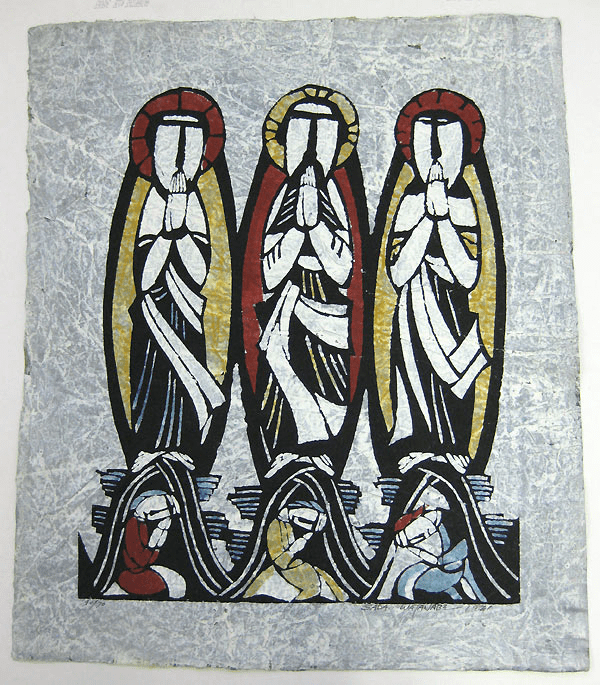
Transfiguration, by Sadao Watanabe, 1971

Jesus intentionally took Peter, James, and John up the mountain to have this experience. Up to that point, a lot of rumors were circulating about Jesus – that maybe he was Elijah come back, or some other prophet, perhaps even Moses himself. But Moses and Elijah showing up next to Jesus, meant that Jesus is not them. 

In the Old Testament, Moses was used by God to deliver the Israelites out of slavery in Egypt and to bring them to the Promised Land. Centuries later, Elijah was used by God to bring about a great repentance of the people from the false god Baal, and a mighty revival to the exclusive worship of the Lord.

As good as Moses and Elijah were, having them with Jesus on the mountain meant that it gets even better with Christ. Jesus is the Messiah, the True Deliverer, who saves people from their sins. What’s more, Jesus is the ultimate revivalist, bringing truth, grace, and the love of God to people, calling them from legalistic religion back to the true worship of God.

Deliverance and revival were integral to Christ’s earthly ministry. And Jesus expects his followers to do the same. In Christian ministry, there will be suffering, because we must take up our cross. There will also be glory, experiencing and seeing deliverance from sin that comes with revival. 

When I was in college, a group of us Christians met each week for encouragement and prayer. For a two year period, at least one person a week was added to our group, having had a dramatic conversion to Christ. That was an incredible time of being on the mountain with Jesus, seeing him manifested in all his glory through changing people’s lives.

Yet, inevitably, we descend to the valley. What goes up must come down. And how we handle the valley is crucial. On the mountain, things seemed effortless; but in the valley, it’s all different.

Coming off the mountain may lead to various temptations, like wishing you were back on the mountain – looking back to some Golden Age where everything seemed so great, and people were enthused and excited about God and the group you were in. Yet, there are times when the revival fires wane, and the glory departs. Then what?…

God’s Word to us today, given by God the Father, is: “This is my Son, whom I love. Listen to him!”

A 12th century Mosaic of Christ’s Transfiguration

Here is what Jesus has said to us, as recorded by the Evangelist Mark:

“The time has come. The kingdom of God is near. Repent and believe the good news!” (Mark 1:15)

“Come, follow me, and I will make you fishers of men.” (Mark 1:17)

“It is not the healthy who need a doctor, but the sick. I have not come to call the righteous, but sinners.” (Mark 2:17)

“Why are you so afraid? Do you still have no faith?” (Mark 4:40)

“Everything is possible for him who believes.” (Mark 9:23)

“If anyone wants to be first, he must be the very last, and the servant of all.” (Mark 9:35)

“I tell you the truth, anyone who will not receive the kingdom of God like a little child will never enter it.” (Mark 10:15)

“…the Son of Man will be betrayed to the chief priests and teachers of the law. They will condemn him to death and will hand him over to the Gentiles, who will mock him and spit on him, flog him and kill him….” (Mark 10:33-34)

“For even the Son of Man did not come to be served, but to serve, and to give his life as a ransom for many.” (Mark 10:45)

“I tell you, whatever you ask for in prayer, believe that you have received it, and it will be yours. And when you stand praying, if you hold anything against anyone, forgive him, so that your Father in heaven may forgive you your sins.” (Mark 11:24-25)

“My God, my God, why have you forsaken me?” (Mark 15:34)

“Go into all the world and preach the good news to all creation.” (Mark 16:15)

If you have had a mountain top experience with Jesus, let that encounter give you the drive and the hope to keep carrying the bucket through the valley, without living in the past.

If you have never been on the mountain, then today, listen to Jesus and follow what he says.

If you are vexed in your spirit, go to Jesus. Listen to him. Do what he says.

Know the word of the Lord, and bank on it. For our light and momentary sufferings will result in praise, honor, and glory when Jesus Christ is revealed. Amen.

Psalm 80:1-2, 8-19 – Longing for Restoration

Shepherd of Israel, listen!
    You, the one who leads Joseph as if he were a sheep.
    You, who are enthroned upon the winged heavenly creatures.
Show yourself before Ephraim, Benjamin, and Manasseh!
    Wake up your power!
Come to save us!…

You brought a vine out of Egypt.
    You drove out the nations and planted it.
You cleared the ground for it;
    then it planted its roots deep, filling the land.
The mountains were covered by its shade;
    the mighty cedars were covered by its branches.
It sent its branches all the way to the sea;
    its shoots went all the way to the Euphrates River.
So why have you now torn down its walls
    so that all who come along can pluck its fruit,
    so that any boar from the forest can tear it up,
    so that the bugs can feed on it?

Please come back, God of heavenly forces!
    Look down from heaven and perceive it!
Attend to this vine,
    this root that you planted with your strong hand,
    this son whom you secured as your very own.
It is burned with fire. It is chopped down.
    They die at the rebuke coming from you.
Let your hand be with the one on your right side—
    with the one whom you secured as your own—
    then we will not turn away from you!
Revive us so that we can call on your name.
    Restore us, Lord God of heavenly forces!
    Make your face shine so that we can be saved! (Common English Bible)

Let us continually keep in mind that the psalms are quite Jewish. Yes, I often refer to the psalms as the Church’s Prayer Book and unabashedly see them through Christian eyes. Yet, the psalter, at its core, are prayers and songs of the Jewish experience.

The deep longings and yearnings of the Jewish people within a constant stream of hardship, difficulty, and persecution give voice to all humanity. In other words, the bearing of the Jewish soul as the people of God is the crying out on behalf of us all.

The Jews know a thing or two about lament. Today’s psalm is a lament, a prayer, a longing for God to come and restore Israel. It is a cry for the Lord to no longer look upon them with anger. The people knew, in their exposed vulnerability, they needed God. They longed for their God to come and save them and to bring a revitalized nation.

Amid awful circumstances and emotional pain, it can be hard to focus with any sort of concentrated prayer. 

The Jews also help us here because they crafted and arranged the psalms in such a way as to enable and foster recall and memory. So, where many of us Gentiles can be rather more like pagans babbling on in our distress, the Jewish psalms offer us the ability of short, succinct, and staccato prayers. Early Christians called them “breath prayers.” 

Throughout the day we can utter “Stir up your power, O God; come to save us.”  The intention of saying it repeatedly in a day is not to get God’s attention – because we already have it. No, the purpose is to connect us with Divine resources for deliverance; to be in constant touch and continual communion with the One who can ultimately restore, renew, revitalize, and reform the world with justice and righteousness. 

Repeated short prayers offer us the opportunity to express our longing for the flourishing of the earth and its inhabitants, as well as to enjoy walking with God in the garden of fellowship, peace, and goodwill.

To pray is to be restored.

Restoration is a beautiful thing. I rarely watch makeover shows on television, but if I notice a program where an old house, seemingly better suited for the wrecking ball, getting restored to its original charm and beauty, I am hooked. 

We as people seem to resonate deeply with things being repaired and rejuvenated to looking brand new again.

Again, the Jewish people go before us, through the psalms, with the vision to see the old become new. Whereas some may get lost in the drab discouragement of a gray and dreary environment, forgetting the original shine of how things once were, Asaph, the consummate Jewish song leader, guided the people in remembering how God’s people enjoyed the covenant and the promises of God. 

Yet, over time, the relationship was not maintained and cared for; the people gradually slid into disrepair, much like a once grand old house, now merely a haunt for critters and birds. Centuries of neglecting prayer and worship brought a situation where it seemed the only recourse was to do away with the people and begin again.

I certainly do not want to be on the bad end of God’s anger. I would much rather learn my lesson from the Jewish experience and enjoy Divine favor.

I also long to see this old fallen world restored to her original beauty. So, we must come to God – not once – but again and again, over, and over. Like the hammer of perseverance, pounding nail after nail, so we must offer our prayers morning, noon, and night, day after day, crying out to God with the great cry of the Jewish people:  “Restore us, O God; let your face shine, that we may be saved!”

Merciful God of all nations bring restoration to our lives, our families, our faith communities, our workplaces, our human institutions, our neighborhoods, and our shared world. Send your Holy Spirit so that we might enjoy seasons of blessing again.  Restore, renew, revive, and rejuvenate our disordered love. May your face shine upon us once again through the mighty name of Jesus. Amen.

2 Chronicles 15:1-15 – Revive Us Again

The Spirit of God came on Azariah son of Oded. He went out to meet Asa and said to him, “Listen to me, Asa and all Judah and Benjamin. The Lord is with you when you are with him. If you seek him, he will be found by you, but if you forsake him, he will forsake you. For a long time, Israel was without the true God, without a priest to teach and without the law. 

But in their distress they turned to the Lord, the God of Israel, and sought him, and he was found by them. In those days it was not safe to travel about, for all the inhabitants of the lands were in great turmoil. One nation was being crushed by another and one city by another, because God was troubling them with every kind of distress. But as for you, be strong and do not give up, for your work will be rewarded.”

When Asa heard these words and the prophecy of Azariah son of Oded the prophet, he took courage. He removed the detestable idols from the whole land of Judah and Benjamin and from the towns he had captured in the hills of Ephraim. He repaired the altar of the Lord that was in front of the portico of the Lord’s temple.

Then he assembled all Judah and Benjamin and the people from Ephraim, Manasseh and Simeon who had settled among them, for large numbers had come over to him from Israel when they saw that the Lord his God was with him.

They assembled at Jerusalem in the third month of the fifteenth year of Asa’s reign. At that time, they sacrificed to the Lord seven hundred head of cattle and seven thousand sheep and goats from the plunder they had brought back. They entered into a covenant to seek the Lord, the God of their ancestors, with all their heart and soul. All who would not seek the Lord, the God of Israel, were to be put to death, whether small or great, man or woman. They took an oath to the Lord with loud acclamation, with shouting and with trumpets and horns. All Judah rejoiced about the oath because they had sworn it wholeheartedly. They sought God eagerly, and he was found by them. So, the Lord gave them rest on every side. (New International Version)

God’s people had drifted. Times of seeking the Lord became few and far between – until it rarely happened, at all. They were spiritually dry with seemingly no hope. How did they get to the point of being so far from God that they needed a spiritual revival?

After God brought Israel out of hundreds of years of slavery in Egypt, they were led to the Promised Land with Moses as leader. Moses died, and his young protégé Joshua took over and led Israel in her military campaigns to take the land that God had promised them. 

God kept the divine promises. However, although Israel had geographically taken the land, they did not completely dislodge all the peoples living there, as God had told them to do. God’s people only partially obeyed. They were content to be in the land without dealing with all the remaining people.

Israel and Judah’s relationship to the land also serves as a metaphor for the church and her faith. Israel saw the land as a possession, as something to have, rather than as something to be used and developed for the glory of God. 

If and when God’s people, in any age, look upon their faith as merely a possession, instead of a dynamic relationship between themselves and the Lord, then the beginnings of spiritual rigor mortis begin to settle in. 

We get a haunting narrative in the book of Judges, after the people took the land, and Joshua died: 

“After that whole generation had been gathered to their ancestors, another generation grew up who knew neither the Lord nor what he had done for Israel… They forsook the Lord, the God of their ancestors, who had brought them out of Egypt. They followed and worshiped various gods of the peoples around them. They aroused the Lord’s anger.” (Judges 2:10-12)

The land became something not to lose, instead of something God wanted to use to grow them into faithful people.

The day God’s people took the land was the day they rejoiced in victory, and also the day their faith began to die. The Old Testament is a long drawn out story of a disobedient and obstinate people who continually forsake their God and live like the nations for whom they did not overcome. 

The Lord, ever the longsuffering and patient God, went century after century sending prophets to call them back to a living faith. Yet, with each passing year, they’d die a little bit more.

The promise, however, was always there: Seek God, and you will find him. Whenever the people were reminded of that reality and took it to heart by going after the Lord, there was revival in the land.

Restore us, Lord God Almighty;
    make your face shine on us,
    that we may be saved.

Psalm 80:19, NIV

God’s people, in every age, must look upon faith as a wonderful opportunity to spiritually engage the world – to explore all the dimensions of knowing God. That requires putting unhealthy stuff aside and taking up healthy practices. The word for that action is “repentance.” And the result is revival, or new life.

For the Christian, if the goal is to just keep some semblance of looking like a real follower of Jesus, then there is probably some inner distress which no one sees. If we become more afraid of making mistakes than we are of missing God-given opportunities, then the time is ripe for a revival. 

God does not send us to safe places to do easy things; the Lord sends prophets to remind us of our true calling, to revive us again.

The need for resurrection presupposes that there is death. Praying for revival, renewal, and reawakening means that something needs life. With God, nothing is impossible – even the deadest and driest of people and situations.

God specializes in both giving and restoring life. The Lord does more than help; God finds us and changes us. reanimates us from spiritual rigor mortis to lively resurrection through breathing on us. Jesus came to his disciples after the resurrection and said:

“Peace be with you! As the Father has sent me, I am sending you.” And with that he breathed on them and said, “Receive the Holy Spirit. ” (John 20:21-22, NIV)

Faith is more than a possession; it is also a gift to be used to glorify God in loving one another and loving the world as Jesus did.

You live where you live because God wants you to bring life to your neighborhood. 

Who will pray for your neighbors, if not you? 

Who will be concerned for our communities, if not us? 

You work at your workplace because God wants to bring life to it.

Who will make a difference at your workplace, if not you? 

You are in your family, your school, or your church because God wants to bring life to all those spaces and places.

Who will bring a vigorous spiritual life everywhere they are, if not you? 

We are to seek the Lord. It isn’t a game of hide-and-seek. It is an act of faith, believing that God can and will be found by those who seek after him. And wherever God is found, there you will find abundant life.

Perhaps, just maybe, what is needed is some heartfelt, sustained, and focused prayer to God.

Ask and it will be given to you.

Seek and you will find.

Knock and the door will be opened to you. 

For everyone who asks receives; the one who seeks finds; and to the one who knocks, the door will be opened. (Matthew 7:7-8)

Revive us again, fill each heart with thy love.
May each soul be rekindled with fire from above.

Hallelujah! Thine the glory, hallelujah! Amen!
Hallelujah! Thine the glory, revive us again. – W.P. Mackay, 1863