Consider Your Reputation (Revelation 18:1-10, 19-20)

After this I saw another angel coming down from heaven. He had great authority, and the earth was illuminated by his splendor. With a mighty voice he shouted:

“‘Fallen! Fallen is Babylon the Great!’
    She has become a dwelling for demons
and a haunt for every impure spirit,
    a haunt for every unclean bird,
    a haunt for every unclean and detestable animal.
For all the nations have drunk
    the maddening wine of her adulteries.
The kings of the earth committed adultery with her,
    and the merchants of the earth grew rich from her excessive luxuries.”

Then I heard another voice from heaven say:

“‘Come out of her, my people,’
    so that you will not share in her sins,
    so that you will not receive any of her plagues;
for her sins are piled up to heaven,
    and God has remembered her crimes.
Give back to her as she has given;
    pay her back double for what she has done.
    Pour her a double portion from her own cup.
Give her as much torment and grief
    as the glory and luxury she gave herself.
In her heart she boasts,
    ‘I sit enthroned as queen.
I am not a widow;
    I will never mourn.’
Therefore in one day her plagues will overtake her:
    death, mourning and famine.
She will be consumed by fire,
    for mighty is the Lord God who judges her.

“When the kings of the earth who committed adultery with her and shared her luxury see the smoke of her burning, they will weep and mourn over her. Terrified at her torment, they will stand far off and cry:

“‘Woe! Woe to you, great city,
    you mighty city of Babylon!
In one hour your doom has come!…’

They will throw dust on their heads, and with weeping and mourning cry out:

“‘Woe! Woe to you, great city,
    where all who had ships on the sea
    became rich through her wealth!
In one hour she has been brought to ruin!’

“Rejoice over her, you heavens!
    Rejoice, you people of God!
    Rejoice, apostles and prophets!
For God has judged her
    with the judgment she imposed on you.” (New International Version)

Much of the book of Revelation, also known as The Apocalypse of John, is related in symbolic language. The Apostle John had a vision – much like a dream – and saw things that were to come. Like the prophet Ezekiel, experiencing a vision from the Lord is hard to put into words once you’ve experienced it.

John sees and hears the fall of Babylon, that is, the city of Rome. He heard the angel proclaim the empire’s utter desolation and saw what the city would lose. It’s bad news for Rome but good news for the rest of the earth. Drunkenness and sexual immorality are metaphors for the Roman Empire’s crime of acquiring wealth and luxury on the backs of others through imperialism.

What’s more, Rome deceived the nations by causing them to think and believe this economic and religious imperialism was right, good, and needed. So, other city states and nations went to bed with them in this impure and unholy cause. Therefore, divine judgment was coming.

The Fall of Babylon, 15th century artwork

The Apostle John wanted his readers to make a clean break with the Roman Empire and everything it represents. Rome had a “good” reputation with many of the conquered and colonized peoples in the Empire. But, in reality, they had spread evil and encouraged others in their immorality. There was an awfully dark underbelly to Rome’s power and authority that the people of God were invited to see and repudiate.

The issue of reputation is an important one, because how we come across to others might be different than who we actually are.

One day at a parent-teacher conference, many years ago when my middle daughter was in second grade, the teacher told my wife and I about the class reading some Winnie the Pooh books. The kids were to talk about which Pooh character they liked the most and why. Since my sweet daughter is an outgoing and bouncy person, I was certain that she had said that Tigger was her favorite. But instead, she told the teacher her favorite was Eeyore, “because Eeyore reminds me of my Daddy.”

Ouch. I wasn’t ready for that one. Yet, as I thought about my daughter’s answer, I began to see that since I was working as a factory supervisor, going to graduate school at night, and being a part-time church pastor, I was continually drained and tired. So, my daughter experienced me as if I was Eeyore loping about the house with a pinned-on tail.  

Before that parent-teacher conference encounter, I never would have described myself as my daughter did. Obviously, my reputation did not match my self-perception – which leads me to ask a question for you to struggle with: What is your reputation with others? 

The question is not: What do you think your reputation is? That’s because the only way to know your reputation is to interact with other people. And their answers may be very different than what you think they might be.

If there is a clear disconnect between what someone or some group says about you, and what you think is true about you, then please do not dismiss their thoughts or opinions. You may not like what they say, but we need to weigh the words and glean as much wisdom as we can from them.  

Also, if it is a negative perception, or truly off the mark, use the information to help inspire you toward change. And if there are things that you know need changing, think about what kind of reputation you want to have and begin setting some goals for achieving what you want. Begin with the results you want, and then focus on the small steps you can do to gain what you are after.

There is yet one more critical question to ask, and the way you answer it requires the utmost honesty and vulnerability: What is your reputation with God?

As with others, your approach is to be the same, that is, ask God what God thinks about you. Read Holy Scripture and spend time with the Lord. No individual believer or faith community can ever hope to glorify God and have effective ministry unless they are genuine and urgent about where they stand before God and what their reputation is with people outside of church.

Let’s not assume that others do or should think highly of us, of Christians, or of the Church. Ask the questions of reputation. Use them to spawn the kind of interaction that is needed to help address what God wants for your life. 

I did not want to be Eeyore, so I reassessed my use of time so that I could be more fully present to my family. What will it mean for you?

Blessed Holy Spirit, in the name of Jesus, help me to cultivate godly character, thereby building a good reputation. Deliver me from whatever will destroy my reputation. Save the leaders of your church everywhere from the enemy that seeks to damage their reputation. Protect and preserve them, O Lord. Amen.

Encountering God (Exodus 19:9-25)

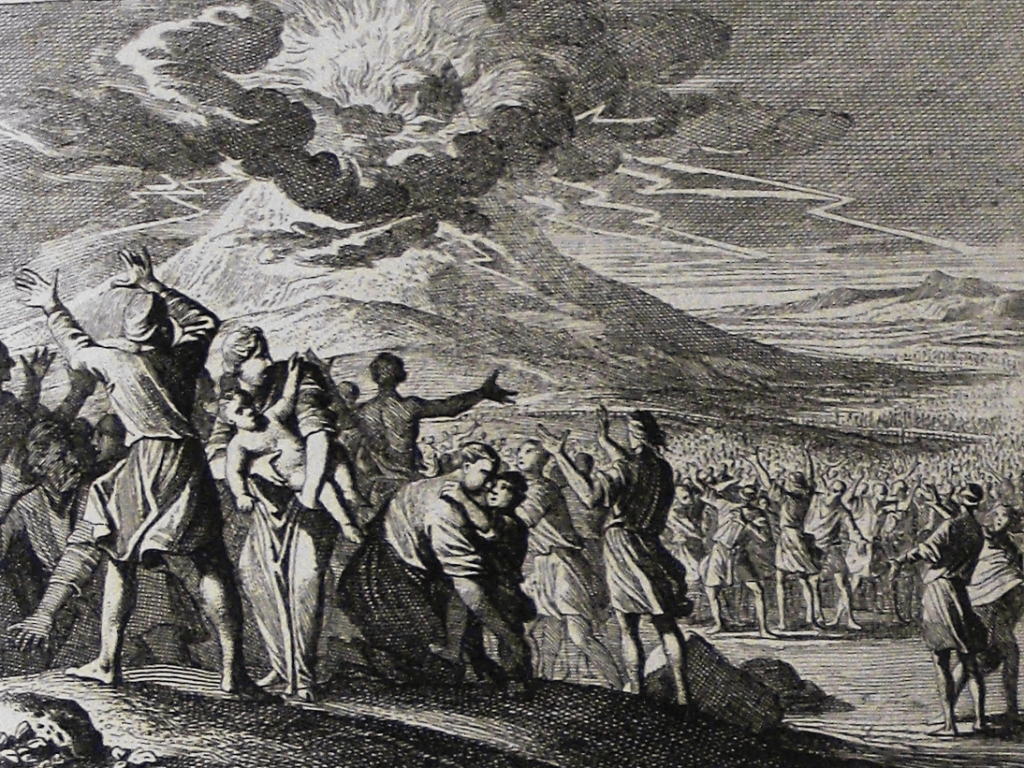
Israel at Mount Sinai, by Jan Luijken (1649–1712)

Then the Lord said to Moses, “I will come to you in a thick cloud, Moses, so the people themselves can hear me when I speak with you. Then they will always trust you.”

Moses told the Lord what the people had said. Then the Lord told Moses, “Go down and prepare the people for my arrival. Consecrate them today and tomorrow, and have them wash their clothing. Be sure they are ready on the third day, for on that day the Lord will come down on Mount Sinai as all the people watch. Mark off a boundary all around the mountain. Warn the people, ‘Be careful! Do not go up on the mountain or even touch its boundaries. Anyone who touches the mountain will certainly be put to death. No hand may touch the person or animal that crosses the boundary; instead, stone them or shoot them with arrows. They must be put to death.’ However, when the ram’s horn sounds a long blast, then the people may go up on the mountain.”

So Moses went down to the people. He consecrated them for worship, and they washed their clothes. He told them, “Get ready for the third day, and until then abstain from having sexual intercourse.”

On the morning of the third day, thunder roared and lightning flashed, and a dense cloud came down on the mountain. There was a long, loud blast from a ram’s horn, and all the people trembled. Moses led them out from the camp to meet with God, and they stood at the foot of the mountain. All of Mount Sinai was covered with smoke because the Lord had descended on it in the form of fire. The smoke billowed into the sky like smoke from a brick kiln, and the whole mountain shook violently. As the blast of the ram’s horn grew louder and louder, Moses spoke, and God thundered his reply. The Lord came down on the top of Mount Sinai and called Moses to the top of the mountain. So Moses climbed the mountain.

Then the Lord told Moses, “Go back down and warn the people not to break through the boundaries to see the Lord, or they will die. Even the priests who regularly come near to the Lord must purify themselves so that the Lord does not break out and destroy them.”

“But Lord,” Moses protested, “the people cannot come up to Mount Sinai. You already warned us. You told me, ‘Mark off a boundary all around the mountain to set it apart as holy.’”

But the Lord said, “Go down and bring Aaron back up with you. In the meantime, do not let the priests or the people break through to approach the Lord, or he will break out and destroy them.”

So Moses went down to the people and told them what the Lord had said. (New Living Translation)

Moses receives the Ten Commandments, by Caspar Luijken (1672-1708)

There’s a lot of drama surrounding today’s Old Testament story. That’s because it’s a big deal when an announcement comes that God is about to show up, speak to the people, and be with them. This is definitely not the stuff of daily mundane life.

The Mount Sinai event is one of the most remembered and talked about events in the Old Testament. This encounter establishes that the presence of the Lord is with Moses, thereby giving him authority over the people. It authenticates the leadership of Moses up to this point – in leading the people out of Egyptian slavery and to the Promised Land.

The presence of God with the people, demonstrated in Moses the leader, assures the Israelites of protection against dangers from other nations and peoples. The divine presence of the Lord will be seen preeminently in the giving of the Law. God’s very Word is encapsulated in the commands and instructions given to Moses on the mountain.

Although the scene on Mount Sinai appears dark, serious, and even scary, it nonetheless is a gift of God’s self-revelation to the people. The Law is a wonderful and gracious provision for Israel. The Lord is providing necessary guidance for living, direction in shaping successful spiritual lives, and the opportunity for obedience to a life-giving system of laws.

If the Israelites hear and obey the Lord, they will be God’s special and treasured people – a nation of priests, a people set apart to be a light for the world.

So, preparations were made for God to enter. The Lord is truly awesome and holy, and so, certain boundaries needed to be established so that the people would be safe and not overcome by such immense light and power. The mountain shakes in anticipation of the divine arrival; the shofar (ram’s horn) is heard, signaling the imminent entrance of God.

The people are assembled by Moses. God descends in the fire, which accompanies the Lord’s presence. Yahweh has come to Israel. The way is now prepared for God’s revelation to be given to Moses in Israel’s hearing. It is an awesome sight and experience.

Perhaps your own days on this earth seem very ho-hum compared to the mountain encounter of Moses and God. You may even feel as if your prayers are puny and don’t get beyond the ceiling of your house. Yet, there is always and continually an opportunity to meet with this very same God, without all the pomp and scariness.

Every single day we have the gracious and wonderful opportunity of opening the book containing a good and merciful God’s self-revelation, and reading gracious words of life to live by. We have guidance for our earthly journey; there is direction for our needy souls.

Your word is a lamp to guide my feet
    and a light for my path. (Psalm 119:105, NLT)

All Scripture is inspired by God and is useful to teach us what is true and to make us realize what is wrong in our lives. It corrects us when we are wrong and teaches us to do what is right. God uses it to prepare and equip his people to do every good work. (2 Timothy 3:16-17, NLT)

Blessed Lord, who caused all Holy Scriptures to be written for our learning: Grant us so to hear them, read, mark, learn and inwardly digest them, so that we may embrace and ever hold fast the blessed hope of everlasting life, which you have given us in our Savior Jesus Christ; who lives and reigns with you and the Holy Spirit, one God, forever and ever. Amen.

Love and Obedience (Revelation 3:7-13)

“Write this letter to the angel of the church in Philadelphia.

This is the message from the one who is holy and true,
    the one who has the key of David.
What he opens, no one can close;
    and what he closes, no one can open:

“I know all the things you do, and I have opened a door for you that no one can close. You have little strength, yet you obeyed my word and did not deny me. Look, I will force those who belong to Satan’s synagogue—those liars who say they are Jews but are not—to come and bow down at your feet. They will acknowledge that you are the ones I love.

“Because you have obeyed my command to persevere, I will protect you from the great time of testing that will come upon the whole world to test those who belong to this world. I am coming soon. Hold on to what you have, so that no one will take away your crown. All who are victorious will become pillars in the Temple of my God, and they will never have to leave it. And I will write on them the name of my God, and they will be citizens in the city of my God—the new Jerusalem that comes down from heaven from my God. And I will also write on them my new name.

“Anyone with ears to hear must listen to the Spirit and understand what he is saying to the churches. (New Living Translation)

In 1983, Chuck Colson, a former White House Counsel and founder of Prison Fellowship, wrote a timely and influential book entitled Loving God. In it, he presented a simple yet biblical premise concerning the life of every believer in Jesus: The way to love God is to obey God. 

Every door that opens, hinges on our listening to God, and then obeying what the Lord says to do. This is how we show our love for God.

Jesus himself communicated to the church at Philadelphia (not Pennsylvania, but ancient Asia Minor, now present-day Turkey) affirming their faithful obedience of the message. Because of their steadfast observance of the gospel, the Philadelphian believers would be protected and loved by Jesus. 

The church at Philadelphia did much more than offer a confession of loving God – they affirmed their confession through a steadfast loving obedience to Jesus. 

In some Christian traditions, this is described as “living into our baptism.”  It’s one thing to experience the waters of baptism through being set apart by the Holy Spirit for a relationship with God in the person and finished work of Jesus; and it’s quite another thing to “live into” this reality by learning and listening to God’s Word, and then dutifully obeying it.

Humans are complex creatures in their psychology, sociology, and history. However, there is at least one simple straightforward biblical truth we all can live into: To love God is to obey God. 

Therefore, it is quite necessary for us to spend extended times reading and knowing our Bibles, so that we can adhere and hold fast to what it says. 

“It is not what we do that matters, but what a sovereign God chooses to do through us. God doesn’t want our success; He wants us. He doesn’t demand our achievements; He demands our obedience. The Kingdom of God is a kingdom of paradox, where through the ugly defeat of a cross, a holy God is utterly glorified. Victory comes through defeat; healing through brokenness; finding self through losing self.”

Charles Colson, Loving God

When we truly love someone, we want to do what they say, to fulfill their wishes – whatever those desires are. And then, when we do it, there is joy in accomplishing it. We don’t think about how much it costs, or all the work that goes into it. Instead, we say to ourselves, “This person is worth it. I’m glad to do it.”

This is why love is at the center of all true obedience to God. Those without love eventually give up, fall away, and fail to persevere through the difficulties of doing the will of God. But those enamored with love for God consider it a privilege to endure suffering for the sake of Jesus Christ.

Just yesterday I met with a dear woman in the hospital who had endured many hard things in her life. She relayed all of this to me with a sincere smile – because she is so thankful for God’s grace in her life. The woman’s face was bright with the love of God in her life; and she was profoundly grateful that the Lord saw fit to send me to see her.

My friends, how our world would be so much different and better, if we Christians would but bask in the love of God through Jesus Christ our Savior and Lord! We have quite enough Christians in this world who appear as if they were baptized – not in the gracious water of life – but in the sour vinegar of pickle juice. They tend to only obey out of duty, and do so with the grumpy frown which no one wants to be around.

This old fallen world needs us – our love for God and our love for one another – a love which informs and guides our every word and action. Hard things become easy with the presence of love, which the patriarch Jacob knew so well:

Jacob worked seven years for Laban, but the time seemed like only a few days, because he loved Rachel so much. (Genesis 29:20, CEV)

People of God, we can do hard things. We can do them because of love.

What does the Lord your God ask of you? Only this: to revere the Lord your God by walking in all his ways, by loving him, by serving the Lord your God with all your heart and being, and by keeping the Lord’s commandments and his regulations that I’m commanding you right now. It’s for your own good! (Deuteronomy 10:12-13, CEB)

May it be so, to the glory of God, and for the blessing of the world, as well as our own lives.

Gracious God, thank you for the message of good news that in Jesus Christ I have forgiveness of sins. Help me to hold onto this gospel through all the vicissitudes of life so that obedience springs from my heart in all things by the power of the Holy Spirit. Amen.

Some Needed Encouragement (Revelation 15:1-4)

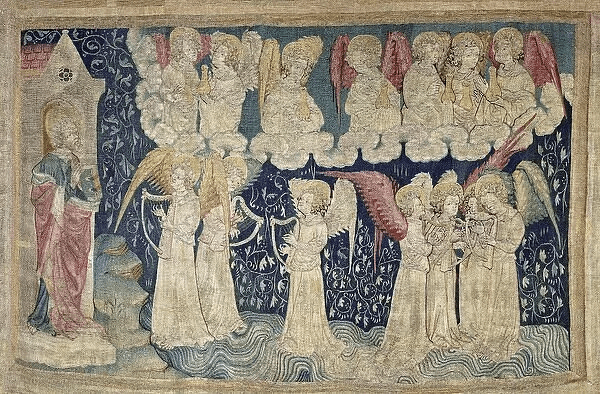
The Seven Last Plagues and the Harps of God, by Nicolas Bataille, c.1380 C.E.

I saw in heaven another great and marvelous sign: seven angels with the seven last plagues—last, because with them God’s wrath is completed. And I saw what looked like a sea of glass glowing with fire and, standing beside the sea, those who had been victorious over the beast and its image and over the number of its name. They held harps given them by God and sang the song of God’s servant Moses and of the Lamb:

“Great and marvelous are your deeds,
    Lord God Almighty.
Just and true are your ways,
    King of the nations.
Who will not fear you, Lord,
    and bring glory to your name?
For you alone are holy.
All nations will come
    and worship before you,
for your righteous acts have been revealed.” (New International Version)

Let’s keep in mind that the book of Revelation (also known as The Apocalypse of John) is a vision of the Apostle John about how things shake out in the end. The purpose of the vision is not for us to get lost in esoteric speculations about the future and try to figure out specific dates and times of God’s judgment.

Rather, John’s Revelation was primarily meant to give believers a future hope that their hardships and suffering will not last forever; there is a time coming, soon, when Judge Jesus will make all things right and all things new. In other words, the vision of John was designed to provide needed encouragement to followers of Jesus.

The believers needed a connection to their spiritual heritage – a way to see that they weren’t an isolated faith island in the middle of the world’s crud. The heavenly beings were singing a song of Moses and of the Lamb (Jesus). The two are connected, thus bringing together the saints of ages past with the struggling Christians of the present.

The song of Moses is a song of triumph, sung after the Israelites passed through the Red Sea unharmed and the Egyptian army was eradicated:

“I will sing to the Lord,
    for he is highly exalted.
Both horse and driver
    he has hurled into the sea.

“The Lord is my strength and my defense;
    he has become my salvation.
He is my God, and I will praise him,
    my father’s God, and I will exalt him.
The Lord is a warrior;
    the Lord is his name.
Pharaoh’s chariots and his army
    he has hurled into the sea.
The best of Pharaoh’s officers
    are drowned in the Red Sea.
The deep waters have covered them;
    they sank to the depths like a stone.
Your right hand, Lord,
    was majestic in power.
Your right hand, Lord,
    shattered the enemy.

Flee From Egypt, by Rev. Albert Lee Wagner, 1975

“In the greatness of your majesty
    you threw down those who opposed you.
You unleashed your burning anger;
    it consumed them like stubble.
By the blast of your nostrils
    the waters piled up.
The surging waters stood up like a wall;
    the deep waters congealed in the heart of the sea.
The enemy boasted,
    ‘I will pursue, I will overtake them.
I will divide the spoils;
    I will gorge myself on them.
I will draw my sword
    and my hand will destroy them.’
But you blew with your breath,
    and the sea covered them.
They sank like lead
    in the mighty waters.
Who among the gods
    is like you, Lord?
Who is like you—
    majestic in holiness,
awesome in glory,
    working wonders?

“You stretch out your right hand,
    and the earth swallows your enemies.
In your unfailing love you will lead
    the people you have redeemed.
In your strength you will guide them
    to your holy dwelling.
The nations will hear and tremble;
    anguish will grip the people of Philistia.
The chiefs of Edom will be terrified,
    the leaders of Moab will be seized with trembling,
the people of Canaan will melt away;
    terror and dread will fall on them.
By the power of your arm
    they will be as still as a stone—
until your people pass by, Lord,
    until the people you bought pass by.
You will bring them in and plant them
    on the mountain of your inheritance—
the place, Lord, you made for your dwelling,
    the sanctuary, Lord, your hands established.

“The Lord reigns
    for ever and ever.” (Exodus 15:1-18, NIV)

Throughout the millennia, this deliverance from harsh slavery to freedom is annually recalled and remembered in the Passover. The original Passover in Egypt involved a lamb being slain and it’s blood applied to the doorposts of each Jewish home. The avenging angel “passed over” those homes and instead dealt with the Egyptian houses which had no lamb’s blood over the door.

The song of Moses and the song of the Lamb (Jesus) are really the same song. Both the deliverance out of Egypt and through the Red Sea, as well as the deliverance from guilt and shame through the cross and resurrection, was real salvation from all that oppressed and hindered the people from living into their true selves.

This connection to salvation history was a great boon to the early believers undergoing their own brand of injustice, oppression, and persecution – just for being followers of Jesus.

So, we all need to apply the death of the Lamb to our present situations, so that we can endure through hardship and not give up and experience a failure of faith. We continually need a strengthening of faith, to recall and remember who we are and to whom we belong, so that we will sing our own song of hope and deliverance.

“Awake and Sing the Song,” by English hymnist William Hammond (1719-1783)

Awake, and sing the song
Of Moses and the Lamb;
Tune every heart and every tongue
To praise the Savior’s name.

Sing of His dying love;
Sing of His rising power;
Sing how He intercedes above
For those whose sins He bore.

Tell, in seraphic strains,
What He has done for you;
How He has taken off your chains
And formed your hearts anew.

His faithfulness proclaim
While life to you is given:
Join hands and hearts to praise His name
Till we all meet in heaven.

Amen.