Mercy and Judgment (Revelation 8:1-5)

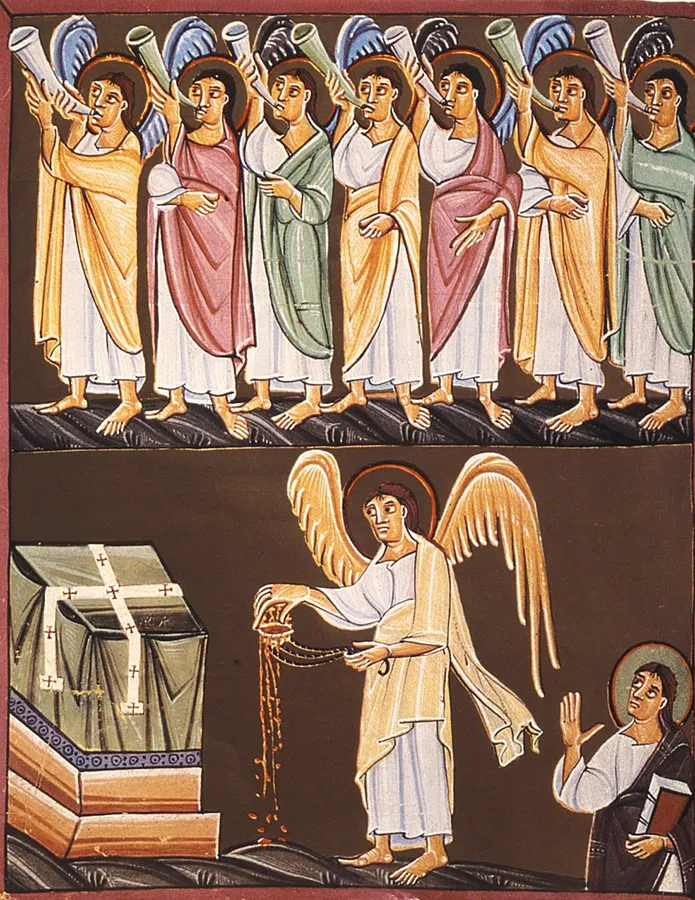
Seven angels with seven trumpets, and the angel with a censer, from the Bamberg Apocalypse, c.1020 C.E.

Then, when the Lamb opened the seventh seal, there was silence in heaven for about half an hour.

Then I saw the seven angels who stand before God, and seven trumpets were given to them. Another angel came and stood at the altar, and he held a gold bowl for burning incense. He was given a large amount of incense, in order to offer it on behalf of the prayers of all the saints on the gold altar in front of the throne. 

The smoke of the incense offered for the prayers of the saints rose up before God from the angel’s hand. Then the angel took the incense container and filled it with fire from the altar. He threw it down to the earth, and there were thunder, voices, lightning, and an earthquake. (Common English Bible)

When I was kid, growing up on a Midwest American farm, I remember times when severe weather was coming. I knew it was going to be bad whenever everything became still and there was complete silence: No wind, no birds singing, no insects chirping, nothing moving whatsoever. It was the eerie silence which precedes something big coming.

That is the way it will be in heaven when the seventh seal is opened. The silence is so quiet that you know a lot of noise and movement are about to happen. It’s not serene silence; it’s scary silent.

With the opening of the seventh seal, a climactic moment is reached. The silence is not only an anticipation of the coming drama, but is also a sign of reverence and awe.

The seventh seal initiates a series of woes: The seven trumpets. But before the trumpets begin, an angel appears. Standing before a heavenly altar, the angel mixes incense along with prayers from the people, then offers them on the altar.

These prayers of the people are for justice, and a longing for the kingdom to come, and God’s will to be done, on earth, as it is always done in heaven.

The imagery relates to us that God hears the prayers, and will act, according to the divine character and will.

The angel takes fire from the altar and hurls it down to earth, causing thunder and lightning, and an earthquake. In other words, the prayers are being answered; they are having an effect. Judgment on the earth begins with the blowing of the seven trumpets.

As we may expect, the incredible silence gives way to an equally incredible noise of weather and the earth moving. And the angel, serving as a quiet and contemplative high priest, now moves to becoming a judge upon the earth.

It turns out that mercy and judgment are not two contrasting concepts and actions; they are two sides of the very same coin. The altar of mercy becomes the source of judgment.

Whenever there is an injustice, we want (and expect) to have that act acknowledged and taken care of by a proper authority. To have a judge simply say that he/she is merciful and will acquit the guilty, does not work in every situation. Mercy only exists because of the presence of guilt and judgment.

God takes care of sin because God loves. An unloving deity would be unconcerned, random, and capricious in handling injustice. But not the God of the Bible. God shows mercy to the righteous, and will judge the wicked.

God’s mercy extends to the point of acquitting the guilty, if God so desires to do so. And everyone needs mercy, because we all have committed injustices in our lives.

Yet, by means of humble contrition and faith, we can mercifully discover gracious amnesty. This is why Jesus came, to take care of the sin issue once for all through the Cross.

We have been made holy by God’s will through the offering of Jesus Christ’s body once for all. (Hebrews 10:10, CEB)

In the time of the Apostle John’s vision, which is the Book of Revelation, Christians were facing persecution and martyrdom. The prayers of the suffering believers rose to heaven:

They cried out with a loud voice, “Holy and true Master, how long will you wait before you pass judgment? How long before you require justice for our blood, which was shed by those who live on earth?” (Revelation 6:10, CEB)

God’s response to the prayers of the saints is to send judgmental fire against the earth by the hand of the angel. In John’s apocalyptic vision, not only are the believers in Christ facing trials and tribulations for their faith, but the unbelieving persecutors who victimize the saints will be punished, as well.

If the persecutors use fiery elements against the believers, God can (and will) turn that fire back on the them. This is similar to the Book of Exodus, in which the plagues that struck and judged the Egyptians were, at the same time, a means of protecting and preserving the Israelites.

The Book of Revelation included in the Christian canon of scripture, not for the purpose of predicting the time or the season in which Jesus Christ will come back to judge the living and the dead. Rather, John’s Apocalypse is meant to encourage the followers of Christ that their suffering will not last forever; and neither will the arrogance of the wicked.

We don’t know when all of this end-of-the-age stuff is going to shake out. Which is why it is so important we learn to persevere through suffering. Because we might have to wait awhile.

Prayer for us then becomes not simply something we do if we have a bit of discretionary time; it becomes vital for us. We discern that we must speak with God. We are compelled to offer our prayers. We feel the great need to cry out and petition God for justice and righteousness.

It seems, if I don’t pray, I won’t make it. Therefore, I must pray. I will pray with all of my heart and soul, till I cannot pray anymore. And then I will pray some more, because I need God.

There is nothing easy about moving through suffering. It’s hard to persevere. It hurts to be the brunt of another’s violent tongue and/or hand. Yet, we do not experience this alone. The divine presence is with us. And that makes all the difference.

Oh God:
Give me strength to live another day;
Let me not turn coward before its difficulties, or fail in its duties;
Let me not lose faith in other people;
Keep me sweet and sound of heart, in spite of ingratitude, treachery, or meanness;
Preserve me from minding little stings, or giving them;
Help me to keep my heart clean, and to live so honestly and fearlessly that no outward failure can dishearten me, or take away the joy of conscious integrity;
Open wide the eyes of my soul that I may see good in all things;
Grant me this day some new vision of your truth;
Inspire me with the spirit of joy and gladness and make me the cup of strength to suffering souls; in the name of the strong Deliverer, our only Lord and Savior, Jesus Christ. Amen.

The Trumpets of Judgment (Revelation 8:6-9:12)

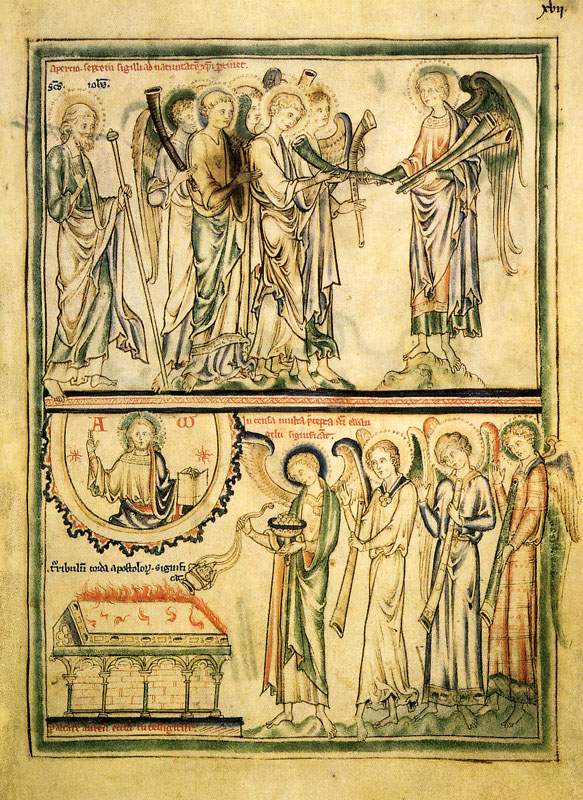
The seven angels with seven trumpets, and the angel with a censer, c. 1020 C. E.

Then the seven angels who had the seven trumpets prepared to sound them.

The first angel sounded his trumpet, and there came hail and fire mixed with blood, and it was hurled down on the earth. A third of the earth was burned up, a third of the trees were burned up, and all the green grass was burned up.

The second angel sounded his trumpet, and something like a huge mountain, all ablaze, was thrown into the sea. A third of the sea turned into blood, a third of the living creatures in the sea died, and a third of the ships were destroyed.

The third angel sounded his trumpet, and a great star, blazing like a torch, fell from the sky on a third of the rivers and on the springs of water—the name of the star is Wormwood. A third of the waters turned bitter, and many people died from the waters that had become bitter.

The fourth angel sounded his trumpet, and a third of the sun was struck, a third of the moon, and a third of the stars, so that a third of them turned dark. A third of the day was without light, and also a third of the night.

As I watched, I heard an eagle that was flying in midair call out in a loud voice: “Woe! Woe! Woe to the inhabitants of the earth, because of the trumpet blasts about to be sounded by the other three angels!”

The fifth angel sounded his trumpet, and I saw a star that had fallen from the sky to the earth. The star was given the key to the shaft of the Abyss. When he opened the Abyss, smoke rose from it like the smoke from a gigantic furnace. The sun and sky were darkened by the smoke from the Abyss. And out of the smoke locusts came down on the earth and were given power like that of scorpions of the earth. 

They were told not to harm the grass of the earth or any plant or tree, but only those people who did not have the seal of God on their foreheads. They were not allowed to kill them but only to torture them for five months. And the agony they suffered was like that of the sting of a scorpion when it strikes. During those days people will seek death but will not find it; they will long to die, but death will elude them.

The locusts looked like horses prepared for battle. On their heads they wore something like crowns of gold, and their faces resembled human faces. Their hair was like women’s hair, and their teeth were like lions’ teeth. They had breastplates like breastplates of iron, and the sound of their wings was like the thundering of many horses and chariots rushing into battle. They had tails with stingers, like scorpions, and in their tails they had power to torment people for five months. They had as king over them the angel of the Abyss, whose name in Hebrew is Abaddon and in Greek is Apollyon (that is, Destroyer).

The first woe is past; two other woes are yet to come. (New International Version)

Angels receiving seven trumpets, c. 1255 C.E.

Woah; this isn’t exactly some light bedtime reading. It has to do with the end of all things, with God’s judgment upon the earth. Seven angels with seven trumpets are about to sound them with disastrous results. The last three trumpets are also referred to as the three woes upon the earth.

The first four trumpets are bad, yet not nearly as terrible as the last three. The first four affect the natural world and one-third of the earth; whereas the last three directly impact the earth’s inhabitants and affect the entire world.

As hard as it may be to accept biblical readings like today’s, God is not only the author of abundant flourishing, but also of devastating destruction. And it’s in direct answer to the prayers of the saints. (Revelation 8:3)

Although hail and blood remind the biblical student of the plagues of judgment in ancient Egypt before the great exodus of Israelites, it’s the fire that does damage to the trees and grass of the earth. A third of the earth’s land resources are completely burned up.

The second angel blowing the second trumpet results in a great mountain being hurled into the sea. This is reminiscent, for those familiar with the Gospels, of Jesus stating that one with a small amount of faith can command a mountain to be thrown into the sea, and it will be done. (Mark 11:23)

Going back into the Old Testament, in the giving of the Law on the mountain, and with the disobedience of the people at the foot of the mountain, Mount Sinai was ablaze with fire and the glory of God. The New Testament scene in Revelation appears to be something of a Mount Sinai taken up and thrown into the sea – signifying that the grace of Christ has supplanted the curse of the law.

As a result of the second trumpet, a third of all the great oceans are destroyed.

Although C.S. Lewis gave the name “Wormwood” to a fictional agent of Satan, the Wormwood here is a messenger of God, a star that falls from the sky as a result of the third trumpet blown. A third of all the earth’s drinkable water becomes bitter because of the star – which seems to be a link to previous times of judgment from God:

“I will make them eat bitter food
    and drink poisoned water,
because from the prophets of Jerusalem
    ungodliness has spread throughout the land.” (Jeremiah 23:15, NIV)

“They have followed the stubbornness of their hearts; they have followed the Baals, as their ancestors taught them.” Therefore this is what the Lord Almighty, the God of Israel, says: “See, I will make this people eat bitter food and drink poisoned water. (Jeremiah 9:14-15, NIV)

There’s nothing that falls from the sky with the blast of the fourth trumpet. Yet a third of the sun, moon, and stars are dimmed. This is a portent that something worse is about to happen – which is what the “eagle” [vulture] announces against the earth’s inhabitants.

Another star falls to the earth, but with even more disaster than the previous star – opening a pit in the heart of the earth. Smoke comes billowing out, darkening the sun. Then, locusts with the stinging power of scorpions, come upon the land.

Rather than humans having authority to trample on snakes and scorpions, these demonic insects carry the ability and the authority to harm humanity – much like the great locust horde of judgment during the time of the prophet Joel (Joel 2:1-11). The difference with John’s Apocalypse is that these are a demonic host with Apollyon the Destroyer leading them.

The previous judgments were from above; this first woe is from below – connecting the powers of death, destruction, and the grave together with the force of evil. It’s a time of sheer torture; a traumatic five months of horrendous agony.

Conclusion

None of these terrible scenes of judgment are meant to scare the hell out of anybody and put the fear of heaven into them. Instead, the New Testament book of Revelation (also known as the Apocalypse of John) is meant for devoted believers in Jesus to be encouraged that an end is coming. They can persevere in following Jesus because it will be worth it.

The hardships, difficulties, and persecutions experienced – for following the words and ways of Jesus – will not last; a time is coming soon when God will judge the living and the dead. Evil will be dealt its final blow. And we will enter a realm of unending peace with the God for whom we have given our all.

Therefore, since we are receiving a kingdom that cannot be shaken, let us be thankful, and so worship God acceptably with reverence and awe, for our “God is a consuming fire.” (Hebrews 12:28-29; Deuteronomy 4:24)

May the Lord answer you in the day of trouble!
    The name of the God of Jacob protect you!
May he send you help from the sanctuary
    and give you support from Zion.
May he remember all your offerings
    and regard with favor your burnt sacrifices. Selah

May he grant you your heart’s desire
    and fulfill all your plans. Amen. (Psalm 20:1-4)