

“To the angel of the church in Pergamum write:
These are the words of him who has the sharp, double-edged sword. I know where you live—where Satan has his throne. Yet you remain true to my name. You did not renounce your faith in me, not even in the days of Antipas, my faithful witness, who was put to death in your city—where Satan lives.
Nevertheless, I have a few things against you: There are some among you who hold to the teaching of Balaam, who taught Balak to entice the Israelites to sin so that they ate food sacrificed to idols and committed sexual immorality. Likewise, you also have those who hold to the teaching of the Nicolaitans. Repent therefore! Otherwise, I will soon come to you and will fight against them with the sword of my mouth.
Whoever has ears, let them hear what the Spirit says to the churches. To the one who is victorious, I will give some of the hidden manna. I will also give that person a white stone with a new name written on it, known only to the one who receives it. (New International Version)
I’ve lived in one or two places in my life that I might have secretly described as the city where Satan lives. Jesus, however, in words to an ancient church, put it out there that they were living in such a place.
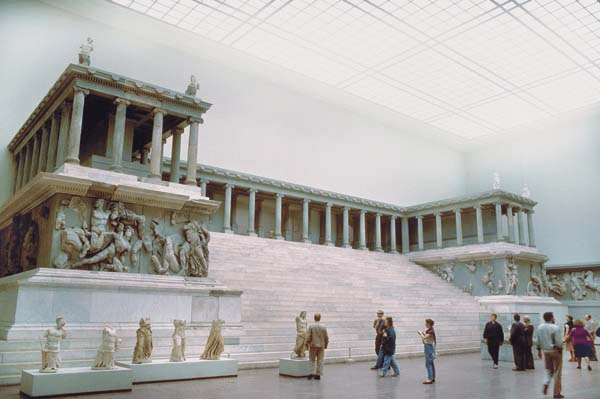
We aren’t told why Jesus described the city of Pergamum that way. Many ancient and important places typically had a prominent temple to some Greek god or goddess. In Pergamum, there existed a temple to Asclepius, the god of healing, symbolized by a snake – which isn’t exactly a positive icon in the worship of God.
The bad names didn’t stop there. Balaam is mentioned. He was a foreigner to Israel who is associated with false prophecy and leading worshipers of God astray. Balaam was blamed for the people’s idolatry and immorality before entering the Promised Land. (Numbers 31:16)
“Probably the greatest tragedy of the church throughout its long and checkered history has been its constant tendency to conform to the prevailing culture instead of developing a Christian counter-culture.”
John R.W. Stott
The name “Nicolaitans” is likely a Greek form of saying “Balaamites.” Thus, they are one in the same thing. It seems that Jesus was pointing a finger directly at particular religious practices consistent with the tradition of Balaam, namely, eating food sacrificed to idols and committing sexual immorality.
Idols and temples and eating were a hot button issue in the earliest church. All the places that churches were established, there were a significant number of Gentile converts from Greek religion to following Christ and worshiping God. And it was anything but a nice easy clean break from the old to the new.
I would surmise that the Balaamites and Nicolaitans are a group of Christian converts from paganism who were embracing a more syncretistic religion, and urging others to do the same – to maintain and engraft some of the Roman values and Greek religious practices so that the church would become more socially accepted and economically viable. Perhaps, they may have reasoned, there would be less persecution and things would generally go better for everyone.
“Some Christians want enough of Christ to be identified with him but not enough to be seriously inconvenienced.”
D.A. Carson
Whereas the Apostle Paul had a more nuanced understanding of the relationship between the church and the culture, the communication to the church at Pergamum was a definitive statement that Nicolaitans are immoral idolaters and the only thing to do in such a case is for them (not the entire congregation as a whole) to repent, stop the syncretism, and start devoting themselves completely to the worship of God alone.
Jesus himself was advocating for a firm refusal in trying to achieve respectability, to make compromises in religious practice. It certainly appears that, at least in the case of Pergamum’s converts, there was to be absolutely no connection with the old religion – not even with eating any meat or anything else that came from the pagan temple.
The Greek god Asclepius was connected with medicine and healing. So, why would this be such a problem for the fledgling church? Why would the city of Pergamum be labeled as the place where Satan lives?
Pergamum was a prominent city. It’s Greek culture, cultural and social traditions, and religious center represented the pinnacle of pagan society. This perhaps explains in part why early Christians viewed the place as a bastion of the devil.
Antipas, the Christian Bishop of Pergamum, is said to have been martyred there at the end of the first century, C.E. – which is around the time when many scholars believe the Book of Revelation was composed.
Whatever was actually going on at the time, there were most certainly significant tensions between the Christian and pagan communities which existed in the ancient city of Pergamum. Avoiding persecution, even death, may have been foremost in the minds of the Nicolaitans – who wanted accommodations with paganism that went too far, even for Jesus.
“Christ claims no man purely as a natural being, but always as one who has become human in a culture; who is not only in culture, but into whom culture has penetrated.”
H. Richard Niebuhr
It’s always been a difficult thing for Christians of every historical age to know how to deal with being in a society that is of a different culture and religion. And every generation of believers need to struggle through and reaffirm what Christian faith looks like wherever they live in this world, and in whatever cultural context they find themselves within.
In the letter to the church at ancient Pergamum, we perhaps find some guidance in Christ’s affirmation of holding onto Christian faith and keeping up a public profession of fidelity to him; and in Christ’s denunciation of diluting that Christian faith with too much accommodation to pagan culture.
Not every believer is going to agree in how to practically proceed with such matters. Yet these are issues worth having constructive conversations about, rather than simply digging into an established personal trench and, from there, lobbing unhelpful volleys of words at those who disagree.
Almighty God and Father of our Lord Jesus Christ, you are a jealous God who will not accept any attachment to other gods. I affirm you as the Most High God, and you will not give your honor or acclaim to idols. Please help us your people to avoid putting anything or anybody above or below you. Amen.


 Rev. Tim Ehrhardt