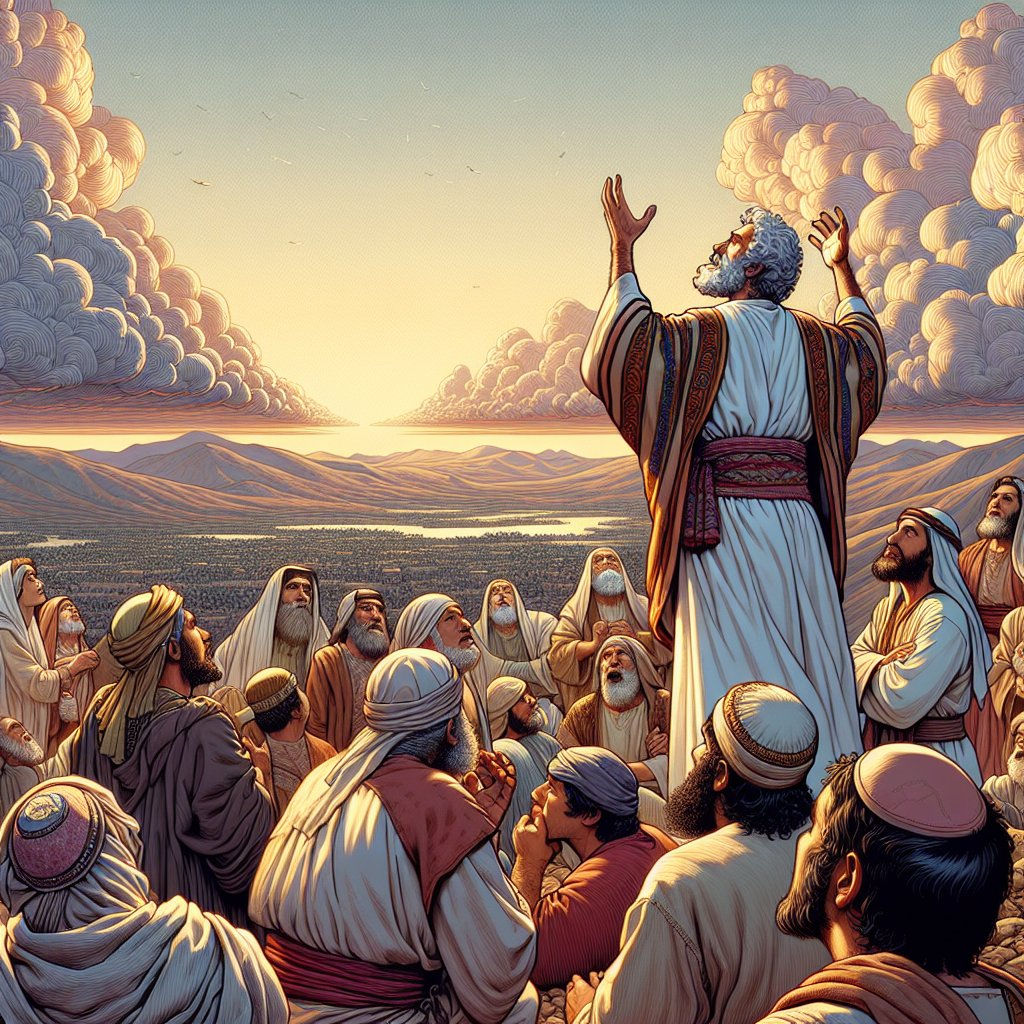
Return To the Lord (Amos 4:6-13)

I gave you cleanness of teeth in all your cities
    and lack of bread in all your places;
yet you did not return to me,
            says the Lord.

And I also withheld the rain from you
    when there were still three months to the harvest;
I would send rain on one city
    and send no rain on another city;
one field would be rained upon,
    and the field on which it did not rain withered;
so two or three towns wandered to one town
    to drink water and were not satisfied;
yet you did not return to me,
            says the Lord.

I struck you with blight and mildew;
    I laid waste your gardens and your vineyards;
    the locust devoured your fig trees and your olive trees;
yet you did not return to me,
            says the Lord.

I sent among you a pestilence after the manner of Egypt;
    I killed your young men with the sword;
I carried away your horses;
    and I made the stench of your camp go up into your nostrils;
yet you did not return to me,
            says the Lord.

I overthrew some of you
    as when God overthrew Sodom and Gomorrah,
    and you were like a brand snatched from the fire;
yet you did not return to me,
            says the Lord.

Therefore thus I will do to you, O Israel;
    because I will do this to you,
    prepare to meet your God, O Israel!

For the one who forms the mountains, creates the wind,
    reveals his thoughts to mortals,
makes the morning darkness,
    and treads on the heights of the earth—
    the Lord, the God of hosts, is his name! (New Revised Standard Version)

“Luxury often leads to forgetfulness. As for you, my beloved, if you sit at table, remember that from the table you must go to prayer. Fill your belly so moderately that you may not become too heavy to bend your knees and call upon your God.” St. John Chrysostom, On Wealth and Poverty 

Let us test and examine our ways and return to the Lord.

Lamentations 3:40, NRSV

Again and again, century after century, Israel’s God, Yahweh, sent prophets and calamities in order to shake God’s people from their wayward path.

It was expected that observance and faithfulness to God’s covenant would bring times of goodness and prosperity. Conversely, times of disobedience would elicit misfortune. It seems the people forgot that infidelity to the covenant leads to calamitous circumstances.

Through it all, Israel and Judah were unfaithful. All Yahweh ever wanted was for the people to return to their God, and enjoy all the blessings and benefits of being in a divine/human harmony. But the people weren’t having it.

Amos, throughout his prophecy, made it clear that personal transgressions, social injustice, religious infidelity, and national sins were at the heart of the trouble.

There was a tremendous wealth inequality which existed in ancient Israel. The people lost sight of the reality that everything belongs to God. Therefore, any resources they were blessed with should have been used to help the common good of all, especially the poor and needy.

It was from the prophets like Amos that the great early church preacher, St. John Chrysostom, developed his understanding of personal responsibility, church ministry, and national concern.

In sermon after sermon, Chrysostom argued and established that excessive wealth is dangerous to the soul. He continually warned his parishioners that those who accumulate exorbitant wealth are actually storing up a great retribution for themselves in the next life.

He insisted that the proper response to the extravagance of one’s possessions and money is to return to God and give liberally to others. One must understand, St. John argued, that all things belong to God. Thus, to acquire more and more is, in reality, a form of stealing from the poor.

Kindness and charity to the poor is imperative. Otherwise, a society cannot expect to realize ongoing blessing from God. Chrysostom constantly advocated for people to be generous in giving, not only to help the poor, but also to spur one’s spiritual growth and spiritual wealth. Building treasure in heaven, rather than on earth, was St. John’s basic orientation in life.

In today’s Old Testament lesson, after rehearsing seven different calamities which were meant as warnings, the eighth calamity would be to meet God face to face. We get the gist of the argument as a meeting that wouldn’t go so well for the filthy rich… that is, unless they willingly return to God and submit themselves and their stuff to the Lord of all.

Every one of us must ultimately come to grips with the fact that mercy and wrath are very real concepts that look one another in the eye. There is both hope and warning.

Will we return to the Lord, or will God effect a great visitation upon us?

Will God save us at the eleventh hour, or will the Lord bring devastation?

Either way, there is a meeting coming. Prepare to meet your God. It’s up to us how that meeting is going to shake out.

There is yet hope for those who are penitent, even and especially for those who finagled to obtain power and wealth for themselves. But if they are stubborn, they will find out what is the face opposite of mercy. This is the era of return, because it is still possible to change.

Yet even now, says the Lord,
    return to me with all your heart,
with fasting, with weeping, and with mourning;
    rend your hearts and not your clothing.
Return to the Lord your God,
    for he is gracious and merciful,
slow to anger, abounding in steadfast love,
    and relenting from punishment. (Joel 2:12-13, NRSV)

Most merciful God, we confess that we have sinned against you in thought, word, and deed, by what we have done, and by what we have left undone.

We have not loved you with our whole heart; we have not loved our neighbors as ourselves. We are truly sorry and we humbly repent.

For the sake of your Son Jesus Christ, have mercy on us and forgive us; that we may delight in your will, and walk in your ways, to the glory of your Name. Amen. (Book of Common Prayer)

Second Sunday of Advent – Prepare the Way (Luke 3:1-6)

The Call from John the Baptist to Repent, by Renier de Huy, 12th century

In the fifteenth year of the reign of Tiberius Caesar, when Pontius Pilate was governor of Judea, and Herod was ruler of Galilee, and his brother Philip ruler of the region of Ituraea and Trachonitis, and Lysanias ruler of Abilene, during the high priesthood of Annas and Caiaphas, the word of God came to John son of Zechariah in the wilderness. He went into all the region around the Jordan, proclaiming a baptism of repentance for the forgiveness of sins, as it is written in the book of the words of the prophet Isaiah,

“The voice of one crying out in the wilderness:
‘Prepare the way of the Lord;
    make his paths straight.
Every valley shall be filled,
    and every mountain and hill shall be made low,
and the crooked shall be made straight,
    and the rough ways made smooth,
and all flesh shall see the salvation of God.’ ” (New Revised Standard Bible)

In this Christian season of Advent, we are reminded that God is not only high above us, transcendent, far away; God is also close to us, immanent, and with us.

We remember at this time of year that God does not remain distant, but entered our time and space at a particular moment in history, for a distinct purpose.

The Roman Empire was powerful, large, and very much in control of every place where it existed. The litany of imperial rulers and authorities which the Gospel writer Luke listed is meant to give us a feel of the Roman weight, and how much Roman might was ensconced in Judea.

The world at the turn of the common era was under the dominion of powerful people with lots of influence. But God did not come to any of them. Instead, God came to a loner – a man who spent his time out in the wilderness. His name was John, the son of Zechariah. We know him as John the Baptist.

With God coming to John at a precise point of time in a particular place, that made John a prophet with a singular message. John was born for this. (Luke 1:76)

It is fitting that a man hanging out on the fringes of society all by himself would be the one to prepare the way for Messiah.

After all, Messiah’s message would be one of bringing good news to the poor, proclaiming release to prisoners, and freeing those who are oppressed. (Luke 4:18-19; Isaiah 61:1-2)

God’s prophetic calling for John was one of preparation. John was to prepare the way of the Lord. He was to get the people ready to receive Messiah.

John went about his ministry of preparation by calling folks to repent, to change their minds and amend their ways, so that there might be forgiveness.

In a reference from the prophet Isaiah, Luke alluded to Jewish exiles returning from their Babylonian captivity. The actual physical road from Babylon to Jerusalem was a hard journey due to the distance and topography.

The “road” or the “way” in Holy Scripture is also a metaphor for the spiritual journey we take in this life. And that road has a lot of challenges to it. The very act of walking as a pilgrim over a long arduous journey changes a person.

It is rarely the destination that makes a person; it’s the journey itself which leads one to a changed life of thinking differently, and seeing things from a perspective we’ve never seen before.

The smoothing out of the road is a way of saying God is making it easier for people to return to the Lord, to get them ready for a new life with promises fulfilled and unexpected joy.

In other words, valleys raised and mountains flattened represent God’s efforts at helping us experience a complete transformation of life. The Lord will do everything possible to make renewal and restoration happen for us.

The Lord will set things right. In our contemporary world that is now largely controlled by powerful oligarchs and the super-rich, God will turn it upside-down. All of the world’s current powerful people will find themselves looking up, not down.

It would be nice and reassuring if I could give you certainty about the journey ahead. But I cannot do that. Yet, what I can do is assure us of what is at the end of the road. Look beyond the current days of self-centered leadership and popular ignorance, and understand that all flesh shall see the salvation of God.

Prepare the way of the Lord. We do that by how we go about walking the road. Each step we take every day is important and makes a difference. And when we stumble, there is plenty of grace to help get us back on our feet and moving forward.

We are all collectively journeying together to Bethlehem. And as we daily move and walk, at the end of our journey, Jesus is there.

But when the fullness of time had come, God sent his Son, born of a woman, born under the law, in order to redeem those who were under the law, so that we might receive adoption as children. (Galatians 4:4, NRSV)

And nothing can stop us or separate us from the love of God that is in Jesus Christ our Lord.

For I am convinced that neither death, nor life, nor angels, nor rulers, nor things present, nor things to come, nor powers, nor height, nor depth, nor anything else in all creation will be able to separate us from the love of God in Christ Jesus our Lord. (Romans 8:38-39, NRSV)

The journey may be arduous. You might feel like giving up. But Jesus is our Immanuel, God with us. In him, is our hope and our joy.

O Holy One of Israel, out of the embrace of mercy and righteousness, you have brought forth joy and dignity for your people. Remember now your ancient promise; make straight the paths that lead to you, and smooth the rough ways, so that in our day we might bring forth your compassion for all humanity. Amen.

The Need for Partnership and Participation (Malachi 3:5-12)

“So I will come to put you on trial. I will be quick to testify against sorcerers, adulterers and perjurers, against those who defraud laborers of their wages, who oppress the widows and the fatherless, and deprive the foreigners among you of justice, but do not fear me,” says the Lord Almighty.

“I the Lord do not change. So you, the descendants of Jacob, are not destroyed. Ever since the time of your ancestors you have turned away from my decrees and have not kept them. Return to me, and I will return to you,” says the Lord Almighty.

“But you ask, ‘How are we to return?’

“Will a mere mortal rob God? Yet you rob me.

“But you ask, ‘How are we robbing you?’

“In tithes and offerings. You are under a curse—your whole nation—because you are robbing me. Bring the whole tithe into the storehouse, that there may be food in my house. Test me in this,” says the Lord Almighty, “and see if I will not throw open the floodgates of heaven and pour out so much blessing that there will not be room enough to store it. I will prevent pests from devouring your crops, and the vines in your fields will not drop their fruit before it is ripe,” says the Lord Almighty. “Then all the nations will call you blessed, for yours will be a delightful land,” says the Lord Almighty. (New International Version)

Return To God

God and God’s people were at odds with each other. The Lord was weary of the people’s constant complaining. They had a wrongheaded notion that God was absent, just because circumstances were not going their way.

Yet it is important to keep in mind that belief in God’s presence and God’s inherent goodness is absolutely essential to a faithful and good life.

If you think God is absent, then the best place to find God is at the outskirts or margins of a society. The Lord is there to protect the weakest persons and those who have been neglected by others.

The needy in Israel were on the outside without any power or a voice, which is why the prophet Malachi called the people to repentance – to change and amend their ways. They should return to God.

But what does a return to God look like? Since the people generally did not think they were doing anything necessarily wrong, they didn’t have a clue how to do this returning to God. They didn’t have the sense to know they were on the outs with God – which is why the prophet Malachi was speaking to them.

To the people at that time, and practicing the injustice that they were practicing, God responded that they should return by stopping their robbery of God.

Tithes and Offerings

Specifically, the people should reinstate the full mandated practice in the law of tithes and offerings.

Please understand that these tithes and offerings have nothing to do with modern capital fund campaigns for building churches or establishing new ministries. Rather, these words have a specific context that we must pay attention to.

The “tithe” in Israel was the temple tax, paid to the Levites, because this was the tribe of Levi’s only source of income. (Numbers 18:20-30)

An “offering” is a general term, referring to all the sorts of sacrifices offered at the temple as a part of Israelite worship. And once again, the Levites depended upon these offerings in order to eat and live.

Thus, tithes and offerings in Israel had a synergistic purpose of providing the people an opportunity to worship God and center their communal life around the Lord; and also providing for the Levites, so that they could make their living.

And then, the priests who attended to all the temple functions would use funds from the tithes and offerings to help the poor and indigent in the community.

So, a failure to provide tithes and offerings was an injustice, because it was neglecting to care for fellow members of society who needed help.

People could starve and die without practicing God’s law concerning tithes and offerings. And that is why it angered God so much whenever people reneged on their duty toward the temple practices.

Cooperation, Not Competition

Therefore, repentance and returning to God would happen only when the priests and the people cooperated together. Then, God’s faithfulness could be made effective and manifest itself among the entire social structure of Israel.

The entire society was built upon a divine/human cooperative. It required both human action and divine blessing working together.

None of this was a contract or a deal in which people do the right thing, and then God automatically blesses, like some divine slot machine that persons put coins into.

Instead, it is a system in which the laity work together with the clergy; and then all the people work together with God. In other words, God’s ideal is partnership and participation.

God will bring a great produce. But the people would have to do the hard work of planting and harvesting the crops. This is very far from any sort of name-it-and-claim-it theology in which a person prays for whatever they want and God will give it to them. That is not how an abundant life is produced.

Abundance comes wherever there are partners who participate with each other. If that system breaks down, then people are in a world of trouble.

So, people must take the social justice of God quite seriously – with its specific requirements about caring for one another.

Although we may not have the same particular system of Levites and a Temple, God’s heart for justice, for people’s basic needs to be met and satisfied, has never changed. That value still stands the test of time throughout all of human history.

Almighty God, who created us in your own image: Grant us grace to fearlessly contend against evil, and to make no peace with oppression. Enable us to reverently use our freedom, in the establishment and maintenance of justice in our communities and among the nations, to the glory of your holy Name. Amen.

Return to the Lord (1 Samuel 7:3-15)

Samuel prays to the Lord on behalf of the people, by Bible Art

So Samuel said to all the Israelites, “If you are returning to the Lord with all your hearts, then rid yourselves of the foreign gods and the Ashtoreths and commit yourselves to the Lord and serve him only, and he will deliver you out of the hand of the Philistines.” So the Israelites put away their Baals and Ashtoreths, and served the Lord only.

Then Samuel said, “Assemble all Israel at Mizpah, and I will intercede with the Lord for you.” When they had assembled at Mizpah, they drew water and poured it out before the Lord. On that day they fasted and there they confessed, “We have sinned against the Lord.” Now Samuel was serving as leader of Israel at Mizpah.

When the Philistines heard that Israel had assembled at Mizpah, the rulers of the Philistines came up to attack them. When the Israelites heard of it, they were afraid, because of the Philistines. They said to Samuel, “Do not stop crying out to the Lord our God for us, that he may rescue us from the hand of the Philistines.” Then Samuel took a suckling lamb and sacrificed it as a whole burnt offering to the Lord. He cried out to the Lord on Israel’s behalf, and the Lord answered him.

While Samuel was sacrificing the burnt offering, the Philistines drew near to engage Israel in battle. But that day the Lord thundered with loud thunder against the Philistines and threw them into such a panic that they were routed before the Israelites. The men of Israel rushed out of Mizpah and pursued the Philistines, slaughtering them along the way to a point below Beth Kar.

Then Samuel took a stone and set it up between Mizpah and Shen. He named it Ebenezer, saying, “Thus far the Lord has helped us.”

So the Philistines were subdued and they stopped invading Israel’s territory. Throughout Samuel’s lifetime, the hand of the Lord was against the Philistines. The towns from Ekron to Gath that the Philistines had captured from Israel were restored to Israel, and Israel delivered the neighboring territory from the hands of the Philistines. And there was peace between Israel and the Amorites.

Samuel continued as Israel’s leader all the days of his life. (New International Version)

Faithfulness to God matters. One cannot worship the Lord by day, then have a moonlighting job with other gods.

The priest and prophet Samuel helped lead Israel to repentance, and thus, a restoration of right relationship with their God. His leadership made all the difference. Samuel was not like the previous priests of Eli and his sons; nor was he like anyone else who didn’t really know what they were doing.

Samuel performed the appropriate sacrifices correctly; interceded with God on behalf of the people; enabled them to achieve victory; and continually and carefully watched over everything. Samuel was a needed stabilizing force in Israel. He identified sin in the nation and dealt with it wisely. Samuel led them to do right.

I confess my iniquity; I am troubled by my sin.

Psalm 38:18, NIV

Godly sorrow brings repentance that leads to salvation and leaves no regret, but worldly sorrow brings death. (2 Corinthians 7:10, NIV)

Come near to God and he will come near to you. Wash your hands, you sinners, and purify your hearts, you double-minded. Grieve, mourn and wail. Change your laughter to mourning and your joy to gloom. Humble yourselves before the Lord, and he will lift you up. (James 4:8-10, NIV)

Today’s Old Testament lesson brings up important questions of acknowledging disobedience, ignorance, and guilt; and how we are to respond to it.

Whenever we say or do something that we ought not to, it’s like squeezing a big tube of toothpaste out; there’s no way you can get it back in.

I actually did that once when I was a little kid. I saw new tube of toothpaste in the bathroom and wondered what it would be like to squeeze out a big amount. So, I did. It was fun. I did it again, then again and again, until it was all gone.

Knowing that perhaps this toothpaste thing might be a problem, I made an artwork out of it. After I was done, I turned off the light, shut the door, and in my little four-year-old brain, hoped nobody would see it. But oh my, they did!

As we get older, and into adulthood, we discover that we have a capacity to do a lot worse than toothpaste escapades. When we sin, there’s no way to put everything back the way it was before. Everything has changed because of our actions (or inactions). And we cannot make it look better, or put a positive spin on it.

There needs to be repentance – a confession of sin, a coming to God, and letting grace and forgiveness have its way. This is the path to restoration in returning to God, in bringing relational connections together again.

Repentance means that we tell God what we did; and that we’re sad about it. Instead of running away, we run to God and admit our guilt. This, by no means, is easy; but it’s the only way to take care of the problem and to feel better about it. And the Lord won’t make us feel worse, but will help us, no matter what.

Everybody is sad when they are caught doing something bad. But there is a good kind of sad, and a bad kind of sad. The bad kind of sad thinks to self, “I’m so stupid; I can’t do anything right,” and punishes myself for the wrong. On the other hand, the good kind of sad helps us realize that we never want to do that thing ever again; and we look to Jesus to forgive us and be our example of what to do right.

Good leaders, like Samuel, assist us in this process with grace, sensitivity, humility, respect, and a forthright spirit.

Most merciful God, we confess that we have sinned against you in thought, word, and deed, by what we have done, and by what we have left undone. We have not loved you with our whole heart; we have not loved our neighbors as ourselves. We are truly sorry and we humbly repent. For the sake of your Son Jesus Christ, have mercy on us and forgive us; that we may delight in your will, and walk in your ways, to the glory of your Name. Amen.