1 Corinthians 15:20-34 – That’s Weird

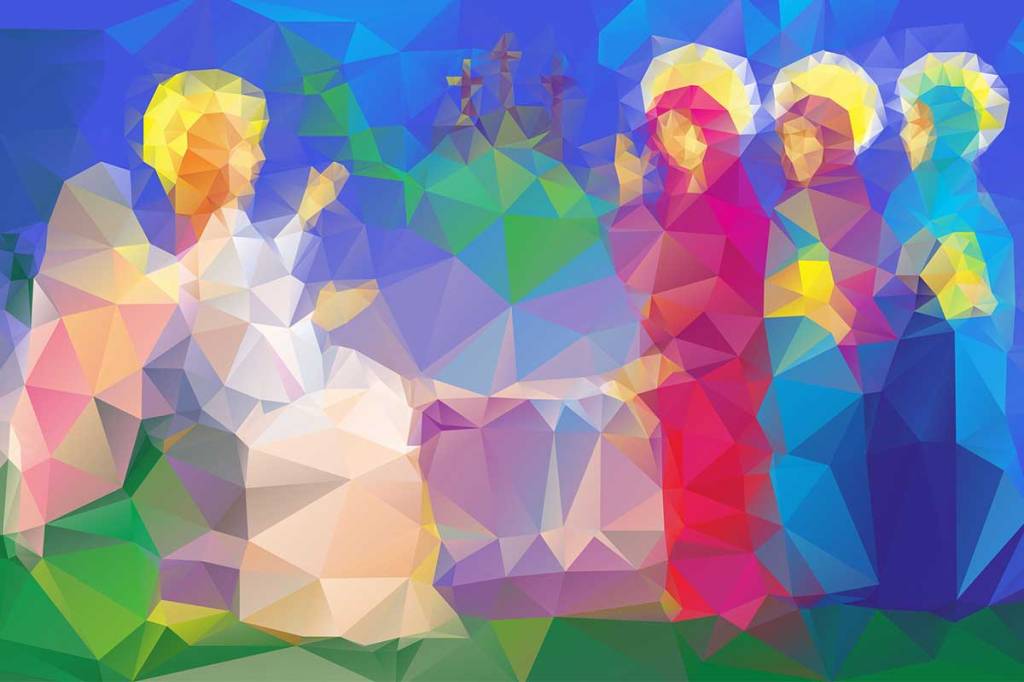
“Nonsense” by Wanidaem, 2016

But in fact, Christ has been raised from the dead, the first fruits of those who have died. For since death came through a human being, the resurrection of the dead has also come through a human being; for as all die in Adam, so all will be made alive in Christ. But each in his own order: Christ the first fruits, then at his coming those who belong to Christ. Then comes the end, when he hands over the kingdom to God the Father, after he has destroyed every ruler and every authority and power. For he must reign until he has put all his enemies under his feet. The last enemy to be destroyed is death. For “God has put all things in subjection under his feet.” But when it says, “All things are put in subjection,” it is plain that this does not include the one who put all things in subjection under him. When all things are subjected to him, then the Son himself will also be subjected to the one who put all things in subjection under him, so that God may be all in all.

Otherwise, what will those people do who receive baptism on behalf of the dead? If the dead are not raised at all, why are people baptized on their behalf?

And why are we putting ourselves in danger every hour? I die every day! That is as certain, brothers and sisters, as my boasting of you—a boast that I make in Christ Jesus our Lord. If with merely human hopes I fought with wild animals at Ephesus, what would I have gained by it? If the dead are not raised,

“Let us eat and drink,
    for tomorrow we die.”

Do not be deceived:

“Bad company ruins good morals.”

Come to a sober and right mind, and sin no more; for some people have no knowledge of God. I say this to your shame. (New Revised Standard Version)

There was a lot of goofiness going on with the Corinthian church.

That’s why the Apostle Paul’s first letter is long and filled with addressing a variety of problems. Some of those issues we can understand and relate to, and some we don’t have much of a clue what’s really going on. I tend to think that because the Corinthian believers tended to keep some bad company, a lot of weird stuff pops up, like vicarious baptisms for the dead. Where the heck did that come from?

“Weird Blue Painting” by Matthew Freese

Well, what we do know is that when Jesus told good old Peter the fisherman to leave his nets behind and become a fisher of people, catching them was only half the work. Cleaning them takes a lot of work, too.

I have done my share of fishing in life (both real fish and real people), and I can say that cleaning fish is a messy affair. Just as a fish gets gutted, so a person, caught for Jesus, needs to be eviscerated of all the worldly entrails of sin. And that didn’t completely happen with the Corinthians.

Rather than hanging out with the goofy weird dudes who are saying and doing only God knows what, Paul brought the Corinthians back to the center of the gospel. He reeled them into Christ’s resurrection.

The resurrection of Jesus Christ from death is the penultimate event of securing victory from sin’s guilt and shame, as well as death’s sting. It’s the resurrection which enables every Christian to realize the power of cutting out the weird and goofy stuff of worldly sin for the meat of Christ’s words and ways.

Because Christ arose with a real physical body, we, too, will experience a bodily resurrection. This means, as believers in Jesus, we are not to have a goofy approach that resurrection is all spiritual with nothing physical going on, as if the body were just some weird container for the soul that we have to put up with here on earth.

Whenever that weird thinking takes place, people do goofy things, believing they can do whatever the heck they want, since the body is like a paper plate that we’ll just toss in the garbage when we’re done with it. Christ’s kingdom ethics and physical morality ends up taking a back seat to ethereal philosophical musings. Leave it to the Greek Corinthians to do mental gymnastics in order to live however they want. Sometimes, when I read Paul’s letter, it feels like I’m watching an old “Leave It to Beaver” episode where Beaver is having all kinds of goofy thinking and doing weird stuff because of Whitey and Larry’s bad advice.

Jerry Mathers as the Beaver

Coming back again and again to the redemptive events of Jesus helps preserve us from the esoteric bunny trails of theological goofiness. Yet, if we continue to keep company with a bunch of folks who are into power and control through the ungodly means of mistreating the body (and other people), making comparisons between the physical and the spiritual, (as if they were two completing separate identities), obsessing over their weird and unintelligible philosophies, and refusing to take responsibility for their physical actions – then, we’re going to turn goofy, just like them.

Come to your senses, Paul would say, and get your head screwed on straight. Fill the space between your two ears with proper knowledge of Christ’s resurrection, and pay attention to your hands and feet, because they are the tangible means of putting the will of God into practice.

There’s a goofy and weird “ha, ha,” and then there’s a goofy and weird “uh, oh.” Keep the “ha, ha,” avoid the “uh, oh,” and you’ll be just fine.

Lord, have mercy. Christ, have mercy. Lord, have mercy on us, your people, and grant us your wisdom and peace. Amen.

Ezekiel 37:1-14 – Speak to the Dry Bones

Sometime later, I felt the Lord’s power take control of me, and his Spirit carried me to a valley full of bones. The Lord showed me all around, and everywhere I looked I saw bones that were dried out. He said, “Ezekiel, son of man, can these bones come back to life?”

I replied, “Lord God, only you can answer that.”

He then told me to say:

Dry bones, listen to what the Lord is saying to you, “I, the Lord God, will put breath in you, and once again you will live. I will wrap you with muscles and skin and breathe life into you. Then you will know that I am the Lord.”

I did what the Lord said, but before I finished speaking, I heard a rattling noise. The bones were coming together! I saw muscles and skin cover the bones, but they had no life in them.

The Lord said:

Ezekiel, now say to the wind, “The Lord God commands you to blow from every direction and to breathe life into these dead bodies, so they can live again.”

As soon as I said this, the wind blew among the bodies, and they came back to life! They all stood up, and there were enough to make a large army.

The Lord said:

Ezekiel, the people of Israel are like dead bones. They complain that they are dried up and that they have no hope for the future. So, tell them, “I, the Lord God, promise to open your graves and set you free. I will bring you back to Israel, and when that happens, you will realize that I am the Lord. My Spirit will give you breath, and you will live again. I will bring you home, and you will know that I have kept my promise. I, the Lord, have spoken.” (Contemporary English Version)

Dry. It might be good for humor or a martini. Dry, however, doesn’t feel good when it is a time of spiritual dryness. In many ways, this past year has been very dry. Quarantine. Masking. Social distance. Lost jobs and businesses. Some churches already dry from withering attendance simply folded and died.

The hard circumstances of our world, stress in our families, and challenging personal lives may easily create anxiety, and, so, parch our souls and leave our spirits bone dry. There is, however, a God who can breathe new life into us and move us from old-worn ruts in our thinking, feeling, and behaving, to renewed ways of being in the world. 

The prophet Ezekiel’s vision is a promise and a hope of resurrection, revival, and new life. Regardless of who we are and the situations in front of us, we are all displaced people – cast out of Eden and in need of restoration.  We, along with the ancient Israelites, are in exile and long to return to our true home with God. Along with St. Augustine we declare:

“Our hearts are forever restless until they find their rest in God.”

St. Augustine

There are dry bones lying around – parched places in need of being reinvigorated. Maybe you are experiencing the dry bones of hopelessness and despondency. Perhaps you are in a dark night of the soul where all of life seems like one huge rut. It could be you are wondering if God is really listening, or is even there at all, because of the dry bones surrounding you.

I do a lot of work as a chaplain on a behavioral health unit with folks who are, ironically, bone dry from too much drinking. Their alcoholism is like a massive desert littered with thousands of dry bones. Attempting to reanimate themselves while dulling the pain of incredibly hard dry circumstances, they drink liter after liter of “spirits” to replace the dead spirit inside them. Many become so dry and dead, inside their immaterial selves, that they seek to end their material lives through suicide.

But it need not be this way. We might believe we will be able to live life and pursue God better without danger or hardship – that somehow difficulty is not to be part of life. The dry bones exist, however, as an opportunity for God to give life. That’s why Alexander Solzhenitsyn’s reaction to his exile in a Soviet labor camp in Siberia was to bless it, because it was there that, he said:

“I discovered that the meaning of earthly existence lies not, as we have grown used to thinking, in prospering, but in the development of the soul.”

Alexander Solzhenitsyn

God not only gives life; God restores life. And this is an important truth to know and remember in the inevitable dry times of our lives. God is not only a helper; the Lord reanimates us from spiritual rigor mortis to lively resurrection through breathing on us. And this is done for a reason. Jesus came to his disciples after his resurrection and said:

“Peace be with you!  As the Father has sent me, I am sending you.” And with that he breathed on them and said, “Receive the Holy Spirit.”

John 20:20-21, NIV

God resuscitates us for a purpose, so that we might be a blessing to the world. Faith is not only a possession to keep, but a gift to give. We glorify God in loving one another and loving the world as Jesus did.  God could have resurrected the bones without Ezekiel. Instead, the Lord used Ezekiel and had him participate in the revival by speaking to the bones. 

Such a challenge to speak to the dry bones can seem overwhelming to us. What do you do when your life is upended, even shattered – when such a profound change comes to you that it is impossible for your life to be as it was? 

The questions and commands of God seemed totally absurd to Ezekiel, speaking to dead dry bones. Maybe we ought to operate more in the realm of the absurd than in the realm of the safe routine. Perhaps we ought to expect our faith to be exercised and look for God to breathe new life into the dead and decaying. To believe that something, someone, or even myself can change is to have internalized this amazing story of dry bones living again. 

Our self-imposed graves cannot hold us because God is among us. We need a genuine heaven-sent, Spirit-breathed, glorious reanimation in which God sends reviving grace and raises the dead. 

God Almighty, Lord of Resurrection, be attentive to our prayers. For those whose hope is lost, who feel dried up and cut off from you, open their graves; bring them back to the land of the living. For those who are spiritually oppressed and held captive by the enemy of our souls, release them from their chains; unbind them and let them go! For those who weep, lost and lifeless in a tomb of fear and shame, give them the peace of your presence, and show them what your love can do.

And for those who are complacent, withering on the vine, and living a dull dry existence without any spiritual vigor – awaken them God! Breathe into them new life! Pour out your Spirit gracious God and awaken your people to a revival of obedience, love, and courage. May your people be so full of your Spirit that life comes rolling off our tongues and the strength of life empowers our hands for service. Amen.

1 Corinthians 15:42b-49 – Attention to the Body is Spiritual

It’s the same with the resurrection of the dead: a rotting body is put into the ground, but what is raised won’t ever decay. It’s degraded when it’s put into the ground, but it’s raised in glory. It’s weak when it’s put into the ground, but it’s raised in power. It’s a physical body when it’s put into the ground, but it’s raised as a spiritual body.

If there’s a physical body, there’s also a spiritual body. So, it is also written, the first human, Adam, became a living person, and the last Adam became a spirit that gives life. But the physical body comes first, not the spiritual one—the spiritual body comes afterward. The first human was from the earth made from dust; the second human is from heaven. The nature of the person made of dust is shared by people who are made of dust, and the nature of the heavenly person is shared by heavenly people. We will look like the heavenly person in the same way as we have looked like the person made from dust. (Common English Bible)

Laying around on clouds. Strumming harps. Perhaps chanting. Maybe an angel choir. Ethereal. Yes, quite disembodied. That’s the stereotypical idea when it comes to the afterlife for many people. Although many believers in Jesus realize heaven won’t be quite like that, they still might think of it as non-corporeal.

The stereotypical view really comes from Plato, not Scripture. The ancient Greek philosopher Plato (423-347, B.C.E.) believed the soul to be immortal and the body mortal. Hence, after death, an ethereal existence with no physical attributes. Plato saw death itself as an emancipation from the body.

A New Testament understanding of the body is that it’s perishable and will die. However, the body will be resurrected and become permanently imperishable. Just as Christ died and rose again, so shall we. Since Jesus was raised to new life with an actual spiritual body, complete with the scars of crucifixion, so humanity is raised to new life – not without a body but with a renewed one – and will be fit to exist with God forever.

“All the fullness of deity lives in Christ’s body.” (Colossians 2:9, CEB)

This all might seem like theological trivia or quibbling over philosophical musings. But when we mosey through the Bible, the body is important, lifted-up as equal to the spirit or soul. The material and the immaterial are not to be ranked in order of importance; they are to be held together as equal partners of personhood.

The Lord God formed a man from the dust of the ground and breathed into his nostrils the breath of life, and the man became a living being. (Genesis 2:7, NIV)

Body and soul belong together like a hand in a glove; like biscuits and gravy; or like copy and paste; Calvin and Hobbes; cupcakes and frosting; the moon and the stars; gin and tonic; bacon and anything; and, well, like Adam and Eve. Care of both the material and immaterial dimensions of personhood are vital and necessary.

Our bodies are the vehicles in which we do the will of God in the world. And the same shall be true after this life is over. The next life requires some full lungs to sing to the Lord; tongues to praise God; hands to lift high in worship; and feet to dance with the Trinity – not metaphorically but with actual plain speech and real live action.

We were made from dust, and to dust we shall return. But that isn’t the end of the story. Resurrection has the final say. Mortality will give way to immortality. The perishable will become imperishable. Temporal existence will cease and a permanent life, eternal life, shall endure without degeneration or entropy, with no disease, disorder, or death.

We, therefore, have hope – a confident expectation that it will not always be this way – a planet filled with pain, heartache, and grief. The tent of our present existence will be left behind for a grand mansion with God at the center – all things revolving around divine grace and love with the light of glory dispelling the night forever.

Our faith is embodied; and will be for all time. Embodied spirituality discerns all human dimensions—body, soul, heart, mind, emotions, and consciousness—as equal partners in bringing oneself into fuller personal alignment and engagement with the world.

Spiritual transformation is incomplete unless it encompasses the body. We need to be aware of and connected to our physical selves. Else, we lack wholeness and integrity. The body is not a platonic prison of the soul but a spiritual temple of the Holy Spirit. It is our home and the place where we meet with God.

A complete human being with a full-orbed spirituality is firmly grounded in the body, fully open to the spirit, and in community with others experiencing transformation from the inside-out.

One way of honoring our bodies is to incorporate them into our prayers. Here are some physical postures we can take when praying:

  • Sit with hands open, palms up, ready to receive grace and love from God.
  • Stand with hands open and raised overhead, and face toward ceiling/sky.
  • Kneel with head bowed (I personally use a kneeler. My knees aren’t what they used to be).
  • Kneel with hands/head in one of the positions described above.
  • Walk a prayer labyrinth.
  • Lie on your back (on your bed, the floor, the grass).
  • Lie face down with hands outstretched (prostrate).
  • Genuflect (bow) and make the sign of the cross.
  • Cupped hands facing up to receive blessing from God.
  • Deep breath in (saying “more of you”) and a full exhale out (saying “less of me”).

Our worship on this earth is training us for worship in the new heavens and the new earth. Paying attention to our bodies is good spiritual sense, not to mention being thoroughly biblical.

Almighty God, Creator of heaven and earth, we await your divine presence in our lives – not as we expect or imagine – but just as it is. We allow and invite all the ministry of your Spirit into our lives. We accept whatever you give to us or withhold from us as a gift. And we will attend to our bodies and care for them as faithful stewards of this flesh and blood existence, through Jesus Christ our Lord. Amen.

Acts 4:1-4 – The Message of Resurrection

La Resurrezione by Italian sculptor Pericle Fazzini (1913-1987)

The priests and the captain of the temple guard and the Sadducees came up to Peter and John while they were speaking to the people.They were greatly disturbed because the apostles were teaching the people, proclaiming in Jesus the resurrection of the dead. They seized Peter and John and, because it was evening, they put them in jail until the next day. But many who heard the message believed; so, the number of men who believed grew to about five thousand. (NIV)

There’s nothing quite like upsetting the status quo. And that’s exactly what the apostles Peter and John were doing. Creating trouble, causing a stink, disturbing the peace, and making waves. At least, that’s how the ruling authorities saw the upstart Christians’ activity.

At the heart of the disturbance was the authorities’ deep concern of potential social disorder. After all, the Roman Empire with all its great strength was firmly ensconced in Judea. It was already hard enough trying to maintain Jewish customs and religious practices. Now, these rabblerousers come along with their unorthodox teaching and threaten the very social fabric of Jewish life. No! Get them out of here!

So, off to jail Peter and John went. That’s how the politics of fear typically works. Being afraid of change leads to removing the object of fear. Stuff the apostles in the gulag. Shut and lock the door. Maybe if they are out of sight they will be out of mind to the people.

The rulers were too late. So many people heard the message of Christ’s resurrection that the number of believers in Jesus swelled into the thousands. Well, now, everyone’s really in a pickle! Except the church. Each time the Christians get squelched and silenced, more of them show up. Oh, my, goodness. They’re multiplying like roaches!

It doesn’t help the ruling authorities that these religious bugs continue to interpret their own whippings and jailtime as a positive thing – enjoying the solidarity of suffering with their Lord. Ugh. What’s a decent Sadducee to do?

Turns out nothing can stop resurrection. It cannot be chained, bound, or imprisoned. Once life gets into the hearts of people, there’s no getting it out. The message just takes over and consumes the whole person. Then it spreads to another, like some infectious disease.

Before you know it, the entire social order is off kilter. What a bunch of weirdos. Following a dead guy who they say isn’t dead. Walked right out of the grave, they say. Sheesh. Pull yourselves together. So many unhinged delusional people believing in resurrection!

“Here’s to the crazy ones. The misfits. The rebels. The troublemakers. The round pegs in the square holes. The ones who see things differently. They’re not fond of rules. And they have no respect for the status quo. You can quote them, disagree with them, glorify or vilify them. About the only thing you can’t do is ignore them. Because they change things. They push the human race forward. And while some may see them as the crazy ones, we see genius. Because the people who are crazy enough to think they can change the world, are the ones who do.”

Rob Siltanen

It’s easy for some Christians to be hard on non-Christians, just as it was easy for the ancient Jewish rulers to be hard on others leaving their fold. Sometimes we followers of Jesus forget whence we have come. We can get so upset and worked up in fear. Could be our underwear is too tight. More likely, we take the prideful stance of believing our status quo is best for everyone. So, there’s no listening, paying attention, or teachable spirits.

Peter, John, and the other apostles just went about proclaiming good news with joy. And the gospel spread. Jesus became known first to thousands, then tens of thousands, hundreds of thousands, and millions. Today, according to the Pew Research Center, there are 2.5 billion Christians in the world. That’s a lot of people. Christianity has had two thousand years to create their own status quo, some of it good, some of it not so much.

Yet, at the heart of it all, is the resurrection of Jesus Christ from death. It’s a message that still speaks to billions. And it’s a message Christians need to come back to whenever they are fearful of others challenging their hegemony.

All the hopes and expectations of Christians everywhere are realized not in maintaining some Constantinian sort of Christendom but in the resurrection of Jesus Christ the dead. The former does a lot of handwringing over social and cultural issues. The latter has a lot of joy, celebration, and renewal which works itself out in both personal and systemic redemption.

Because the good news of Easter can hardly be contained in a single day’s celebration, it’s message of new life in Christ is like a bright sun of inexhaustible grace to people everywhere – still warming the earth all these centuries later.

The Apostle Peter went on to pen a letter to struggling Christians facing hard circumstances in a world not yet dominated by Christianity, reminding them of the heart of Christian faith:

Praise be to the God and Father of our Lord Jesus Christ! In his great mercy he has given us new birth into a living hope through the resurrection of Jesus Christ from the dead, and into an inheritance that can never perish, spoil or fade. This inheritance is kept in heaven for you, who through faith are shielded by God’s power until the coming of the salvation that is ready to be revealed in the last time. In all this you greatly rejoice, though now for a little while you may have had to suffer grief in all kinds of trials. These have come so that the proven genuineness of your faith—of greater worth than gold, which perishes even though refined by fire—may result in praise, glory and honor when Jesus Christ is revealed. Though you have not seen him, you love him; and even though you do not see him now, you believe in him and are filled with an inexpressible and glorious joy, for you are receiving the result of your faith, the salvation of your souls.

1 Peter 1:3-9, NIV

May we come back repeatedly to Christianity’s message so that our faith is strengthened, the church is edified, and the world is blessed. Amen.