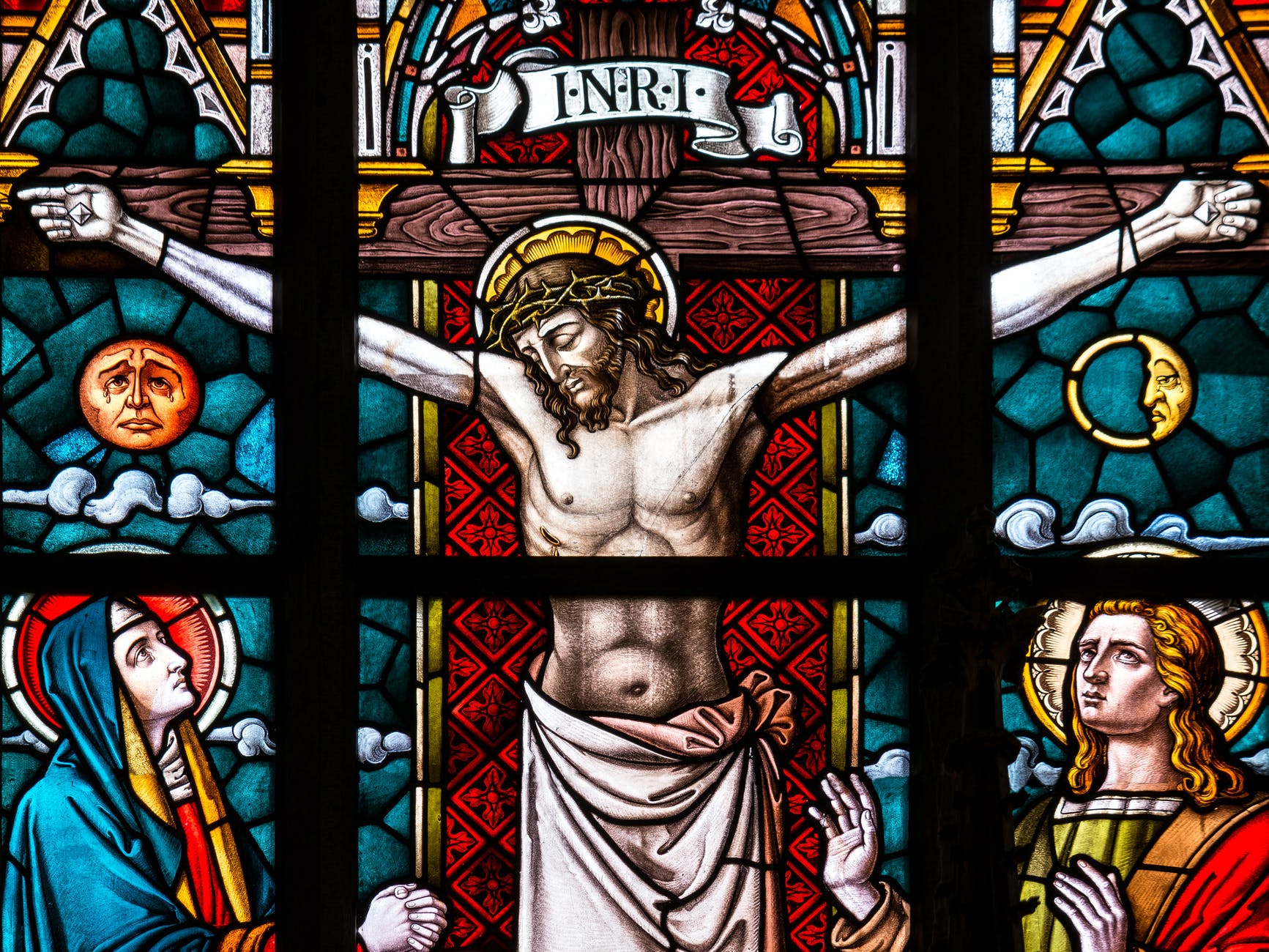
Life by Death

Photo by Pixabay on Pexels.com

A lot of people don’t like change. That is likely an understatement. Change means adjusting to a different reality and adjusting is not something we prefer doing. Many folks would much rather keep things the way they are. Routine, consistency, predictable outcomes—these are things we rely on for a sense of safety and stability in our lives.

Even good change is difficult, if for no other reason than what it takes to get there. Becoming debt-free, getting in shape, or starting a new job are all good changes to make, but to making them can take a lot of determination and effort on our part. In many cases, to change something about ourselves, we must be willing to admit what we are doing is not working and try something different.

God’s love in Jesus Christ changes everything. The kind of change Jesus talked about and died for was not making a few alterations to our lives or re-arranging some of our schedule. For Jesus, change is neither about exerting more effort nor adding things to an already full to-do list.

The change Jesus embraces is a complete transformation from the inside-out. For that to happen, to have a new life, the old life must die. What’s more, Jesus does not want us half dead because then we are only spiritual zombies, not really living the life God intended for us. No, if there is to be a resurrection and new life, there must be a death (John 12:20-33). There are three ways people need to die to live the life that God desires….

1.We need to die to our plans.

Jesus had a crowd of people following him wherever he went. He was interesting and compelling, even magnetic. Christ taught like no other person before him and healed all kinds of people. In the first century, Jesus became the latest fad.  With his fame, there were people who looked to Jesus to further their own agenda and their plans about how things should go.

Earlier in chapter twelve of John’s Gospel, the Apostle recorded a contrast between two people: Mary and Judas. Mary is a picture of dying to her own plans of how things should go. Mary took some expensive perfume, the kind that could have set her up for some needed financial security and poured it all on Jesus’ feet. Then, she humbly wiped it on him with her hair. It is a picture of giving herself completely and wholly to Jesus, no matter the cost, with no strings attached and no other agenda other than total devotion.

Judas, on the other hand, piously objected to Mary’s act of worship. We might hear him rationally pushback on what Mary was doing, saying to his fellow disciple, “My friends, this is a lot of money – money that could be used for the poor instead of needlessly wasting it. A little perfume is fine, but to use the whole bottle is over the top – it isn’t fiscally responsible!” Judas had a secret agenda. He was not thinking of giving himself completely to Jesus, but of how he could use the cash for himself and his own purposes. 

Judas is the picture of a spiritual zombie – half dead, walking around saying all kinds of spiritual things, but only devoted to Jesus and God’s kingdom when it agreed with him. Judas had his own ideas of how the kingdom operation ought to go. When he became convinced Jesus was not going to operate according to his agenda and plans, Judas betrayed him.

I have been crucified with Christ and I no longer live, but Christ lives in me. The life I now live in the body, I live by faith in the Son of God, who loved me and gave himself for me.

galatians 2:20, niv

In John 12:20-22, we have some Greeks (Gentiles) who want to see Jesus. They are interested in him. Unlike Judas and Mary, we are not told why they wanted to meet with him. But the fact that Jesus does not jump on the chance to interact with them probably says something about their motives. 

It is the nature of many people to want to observe whatever big thing is going on. They want to be in the know and talk about the latest happenings. Whenever we see “the crowd” in the Gospels, it is typically a negative connotation, a statement of by-standers, just looking on. 

Much of Christ’s ministry was to teach, heal, cajole, and do whatever he could to press the crowd, the by-standers, into not just following him as a novelty. Jesus wanted them to really follow him by dying to themselves and adopting a new life in the kingdom of God.

When I was a senior in high school the Pope came to Iowa, of all places! Never had that happened. 350,000 people came to see him. It was on a Friday, and we got two days off from school, mainly because trying to get around those two days was nearly impossible. Literally, everything shut down for the event. There were so many people that John Paul II got dropped in on one of Jimmy Carter’s presidential helicopters. 

I lived exactly thirteen miles from where the Pope spoke and had mass with the Catholic faithful. Protestants and Jews flocked to see him, as well. No car was allowed within a five-mile radius of the Pope. People had to park miles away and get shuttled-in. I knew several people from my small town that walked the thirteen miles one way just to see John Paul II. It was exciting and incredible, and is still talked about today in Iowa, forty years later.

Not everyone there that day in Iowa was a faithful Christ follower. Most people do not remember much about what John Paul II said, other than affirming the work of farmers as a needed vocation. Jesus was not at all interested in being a king in the conventional sense. He did not seek popularity or work to consolidate power through sheer force of will or personality. Instead, he died. And he calls us to die, as well – to die to our plans and to our perceived need to be in the know and hob-nob with a celebrity.

2. We must die to self.

This was the message of Jesus. There is no wiggle room to it. There are no walking dead zombies. Jesus responded to the request of the Greeks to see him by not even dealing with it but going on about what people really need to do: die to self.

To make his message clear and understandable, Jesus used the illustration of a seed that must die before it bears fruit.  Seeds wait to germinate until three needs are met: proper amounts of water, warm temperature, and good soil. During its early stages of growth, the seedling relies upon the food supplies stored within the seed until it is large enough for its own leaves to begin making food through photosynthesis. The seedling’s roots push down into the soil to anchor the new plant and to absorb water and minerals from the soil. And its stem with new leaves pushes up toward the light.

This is exactly the kind of process Jesus said needs to happen with people in the kingdom of God. People must never settle for remaining as seeds because that is not what we are designed for. Jesus wants us to be transformed, to experience new life, and to bear righteous fruit. To follow Jesus means to die being a seed and growing into a fruit bearing plant with more seeds to have the whole process occur again.

Jesus said that the person who “hates” their life will gain eternal life. That is, the person who is willing to give up everything to follow Jesus will find true life in Christ. The one who serves Jesus will follow him. Hate is simply a biblical term that means we make the choice to avoid one path in favor of another.

When living in West Michigan, my family enjoyed summers on the beaches of Lake Michigan. My girls loved being there on hot summer days. The beaches are actual sand, not with any gravel or dirt. I would tell my girls to follow me and walk in my footprints. I told them that not only because it would be easier for them to walk, but so they would not stray from me.

Lent is a season designed for us to remember Jesus, to remember we belong to God, and to repent of anything that keeps us away from the Lord.  This brings us to the third way we need to die….

3. We are to die to the world.

Now is the time for judgment on the world. The prince of this world is driven out. The death of Jesus means we can now die to the world. “World” is not the people of this world, in the sense of John 3:16 that God loves the world. This is “world” as the unjust systems that operate within it. Christ achieved victory over this world. He died so that we no longer need to be locked into the oppressive ways of bondage and evil.

Do not love this world nor the things it offers you, for when you love the world, you do not have the love of the Father in you. For the world offers only a craving for physical pleasure, a craving for everything we see, and pride in our achievements and possessions. These are not from the Father, but are from this world. And this world is fading away, along with everything that people crave. But anyone who does what pleases God will live forever.

1 John 2:15-17, NLT

Jesus lived in a vastly different manner than people expected. He was quite counter-cultural. Christ rarely submitted to the usual way of doing things. Jesus did not operate like a worldly king. He did not teach like a worldly instructor. He died not only to redeem individuals but also to redeem entire systems and transform them into instruments of godliness. 

God cares about systemic evil, about ways of operating which keep people in bondage. Jesus cares about politics, economics, and social structures. He cares about governments and municipalities. The Lord cares about school systems and family systems and, yes, even church systems. Jesus died so that we can die to the world’s broken systems. God desires all our institutional ways of operation come under the lordship of Jesus Christ.

It will not do to only focus on private spirituality because Jesus wants to redeem the entire planet, systems included. Jesus is the Judge, and he is currently about the business by means of the Holy Spirit of making all things new. Eventually, the new creation will completely take over when Jesus returns. Now, in the present time, we have this crazy mixture of good and evil everywhere we go. Christians are to follow Jesus personally and privately, as well as corporately and publicly.

For example, the “factory system” is an actual phrase. The factory system is designed to mass produce products with the greatest efficiency possible. And it works. However, in the process, people become extensions of the machines they operate. With efficiency and production as the highest priorities, people can be replaced like cogs in the machine. 

Walk into many American factories and you will see sagging morale and deep animosities between workers and management because the system itself is inherently flawed. Simply implementing some safety protocols and giving a few raises are merely zombie tactics. The system still needs redemption.

When we take seriously the call to follow Christ, we see that the world and its systems are fundamentally broken and in need of redemption. Jesus has deposed the ruler of this world, Satan, through crucifixion and resurrection. We need to die to this world and to systemic evil.

Conclusion

We all become frustrated and discouraged at times, either with ourselves and/or with the world’s evil that exists around us, making our lives hard and even unbearable. Jesus knows how you feel. His soul was troubled with all the sin of the world. And he faced agony beyond anything we will ever know by allowing himself to die. The kind of death Jesus died was awful. It was that way because that is how horrible sin and sinful systems are.

Today Jesus is calling us to die – die to our plans of how we think things should go; die to ourselves by following in his footsteps; and die to participating in the sinful structures and systems of this evil world. We are to live differently. We are to live new lives – which means not simply tweaking some things but completely re-orienting our lives to serve the Lord.

Jesus is drawing us to himself. He is making himself known. Let us not treat Jesus as a novelty, but as the rightful Ruler of the universe by dying to our plans, ourselves, and the world.


John 21:1-14 – Breakfast in the Liminal Space

BreakfastAtDawn MikeMoyers
“Breakfast at Dawn” by Mike Moyers

Later, Jesus himself appeared again to his disciples at the Sea of Tiberias. This is how it happened: Simon Peter, Thomas (called Didymus), Nathanael from Cana in Galilee, Zebedee’s sons, and two other disciples were together. Simon Peter told them, “I’m going fishing.”

They said, “We’ll go with you.” They set out in a boat, but throughout the night they caught nothing. Early in the morning, Jesus stood on the shore, but the disciples didn’t realize it was Jesus.

Jesus called to them, “Children, have you caught anything to eat?”

They answered him, “No.”

He said, “Cast your net on the right side of the boat and you will find some.”

So, they did, and there were so many fish that they couldn’t haul in the net. Then the disciple whom Jesus loved said to Peter, “It’s the Lord!” When Simon Peter heard it was the Lord, he wrapped his coat around himself (for he was naked) and jumped into the water. The other disciples followed in the boat, dragging the net full of fish, for they weren’t far from shore, only about one hundred yards.

When they landed, they saw a fire there, with fish on it, and some bread. Jesus said to them, “Bring some of the fish that you’ve just caught.” Simon Peter got up and pulled the net to shore. It was full of large fish, one hundred fifty-three of them. Yet the net hadn’t torn, even with so many fish. Jesus said to them, “Come and have breakfast.” None of the disciples could bring themselves to ask him, “Who are you?” They knew it was the Lord. Jesus came, took the bread, and gave it to them. He did the same with the fish. This was now the third time Jesus appeared to his disciples after he was raised from the dead. (CEB)

Sometimes, maybe oftentimes, it takes a bit of time to wrap our heads and our hearts around a new reality. After all, if you’ve been used to operating a particular way for a long time, it can be hard to come around to embracing difference – even if that change is really good.

Good ol’ Peter, you’ve got to love him. Bless his heart, the Lord Jesus is risen from death and he, along with some of the other disciple fishermen, are not quite up to speed on resurrection. Christ is alive, the disciples have already seen him on two separate occasions, yet they seem like a dog who has chased a rabbit and now don’t know what to do with it once they’ve surprisingly gotten it.

So, Peter goes fishing. Yep, when all else seems upside-down and topsy-turvy, just go fishing. The problem is: Peter and the boys are going back to a life that doesn’t exist anymore. And that’s pretty much what we all tend to do when we are stuck in a liminal space, caught in a situation of uncertainty without much of a clue what to do. We simply go back to what we’ve always done and hope we catch some fish.

But we can’t catch fish. It isn’t the same anymore. The resurrection of Jesus has completely upended the world. There’s no going back to any sort of pre-resurrection days. All has changed. I’m not sure if the disciples believed they were going to catch any fish, or not. Seems they just had to go do something familiar.

Unknown to them, the rules changed. The old way of fishing won’t work. While they’re off trying to live from the old life, Jesus shows up on shore. The disciples don’t realize its him. So, they don’t anticipate that when Jesus calls out and encourages them that they’ll end up with a nice haul of fish. While the old life yields nothing, the new life with Christ brings abundance, blessing, and fellowship. After the big catch of fish, here are the disciples now eating breakfast with the King of Kings, yet they’re still scratching their heads. What’s going on? Who is it? Well, of course, it’s Jesus, but is it? What’s the plan? I’m so confused.

In the passage and the journey from one reality to another, from a place of familiarity to a place of a future we’ve never seen, from an old life to a new life, there is both the shadow of doubt which makes everything feel so uncertain and the confidence of faith which keeps us going forward. In this middle space there is a continual vacillating between doubt and faith. Rarely is there ever a black-and-white existence. No, instead its wise to become friends with the gray because most lessons we learn come while inhabiting this weird in-between space.

When the disciples encountered Jesus in today’s Gospel story, it was an experience of Jesus in the middle – a six-week time between resurrection and ascension. It was also an experience of the disciples in the middle. There was no going back to a pre-resurrection time of walking and talking with Jesus as they had done before. And there is also no future where they can live in the past or pick up the fishing business just like before.

Although we have the advantage of knowing how the story shakes-out with Christ’s ascension, the giving of the Spirit, and a robustly bold group of disciples going out to change the world – the disciples cannot picture that future in their liminal space on the beach.

We, too, inhabit a middle space. We are in-between the two advents of Christ. This truly is an awkward time in which we, along with disciples, experience a mix of belief and doubt because we aren’t at the end of the story. So, a combination of worship and wondering exists in the here-and-now. Jesus doesn’t chide the disciples for sometimes believing and sometimes not; and, our Lord isn’t exasperated with us because one of the certainties for the Christian is that grace overcomes everything. Sitting down with Word and Meal creates a new space where we can begin to make sense of our sometimes very nonsensical lives.

Great God of Resurrection, help me to embrace both the meaning and the mystery of faith as I negotiate and interpret every situation in my life through the light of Jesus Christ, your Son, my Lord, who lives and reigns with you and the Holy Spirit, one God, now and forever. Amen.

Click There Is a Hope by Stuart Townsend for encouragement through your liminal space.

Isaiah 25:6-9 – Celebrate!

village in front of the mountains
Photo by Quang Nguyen Vinh on Pexels.com

On this mountain the Lord Almighty will prepare
    a feast of rich food for all peoples,
a banquet of aged wine—
    the best of meats and the finest of wines.
On this mountain he will destroy
    the shroud that enfolds all peoples,
the sheet that covers all nations;
    he will swallow up death forever.
The Sovereign Lord will wipe away the tears
    from all faces;
he will remove his people’s disgrace
    from all the earth.
The Lord has spoken. 

In that day they will say, 

“Surely this is our God;
    we trusted in him, and he saved us.
This is the Lord, we trusted in him;
    let us rejoice and be glad in his salvation.” (NIV) 

Mountains are a prominent and symbolic part of Holy Scripture. Abraham sojourned to a mountain where the pinnacle of faith was exhibited. The Law was given on a mountain. Elijah met God on a mountain. Jesus preached the most famous sermon ever on a mountain. From such references, and more, we routinely refer to extraordinary events as “mountaintop experiences.”  

The mountain is a great contrast and antithesis to the valley of death below. It signifies God’s power and reign over all earthly rulersOn the mountain we enjoy a great feast of the soul, not to mention an actual meal full of celebration. After all, food and celebration always go together in God’s kingdom. 

85985-the2blast2bsupper

Whenever healing and/or emancipation happen, it is time for celebration. To celebrate significant events, and even to ritualize them so we remember them, is not only wise – it is much needed and vital to how we are wired as humans. The lack of celebration creates spiritual amnesia. When we need support in the future, we don’t recall the mighty acts of God. Yet, if we consistently practice celebration, the redemption experienced in the past is constantly fresh, like a sumptuous meal which is always before us. We can eat of it anytime we want. 

Banquets are rightly associated with hospitality, generosity, and fellowship. Meals in the ancient Near East culture were much more than utilitarian; eating together was (and, frankly, still is in most parts of the world) a deeply spiritual event which communicates acceptance, encouragement, and love to one another.  

God is the ultimate host. He throws the best parties. God ensures that there is plenty of food, fellowship, and fun. God’s joy knows no bounds. In the middle of a world beset with sadness, loss, and grief, God’s boundless generosity swallows up people’s disgrace and mourning. At God’s Table, no one cries alone; everyone is comforted; nobody walks away hungry; and, every person is waited upon, no matter who they are or where they have come from. Indeed, there is always room at the Table. 

Through Christ’s resurrection, “death has been swallowed up in victory” (1 Corinthians 15:54). Death no longer has any power to control, humiliate, or shame us into submission. Death’s threats are emptyThe Grim Reaper’s teeth have been pulled and his scythe has been broken. He is the party-pooper who is barred from entry. Conversely, there is life and abundance for all who ascend the mountain and feast with God at his Table. The invitation has gone out. The Table is spread. We need only to come. 

In the joy of your Son, Jesus Christ, through his mighty resurrection and in expectation of his coming again, we offer ourselves to you, Almighty God, as holy and living sacrifices. Together with all your people everywhere and in every age, we proclaim the mystery of the faith: 

Christ has died! 

Christ is risen! 

Christ will come again! 

Send your Holy Spirit upon us, we pray, that the bread which we break and the cup which we bless may be to us a sacred communion, a holy celebration of Christ’s body, blood, and victory over death. We declare: 

God has spoken! 

God has acted! 

God has provided! 

May you gather all into your hospitable and abundant kingdom; through Jesus Christ, your Son, our Lord, who lives and reigns with you and the Holy SpiritOne benevolent God, now and forever. Amen. 

Click Celebrate Jesus to keep the Easter songs coming in this season of celebrating new life.

1 Corinthians 15:12-20 – Why Is Resurrection Important?

bd2f0-christiancemetery

So, if the message that is preached says that Christ has been raised from the dead, then how can some of you say, “There’s no resurrection of the dead”? If there’s no resurrection of the dead, then Christ hasn’t been raised either.  If Christ hasn’t been raised, then our preaching is useless, and your faith is useless. We are found to be false witnesses about God because we testified against God that he raised Christ, when he didn’t raise him if it’s the case that the dead aren’t raised. If the dead aren’t raised, then Christ hasn’t been raised either.  If Christ hasn’t been raised, then your faith is worthless; you are still in your sins, and what’s more, those who have died in Christ are gone forever. If we have a hope in Christ only in this life, then we deserve to be pitied more than anyone else. But in fact, Christ has been raised from the dead. He’s the first crop of the harvest of those who have died. (CEB)

Christ’s resurrection is at the very heart and soul of what it means to be Christian. For followers of Jesus, the risen Christ is at the center of life. New life means freedom from sin, death, and hell. It means experiencing life without the shackles of our past indiscretions, present failures, and future anxieties. Christianity is grounded and dependent upon a very real physical rising from death. To put it another way, the new spiritual life which Christians experience in the here and now as a result of Christ’s crucifixion and resurrection is a foretaste of our own bodily resurrection.

If you are asking yourself, “Does this guy believe we are going to walk out of our graves like Jesus did?” the answer is a rollicking, “Yes!”  Although Christians have been granted deliverance, our salvation is not yet here in its fullness. We still need to deal with systemic evil in the world, our old habits of sin which occasionally rear their ugly heads, and an Adversary who seeks to exploit it all to undermine God’s redemptive work in us. There is a time coming when Christ will return and the dead will be raised; and, this will not be merely an ethereal going into the clouds to strum on a harp. It will be a bona fide physical resurrection with a new body. Thus, just as we have been given a new spirit within us, a new body will follow at the end of the age.

The Apostle Paul insisted that if there was no bodily resurrection, then our faith is a sham and its worthless. One of the simple observations to make about today’s New Testament reading is that our faith and life are inextricably linked to the life of Jesus. Christ has purposefully joined himself to us. That link is so strong and vital that, in other places, Paul uses the metaphor of a head and a body – Christ is the head and we the body. Just as one cannot separate head from body and expect to have life, so nobody can separate Christ’s resurrection and our resurrection. We will have a new body to go with our new life because of Jesus Christ’s redemptive events. That new body will be as much real as the one you have right now – just without the residual effects of the curse which so stubbornly cling to it.

So, what does this mean for us? Glad you asked. Christian spirituality is also very much sacramental, that is, we inhabit a bodily faith which is firmly grounded in material reality. God’s grace is communicated to us both spiritually through the unseen world and sacramentally by means of the physical creation. We are to be reminded of that sacramental nature of our faith each time we approach the Lord’s Table and ingest the very real bread and imbibe from the tangible cup. Touch and taste help us to know our faith is meant for the creation of our five senses, as well as to impel us to labor in this world for real causes of alleviating poverty, disease, social injustice, and a myriad of ailments that bog this old fallen earth. In short, both body and soul are of great value to our God, and so, ought to be for us, as well.

What’s more, we have both a spiritual and a sacramental inheritance which awaits us at the end of the age when Christ returns to judge both the living and the dead. For the Christian, this is the basis of our hope – a confident expectation that God will make good on his promises.

Almighty God, through your Son, Jesus, death has been conquered and new life unlocked for us. We pray that all who hold to his bodily resurrection may, through the renewal brought by your Spirit, rise up both spiritually and sacramentally; through our Lord Jesus Christ, who lives and reigns with you in the unity of the Holy Spirit, one God, now and forever. Amen.

In this season of Eastertide, click Christ Arose and we’ll keep the celebration of Christ’s Resurrection coming.