Spiritual Sight and Power (Acts 3:1-10)

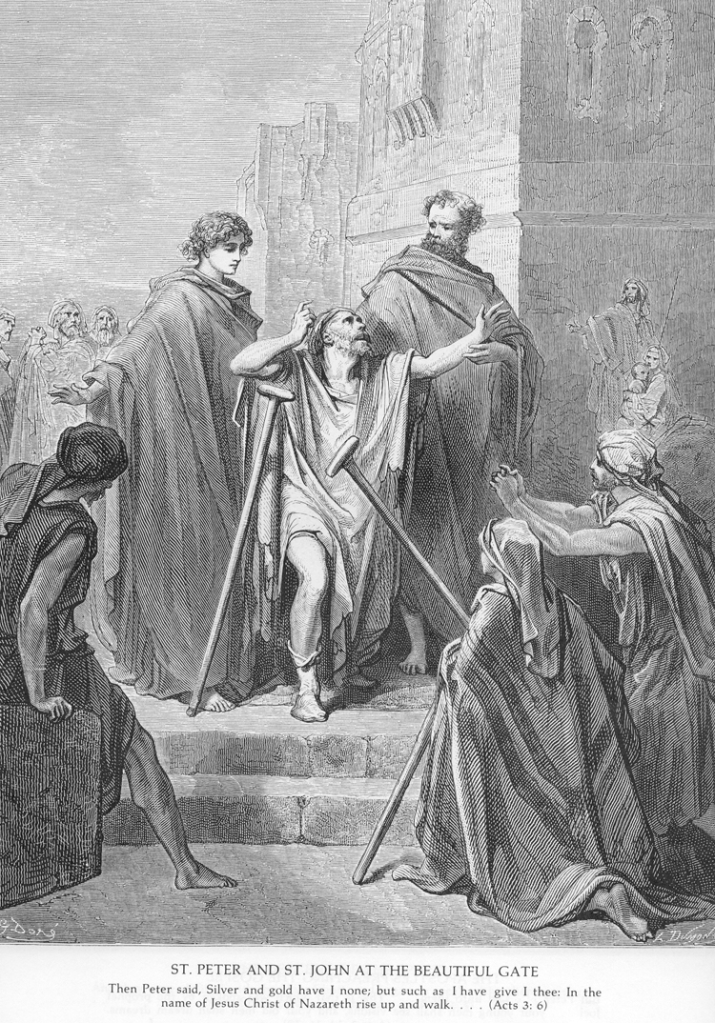
Peter and John heal the crippled man, by Gustave Doré (1832-1883)

Peter and John were going to the temple courtyard for the three o’clock prayer. At the same time, a man who had been lame from birth was being carried by some men. Every day these men would put the lame man at a gate in the temple courtyard. The gate was called Beautiful Gate. There he would beg for handouts from people going into the courtyard. When the man saw that Peter and John were about to go into the courtyard, he asked them for a handout.

Peter and John stared at him. “Look at us!” Peter said. So the man watched them closely. He expected to receive something from them. However, Peter said to him, “I don’t have any money, but I’ll give you what I do have. Through the power of Jesus Christ from Nazareth, walk!” Peter took hold of the man’s right hand and began to help him up. Immediately, the man’s feet and ankles became strong. Springing to his feet, he stood up and started to walk. He went with Peter and John into the temple courtyard. The man was walking, jumping, and praising God.

All the people saw him walking and praising God. They knew that he was the man who used to sit and beg at the temple’s Beautiful Gate. The people were amazed and stunned to see what had happened to him. (God’s Word Translation)

Peter and John at the gate of the temple, by Rembrandt

Money isn’t everything; and neither is having a lot of talent or giftedness. Yet, we often live our lives as if we cannot do much because of our lack of personal abilities and financial resources. But we can. All we need to do is give something that we all have to give.

Peter and John were disciples of Jesus. Though Jesus has ascended to heaven and the gift of the Spirit has come, they still maintained a daily rhythm of prayer three times a day at the temple.

As the two of them were about to attend afternoon prayer, they encountered a man at the gate. We are told that this particular guy was crippled. He came every day to the temple in order to beg. What is interesting to me is that this surely was not the first time Peter and John encountered the guy who begged at the gate.

Did they just ignore him? Was he one of many? Whatever the reason, they never put their eyes to him before. But on this occasion they did. In fact, they fixed their gaze on him and really took the time to stop and look at him.

I remember when my late brother-in-law had a complete turn around of his life to Jesus. At the time, he walked to work every day in the city. And every day there was a beggar on the corner. Most every day he had ignored him. One day he even spit on him.

The day after his great awakening to the Lord, he was walking to work and saw the beggar. But this time he really saw him. And when he looked into the man’s eyes, he had pity upon him. My brother-in-law – who took his lunch with him each day – surrendered it to the beggar. Eventually, he began a practice of bringing enough food for two, sitting down with the man, and talking with him as they ate together.

Perhaps for the first time, these disciples of Jesus, Peter and John, see the man who was there every day at the temple. They have not a thing with them. No money. No lunch. But they had something better: the power of grace and love.

In our contemporary Western society, we prefer things to be efficient and simple. Giving money, preferably online and dispassionately, is ideal for us. This way, we can give without any strings attached while feeling good about ourselves.

Yet, my brother-in-law and Peter and John decided to give the gift of connection. And that meeting of the eyes was the conduit for spiritual power to flow from one person to another. Doing what they saw Jesus do, the disciples gave the man who could not walk his legs back.

As a result, the guy was no longer lame nor a beggar. He became a fellow witness of God’s mercy and power. He went right up into the temple with Peter and John – walking and jumping and praising God.

It is not really money that gets things done. And it’s not our ingenuity or intelligence that really makes things happens. Throughout the book of Acts, demonstrations of God’s mighty power in the name of Jesus Christ is paramount. And those with alternative sources of power are shown to be powerless when it comes to life transformation.

In all of human history, including today, people like power; and power attracts wealth, as well as wealth attracting power. But the power of Christ’s resurrection is completely disconnected from worldly wealth. And it is never used for personal gain or popularity. And what’s more, this sort of power is available to every Christian – and not just a special class of super-Christians or clergy persons.

If we trace apostolic work in the New Testament, we shall find that the people with such spiritual power received it not because of extraordinary faith or exceptional virtue; instead, the Spirit grants us the ability to make a difference in this world by granting us the gift of sight – to truly see another as the precious image bearer of God that they are.

There are people right in front of us every day that we might not see. If we are wondering how to tap into the spiritual power of resurrection, we have no further to look than observing and gazing upon the folks within our eyesight, so that we can see them in new and redemptive ways.

Holy Lord, you gave us something more powerful and more valuable than riches; you have given us healing and hope. Please bring that healing and hope into our world and show us evidence of your presence in our lives. Amen.

Resurrection of the Lord (John 20:1-18)

Mosaic of Mary Magdalene in the garden with Jesus, Resurrection Chapel, Washington National Cathedral, Washington D.C.

Early on the first day of the week, while it was still dark, Mary Magdalene came to the tomb and saw that the stone had been removed from the tomb. So she ran and went to Simon Peter and the other disciple, the one whom Jesus loved, and said to them, “They have taken the Lord out of the tomb, and we do not know where they have laid him.” 

Then Peter and the other disciple set out and went toward the tomb. The two were running together, but the other disciple outran Peter and reached the tomb first. He bent down to look in and saw the linen wrappings lying there, but he did not go in. 

Then Simon Peter came, following him, and went into the tomb. He saw the linen wrappings lying there, and the cloth that had been on Jesus’s head, not lying with the linen wrappings but rolled up in a place by itself. 

Then the other disciple, who reached the tomb first, also went in, and he saw and believed, for as yet they did not understand the scripture, that he must rise from the dead. Then the disciples returned to their homes.

But Mary stood weeping outside the tomb. As she wept, she bent over to look into the tomb, and she saw two angels in white sitting where the body of Jesus had been lying, one at the head and the other at the feet. They said to her, “Woman, why are you weeping?” She said to them, “They have taken away my Lord, and I do not know where they have laid him.” 

When she had said this, she turned around and saw Jesus standing there, but she did not know that it was Jesus. Jesus said to her, “Woman, why are you weeping? Whom are you looking for?” Supposing him to be the gardener, she said to him, “Sir, if you have carried him away, tell me where you have laid him, and I will take him away.” 

Jesus said to her, “Mary!” She turned and said to him in Hebrew, “Rabboni!” (which means Teacher). Jesus said to her, “Do not touch me, because I have not yet ascended to the Father. But go to my brothers and say to them, ‘I am ascending to my Father and your Father, to my God and your God.’” 

Mary Magdalene went and announced to the disciples, “I have seen the Lord,” and she told them that he had said these things to her. (New Revised Standard Version)

Do Not Hold On To Me, by He Qi

Although Peter and John have a role in this story about Christ’s resurrection, the main character is Mary Magdalene. This is significant and symbolic for several reasons:

  1. It was Mary who experienced one of the most profound and deep changes of life due to the ministry of Jesus. Mary had been an immoral woman and spiritually enslaved to the machinations of seven demons. Jesus thoroughly delivered her from her personal hell.
  2. Mary was forever thankful to Jesus for changing her life, and so, she followed Christ and supported him in any way she could. 
  3. Mary was at the foot of the cross when Jesus died. While other disciples were keeping their distance out of fear, Mary was bold in standing with the other women for all to see that they were completely devoted to Jesus. Mary never turned her back on Jesus. 
  4. It was Mary who was there on the Sunday morning of Christ’s resurrection. Whereas the other followers were nowhere to be found, Mary came to the grave, still with a heart given to Jesus and grieving over his death. 

Because Mary had been given a new chance at life, she was deeply thankful and everything she had belonged to Jesus. Mary Magdalene was forgiven much, and, so she loved much. Here she is, after her Lord’s crucifixion, death, and burial, at the grave of Jesus. 

Mary came to the tomb on Easter Sunday still living in a Good Friday world – grieving, sad, and discouraged.  She soon discovered, however, that Christ is risen!

In the midst of your days of disappointment, loss, or sadness, how have you been surprised by joy and the presence of the risen Christ?  How has your grief been turned to gratitude?  Have you seen the risen Lord?  

Let Mary Magdalene’s experience be of encouragement to you. Mary was given new life and was transformed by the Lord. Yet, on Easter Sunday she did not immediately get what the heck was going on. Jesus rising from death was not anywhere on her radar. 

The empty tomb and the angels did not immediately lead her to faith – not until she saw Jesus, and even then, she did not recognize him. Only when Jesus called her name did Mary recognize him and respond, believing it was her Lord. 

And Jesus is still calling out names. He is calling your name. Jesus had said to his disciples that the sheep listen to the shepherd’s voice; he calls his own sheep by name and leads them out (John 10:3-4). One little word can change our lives forever: our name.

Easter opens a whole new world for us, as it did for Mary – a future of announcing good news and proclaiming resurrection.

There is a simple reason why the grave clothes were left in the tomb just lying there – they were not needed anymore! We no longer need the grave clothes of discouragement, defeat, and despair. We no longer need to weep and wonder because Christ is risen! Jesus Christ has called us by name, and we hear his voice.

The twentieth century theologian, Karl Barth, said that what brings people to worship God – not just on Easter, but any day – is an unspoken question clinging to our minds and hearts: Is it true? Is it true that God lives? Is it true that Jesus is alive? Could it be true that I can live a new life in Christ? Is it true that I can rebuild my life?  Is it all true? 

Mary Magdalene approached the tomb and found that it was true: Christ Jesus is risen from death!

Today, all over the world, followers of Jesus are testifying that this day and it’s deep implications for life is real: Christ is risen, and there is new life in Jesus. Believers across the globe are worshiping the risen Lord because they declare along with us, “I have seen the Lord!”

God has always been in the business of changing lives. British author A. N. Wilson, used to be known for his scathing attacks on Christianity and proclaimed the death of God. Yet he celebrated Easter in 2009 at a church with a group of other church members, proclaiming that the story of Jesus is the only one that makes sense out of life and its challenges. Wilson said:

“My own return to faith has surprised none more than myself…. My belief has come about in large measure because of the lives and examples of people I have known—not the famous, not saints, but friends and relations who have lived, and faced death, in light of the resurrection story, and in the quiet acceptance that they have a future after they die.”

The moment Jesus calls a person’s name, the power of the resurrection is enabled—the same power that raised Jesus from the dead. 

Come now, see what you consider as immovable slabs of stone in your life—bitterness, insecurity, fear, self-doubt or cynicism. Those immense rocks can be rolled away. To know Jesus is to know the power of the resurrection. 

We don’t need to merely hear testimonies of changed lives like Mary Magdalene’s; we can experience new life ourselves.

There is one word, one name, which has forever changed the world: “Jesus.”  And Jesus wants to change the world by uttering one simple word, one name, your name, so that you can exclaim with great joy, “I have seen the Lord!”

Loving Lord Jesus, you are our freedom. When I was lost in a dark hole of guilt and shame, you liberated me. You lifted me from sin, death, and hell.

Almighty God, hear today our prayers for the salvation of the world. Grant mercy to everyone who has turned away from you. Open their hearts and minds with your gracious light. Gather your children from the east and the west, from the north and the south. 

O God, bring people everywhere out of the darkness of disease and death, and into your marvelous light. Hear our prayers and answer us. May the benevolent way of Jesus be the hope of the world; among all nations may your salvation come.

Gracious Lord, our neighbors, relatives, friends, and co-workers, along with the sick, the poor, the prisoner, the widow, and all creation are in your hands. Therefore, fill us all with your love and your mighty resurrection power! And, grant us peace through Jesus Christ, our risen Lord. Amen.

The Power of Deliverance (Exodus 14:10-31, 15:20-21)

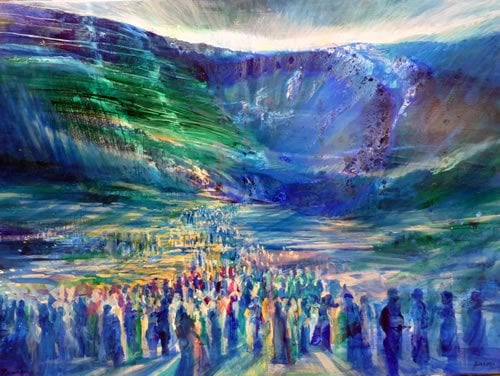
The Parting of the Sea, by Yoram Ranaan

As Pharaoh approached, the Israelites looked up and saw that the Egyptians were coming after them. Terrified, the Israelites cried out to the Lord. They said to Moses, “Did you bring us out into the desert to die because there were no graves in Egypt? Look what you’ve done by bringing us out of Egypt! Didn’t we tell you in Egypt, ‘Leave us alone! Let us go on serving the Egyptians’? It would have been better for us to serve the Egyptians than to die in the desert!”

Moses answered the people, “Don’t be afraid! Stand still, and see what the Lord will do to save you today. You will never see these Egyptians again. The Lord is fighting for you! So be still!”

Then the Lord said to Moses, “Why are you crying out to me? Tell the Israelites to start moving. Raise your staff, stretch out your hand over the sea, and divide the water. Then the Israelites will go through the sea on dry ground. I am making the Egyptians so stubborn that they will follow the Israelites. I will receive honor because of what I will do to Pharaoh, his entire army, his chariots, and cavalry. The Egyptians will know that I am the Lord when I am honored for what I did to Pharaoh, his chariots, and his cavalry.”

The Messenger of God, who had been in front of the Israelites, moved behind them. So the column of smoke moved from in front of the Israelites and stood behind them between the Egyptian camp and the Israelite camp. The column of smoke was there when darkness came, and it lit up the night. Neither side came near the other all night long.

Then Moses stretched out his hand over the sea. All that night the Lord pushed back the sea with a strong east wind and turned the sea into dry ground. The water divided, and the Israelites went through the middle of the sea on dry ground. The water stood like a wall on their right and on their left.

The Egyptians pursued them, and all Pharaoh’s horses, chariots, and cavalry followed them into the sea. Just before dawn, the Lord looked down from the column of fire and smoke and threw the Egyptian camp into a panic. He made the wheels of their chariots come off so that they could hardly move. Then the Egyptians shouted, “Let’s get out of here! The Lord is fighting for Israel! He’s against us!”

Then the Lord said to Moses, “Stretch out your hand over the sea so that the water will flow back over the Egyptians, their chariots, and their cavalry.”

Moses stretched his hand over the sea, and at daybreak the water returned to its usual place. The Egyptians tried to escape, but the Lord swept them into the sea. The water flowed back and covered Pharaoh’s entire army, as well as the chariots and the cavalry that had followed Israel into the sea. Not one of them survived.

Meanwhile, the Israelites had gone through the sea on dry ground while the water stood like a wall on their right and on their left. That day the Lord saved Israel from the Egyptians, and Israel saw the Egyptians lying dead on the seashore. When the Israelites saw the great power the Lord had used against the Egyptians, they feared the Lord and believed in him and in his servant Moses….

Then the prophet Miriam, Aaron’s sister, took a tambourine in her hand. All the women, dancing with tambourines, followed her. Miriam sang to them:

“Sing to the Lord.
He has won a glorious victory.
He has thrown horses and their riders into the sea.” (God’s Word Translation)

Things can change quickly.

One day, you’re living in slavery, and the next, you’re free. One minute, you’re celebrating freedom, then the next minute, you’re backed into a corner, and it looks like the end – only to be dramatically delivered from calamity.

One day (Holy Saturday) the disciples were lower than a snake’s belly in a wagon wheel rut; the next day (Easter Sunday) they’re wondrously slack-jawed with hopes higher than the sky.

Today’s Old Testament reading impresses on us the necessity of trusting God one day at a time, one minute at a time. Circumstances will change; God’s basic character will not change. Therefore, we have the continual opportunity of exercising our faith, and practicing trust in the Lord, by living into a new reality.

In this Christian season of Eastertide (spanning the next 50 days until the Day of Pentecost) we discover resurrection power in putting to death old unhealthy practices and adopting new healthy life-giving habits. Eastertide’s intentional focus is to recognize and celebrate the resurrection of the Lord Jesus Christ, and so, to exult in our own new life in him.

Revisiting both Christ’s resurrection, and the Red Sea deliverance, helps to remind us God’s invisible power to save is stronger and greater than any visible powers on this earth. Both of these deliverance stories keep us focused on the hope of individual renewal, corporate revitalization, and worldwide revival.

Eastertide is the season to engage in some renewal practices. The following are a few ideas for living into our deliverance from God:

  • Pray for revival of spirituality. Christ brings salvation and life, so praying to God for revival is a deliberate way of connecting with God.
  • Pay attention to words. Gossip, back-biting, slander, and other sins of the tongue kill people. Instead, consider how to use your speech for encouragement, love, mercy, forgiveness, and building up one another. This promotes growth, health, and life.
  • Proclaim resurrection. I believe the church is meant to be the hope of the world because Christ is the risen Lord. Graciously proclaim the resurrected Christ and how the spiritual life makes a difference in life.
  • Put yourself out there. Start the new ministry you always believed would make a difference. Take a risk. You’ve been given eternal life, so can you really fail?
  • Promote daily habits of spiritual health and life. Develop a realistic and workable plan for yourself when it comes to basic spiritual practices of Scripture reading, prayer, worship, etc. And stick to it by involving others.

There will always be people in our lives who try and pull us from what’s most important, even persons who want to keep the status quo to the point of seeking to destroy us. Be ready. Keep Eastertide in front of you; God has raised us to new life.

Allow Christ’s resurrection take root in your heart to such an extent that life itself informs all your thinking, speaking, feeling, and acting. The victory is won. So, sing to the Lord!

Hebrews 13:20-21 – Conflict and Peace

Pretty Place Chapel Blue Ridge Mountains
Pretty Place Chapel in the Blue Ridge Mountains

May the God of peace,
who brought back the great shepherd of the sheep,
our Lord Jesus,
from the dead by the blood of the eternal covenant,

        equip you with every good thing to do his will,
by developing in us what pleases him through Jesus Christ.
To him be the glory forever and always. Amen. (CEB)

These verses are the benediction, that is, the blessing given at the end of a long letter to a group of struggling Jewish Christians. In fact, things were so difficult for these believers that they were giving serious consideration to reneging on their commitment to Christ. So, the author of Hebrews sent them an exhortation and an encouragement to remain true and steadfast to the faith.

What is needed is not a shrinking back from faith but instead an enduring faith which is sustainable for the long haul of a person’s life.

The believers had both inner and outer conflict. They were experiencing hardship and persecution in the form of confiscation of their property and public insults. The Christians had started out well, facing such trouble with confidence through standing side-by-side with others who were suffering as well as holding on to their vibrant faith.

Yet, over time, their resolve began to break down. A slow drift occurred. Eventually, they started to retreat from the helping of others. They emotionally and spiritually inched their way to becoming despondent to the point of questioning whether all this Christianity stuff was worth it. The outer conflict worked its way inside their souls and damaged their spirits. By the time the writer of Hebrews comes along, a group of Christians are stuck in discouragement.

It’s one thing to deal with trouble and hardship on one day, even two. It’s quite another thing when that difficulty does not let up – when days turn into weeks, weeks into months, even months into years.

There are times when peace seems to have about as much chance of being realized as winning the lottery.

Yet, God is the God of peace, real lasting harmonious spiritually restful peace. It was achieved through the life and death of Jesus. The peace Jesus has brought is so much more than the absence of conflict. God’s peace is freedom from fear and anxiety. It is a settled confidence deep down inside that God will ultimately make good on all his promises and that things will not always be this way.

Until that day comes, God is not sitting in some divine Lazy-Boy recliner watching old reruns of the Angels playing baseball. Rather, God is active through carefully, deliberately, and, to our occasional consternation, slowly equipping us and developing us into spiritually fortified people who do the will of God and please Jesus in everything they do and say. Jesus is the Great Shepherd of the sheep who will not lead us astray but will settle us in green pastures.

The word translated “equip” is a rich word (Greek καταρτίσαι, pronounced “cot-ar-tids-ay”) which means to set something straight. Picture a bone which has been broken and needs to be reset and have time to heal. That is what God is doing in his people – repairing broken spirits. This divine healing is equipping believers for a lifetime of handling adversity with faith, confidence, and endurance. The process, frankly, hurts and requires patience before healing and health come.

If God can raise the dead, he can most certainly handle any earthly trouble we are going through.

God is in the transformation business. Extreme makeovers are his specialty. He uses hard circumstances, troubles, and torments of our lives and bends them into divine tools to form and shape his people to both survive and thrive in the world.

Complaining spirits, blaming and shaming others, and impatience borne of unrealistic expectations are the evidence of damaged emotions, wounded souls, and weak faith. This is the antithesis of God. He’s not overlooking humanity with a divine *sigh* in exasperation. That’s because he is the God of peace who is bringing all things to a conclusion in Christ. Jesus will come to judge the living and the dead. The Holy Spirit is now and very presently active to heal damaged emotions, repair wounded souls, and strengthen faith.

In those times when God seems absent and prayers seem to bounce off the ceiling are the times that God is establishing peace and expanding our capacity for faith and patience.

Benediction, blessing, and doxology come through the dark night of the soul and not by avoiding it.

Soli Deo Gloria. To God be the Glory.

Almighty God,
all thoughts of truth and peace
proceed from you.
Kindle in the hearts of all people
the true love of peace.
Guide with your pure and peaceable wisdom
those who take counsel
for the nations of the earth;
that in tranquility your kingdom
may go forward,
till the earth is filled
with the knowledge of your love;
through Jesus Christ our Lord. Amen.

–From the Book of Common Order of the Church of Scotland, St. Andrew Press.

Click It Is Well with My Soul by TenTwoSix Music and arranged by David Wise.