Take the Path of Peace (Zechariah 1:1-17)

Michelangelo’s depiction of the prophet Zechariah, Sistine Chapel, Rome

In the eighth month of the second year of Darius, the word of the Lord came to the prophet Zechariah son of Berekiah, the son of Iddo:

“The Lord was very angry with your ancestors. Therefore tell the people: This is what the Lord Almighty says: ‘Return to me,’ declares the Lord Almighty, ‘and I will return to you,’ says the Lord Almighty. Do not be like your ancestors, to whom the earlier prophets proclaimed: This is what the Lord Almighty says: ‘Turn from your evil ways and your evil practices.’ But they would not listen or pay attention to me, declares the Lord. Where are your ancestors now? And the prophets, do they live forever? But did not my words and my decrees, which I commanded my servants the prophets, overtake your ancestors?

“Then they repented and said, ‘The Lord Almighty has done to us what our ways and practices deserve, just as he determined to do.’”

On the twenty-fourth day of the eleventh month, the month of Shebat, in the second year of Darius, the word of the Lord came to the prophet Zechariah son of Berekiah, the son of Iddo.

During the night I had a vision, and there before me was a man mounted on a red horse. He was standing among the myrtle trees in a ravine. Behind him were red, brown and white horses.

I asked, “What are these, my lord?”

The angel who was talking with me answered, “I will show you what they are.”

Then the man standing among the myrtle trees explained, “They are the ones the Lord has sent to go throughout the earth.”

And they reported to the angel of the Lord who was standing among the myrtle trees, “We have gone throughout the earth and found the whole world at rest and in peace.”

Then the angel of the Lord said, “Lord Almighty, how long will you withhold mercy from Jerusalem and from the towns of Judah, which you have been angry with these seventy years?” So the Lord spoke kind and comforting words to the angel who talked with me.

Then the angel who was speaking to me said, “Proclaim this word: This is what the Lord Almighty says: ‘I am very jealous for Jerusalem and Zion, and I am very angry with the nations that feel secure. I was only a little angry, but they went too far with the punishment.’

“Therefore this is what the Lord says: ‘I will return to Jerusalem with mercy, and there my house will be rebuilt. And the measuring line will be stretched out over Jerusalem,’ declares the Lord Almighty.

“Proclaim further: This is what the Lord Almighty says: ‘My towns will again overflow with prosperity, and the Lord will again comfort Zion and choose Jerusalem.’” (New International Version)

God hulking-out isn’t something you want to see repeated, insisted the prophet.

Zechariah directed his message to the Jews returning from their exile in Babylon. He reminded them that their parents and forebears had been called to repent and return to the Lord. They didn’t. Hence, the Babylonian exile. Big hint from the prophet to the people: Don’t ever do that again. Things will get angry, large, and green if you do.

Zechariah’s generation was being given a chance: To live into God’s covenant and law; to hold fast onto their identity as God’s people.

The people listened to the prophet. They expressed their repentance and a desire to turn from past evil ways and embrace the ways of the Lord. And the returning exiles also acknowledged and accepted God’s judgment. The returning exiles understood that, as a people, they deserve the consequences to centuries of neglecting justice, mercy, and humility.

Every generation of believers must learn from the past. Not only do they need to receive the teachings and traditions of those who went before them, but each generation must also struggle with how to put that teaching and tradition into practice.

The past needs to be squarely faced and deliberately pulled into the present. That is the way a genuine hope is born, giving direction for the future. In other words, old words and ways from the past need new experiences in the present; only by doing this will there be guidance.

Bring in your kingdom so that your will is done on earth as it’s done in heaven. (Matthew 6:10, CEB)

Today’s Old Testament lesson includes the first of eight night visions from the prophet Zechariah. The gist of the first prophetic oracle is a message of assurance and comfort: God will restore. The Lord will renew.

Divine intervention is about to happen in the rebuilding of the temple – a physical example of the spiritual reality that is happening. Just as the ancient temple was being restored for new generations of worshipers, so the people were being renewed to be an example of piety and fidelity to God for millennia to come.

Peace and prosperity will again be realized.

Throughout Scripture, trees are a symbol of a thriving and flourishing life. The myrtle tree is a sign of God’s promise to bring new life, branching out to spread into the next generations. Like all trees, the myrtle needs plenty of moisture when young. Yet, it is distinctive in that the myrtle tree can tolerate drought, grow despite limited soil, and remain hardy when it becomes mature.

Your anger lasts a little while,
but your kindness lasts
    for a lifetime.
At night we may cry,
but when morning comes
    we will celebrate. (Psalm 30:5, CEV)

“Tolerate,” “grow,” and “remain” are anything but passive words. People are more than mere observers. “Repent” and “return” and “renew” are verbs. There is a great deal of activity to do. A divine/human cooperation needs to occur. On God’s end, even the angels get involved in the action. What’s happening here is both heavenly and earthly business.

Relational dynamics between God and God’s people are to be a dialogue and not a one-sided monologue. The Lord and the present generation are to demonstrate for future peoples how peace is actually realized and enjoyed.

The Vision of Zechariah, by Unknown artist, c.1300 C.E., Sicily

Like all biblical visions, Zechariah’s is not readily understandable. Nobody is sure about what the symbolism is behind the vision’s horses. Yet, I’ll venture to say that it’s the colors which are significant: red is the color of action; brown is a color of stability and fertility; and white represents purity and holiness. Red, brown, and white mixed together creates a beige color.

Beige is an earthy and dependable color. It’s an inherently welcoming and calming color, offering warmth and symbolizing harmony and comfort. Together, with the horses we have a representation of strength, stability, and structure. They are signs of peace and rest, of God’s shalom.

Spiritual wholeness, moral integrity, relational harmony, and settled peace don’t just magically happen. 

For the Christian, peace was bought at a price – the blood of Jesus. (Colossians 1:20)

Peace must be both passively received and actively pursued. (Ephesians 4:3)

Practices of peace need to be engrafted into our lives so that we might daily experience it. (Romans 14:13-15:7)

The name “Zechariah” is a Hebrew word meaning, “God remembered.” God has not forgotten divine promises. 

The time has come to take hold of the vision God had from the very beginning to walk with humanity in continual fellowship and happiness in the garden, a place of abundant growth, beauty, and health – a place of peace and rest.

The happiest, fully rested, and most peaceful people and nations on earth continually find a steady stream of joy in their families, their rituals/traditions, and their religion.

To find joy and happiness in life is to find peace and rest. And peace is something to be shared, to be passed onto others.

“The peace of Christ be with you.”

“And also with you.”

Such ritual words and practices are reminders of continually returning to the Lord and finding simplicity and satisfaction in Jesus.

In observing and celebrating the Lord’s Table, we find our penultimate remembrance of how peace was achieved, as well as our supreme participation in the triune God.

Perhaps, then, peace and prosperity will extend their tree-like branches over the earth and into the next generations.

Grace to you and peace from God our Father and the Lord Jesus Christ.

Peace before us,
Peace behind us,
Peace under our feet.

Peace within us,
Peace over us,
Let all around us be peace.

Christ before us,
Christ behind us,
Christ under our feet.

Christ within us,
Christ over us,
Let all around us be Christ. – a Navajo Prayer

Get Rid of Sin (1 Corinthians 6:1-11)

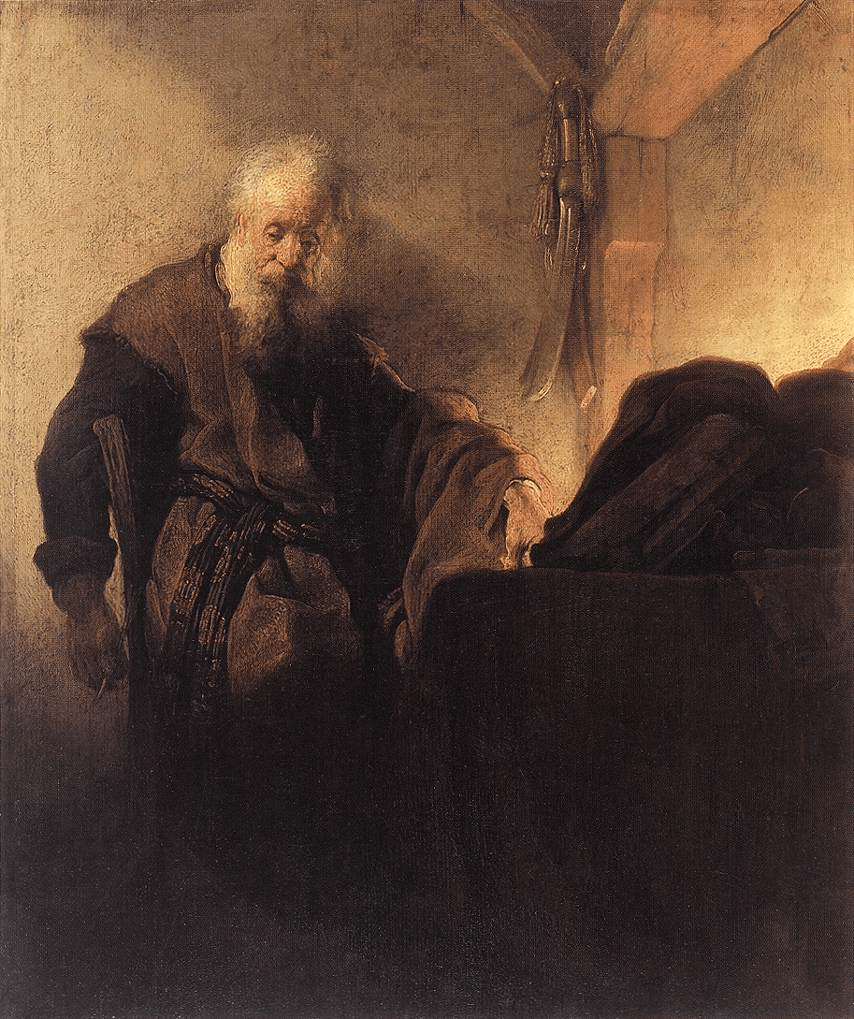
The Apostle Paul at his Desk, by Rembrandt, 1657

When any of you has a grievance against another, do you dare to take it to court before the unrighteous, instead of taking it before the saints? Do you not know that the saints will judge the world? And if the world is to be judged by you, are you incompetent to try trivial cases? Do you not know that we are to judge angels, to say nothing of ordinary matters? If you have ordinary cases, then, do you appoint as judges those who have no standing in the church? I say this to your shame. Can it be that there is no one person wise enough to decide between brothers and sisters? Instead, brothers and sisters go to court against one another, and this before the unbelievers.

In fact, to have lawsuits at all with one another is already a defeat for you. Why not rather be wronged? Why not rather be defrauded? But you yourselves wrong and defraud—and brothers and sisters at that.

Do you not know that wrongdoers will not inherit the kingdom of God? Do not be deceived! The sexually immoral, idolaters, adulterers, male prostitutes, men who engage in illicit sex, thieves, the greedy, drunkards, revilers, swindlers—none of these will inherit the kingdom of God. And this is what some of you used to be. But you were washed, you were sanctified, you were justified in the name of the Lord Jesus Christ and in the Spirit of our God. (New Revised Standard Version)

The one constant which every Church and each Christian will have to deal with until Jesus returns is the ever-present reality of sin

“Sin” isn’t a word that is much used anymore, even among many Christians. This is both good and bad. It’s good in the sense that we have expanded our vocabulary to better understand the concept and reality; and it’s bad because we sometimes label something as different than what it really is.

The Apostle Paul’s letter to the Corinthian Church confronts the presence of sin within the congregation. The reason why the letter is so long is that Paul painstakingly deals with every sin that had taken root in the community.

St. Paul at His Writing Desk by Rembrandt, 1630

In our New Testament lesson for today, Paul mentions some of those sins, especially tackling the unhealthy way the Christians were dealing with their internal strained relations of each other. One of the ways sin manifests itself is through confronting another’s sin with our own sin. Yeah, it gets complicated pretty quickly when that happens.

In other words, we too often try to meet a legitimate need through illegitimate means. That sort of practice is at the core of many a sinful attitude and action.

So then, there were those in the Corinthian Church who had legitimate grievances but sought to rectify the situation using secular means to handle a sacred need. Instead of focusing on restoration and relationship, utilizing the spiritual implements of gentleness and humility, they gave into the temptation for retribution through unrighteous persons who would level judgment.

None of this is intended for Christians to avoid the established court systems of the land. Rather, it is a warning not to punch somebody in the face when they slap you on the cheek. Seeking punishment isn’t the way of Christ. Reconciliation and restoration has been achieved through the cross of Christ – and Paul expected the Church to live as a new community based in mutual encouragement and accountability.

Paul clearly saw the shadowy places of the human heart and understood that light needed to come to those hidden areas. And he wasn’t about to sit back and let bitterness spread like gangrene in the Body of Christ.

Sin is both things we do (1 John 3:4), as well as things we leave undone (James 4:17). Sin is both the breaking of God’s commands, and the lack of conforming to the teachings of Jesus. 

Christians throughout the ages have generally understood that the Ten Commandments (Exodus 20:1-17) and Christ’s law of love (Luke 10:27) constitute a brief summary of God’s holy and moral instruction for humanity.  This is all based in the character of God as a holy and loving Being. 

Sin, then, may be defined as anything in a person which does not express, or is contrary to, the basic character of God. All sin, whether in our actions or inactions, is rooted in an attitude and activity of self-centeredness, of thinking about ourselves as the center of the universe, rather than God. 

The Apostle Paul, by Rembrandt, 1633

The consequence of this sin brings about an obsession with lust (1 John 8:34; Galatians 5:16); a broken relationship with God (Romans 3:23; Galatians 5:17); bondage to Satan (1 Timothy 3:6-7; 2 Timothy 2:26); death (Romans 6:23; 8:6); hardening of the heart (Hebrews 3:13); and deception (1 Corinthians 3:18; James 1:22, 26) just to a name a few.

This means that we are guilty of transgressing basic morality; we fail to live into being ethically virtuous people on any sort of consistent basis. Yes, I know this all sounds like a total Debbie-Downer. Well, actually, it’s total depravity. But being depraved doesn’t mean we are never capable of doing good; it just means that sin has profoundly touched everything in our lives, without exception.

The ironic paradox is that experiencing true joy and satisfaction comes through knowing how great our sin is. We live above sin by being set free from it through the grace of God in Jesus Christ. 

In order to be redeemed from sin, a provision must be made – and sin has been dealt with, once and for all, through the person and work of Jesus. Christ is our representative, taking our place with the retribution we deserved (Galatians 4:4-5; Ephesians 2:5-6; Colossians 2:9-15; Hebrews 2:17-18; 1 John 2:1).

Jesus Christ is our ultimate substitute (Romans 5:8); which resulted in our redemption (Galatians 5:13); which resulted in his sacrifice for sin satisfying all justice (Romans 3:25); which resulted in our reconciliation to God (Romans 5:10). 

Therefore the believer in Jesus is forgiven of sin because Christ’s sacrifice is sufficient to deal with all the effects, consequences, and origin of sin. The sin issue has been handled decisively and definitively; the Christian is now complete in Christ (Colossians 2:10).

Sin is awful. It ruins relationships and destroys everything it touches. Sin leaves terrible consequences in its wake and a bad aftertaste. Yet, sin does not have the last word; grace does. 

Christ’s crucifixion and resurrection is the decisive blow to sin’s power. The Church is built on this foundation of grace and reconciliation between God and people. Anything less is neither Christian nor a Church but a country club of people plotting to get back at others while eating tartlets and talking gossip. 

The bad news is that sin is really bad; but the good news is that Christ is really good, and overcomes the worst that sin can throw at him. Thank you, Jesus. Amen.

Lament Your Losses (Lamentations 3:19-26)

“The Lamentations of Jeremiah,” a woodcut by Julius Schnorr von Carolsfeld (1794-1872)

I remember my affliction and my wandering,
    the bitterness and the gall.
I well remember them,
    and my soul is downcast within me.
Yet this I call to mind
    and therefore I have hope:

Because of the Lord’s great love, we are not consumed,
    for his compassions never fail.
They are new every morning;
    great is your faithfulness.
I say to myself, “The Lord is my portion;
    therefore I will wait for him.”

The Lord is good to those whose hope is in him,
    to the one who seeks him;
it is good to wait quietly
    for the salvation of the Lord. (New International Version)

“Through the prism of my tears I have seen a suffering God. It is said of God that no one can behold his face and live. I always thought this meant that no one could see his splendor and live. But I have come to see that it more likely means that no one can see his sorrow and survive.”

Nicolas Wolterstorff, Lament for a Son

None of us gets off this planet without experiencing terrible grief. It is endemic to the human condition.

Grief attaches itself to any significant change or loss – bereavement, divorce, surgery, losing a job, bankruptcy, and so much more – bring grief to our lives. They are unwanted events we did not ask for. 

The worst response to grief-producing events is to ignore them, minimize them, say they are simply in the past, stuff the feelings down, and just move on.

It’s actually unbiblical to respond that way because Holy Scripture discerns that we need to lament our losses.

Lamentations is an entire book of the Bible given to a single purpose: lamenting a grievous loss.

The prophet Jeremiah was called by God to pronounce judgment against Jerusalem. Not only was Jeremiah commissioned to proclaim an unpopular message, but he was also given a promise that the people would not listen to him. Jerusalem would be destroyed. The people sent into exile. This only compounded Jeremiah’s sadness with complicated grief.

Jeremiah is a melancholy messenger who preached exactly what the Lord wanted him to preach. God’s words came true. The people did not turn from their empty worship and wayward lifestyles. And they persecuted Jeremiah for speaking words of judgment.

The Babylonians came and tore down the walls of Jerusalem, decimated the city and the temple, and carried off the people into exile.

In his terrible grief over the ruined city of Jerusalem, Jeremiah wept and lamented the loss of his hometown and the temple.

It was only after an extended time of grieving that Jeremiah turned his attention toward the love of God. The Lord’s compassions become new every morning. And the renewal will happen without Jerusalem at the center of Jewish life.

Cheap hope tries to circumvent grieving and lamenting of loss. Genuine hope knows the true path of renewal is through the grief, not around it.

There are two popular phrases in Western culture that need to be jettisoned altogether when speaking with people experiencing change or loss. These phrases, at the least, are not helpful; and, at worst, are harmful:

  1. “Get over it!” can short circuit the grief process and puts grieving people in the awkward position of not seeing the power of lament through to its end of acceptance, resolution, and fresh hope. Far too many people in the world, and even the church, remain stuck in some stage of grief, unable to effectively move through it because others expect them to be joyful and victorious; but they really feel downright awful – and now also feel guilty for being sad.
  2. “You have to be strong!” is typically said to people who are in a state of weakness. But they can’t be strong. We would never think of telling someone with broken bones to have the strength to walk or even drive anywhere without assistance. We understand they need to heal. Yet, we tell this to people with broken spirits, and then can’t understand why they don’t just bounce back from their emotional stupor. Broken spirits and broken hearts, like broken bones, need time to heal.

Lament is the pathway to knowing compassion and becoming a compassionate person, like Jesus. Wallpapering over our losses without lamenting them is at the root of many, if not most, emotional problems today. 

“Catastrophic loss by definition precludes recovery.  It will transform us or destroy us, but it will never leave us the same….  I did not get over my loved ones loss; rather I absorbed the loss into my life until it became part of who I am. Sorrow took up permanent residence in my soul and enlarged it.”

Jerry Sittser, A Grace Disguised: How the Soul Grows Through Loss

We all accumulate losses over the course of a lifetime. Many are small losses; some are devastating losses. The death of children, disability, sexual assault, abuse, cancer, infertility, suicide, and betrayal are all examples of crushing loss – losses that need to experience lament. 

All these changes are irreversible; we cannot return to how things once were. We must move through the grief by lamenting each loss. And as we lurch ahead, we cling to the words of Jeremiah. Because of the Lord’s great love, we are not consumed and swallowed whole from grief, for his compassions never fail. They are new every morning. Great is God’s faithfulness.

So, how do we lament our losses in a healthy way?

  1. Remember our afflictions and losses. Avoid superficial responses to significant events. Acknowledge, own, and feel the pain of the loss. This is the path to realizing new life.
  2. Pay attention to faith, hope, and love. This can only be done if we are alert to the grief process. Elizabeth Kubler-Ross identified five stages of grief: denial, anger, bargaining, depression, and resolution or acceptance. We rarely move neatly through each stage. The important thing is that we get to the place of seeing God’s committed love to us, not just in spite of the suffering, but because of it.
  3. Do not minimize your pain and suffering. We must sit with our pain. Do not dismiss your loss by saying others have it worse, or that it’s nothing. Year after year, many Christians do not confront the losses of life, minimizing their failures and disappointments. The result is a profound inability to face pain. And it has led to shallow spirituality and an acute lack of compassion.
  4. Know that Jesus grieved. Messiah is a man of sorrows and acquainted with grief. (Isaiah 53:3) At the tomb of Lazarus, Jesus did not say “Come on everyone, stop all this crying” but wept with the people. (John 11:35) When entering Jerusalem, Jesus did not say “too bad guys, I’m moving on without you” but lamented over the city desiring to gather them as a hen does her chicks. (Luke 13:34) On the cross, Jesus did not say “Lighten up everyone; God is good; he will be victorious!” But instead said, “My God, my God, why have you forsaken me?” (Matthew 27:46) Holy Scripture tells us that Jesus learned obedience from what he suffered. (Hebrews 5:8)

Grief and lament is an indispensable part of a full-orbed spirituality and essential for emotional health.

Life does not always make sense. There is deep mystery to the ways of God. The Lord is doing patient and careful work inside of each one of us. While he is busy within our souls, we will likely feel lost and disconnected, not seeing the full tapestry of what he is creating. Weariness, loneliness, a sense that prayers are not being heard, and a feeling of helplessness are all common experiences of God’s resetting a broken spirit.

John Milton’s classic piece of literature, Paradise Lost, compares the evil of history to a compost pile – a mixture of decaying food, animal manure, dead leaves, and whatever else you put on it. Yet, if you cover the compost with dirt, after a long while it no longer smells. The soil becomes a rich natural fertilizer and is ideal for growing a garden. 

We must be willing to wait, in some cases, years. Milton’s point was that the worst events of history and the evil we experience are compost in God’s overall plan. Out of the greatest wrong ever done, the betrayal, crucifixion, and death of Jesus, came the greatest good – God transformed the stench of evil into good without diminishing the awfulness of that evil.

People who have submitted to grief and lamented their losses are:

  • Patient with others and able to wait on God
  • Kind and compassionate
  • Lack pretense and have no need to impress others
  • Comfortable with mystery and don’t need all the answers
  • Humble, gentle, and meek
  • Able to see God in the mundane, banal, and lowly
  • At home with themselves and with God
  • Equipped to love others as Jesus did

Maybe we are always running, working, and playing because we are constantly trying to keep grief from catching up to us.

Slow down. Let grief catch you. Express lament. Allow grief and lament to do its deep and powerful work within you, to the glory of God. Amen.

From Desolation to Restoration (Jeremiah 33:1-13)

While Jeremiah was still locked up in jail, a second Message from God was given to him:

“This is God’s Message, the God who made earth, made it livable and lasting, known everywhere as God: ‘Call to me and I will answer you. I’ll tell you marvelous and wondrous things that you could never figure out on your own.’

“This is what God, the God of Israel, has to say about what’s going on in this city, about the homes of both people and kings that have been demolished, about all the ravages of war and the killing by the Chaldeans, and about the streets littered with the dead bodies of those killed because of my raging anger—about all that’s happened because the evil actions in this city have turned my stomach in disgust.

“But now take another look. I’m going to give this city a thorough renovation, working a true healing inside and out. I’m going to show them life whole, life brimming with blessings. I’ll restore everything that was lost to Judah and Jerusalem. I’ll build everything back as good as new. I’ll scrub them clean from the dirt they’ve done against me. I’ll forgive everything they’ve done wrong, forgive all their rebellions. And Jerusalem will be a center of joy and praise and glory for all the countries on earth. They’ll get reports on all the good I’m doing for her. They’ll be in awe of the blessings I am pouring on her.

“Yes, God’s Message: ‘You’re going to look at this place, these empty and desolate towns of Judah and streets of Jerusalem, and say, “A wasteland. Unlivable. Not even a dog could live here.” But the time is coming when you’re going to hear laughter and celebration, marriage festivities, people exclaiming, “Thank God-of-the-Angel-Armies. He’s so good! His love never quits,” as they bring thank offerings into God’s Temple. I’ll restore everything that was lost in this land. I’ll make everything as good as new.’ I, God, say so.

“God-of-the-Angel-Armies says: ‘This coming desolation, unfit for even a stray dog, is once again going to become a pasture for shepherds who care for their flocks. You’ll see flocks everywhere—in the mountains around the towns of the Shephelah and Negev, all over the territory of Benjamin, around Jerusalem and the towns of Judah—flocks under the care of shepherds who keep track of each sheep.’ God says so. (The Message)

The prophecy of Jeremiah is a large and rather difficult biblical book to read – not because it’s hard to understand, but for the continual words of divine judgment. Jerusalem, the center of the world and the jewel of Judaism, would be destroyed by a pagan army.

This was a very unpopular message in the city of Jerusalem. It was the sort of message which landed Jeremiah in prison, more than once. No one, in any age, wants to hear a steady stream of how their society will be crushed by enemies they despise.

Yet, consistent with all the prophetic books of the Old Testament, judgment and destruction never have the last word. There are rhythms of grace and restoration that move imperceptibly underneath the black crud of worldly injustice. And those movements will eventually create a wave of renewal which can wash away the apathy, anger, and avarice around us.

We, as readers examining the prophecy a millennia and half later, may fail to notice that God’s judgment is no spur of the moment thing. The destruction of Jerusalem by the Babylonians was centuries in the making.

The patience and continual wooing of the Lord for the people to return to fidelity of worship and practice of justice is what dominates the prophecy – and not some capricious deity who spontaneously flares in anger and scorches the earth.

All we have is now. This present moment is the one we are living. So, instead of worrying about the future – either of getting to heaven, or of avoiding hell – we are to love and serve the Lord in the now, and love our neighbor, in this present time we have to do it.

God will take care of the future. We can trust God to do what is right, just, and fair for ourselves and everyone else.

For the Christian, the gospel of Jesus Christ is a life to be lived, not just a set of rules or rituals to observe or doctrines to believe.

Every spiritual person since the dawn of time has struggled with the temptation to bifurcate the inner and outer self. That is a path of disintegration. It ends in destruction.

Jeremiah’s prophecy is an acknowledgment and naming of doing outward religious practices, while possessing an inward disposition which is very far from God.

The people were practicing “rabbit’s foot” religion, that is, believing that as long as they kept certain observances in place, then that would inoculate them from any harm – and they could do whatever they wanted.

Indeed, their hearts became hardened to the voice of the Lord and the cries of the oppressed. Yet, judgment never has the final say; grace and mercy do.

As bad as things may get, our circumstances are never too deep for God to turn them around. Restoration and renewal are divine specialties. And if a heart becomes so hard as to be petrified, the Lord is able to replace the heart of stone for a heart of flesh.

A dry and inhabitable soul can turn to a lush garden. A desolate life can be transformed to a habitation of justice, righteousness, and peace. The ire and irk of God can change to divine blessing and holy joy.

All spiritual restoration begins with silence… humility… repentance… return….

Renewal is a process, not an event. It is slow and tedious, pedantic and pedestrian. Restoration takes time. It is living one day at a time, putting one foot in front of the other, making daily choices of trust and faith which eventually add up to a beautiful life.

And along the way, the steadfast love of God never fails – always there, always supportive. Like earthly gravity, heavenly love is constant, continually keeping us grounded, even when we don’t acknowledge or understand it.

So, may today, and every day, be for you a walk of faith, trusting in the restorative presence of God to heal and transform pain and hopelessness to peace and well-being. May all desolate souls be restored. Amen.