Isaiah 61:1-7 – Better Days Ahead

The Spirit of the Sovereign Lord is on me,
    because the Lord has anointed me
    to proclaim good news to the poor.
He has sent me to bind up the brokenhearted,
    to proclaim freedom for the captives
    and release from darkness for the prisoners,
to proclaim the year of the Lord’s favor
    and the day of vengeance of our God,
to comfort all who mourn,
    and provide for those who grieve in Zion—
to bestow on them a crown of beauty
    instead of ashes,
the oil of joy
    instead of mourning,
and a garment of praise
    instead of a spirit of despair.
They will be called oaks of righteousness,
    a planting of the Lord
    for the display of his splendor.

They will rebuild the ancient ruins
    and restore the places long devastated;
they will renew the ruined cities
    that have been devastated for generations.
Strangers will shepherd your flocks;
    foreigners will work your fields and vineyards.
And you will be called priests of the Lord,
    you will be named ministers of our God.
You will feed on the wealth of nations,
    and in their riches you will boast.

Instead of your shame
    you will receive a double portion,
and instead of disgrace
    you will rejoice in your inheritance.
And so you will inherit a double portion in your land,
    and everlasting joy will be yours. (New International Version)

The message of better days ahead was a breath of fresh air to a beaten down people.

Just today I was speaking with an intensive care nurse who said, “It’s one thing to have a hard day, or know a few weeks will be difficult. It’s altogether another thing when it seems there’s no end to the hard deaths we experience.” Whenever things have gone sideways for so long, we find our lives needing restoration and renewal.

That was the situation for the ancient Israelites. They needed deliverance from their awful predicament. They longed for healing, freedom, and comfort from their grief. After centuries of a downward spiral into disobedience and going their own way, the people found themselves bereft of resources.

After you have suffered for a little while, the God of all grace, the one who called you into his eternal glory in Christ Jesus, will himself restore, empower, strengthen, and establish you.

1 Peter 5:10, CEB

The people needed the year of the Lord’s favor – the year of Jubilee. The Jubilee was supposed to occur every fiftieth year of Israel’s existence in the Promised Land. For forty-nine years there were individuals and families who either incurred debt, indentured themselves into servitude for survival, landed in prison, or ended up laboring in the fields they once owned.

According to the Law, after the forty-nine years, on the fiftieth year, the debts were erased, slaves were freed, fields allowed to rest, and the land restored back to its original owners. God’s deliverance is meant to be not only spiritual, but also very tangible and real.

Salvation is not just otherworldly – it’s also a transformation of the world we inhabit in the here and now.

The need for good news presupposes there’s been some bad news happening. The Lord deliberately gives attention to the oppressed, the brokenhearted, the captives, the prisoners, those who mourn, and the faint of heart. God is concerned for the lowly and the weak. 

It’s significant to note that Israel found themselves in such need not necessarily because they were always victims of adverse situations, but also because they failed to obey the stipulations of their covenant with God. 

We have no actual evidence the Israelites even practiced the Jubilee. After entering the Promised Land, by the time fifty years came down the pike, they had slid so far down the spiritual drain, it was completely off their radar to practice a Jubilee.

It seems no one had any intention of forgiving debts, freeing their indentured servants, giving back the land to original owners, or providing the land itself with a Sabbath rest. 

To not practice the Jubilee was to rob people of their land and practice injustice. But God loves justice and hates robbery. God pays attention to those who are not receiving very real and tangible needs for their lives. So, God speaks words of hope and deliverance for those in circumstances beyond their ability to cope.

The first few verses of today’s Old Testament lesson were the words Jesus read in the synagogue when he began his earthly ministry. Christianity observes that Jesus Christ is the ultimate fulfillment of this promise for deliverance and provision. He came to establish a Jubilee celebration that would never end.

It might be easy for some folks to overlook these verses as pertaining to them. After all, they are blessed, both materially and spiritually. They can always identify people who are in much more need than they are. But we must recognize that the maladies of our hearts are very real. There are specific conditions in our lives that leave us, not just them,in bondage and in need of restoration, renewal, and revitalization, just like the Israelites of old. 

We must name those maladies which are stuffed away in a closet of our heart, such as: the love of things and money; severed relationships; old grudges; hidden addictions; domestic violence; denial of depression; secret affairs; cutting; fear; anger; greed; and hatred. Outward smiles and small talk may hide the truth from others, but they do nothing to hide from a God for whom everything is laid bare.

It’s okay to be a glowstick, sometimes we need to break before we shine.

The good news is not just something for someone else who has “obvious” needs. The gospel must touch our lives and bring us freedom so that we can pass on that very real good news to the legion of social ills that make our world sick. 

There are people all around us who need spiritual, emotional, and material help. Yet, we will not have eyes to see them, or have hearts to help, if we are stuffing our burdens so deep within that we are blind to others.

On the other hand, we may too easily read today’s lesson in a manner it was not meant to be heard, as if we are more in need than we actually are, hearing it something like this: The Spirit of consumer choices is upon me, because the Lord has anointed me to preach good news to the middle-class. He has sent me to bind up the half-hearted, to proclaim more options for the limited, and release from Black Friday for the buyers, to proclaim the year of the Cyber-Monday. 

Perhaps we may not be so crass as to say that out loud, but we might have the tendency to misinterpret Bible passages so as to avoid our own great poverty of heart.

Whichever lens we tend to look at Isaiah’s prophecy, when we become experts at ignoring our needs and emotions, we fail to see the year of Jubilee. The stark reality is that no matter who we are, we need a biblical Jubilee.

Many people are either one paycheck, one prodigal kid, one mental health diagnosis, one serious illness, one drink, one affair, or one bad decision away from being the people we typically identify as in need – the ones that bad things happen to – the ones we do not want as next door neighbors.

We may not yet be vulnerable enough to admit our situation. So, we keep practicing the denial of our spiritual poverty. But everyone knows what a broken heart is. Everybody has a bondage they don’t want to admit. All people need renewal and restoration.

If we believe that tomorrow will be better, we can bear a hardship today.

How, then, shall we live?

Turn from the things which cause us poverty and bondage and turn toward delighting in the Lord your God. Rejoice, because God will make a sprout come up. God will cause us to grow. God will rebuild our ruined souls. God will restore the places of our lives that have been devastated. God will even renew the places that haven’t seen renewal for generations. It begins with you and me allowing the justice of God to work within us.

God can neither bring comfort to those who don’t mourn, nor turn grief into joy unless there is an acknowledgment of a dire situation. If we want to be an oak of righteousness, then there must be a confession of despair and an allowance of God’s justice through Jesus Christ to work its way in us.

Let us envision Jesus coming into our lives and replacing a tattered hat of grief with a crown of beauty. Picture the Lord placing on us a garment of praise to replace those stinky clothes of grumbling. Allow your life to display the grace of God in Christ, since we have been profoundly touched by the justice of God.

Lord Jesus, Carpenter and King, be merciful to the multitudes who today bear the indignities of injustice everywhere. Raise up leaders in every land dedicated to your righteous standards of order, equity, and justice. Grant to us the grace to fulfill our vocation of being loyal to kingdom ethics. Sharpen our intellects to pierce the pettiness of prejudice; to perceive the beauty of human fellowship. Guide our minds to a meaningful understanding of the problems of the poor, the oppressed, the unemployed, and the needy. Incline our hearts toward them, as is your heart, O Lord. May we hunger and thirst after justice always and do it in the power of the Holy Spirit. Amen.

Luke 4:14-30 – Why Is Our Ministry Important?

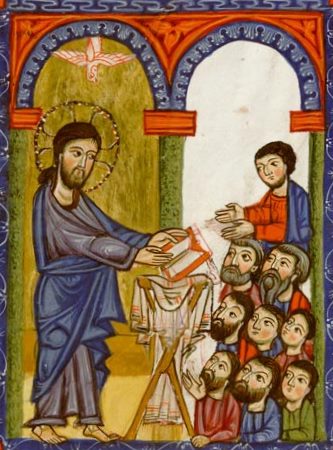
Jesus Unrolls the Scroll in the Synagogue, by French artist James Tissot (1836-1902)

Jesus returned to Galilee in the power of the Spirit, and news about him spread through the whole countryside. He was teaching in their synagogues, and everyone praised him.

 He went to Nazareth, where he had been brought up, and on the Sabbath day he went into the synagogue, as was his custom. He stood up to read, and the scroll of the prophet Isaiah was handed to him. Unrolling it, he found the place where it is written:

 “The Spirit of the Lord is on me,
    because he has anointed me
    to proclaim good news to the poor.
He has sent me to proclaim freedom for the prisoners
    and recovery of sight for the blind,
to set the oppressed free,
     to proclaim the year of the Lord’s favor.”

Then he rolled up the scroll, gave it back to the attendant and sat down. The eyes of everyone in the synagogue were fastened on him. He began by saying to them, “Today this scripture is fulfilled in your hearing.”

All spoke well of him and were amazed at the gracious words that came from his lips. “Isn’t this Joseph’s son?” they asked.

Jesus said to them, “Surely you will quote this proverb to me: ‘Physician, heal yourself!’ And you will tell me, ‘Do here in your hometown what we have heard that you did in Capernaum.’”

“Truly I tell you,” he continued, “no prophet is accepted in his hometown. I assure you that there were many widows in Israel in Elijah’s time, when the sky was shut for three and a half years and there was a severe famine throughout the land. Yet Elijah was not sent to any of them, but to a widow in Zarephath in the region of Sidon. And there were many in Israel with leprosy in the time of Elisha the prophet, yet not one of them was cleansed—only Naaman the Syrian.”

All the people in the synagogue were furious when they heard this. They got up, drove him out of the town, and took him to the brow of the hill on which the town was built, in order to throw him off the cliff. But he walked right through the crowd and went on his way. (New International Version)

Jesus was the hometown boy of Nazareth, the rising star who was putting the small village on the map. He walked into the synagogue on the Sabbath with the people all watching with pride, their chests puffed with delight over one of their own making it to the big time. 

It just so happened that on that day the Old Testament reading was from the prophet Isaiah – a prophecy of grace and healing that fit the budding ministry of Jesus. Here was the hope of Israel. It was all bunnies and butterflies, until Jesus decided to say a few words to them all….

Jesus took the prophecy of Isaiah about proclaiming liberty to captives and the oppressed and then applied it, not to his fellow Jews who were present, but to, of all people, Gentiles! 

Jesus just had to open his mouth and point out that in the days of Elijah, the prophet was sent to a Gentile woman. In addition, Jesus let everyone know the prophet Elisha cleansed a Gentile. The gathered synagogue worshipers understood exactly what Jesus was doing – claiming to be the ultimate prophet, sent for those people. 

It was too much for the people gathered for worship. All hell broke loose as the “worshipers” became so angry and insolent that they drove Jesus out of town and tried to kill him. Jesus had that kind of effect throughout his earthly ministry by saying and doing the unexpected. 

The people of Nazareth seemed to have always interpreted the message of Isaiah and the prophets as being for themselves, not others. Whenever any believer or church loses sight of a biblical message and re-interprets it as being for only us, then we end up like the Nazarenes of old who did not recognize Jesus for who he really is and what he really came to do. 

Some believers and churches need a question asked of them: Are you ready to throw Jesus off a cliff?

Our faith is not merely individual; it is meant to impact the world. In the beginning the earth was created by God and it was good. Yet, it didn’t take long for things to go sideways. The fall of humanity into sin and disobedience brought death and decay to the world. Ever since, the human condition has been dominated by guilt, shame, indifference, violence, taking advantage of others, pride, and selfishness.

However, God did not leave the world to its own demise. The Lord began the process of reconciliation, culminating in the person and work of Jesus Christ. And now, Christians are a new society, the community of the redeemed, the church. As the people of God, we are called to do justice, love mercy, and walk humbly.

Jesus came to save us from our predicament, and to proclaim good news to the poor, freedom for prisoners, recovery of sight for the blind, and freedom for those oppressed by others. The kingdom of God is to extend over every square inch of this earth, every nation, every race and ethnicity, every institution and organization, and every individual. It all belongs to God’s rule and reign in Christ.

Jesus has made us, his disciples, ambassadors of reconciliation. Ever since the fall of humanity, God is reclaiming and redeeming, even now, all of creation back to himself. The Lord is seeking to bring people back into the harmony that existed in the Garden of Eden. Although this will only be fully realized when Christ returns, we presently now have the responsibility to be gracious agents of God’s kingdom, restoring all areas of this world and all people to their rightful place, at peace with God.

There is every reason to hope because a new world began emerging at the resurrection of Jesus Christ from death. As Christians, we accept struggle and hardship in this life and endure all things because, even though disease, destruction, and death claim so many lives, the love of God in Christ will never change nor die.

Because of the risen and ascended Christ, who is the light for all people everywhere, Christ’s disciples are able to respond to the great mass of human suffering with compassion.

This is important since compassion might not be our initial reaction to human suffering. Like the villagers in Christ’s hometown of Nazareth, we can chafe at the thought of compassionately reaching out to the poor, the prisoner, the blind, and the oppressed. We might either resist ministry to the “other” because we believe they caused their own poverty and adverse situation, or because we simply don’t believe we are wired for ministry to them.

If you knew me before I was a Christian, you might not recognize me. I didn’t love anybody. I had no compassion for anyone. It wasn’t until I experienced the love and compassion of Jesus Christ that my life turned upside-down. I began responding to human need with a deep concern. I sought to connect with all kinds of people. I wanted to make a difference in the world.

Back then I was (and to some degree still am) something of an agitator. Maybe that’s one reason I am so drawn to the compassion of Christ. For compassion is actually a radical form of criticism, declaring that our pains and our hurts are to be taken seriously, that they are not to be accepted as natural but abnormal and unacceptable for the human condition. It’s not supposed to be this way!

The compassion of Jesus needs to be understood as a totally subversive action against the kingdom of darkness, a bold and daring affront against all that keeps people locked into systems of oppression and poverty.

The world needs to experience the Church everywhere as a place and a people of good news – expressed in both word and deed – in which they are hospitably invited into the very life of God and experience the fullness of peace and joy in the Holy Spirit. In other words, we are not only in the personal transformation business, but we are also in the business of transforming society so that the common good of all persons is upheld.

As the church proclaims and seeks to establish the kingdom of God, it comes to see that all human need is important – whether it is spiritual, physical, mental, or emotional. We “do justice” by helping others experience the reality of God’s love in Christ and compassionately meet their holistic needs. We “love mercy” by showing hospitality and inviting folks very different from ourselves into our lives. We “walk humbly” with our God by emulating the compassionate ministry of Jesus to all people.

What is your “compassion quotient?” That is, how much compassion do you have in your life right now?

What are some tangible ways we can work on raising our level of compassion and demonstrating compassionate action to those around us and in our city?

It is questions like these that enable us to sync our lives with the heart of Jesus, who still desires to bring good news to the world.

Almighty God, you sent your Son Jesus Christ to reconcile the world to yourself: We praise and bless you for sending your people in the power of the Spirit to preach the Gospel to all nations. We thank you that in all parts of the earth a community of love has been gathered together by many prayers and labors, and that your people share in your mission of restoring all people to unity with yourself and one another in Christ; for the kingdom and the power and the glory are yours forever. Amen.

Jeremiah 31:7-14 – A Restored People

Now this is what the Lord says:
“Sing with joy for Israel.
    Shout for the greatest of nations!
Shout out with praise and joy:
‘Save your people, O Lord,
    the remnant of Israel!’
For I will bring them from the north
    and from the distant corners of the earth.
I will not forget the blind and lame,
    the expectant mothers and women in labor.
    A great company will return!
Tears of joy will stream down their faces,
    and I will lead them home with great care.
They will walk beside quiet streams
    and on smooth paths where they will not stumble.
For I am Israel’s father,
    and Ephraim is my oldest child.

“Listen to this message from the Lord,
    you nations of the world;
    proclaim it in distant coastlands:
The Lord, who scattered his people,
    will gather them and watch over them
    as a shepherd does his flock.
For the Lord has redeemed Israel
    from those too strong for them.
They will come home and sing songs of joy on the heights of Jerusalem.
    They will be radiant because of the Lord’s good gifts—
the abundant crops of grain, new wine, and olive oil,
    and the healthy flocks and herds.
Their life will be like a watered garden,
    and all their sorrows will be gone.
The young women will dance for joy,
    and the men—old and young—will join in the celebration.
I will turn their mourning into joy.
    I will comfort them and exchange their sorrow for rejoicing.
The priests will enjoy abundance,
    and my people will feast on my good gifts.
    I, the Lord, have spoken!” (New Living Translation)

Experiencing restoration is a beautiful thing. Sick and suffering bodies restored to health brings rejoicing. Estranged relationships brought together again elicits singing. Spirits broken by sin made whole again through restoring grace causes shouts of joy.

God is an expert in restoration. Dilapidated communities, broken individuals, and peoples in diaspora can find fresh hope amid challenging circumstances.

Take a look at the actions of God through the verbs in today’s Old Testament lesson:

  • “I will bring.” The Lord gathers scattered people together, as well as making the disparate parts of people into a unified whole again.
  • “I will not forget.” In the gathering action of God, no one is left behind. Attention is given to the stragglers, to those unable on their own strength or ability to journey on the road back to the Lord.
  • “I will turn.” The unfortunate are turned into the fortunate. The underprivileged become privileged. Grief, lament, and mourning give way to joy and a new lease on life.
  • “I will comfort.” A great reversal occurs with God’s intervention. Sorrow is transformed into praise. Goodness is found in abundance because the Lord is a good God.

God calls the people to action, to a response of experiencing the restorative powers of grace. The Lord encourages such behavior because it helps us never forget that no one and no circumstance is ever beyond the renewing grace of God. Notice the verbs which characterize that response:

  • “Sing.” No mumbling here, my friends. No timidity about being off tune. A lonely person, fragmented group, depressed community, polarized neighborhood, or scattered nation restored by God’s merciful grace becomes an exuberant people. Singing organically arises from them.
  • “Shout.” Even the rocks will cry out if the people don’t. A last second win in the sports stadium amongst thousands of fans doesn’t even hold a candle to celebrative shouts of believers gathered and restored.
  • “Listen.” Whenever hearing God’s voice results in restoration, then the desire and motivation to listen increases exponentially.
  • “Proclaim.” Proclaiming good news is a joy and privilege. And in anticipation of Epiphany, the gospel declared to Gentiles is a gracious message of inclusion and hope.

We are helped to picture the incredible restoration of people coming together and gathered by God with two metaphors:

  1. The Good Shepherd. Like a faithful shepherd over the flock of sheep, the Lord actively seeks the lost, brings them home, and continues to stand watch over them as a compassionate guardian.
  2. The Exodus. Just as God redeemed the people out of Egyptian slavery and took them to a good land of abundance, so the Lord shall return those persons exiled from that abundant place and restore them to the peace of settled rest.

The restoring action of God gathers the scattered. The lost are found. That which is fragmented is made whole. Those previously disabled become able. The weak become strong, the sick healed, the hungry fed, and the prisoner freed.

In times of famine, pandemic, poverty, hardship, and scant resources, there is hope. The Lord knows how to restore fortunes and bring untold abundance amid the most difficult of situations.

True joy comes through hard suffering. The pains of childbirth give way to unspeakable joy.

Today is the final day in the twelve days of the Christmas season. God, entering humanity through a woman, in the flesh, began the gracious work of ransoming, redeeming, and restoring a sinful world that had exiled itself from peace and abundance. In Christ, our lives are full of blessing.

Praise the God and Father of our Lord Jesus Christ for the spiritual blessings that Christ has brought us from heaven! (Ephesians 1:3, CEV)

“I am the gate. Those who come in by me will be saved; they will come in and go out and find pasture. The thief comes only in order to steal, kill, and destroy. I have come in order that you might have life—life in all its fullness. I am the good shepherd, who is willing to die for the sheep.” (John 10:9-11, GNT)

May you know and experience the restorative grace of God in Christ today and every day. Amen.

Micah 4:6-8 – Belonging

“In that day,” declares the Lord,

“I will gather the lame;
    I will assemble the exiles
    and those I have brought to grief.
I will make the lame my remnant,
    those driven away a strong nation.
The Lord will rule over them in Mount Zion
    from that day and forever.
As for you, watchtower of the flock,
    stronghold of Daughter Zion,
the former dominion will be restored to you;
    kingship will come to Daughter Jerusalem.” (New International Version)

One of the great tragedies of our world, as well as one of the worst feelings of humanity, is the sense that one does not belong.

Since people are hard-wired by God for community, belonging is essential, not optional. The image of the rugged individualist who gets things done on their own terms and marches to the beat of a different drum might be an appealing picture to many Westerners – but it falls woefully short of real lived human experience.

Since the fall of humanity, people have tended to group themselves into insiders and outsiders. In other words, discrimination is the enemy of true belonging. And, what’s more, there always seems to be people who are ready to create such division for their own purpose and profit. Indeed, it’s an age old tale, perhaps best told by Dr. Seuss in his classis book, Sneetches and Other Stories (1961).

In the story, Sneetches with stars on their bellies discriminate against and shun those without. A slick entrepreneur, Sylvester McMonkey McBean, offers the Sneetches without stars on their bellies the chance to get them with his Star-On machine, for three dollars, of course.

The application of stars upon thars is instantly and wildly popular. However, this abjectly upsets the original star-bellied Sneetches. They are in danger of losing their special status! So, McBean then tells them about his Star-Off machine, costing ten dollars, of course, and the Sneetches who originally had stars happily pay the money to have them removed.

Since McBean only cares about profit, he allows the recently starred Sneetches through this machine, as well. Ultimately, the entire affair escalates, with all the Sneetches running from one machine to the next…

“…until neither the Plain nor the Star-Bellies knew

whether this one was that one… or that one was this one…

or which one was what one… or what one was who.”

The Sneetches end up penniless. McBean leaves a rich man. The Sneetches learn from the experience that neither plain-belly nor star-belly Sneetches are superior. They finally become friends. Dr. Suess intended his story to be a satire of discrimination between races and cultures.

The kingdom of God is an egalitarian realm. There are no walls and barriers dividing people into opposing groups. And there isn’t such a thing as marginal, excluded, insignificant, forbidden, or discounted people.

Micah’s prophecy tells not of the privileged and powerful coming together for renewal but the lame. God’s care in maintaining a remnant and gathering them for restoration will be made up of the wounded, the ones who have no ability to bring themselves to the center.

The upside-down kingdom of God makes the last first, and the first, last. The Lord’s rule and reign champions the disabled and the misfits – those without an ability to come. They may be forgotten by others but never by God.

Like Santa coming to the island of misfit toys, rescuing and airlifting forgotten toys so that they can become treasured gifts for boys and girls – so God creates belonging where there seems none to be had. And leading the effort is a tossed aside reindeer named Rudolph, using his unique “deformity” to cut through the tough winter storm.

Perhaps you feel a bit, or maybe a lot, like the square peg trying to fit into a round hole. It could be that you wonder whether there is a place for you. You have experienced life as something of an oddity, as if the normal world around you is not aware of your very personhood.

The good news is that a prominent place is given to the humble, for those attempting to make a difference in the world that gives them no place to belong. God sees. God hears. God knows. God cares.

The Lord sends a Savior, a Deliverer, who will himself be a peculiar individual on this earth. It will seem as if he is from another place… which he is. But, then again, aren’t we all? Each of us was crafted with divine care and attention.

You are the one who created my innermost parts;
    you knit me together while I was still in my mother’s womb.
I give thanks to you that I was marvelously set apart.
    Your works are wonderful—I know that very well.
My bones weren’t hidden from you
    when I was being put together in a secret place,
    when I was being woven together in the deep parts of the earth.
Your eyes saw my embryo,
    and on your scroll every day was written that was being formed for me,
    before any one of them had yet happened. (Psalm 139:13-16, CEB)

The Lord has good plans for you and me. It might seem as if there are times God is placing a heavy hand upon us, even punishing. Yet, restoration is in the future. In this season of the year, we celebrate that Jesus is our Immanuel, God with us.

May Christ, who by his incarnation gathered into one, things earthly and heavenly, fill you with joy and peace. Amen.