2 Kings 4:32-37 – But That Is Not the End of the Story

Elisha and the Shunammite woman by Dutch painter Gerbrand van den Eeckhout (1621-1674)

Elisha entered the house and found the boy stretched out on the bed dead. He went into the room and locked the door—just the two of them in the room—and prayed to God. He then got into bed with the boy and covered him with his body, mouth on mouth, eyes on eyes, hands on hands. As he was stretched out over him like that, the boy’s body became warm. Elisha got up and paced back and forth in the room. Then he went back and stretched himself upon the boy again. The boy started sneezing—seven times he sneezed!—and opened his eyes.

He called Gehazi and said, “Get the Shunammite woman in here!” He called her and she came in.

Elisha said, “Embrace your son!”

She fell at Elisha’s feet, face to the ground in reverent awe. Then she embraced her son and went out with him. (The Message)

Life sometimes feels like a roller coaster. Our emotions go up and down alongside the circumstances which bring them forth.

Elisha was one of the all-time great prophets in ancient Israel. He developed an ongoing friendship with a woman from the town of Shunem. It was her simple hospitality to a stranger that brought about the enduring relationship.

Whenever Elisha passed through on his prophetic business, he would stop in and have a meal or spend the night in a special room set aside just for him.

But that is not the end of the story….

The woman was about to have a big change of life, a life she could not have ever seen coming and only dreamed of.

The Shunammite woman had no children and was not able to conceive. Yet, on one of his visits, Elisha promised her she would hold her very own infant child… which she eventually did. A year after Elisha’s pronouncement, the woman and her husband had a son.

The woman went from discouraged to elated. The child grew. The Shunammite and her family were content and living well.

But that is not the end of the story….

In today’s Old Testament lesson, we pick up the narrative as the child is a small boy, the family happy and healthy… until they weren’t.

One day the boy was playing, as he did every day. Whatever happened, he developed such a terrible headache that his dear mother rocked him for hours, trying to comfort him. The worst case scenario happened. The boy died.

The woman went from joy to despair in a matter of hours.

But that is not the end of the story….

The grieving mother refused to let death have the last word on her son. She saddled her donkey and went directly to Elisha. The Shunammite lamented to him about her son, and in her grief, cried out how Elisha had gotten her hopes up, only to be dashed by that dark enemy of death.

The prophet responded to the woman’s plea and set off  post haste to her home, which had now become a sort of funeral parlor. Elisha went into the room by himself with the dead boy. In an odd process similar to what Jesus would do centuries later, Elisha did some physical actions in bringing about a miraculous resurrection.

The boy sneezed, got up, and was given back to his mother. Her lowest of the low grinding sadness of distress and despair now turned to the highest of the high elation of joy and gratitude.

But that is not the end of the story….

The story continues because the larger overarching story of God’s gracious intervention into this world to bring about the redemption of all creation.

Along the way, across the millennia, the Lord continues to use faithful people to bring about renewal, restoration, and redemption. In the Christian tradition, the apex of this merciful work is fulfilled in the person of Jesus Christ.

God himself was pleased
    to live fully in his Son.
And God was pleased
    for him to make peace
by sacrificing his blood
    on the cross,
so that all beings in heaven
    and on earth
would be brought back to God. (Colossians 1:19-20, CEV)

The resurrection of the boy, and all risings from death before Jesus, prefigured and foretold the ultimate resurrection of Christ. And because Christ is risen, we too, shall rise from death – both spiritually and bodily.

Therefore, we have been buried with him through baptism into death, in order that just as Christ was raised from the dead through the glory of the Father, so we too may live a new life. For if we have become united with him in the likeness of his death, we will certainly also be united in the likeness of his resurrection. (Romans 6:4-5, NET)

The end of the grand narrative story is moving to a climax. Jesus is coming again to judge the living and the dead. All things shall be restored. All will be made right. We may sorrow in the night, but joy comes in the morning.

Then I saw a new heaven and a new earth, for the first heaven and the first earth had passed away, and the sea was no more. And I saw the holy city, the new Jerusalem, coming down out of heaven from God, prepared as a bride adorned for her husband. And I heard a loud voice from the throne saying,

“See, the home of God is among mortals.
He will dwell with them;
they will be his peoples,
and God himself will be with them and be their God;
he will wipe every tear from their eyes.
Death will be no more;
mourning and crying and pain will be no more,
for the first things have passed away.”

And the one who was seated on the throne said, “See, I am making all things new.” Also, he said, “Write this, for these words are trustworthy and true.” Then he said to me, “It is done! I am the Alpha and the Omega, the Beginning and the End. To the thirsty I will give water as a gift from the spring of the water of life. (Revelation 21:1-6, NRSV)

Our past grief and our present troubles will give way to a future hope – an ending to the story we can barely imagine, a glorious existence with our God which will have no end.

May the Lord come soon.

I pray the Lord Jesus will be kind to you.

May faith, hope, and love surround everyone who belongs to Christ Jesus. Amen.

Romans 7:14-25 – Our Existential Angst

We know that the law is spiritual; but I am unspiritual, sold as a slave to sin. I do not understand what I do. For what I want to do I do not do, but what I hate I do. And if I do what I do not want to do, I agree that the law is good. As it is, it is no longer I myself who do it, but it is sin living in me. For I know that good itself does not dwell in me, that is, in my sinful nature. For I have the desire to do what is good, but I cannot carry it out. For I do not do the good I want to do, but the evil I do not want to do—this I keep on doing. Now if I do what I do not want to do, it is no longer I who do it, but it is sin living in me that does it.
 
So, I find this law at work: Although I want to do good, evil is right there with me. For in my inner being I delight in God’s law; but I see another law at work in me, waging war against the law of my mind and making me a prisoner of the law of sin at work within me. What a wretched man I am! Who will rescue me from this body that is subject to death? Thanks be to God, who delivers me through Jesus Christ our Lord!
 
So then, I myself in my mind am a slave to God’s law, but in my sinful nature a slave to the law of sin. (New International Version)
 
We can relate to the Apostle Paul. We, along with him, have many times said to ourselves, “I don’t understand why I act the way I do. I don’t do what I know is right. I do the things I hate.” 
 
Paul’s existential angst is a timeless description of our common human condition. There are times we seem completely unable to follow our conscience and do what’s right. It can be maddening, even to the point of experiencing a continual low-level discouragement and/or depression which underlies almost everything we do.
 
The prescription for dealing with this mental, emotional, and spiritual malady does not include the law. That’s right. Putting our willpower and effort into obeying commands gets us nowhere. Even if we obey laws and rules and commands for a time, our efforts eventually break down. We fail to do what we want and do just the opposite.
 
The law isn’t bad. It just doesn’t have the capacity to transform us. The law’s purpose is to show us how bad off we really are in this world, to give us an awareness of our true condition so that we will seek help. 
 
We humans are a bundle of contradictions, doing good, then bad, and flip-flopping back and forth – all with great frustration.
 
In our abject misery, what then, shall we do? Who will help us? Is there anyone to save us from our plight?
 
Sheer willpower and obedience will not help us; it won’t work. It will only give us a false hope. Any success in using such willpower only deludes one into believing they have the answer… until they yet fall again into the abyss of their own inner darkness.
 
The good news is that there is a Savior, a Redeemer, a Rescuer who has the will and the power to deliver us from our predicament.
 
The grace of God in Christ is the operative power that changes lives, not the law. Freedom from the tyranny of our “should’s” and our misplaced desires comes from Christ’s forgiveness through the cross. 
 
Like a lover enamored with his beloved, our desires become oriented toward Jesus for his indescribable gift to us. That is the strength of grace. Transformation is relational; it is found in a person, not a program. And the only person and relationship which has the ability to change us is, I believe with all my heart and mind, the Lord Jesus Christ.
 
Why? Because I myself have been transformed and changed by such a relationship with Christ. I, along with the hymn writer John Newton, can say, “I once was lost but now am found, was blind but now I see.”
 
“Self-help” for all the good it really can do, is in many ways an oxymoron. There is no Bible verse which states that God helps those who help themselves.
 
Yes, we have an incredible capacity for good and vast internal resources within us which we lack awareness of for which we can tap into. Yet, when it comes to an outright metamorphosis, we need a new heart – and we can no more simply decide to change our lives any more than we can perform heart transplant surgery on ourselves.
 
People need the Lord.
 
Whenever the foundation of a house is about to crumble, it won’t do to rearrange the living room furniture and do a bit of spruce up painting. And we deceive ourselves if we believe that all our efforts at landscaping the property and having a great curb appeal will do the trick.
 
If the foundation crumbles, the house implodes, and nothing else will matter.
 
Jesus is our cornerstone. Without him, we are at risk, about to fall and without hope. With him, true restoration and renewal happens. And then, when the house is repaired and in order, we set about the task of being good stewards and maintaining and caring for the wonderful changes which were made.
 
If we want freedom from self-loathing and to experience peace and contentment, calmness and confidence, satisfaction and settled peace, then we will grow ever closer to the Savior who exudes all those qualities, and more.
 
For the Lord not only saves and delivers; he also sanctifies and encourages. And the existential angst becomes forgotten.
 
Saving God, I thank you for delivering me from sin, death, and hell through your Son, the Lord Jesus. May your Holy Spirit apply the work of grace to my life every day so that I can realize practical freedom from all that is damaging and destructive in my soul. Amen.

2 Corinthians 13:5-10 – Examine Yourselves

Examine yourselves to see whether you are in the faith; test yourselves. Do you not realize that Christ Jesus is in you—unless, of course, you fail the test? And I trust that you will discover that we have not failed the test. Now we pray to God that you will not do anything wrong—not so that people will see that we have stood the test but so that you will do what is right even though we may seem to have failed. For we cannot do anything against the truth, but only for the truth. 

We are glad whenever we are weak, but you are strong; and our prayer is that you may be fully restored. This is why I write these things when I am absent, that when I come I may not have to be harsh in my use of authority—the authority the Lord gave me for building you up, not for tearing you down. (New International Version)

God is in the restoration business. Sometimes, we might lose sight of that reality.

In the Gospels, whenever Jesus miraculously healed a person, it was for far more than taking away a disease or correcting a disability. The Lord sought to restore a person’s life by including them in the community. For example:

  • Leprosy put a person on the outside, both literally and relationally. Ceasing to be a leper meant that a person now had no obstacles to full participation in communal life.
  • Blindness reduced a person to being a beggar in order to survive. Having sight restored meant that the person can now work with others, make a living, and contribute to the needs of others.
  • Incarceration was (and still is) a complete removal of a person from society. Being in prison severs much human connection. Release from jail opens the way to reconnection and an opportunity to have a different way of being with others.
  • Poverty encumbers a person and weighs them down so heavily that it limits their ability function socially and relationally. Without poverty, a person is able to establish healthy patterns of giving and receiving within the community.

Those who are physically whole, mentally sharp, emotionally satisfied, and spiritually redeemed are free of obstacles and impediments to communal life.

So, it is a travesty whenever the people who enjoy full inclusion in the community, turn around and separate themselves, keeping relational distance from certain persons, and do not participate in the common good of all.

The type of examination of faith the Apostle Paul was talking about was not to obsess over whether one is a true believer, or not. He was referring to the person who claims faith yet maintains separation from others. In other words, to exclude others is the kind of behavior that unbelievers do, not Christians.

Yet, there are many sections of Christianity and entire Protestant denominations who pride themselves on such separation. They believe they’re being holy and keeping themselves from impurity. However, far too many of them are really putting a sanctified spin on their own sinful predilections to avoid people they don’t like.

Paul has no tolerance for calling exclusion of others “holiness” and naming the maintenance of an insider/outsider status as “sanctification.” The Apostle knew this was all poppycock and wanted nothing to do with it.

Christ didn’t die on a cruel cross, take away the obstacles to faith, open the way to know God, and create peace through his blood for a pack of so-called Christians to then erect imaginary concrete border walls to keep others out of Christian community and fellowship.

In God’s upside-down kingdom, the privileged insiders are really the outsiders; and the underprivileged outsiders are actually the insiders.

The so-called privileged believers are in just as much need for restoration as the leper, the blind, the poor, and the prisoner. The path to their inclusion is solidarity with the entire community of the redeemed – rather than picking and choosing who is in and who is out.

All this, of course, is another way of stating that Christianity is as beset with cliques as anywhere else – with individual believers, local churches, and particular traditions following their pet theologians and pastors and not associating with others who follow a different sort of folks.

The ancient Corinthian church was a train wreck of opposing groups and clique-ish behavior. The Apostle Paul had had enough of it and called the people to do some serious self-examination. And he was careful not to degrade or discourage them but to try and encourage the church to tap into the Christ which dwells within them.

Restoration, for Paul, meant specific behaviors which intentionally include people. To be inclusive means we actively work toward grafting people into community, as well as discourage behaviors that create division. Here are three ways of doing that:

  • Practice hospitality. The word hospitality literally means, “love of stranger.” A hospitable believer goes out of their way to invite another into their life, to give them the gift of relationship and fellowship.

Take care of God’s needy people and welcome strangers into your home. (Romans 12:13, CEV)

Above all, show sincere love to each other, because love brings about the forgiveness of many sins. Open your homes to each other without complaining. And serve each other according to the gift each person has received, as good managers of God’s diverse gifts. (1 Peter 4:8-10, CEB)

  • Nip bitterness in the bud. In an ideal world, everyone holds hands and sings kumbaya together. We live, however, in a fallen world. Harmony, unity, and peace take copious amounts of energy. Like an attentive gardener, we must do the work of identifying weeds and uprooting them, so they don’t take over the garden.

Make every effort to live in peace with everyone and to be holy; without holiness no one will see the Lord. See to it that no one falls short of the grace of God and that no bitter root grows up to cause trouble and defile many. (Hebrews 12:14-15, NIV)

  • Seek to encourage and learn how to do it. Encouragement is both a gift and a skill to be developed. To encourage another is to come alongside and help someone with both affirming words and willing hands. It’s what Jesus did (and does) for us.

Christ died for us so that, whether we are dead or alive when he returns, we can live with him forever. So, encourage each other and build each other up, just as you are already doing. (1 Thessalonians 5:10-11, NLT)

Hospitality, harmony, and help are all forms of love. And love is to be the guiding principle and practice of church and community.

Lord, make us instruments of your peace. Where there is hatred, let us sow love; where there is injury, pardon; where there is discord, union; where there is doubt, faith; where there is despair, hope; where there is darkness, light; where there is sadness, joy. Grant that we may not so much seek to be consoled as to console; to be understood as to understand; to be loved as to love. For it is in giving that we receive; it is in pardoning that we are pardoned; and it is in dying that we are born to eternal life. Amen. – A prayer of St. Francis of

Matthew 9:27-34 – How To Use Your Faith

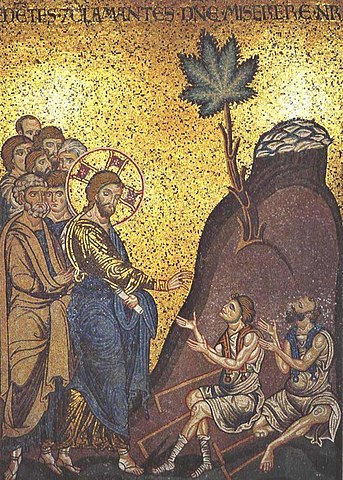
Jesus healing two blind men, 11th century mosaic, Sicily

As Jesus went on from there, two blind men followed him, calling out, “Have mercy on us, Son of David!”

When he had gone indoors, the blind men came to him, and he asked them, “Do you believe that I am able to do this?”

“Yes, Lord,” they replied.

Then he touched their eyes and said, “According to your faith let it be done to you”; and their sight was restored. Jesus warned them sternly, “See that no one knows about this.” But they went out and spread the news about him all over that region.

While they were going out, a man who was demon-possessed and could not talk was brought to Jesus. And when the demon was driven out, the man who had been mute spoke. The crowd was amazed and said, “Nothing like this has ever been seen in Israel.”

But the Pharisees said, “It is by the prince of demons that he drives out demons.” (New International Version)

Every day the news is a steady stream of disease, death, war, and outright human suffering. It’s as if the phrase, “slow news cycle,” is a thing of the past.

As we stare into the face of trouble, I find myself uttering the ancient prayer of the Church: “Lord have mercy.  Christ, have mercy.  Lord have mercy and grant us your peace.” 

We collectively feel the weight of the world’s suffering, experience the heaviness of concern for family and friends, and perhaps wonder how much more people can take.

It’s in the topsy-turvy times that I come back again and again to the deep spiritual convictions which inform what I do each day. One of those underlying creeds and affirmations is this:

Jesus is trustworthy, no matter whether my faith or the faith of others is small or great.

In our Gospel lesson for today, two blind men were healed according to their faith in Jesus. The diverse healing accounts of Jesus in the New Testament, whether the faith was large or small in those healed, leads me to the conclusion that:

It isn’t faith itself that heals, saves, or transforms – it is Jesus.

All the healing accounts in the New Testament Gospels have something in common: They all directly point to Jesus as the object of faith. 

It isn’t about the level or amount of faith, but about where the faith is placed. 

For the Christian, faith itself doesn’t mean much if it isn’t in Jesus.

If I place a large and sincere faith in an inanimate object such as money; in a position of power; or, even in my own independence, my faith isn’t worth much. 

If I have a huge faith in a doctor or a psychiatrist to heal my body or my mind, I will quickly discover there are limits to their abilities. 

If I have a confident faith that my family will meet all my needs, my faith will eventually run into failure when they let me down. That’s because the ultimate object of faith is Jesus. 

If all my faith eggs are in the church basket, my faith will eventually face a crisis because it is a misplaced faith.  Furthermore, the answer I provide for others is not simply getting them to attend church or to adopt my moral code.

There should be a consistency that runs through us all. For Jesus doesn’t change—yesterday, today, tomorrow, he’s always totally himself.

Hebrews 13:8, MSG

We know with certainty that circumstances change, as everyday seems to bring new levels and permutations of unprecedented alterations to our lives – and through it all, Jesus remains as the ever-present Savior, seated at the right hand of God ceaselessly interceding on behalf of those who offer even the slightest mustard seed of faith.

“For truly I tell you, if you have faith the size of a mustard seed, you will say to this mountain, ‘Move from here to there,’ and it will move, and nothing will be impossible for you.”

Jesus (Matthew 17:20-21, NRSV)

It says something about our modern Western society that whenever we hear the words of Jesus on faith that we interpret the mountain moving as an immediate event that happens almost instantaneous, like a snap of the finger. Yet, there is nothing in those words that says that. There is also nothing that says an individual necessarily does it.

The fact of the matter is this: Jesus heals, transforms, and delivers people from sickness, sin, trouble, and overwhelming circumstances in his own good time, not ours.

Just because we pray without ceasing for days, weeks, months, and even years for something doesn’t mean we lack faith if the prayer isn’t answered immediately. It could be that God wants others involved, maybe even across generations, for the impossible mountain to be moved.

It is misplaced faith which expects microwave results. Faith placed appropriately in Jesus as the object of belief discerns that faithful prayer is consistently prayed until there is an answer.

Healing and restoration will happen – just maybe not always how or when we think it will.

Almighty God, you know that we have no power in ourselves to help ourselves: Keep me both outwardly in my body and inwardly in my soul, that I may be defended from all adversities which may happen to the body, and from all evil thoughts which may assault and hurt the soul; through Jesus Christ our Lord, who lives and reigns with you and the Holy Spirit, one God, forever and ever. Amen.