Matthew 11:16-19, 20-25 – Following Jesus

Welcome, friends! Click the video below and let us consider the words of Jesus together.

You may also view this video on TimEhrhardtYouTube

Click Behold the Lamb (Communion Hymn) by Keith and Kristyn Getty, the song mentioned in the video.

May the grace of the Lord Jesus, the love of God the Father, and the fellowship of the Holy Spirit be with you, today and always. Amen.

Following Jesus

Walking with Jesus

The disciple and evangelist Matthew, the former tax collector, purposefully arranged his Gospel of Jesus to emphasize what it means to truly follow Christ. Matthew knew a thing or two about discipleship and following Jesus, having walked away from a lucrative business because Jesus called him. However, the hardest thing for Matthew was likely not giving up the money, as it was daily facing people who knew his past and many who held it over his head – except Jesus. Only grace has the power to change our lives and make us willing to face anything, for good or for ill.

For Matthew, the first sermon of Jesus, The Sermon on the Mount (Matthew 5-7), was meant to move the massive crowd of people physically following Christ to spiritually, ethically, and with heartfelt devotion following Jesus as committed disciples embracing the true way of righteousness – mercy, purity, and peacemaking.

In chapters 8-10 of his Gospel, Matthew narrates amazing events of miracles and healing including: the blind receiving sight; the lame getting on their own two feet and walking; those with leprosy being cured; the deaf hearing; the dead raised to life; and, the good news of God’s benevolent reign preached to the poor. Jesus was not only inviting people to be disciples; he was developing disciples through the sheer force of mercy. This was no sign-up sheet Christianity. This was deliverance from physical and spiritual oppression to a life of walking in the gracious way of Christ, no matter what the cost.

This was beautiful and wonderful ministry. It was life-changing and earth-shattering. However, most of the crowd who followed Jesus around observing the divine interventions were unfazed. In my mind, I picture the crowd like a bunch of social media followers who troll through others stuff and offer little except criticism when they see something that they do not like or agree with.

Jesus had his own comparison. He asked the crowd: To what can I compare this generation? Christ was angling for his listeners to consider the current state of the people and the society. He answered his own question with a saying that the people were familiar with: “We played the flute for you, and you did not dance; we sang a dirge, and you did not mourn.” (Matthew 11:17)

The saying Jesus quoted pertains to weddings and funerals. He was saying that the crowd standing right in front of him, seeing him and seeing his works up close and personal, are like people who have their backs against the wall during a celebration dance at weddings. They are also like people who show no grief and don’t cry at funerals.  In other words, they are dull. They have Jesus right in front of their faces, and they do not see him because they are expecting someone else.

Most of the people could not get over the fact that Jesus hung-out with people who were not like them and kept focusing his ministry on folks who need it the most. Jesus was giving a stinging rebuke – and they knew it. Jesus was essentially calling the unmoved crowd a bunch of bratty little kids who sit around waiting for their idea of Messiah to come along.

Bottom line: Jesus had no acceptance for them simply because they were not willing to accept him on his terms and in his way. So, Jesus then clearly communicated who is accepted with him: Those who need him. They are accepted because the Father has revealed Jesus and truth to the least and the lost. Little children were always overlooked and forgotten people in the ancient world – low on the totem pole of human hierarchy and viewed mostly as potential adults who would someday contribute to society.

Kids need to be cared for. And that is the key to why Jesus spoke of becoming like little children: kids need the care of others or they will not make it. They know it. The plan of God is to bless those who are poor in spirit, not those who think they “already know all that stuff” and have no need for a Messiah who only meets the needs of immigrants, people of color, the aged and the infirm. Those who know their need for a Savior come to Jesus asking for help and find the open arms of God. Those who only know their spiritual pedigree and how much others need them, are glad they are not like people beneath them, and ask for nothing – these are the people who will find themselves looking at God’s back.

The needy are accepted because they humble themselves and come to Jesus and exchange their yokes. Christ’s invitation goes out to all those for whom religion and church has become a grind, for whom trying to always be a good Christian is like carrying a heavy burden. We are invited to replace our heavy yoke with the yoke of Jesus.

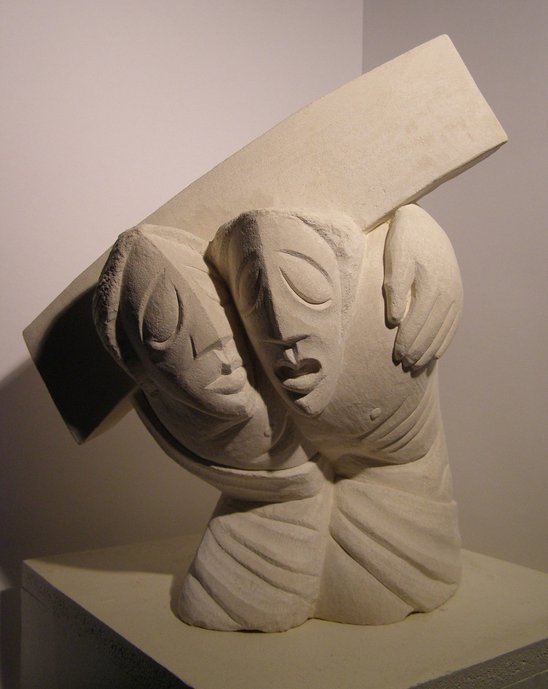
Simon and Jesus by Nicholas Mynheer
Jesus and Simon by Nicholas Mynheer

A “yoke” was a rabbi’s set of rules based in his interpretation of the Law. The disciples of a rabbi would follow him around everywhere and continually listen to his view of how to live the Scripture in everyday life. There were rabbis whose yoke weighed people down with endless rules on every detail of life. Jesus would later say about such teachers:

“They tell you to do things, but they themselves don’t do them. They make strict rules and try to force people to obey them, but they are unwilling to help those who struggle under the weight of their rules. They do good things so that other people will see them.” (Matthew 23:3-5)

Jesus, contrary to other rabbis, taught the Beatitudes and Sermon on the Mount as his yoke, which was a form of living from the heart, and not just to put on a good show for others.

Jesus said “learn from me” because he is gentle and humble in heart. Jesus is not going to turn us away when we sincerely and humbly come to him; in fact, he invites us to come so we might bask in God’s acceptance:

“Come to me, all of you who are tired and have heavy loads, and I will give you rest. Accept my teachings and learn from me, because I am gentle and humble in spirit, and you will find rest for your lives. The burden that I ask you to accept is easy; the load I give you to carry is light.” (Matthew 11:28-30, NCV)

If faith has become all too familiar, if you have lost your sense of awe and wonder about God, if you desire something more than just keeping up with the Christian Jones’s and fulfilling a checklist of Christian duty, then there is an invitation for you to come to Jesus – offered by Christ himself. We get to walk with Jesus.

3374b-thetable

For Christians everywhere throughout the world for two millennia the Table is the place to come in remembrance, communion, and hope. We remember the once for all sacrifice of Christ which unburdened us of our heavy load of sin. We commune with this same Christ now in the present. We anticipate our future hope with confident expectation that Christ is coming again. The Table is an invitation for us to eat and drink of Christ. The words of Keith and Kristyn Getty and Stuart Townsend’s “Communion Hymn” capture Christ’s acceptance of us and our need to receive such grace:

Behold the Lamb who bears our sins away,
Slain for us – and we remember
The promise made that all who come in faith
Find forgiveness at the cross.
So we share in this bread of life,
And we drink of His sacrifice
As a sign of our bonds of peace
Around the table of the King.

The body of our Savior Jesus Christ,
Torn for you – eat and remember
The wounds that heal, the death that brings us life
Paid the price to make us one.
So we share in this bread of life,
And we drink of His sacrifice
As a sign of our bonds of love
Around the table of the King.

The blood that cleanses every stain of sin,
Shed for you – drink and remember
He drained death’s cup that all may enter in
To receive the life of God.
So we share in this bread of life,
And we drink of His sacrifice
As a sign of our bonds of grace
Around the table of the King.

And so with thankfulness and faith we rise
To respond, – and to remember
Our call to follow in the steps of Christ
As His body here on earth.
As we share in His suffering
We proclaim Christ will come again!
And we’ll join in the feast of heaven
Around the table of the King.

Amen.

Psalm 23 – Trust and Rest

Rest

In this sacred season of Eastertide on the Church Calendar, Christians deliberately spotlight on what new life is and how it can bring transformation from fearing adversity to believing God through the adversity; from wondering where the heck my needs are going to be met to trusting in God’s willingness to provide; from worrying about the future to resting in the present.  Psalm 23 is just the right message for both the season and our world circumstances of pandemic and hardship.

Because of the psalm’s familiarity, some might only associate it with funerals and miss its relevance for the here-and-now. That would be quite unfortunate because this is a beautiful poem of trust which is prescient for us to face the vicissitudes of faith and life on this earth and be able to rest in the field of God’s benevolent kingdom.

Therefore, I am offering here my contemporary version of this most famous of psalms for the Church:

Jesus is my Pastor, and I lack absolutely nothing because of it.

My merciful overseer is watching me while I rest secure on a nice soft bed of grace;

             he leads me into an unhurried life; he is thawing out my cold anxious soul.

He leads me in all the right ways for the sake of his great name.

Even though I get lost and find myself in a dark alley,

             I really have no fear of evil;

for I know God is with me,

             his Word and Sacrament – they are more than sufficient to comfort me.

I have a big ol’ appetite and hunger for you, God,

             and you satisfy it,

             even though I have enemies within arm’s length;

you encourage my mind with joyous thoughts,

             so that my heart overflows with hope.

I am quite sure that goodness and mercy will follow me for a lifetime,

             and I will live in peace despite any adverse circumstances my whole life long. Amen.

Click The Lord’s My Shepherd by Stuart Townsend as we find rest for our souls.

Leviticus 23:1-8 – There’s More to Life Than Work

20170925_105157_resized

“The Lord said to Moses:  Speak to the Israelites and say to them: These are my appointed times, the Lord’s appointed times, which you will declare to be holy occasions:  Work can be done for six days, but the seventh day is a Sabbath of special rest, a holy occasion. You must not do any work on it; wherever you live, it is a Sabbath to the Lord.” (Common English Bible)

When I was kid, watching the cartoon The Jetsons was a Saturday morning ritual.  The futuristic family featured George the husband and father, an employee of Spacely Sprockets.  In one episode, George comes home and is met by his dog, Astro, and wife, Jane, looking tired and haggard from a day’s work.  George’s comment when he entered on the treadmill through the door was, “Jane, these 3 hour work days are killing me!”

Indeed, the technological progress of post-war America had led to the common belief among many that with so many advancements, workdays would become smaller, with leisure time growing.  In the 1960’s, it seemed a foregone conclusion that technology would provide the masses with unprecedented amounts of discretionary time for whatever they would want to do.

the jetsons

Fifty years removed from The Jetsons we now know what Americans and people across the world would do with time-saving devices: We simply work a lot more.  Just the opposite has occurred from having loads of leisure time.  People discovered that greater efficiency with technology has brought an equal competition for business and making more money.  Time saved has translated into accomplishing more work, and not in taking vacations and indulging in new hobbies and ventures.

The 4th command of God’s Ten Commandments is needed today more than ever.  It is time to come back to this basic instruction of the Lord, and engraft its wise counsel into our lives.

“Keep the Sabbath day and treat it as holy, exactly as the Lord your God commanded:  Six days you may work and do all your tasks, but the seventh day is a Sabbath to the Lord your God. Don’t do any work on it—not you, your sons or daughters, your male or female servants, your oxen or donkeys or any of your animals, or the immigrant who is living among you—so that your male and female servants can rest just like you. Remember that you were a slave in Egypt, but the Lord your God brought you out of there with a strong hand and an outstretched arm. That’s why the Lord your God commands you to keep the Sabbath day.” (Deuteronomy 5:12-15, Common English Bible)

The point of God’s command to his people is neither to squash commerce, nor to be a curmudgeon about fencing one day a week of doing nothing; instead, the command for Sabbath is designed to be a life-giving day where we discover that:

There is more to life than work.

The word “Sabbath” literally means “to rest.”  God built into his creation a rhythm of rest and work.  God Himself rested, not because he was tired, but because he ceased working long enough to enjoy the earth and everything in it.  Everything in life is done in rhythm.  We walk in rhythm, talk in rhythm, and our hearts beat in a rhythm.  The earth cycles in rhythmic seasons of the year, and the animal kingdom mates and lives in annual rhythms.  All creation is rhythmic.

Whenever we keep going and do not live according to the rhythm laid out for all of God’s creatures, we break.  Even machinery needs a break.  Sometimes I find it more than ironic that we treat our cars and vehicles with the regular maintenance and care that we don’t even extend to ourselves.  We care for our cars because we don’t want to experience a breakdown on the highway.  Yet, much more important is the care of our souls and our bodies.  Without regular intervals of work and rest in a consistent rhythmic pattern, we breakdown, burnout, and, like little children who have missed a nap, we have epic meltdowns of anger, frustration, and passive-aggressive behavior because we simply ignored God’s 4th command.

Now, please don’t misunderstand me at this point.  Some of you may have had a background filled with legalistic embraces of Sabbath.  No this, and no that, no nothing on Sundays, as if God were some divine curmudgeon who frowns at anything happy on the Sabbath.  To rest means to have a change of pace from regular weekday activity of work.  To rest and enjoy the difference of a Sabbath’s day is avoided by so many people because it brings this question to the forefront of our minds:

Who am I if I’m not working?

Our identities can be so tied to our jobs that we compulsively check our multiple e-mail accounts on a day off; tie ourselves to our smart phones and iPhones on vacation; and, allow work to bleed into our time away from the job.  God wisely placed loving boundaries around us.  But like Adam and Eve who could not be content with enjoying the entire garden, we obsessively pluck the forbidden fruit from the one tree that is off limits.

Work brings money, influence, power, relationships, industry, and a host of good things.  The problem is not work; the problem is that we humans can create an idol of it.  When work and all that comes with it consumes our attention, we are on a one-way road to nowhere.  I’ve heard more than one deathbed confession from dying persons, and I’ve yet to hear anyone wish they had worked more.  Nope, it’s usually something out of rhythm and out of whack – that they let their jobs and their ambitions surrounding work call the shots in life, without stopping to enjoy the vast creation, the gifts of God, and the emotional wealth that can come from relationships.

Because we aren’t sure who we are if we’re not working, we just keep working.  If we feel bad, we work harder.  If things are tough at home, we just put more hours in at work.  If we need more money, we pick up a part-time job.  When work becomes the catch-all answer to our many problems, it has become our god and we will worship at the altar of money and activity… until we can learn to stop and rest.

It’s just one day out of seven.  Just 1/7th of your life is needed to change the pace and allow a divine rhythm into your existence.  The temptation, however, is to take a day off from work so that you can do other work at home.  So, the challenge, for many people, is to allow the weekend to be one day where you get stuff done, and another day to truly rest.

This is not easy.  Right now I work six days a week.  And, sometimes, I work a few hours on my “day off.”  I’m speaking to myself as much as I’m speaking to you.  Yet, no one bats an eye at my constant working (well, except maybe my wife!).  In fact, people seem impressed when we work all the time.  We don’t want others thinking us lazy.  We want others to think well of us, and give us accolades for our hard work.  What gets lost in it all is God’s grace to us through rest.

79240-christian2bcontemplation

God desires us to enjoy Him, and not avoid Him.  He wants us to be still and know that He is God.  He longs for us to connect with Him.  This will only happen if we plan and prepare for it.  Sabbath doesn’t just happen; we must engage it.  Maybe we need to put God on our calendars.  Make an appointment with Him like we would anyone else.  Put the same kind of effort into making a date with God that you would with the people you care most about.  Perhaps the best thing you could do is go play a round of golf (if golf isn’t your idol!); go to the beach; or, take a nap.

The thing about Sabbath is that, when we get down to actually practicing it, we find that the world didn’t stop.  When we return to work, the earth is still spinning on its axis.  The company didn’t burn down in our absence.  Life doesn’t cease when we submit to a Sabbath rest; it’s just that we cease from participating in it for a short time.  Our delusions of grandeur dissipate and disappear when we finally come around to consistently obeying a Sabbath rest.

Work is noble.  But there is nothing noble about working without rest.  We are still human beings when we aren’t making money, and still valuable when we don’t have jobs.  Folks in healthcare facilities aren’t any less important because they aren’t holding down a job.  Work doesn’t define us – God’s image within us does.

It isn’t likely that we’ll ever see a George Jetson 3-hour workday, and that’s probably a good thing.  Work’s inherent goodness can only be truly appreciated when we plan and prepare to live and enjoy a Sabbath’s day rest.