Respect Wise Sayings (Proverbs 22:1-9)

Being respected is more important than having great riches.
    To be well thought of is better than silver or gold.

The rich and the poor are alike
    in that the Lord made them all.

The wise see danger ahead and avoid it,
    but fools keep going and get into trouble.

Respecting the Lord and not being proud
    will bring you wealth, honor, and life.

Evil people’s lives are like paths covered with thorns and traps.
    People who guard themselves don’t have such problems.

Train children to live the right way,
    and when they are old, they will not stray from it.

The rich rule over the poor,
    and borrowers are servants to lenders.

Those who plan evil will receive trouble.
    Their cruel anger will come to an end.

Generous people will be blessed,
    because they share their food with the poor. (New Century Version)

The Bible is a big book. In fact, it is more like a compilation of many books – 66 of them, to be precise, contained in the Old and New Testaments. Although the Bible has the grand theme of presenting a redemptive drama, it is not a flat one-dimensional piece of literature. 

Throughout the Bible’s contents, from Genesis to Revelation, it is chocked full of various literary genres. From poetry and narrative stories to apocalyptic accounts and exhortative epistles, Holy Scripture provides a many-sided look at the unfolding drama of God’s redemption toward humanity. 

Included in this big Bible is the book of Proverbs, a collection of wise sayings to help people navigate God’s big world. The chief reason it’s important to know that the Bible contains different types of literature is so that we can read it and interpret it well. 

A proverb is a short pithy statement of experiential truth. 

It’s not the same as commands or law. The individual Hebrew proverbs are designed to point out that, all things being equal, this is how the world works. For example, let’s consider one of the most misunderstood and misused verses in the Bible: Train up a child in the way he should go; even when he is old he will not depart from it. 

Many a parent has been made to feel unrelenting guilt over a wayward son or daughter, believing that somehow they have failed. The reason they have such feelings is that they treat the book of Proverbs as clear promises to claim. But biblical proverbs simply were not meant to be stretched in this manner.

Rather, the proverb is meant to communicate to us that if parents are diligent and faithful in raising kids, that in all likelihood, this training will never leave them; it will always stick with them in some way, shape, or form. 

Furthermore, it’s also true that many a parent has rejoiced over an adult child coming back to their faith after a sojourn in the muck of the world. Important to that return is the foundation laid years ago with faithful parenting that desired to pass on wise and good instruction.

Proverbs, therefore, are meant to encourage us, not with an ironclad promises, but with the hope that all the blood, sweat, and tears that parents, teachers, mentors, and others put into children, and into their diligent work, will someday likely bear much fruit of responsible lives that contribute and benefit the church and the world. 

So, be diligent, patient, and do not give up; keep persevering knowing that your labor in the Lord is not in vain.

And also consider the proverb that honoring, respecting, and fearing God will bring a person wealth, riches, and an abundant life. It might. Perhaps likely. But it’s neither a promise nor a command. And it’s definitely not a math equation; you cannot build an algorithm from it to get rich quick. No, the verse is a proverb.

In other words, if we are careful to pay attention to God, and seek to obey and trust the Lord for all things, then, it is quite likely that you will find yourself with plenty, and not be in want. Thus, we ought never to look at the world with black-and-white glasses that unthinkingly believes that all rich people are hard workers and godly, whereas all poor folk are lazy good-for-nothing’s.

What’s more, many a poor person is rich in faith and good works, whereas many of the rich, care little for God and spend their wealth on self-centered concerns. Understanding a proverb as a proverb helps us to avoid stereotyping people and giving them labels they don’t deserve.

Let’s keep going. I do believe, as the proverb says, that generous people will be blessed. But know this: genuine generosity always costs us something. It will take money, time, energy, and/or resources which become depleted when we give liberally. Some folk never acquire wealth because they are committed to sharing what they have with others. And, in my opinion, these are the persons who are truly blessed.

If we keep an eye toward acquiring wisdom, pursuing experiential knowledge, and trusting God, then we look to places in the Bible like the Proverbs, and seek to live life as it was intended to be lived.

Internalize the biblical proverbs and, all things being equal, you are quite likely to have a good and blessed life.

Blessed and almighty God, the Giver of life, it is from your hand that we have received all we have, and are, and will be. We understand that your divine call upon us is to be the stewards of your abundance, the caretakers of all you have entrusted to us. Help us always to use your gifts wisely; and teach us to share them generously. May our faithful stewardship bear witness to the love of Christ in our lives; we pray with grateful hearts, in the gracious name of Jesus. Amen.

On the Importance of Hospitality (3 John 9-12)

A mosaic of the Apostle John, at the Monastery of St. John the Theologian, in Patmos, Greece

I have written something to the church, but Diotrephes, who likes to put himself first, does not welcome us. So if I come, I will call attention to what he is doing in spreading false charges against us. And not content with those charges, he refuses to welcome the brothers and sisters and even prevents those who want to do so and expels them from the church.

Beloved, do not imitate what is evil, but imitate what is good. Whoever does good is from God; whoever does evil has not seen God. Everyone has testified favorably about Demetrius, and so has the truth itself. We also testify for him, and you know that our testimony is true. (New Revised Standard Version)

I believe in an egalitarian world. Ideally, humanity is meant to live in equity with one another. Humility, meekness, and gentleness are to be the inner dispositions of a person’s life.

These virtues work themselves out in being concerned for the common good of all, laboring toward just and righteous ways of living for everyone and sharing our lives, as well as our resources, with each other. Viewing one another as equals inevitably leads to gracious hospitality.

However, in a world of power disparities, and privileged inequities, are attitudes of seeking attention, a perceived need to always win and be first, and tight-fisted control of authority and money. The common good of all persons is scaled back to be the concern for the common good of some. There is a failure to regard the weak, poor, and vulnerable as legitimate members of the community.

The Apostle John wrote his short succinct letter in a concern that the church may be following a leader who was taking them down a bad path – a road leading to injustice where power and privilege remain with a few, and perhaps even one. John’s plainspoken exhortation was to judge rightly between what is good and bad, and then imitate the good while forsaking the bad.

Hospitality is the true litmus test between the good and the bad.

An openness to the stranger, the immigrant, the migrant, the alien, the foreigner, the newcomer, and the outsider characterizes authentic fellowship.

Being closed to such persons and having a xenophobic bent to others who are different is the mark of unwelcoming and inhospitable people.

Hospitality serves others, whereas being inhospitable cajoles others to serve our needs.

Jesus, the Lord of all, did not come to this earth for people to serve him. Christ came to serve others, and to give his life to save many people (Matthew 20:28; Mark 10:45; John 13:1-17). We are to imitate the loving service and radical hospitality of the Lord Jesus. He is our example. We are to imitate Christ.

We must have both orthodoxy (right belief) and orthopraxy (right practice). Both go together like a hand in a glove. Good actions are the result of good and proper beliefs. The following are some thoughts about this nexus between belief and practice:

  • Hospitality (literally “love of the stranger”) is a way of life fundamental to orthodox Christianity, based in the person and work of Jesus
  • God is hospitable and loves the outsider, welcoming them into the dance of the Trinity, and provides for them; our human hospitality is to reflect this divine welcome
  • Hospitality means extending to another a kindness typically reserved for family or friends
  • The teaching of the New Testament emphasizes the practice of hospitality (Luke 14:12-14; Matthew 25:31-46)
  • The consistent witness of church history is to lift up and hold Christian hospitality.

“Whatever person you meet who needs your aid, you have no reason to refuse to help them.”

John Calvin

This was no mere theoretical advice for Calvin, whose ministry center of Geneva, Switzerland swelled with French Huguenot refugees fleeing persecution. Calvin, always the theologian, grounded his understanding of hospitality in the divine:

“We should not regard what a person is and what they deserve but we should go higher – that it is God who has placed us in the world for such a purpose that we be united and joined together. God has impressed the divine image in us and has given us a common nature, which should incite us to provide one for the other.”

John Calvin
  • Hospitality is a practice which integrates both respect and care. St. John Chrysostom warned his congregation to show “excessive joy” when offering hospitality to avoid shaming the recipient of care.
  • Biblical hospitality does not need to know all the details of someone’s life before extending care. If Christ forgave and healed those who injured him, how could we neglect even a starving murderer? 
  • True hospitality involves a face-to-face relationship of encouragement and respect – not just a distant giving of alms. Hospitable persons pay attention to others and share life with them.
  • The great twin concerns of hospitality are universalizing the neighbor and personalizing the stranger. One reason why many of the rich have little sympathy for the poor is because they seldom visit them. Hospitality depends on us recognizing our commonalities with strangers rather than our differences.
  • This is how we evaluate our hospitality: Did we see Christ in them? Did they see Christ in me?

Hospitable God:

Give us eyes to see the deepest needs of people.

Give us hearts full of love for our neighbors as well as for the strangers we meet.

Help us understand what it means to love others as we love ourselves.

Teach us to care in a way that strengthens those who are sick.

Fill us with generosity so we feed the hungry, clothe the naked, and give drink to the thirsty.

Let us be a healing balm to those who are weak and lonely and weary by offering our kindness to them.

May we remember to listen, smile, and offer a helping hand each time the opportunity presents itself. And may we conspire to create opportunities to do so.

Give us hearts of courage to risk loving our enemy.

Inspire us to go out of our way to include outsiders.

Help us to be welcoming and include all whom you send our way.

Let us be God’s hospitality in the world. Amen.

Listen To Lady Wisdom (Proverbs 3:13-18)

Tree of Life, by Margarita Kriebitzsch, 2013

You’re blessed when you meet Lady Wisdom,
    when you make friends with Madame Insight.
She’s worth far more than money in the bank;
    her friendship is better than a big salary.
Her value exceeds all the trappings of wealth;
    nothing you could wish for holds a candle to her.
With one hand she gives long life,
    with the other she confers recognition.
Her manner is beautiful,
    her life wonderfully complete.
She’s the very Tree of Life to those who embrace her.
    Hold her tight—and be blessed! (The Message)

I like it that the author chose to personify wisdom as a woman. Maybe that’s because I have a wife and three daughters. Perhaps it has something to do with the fact that they, along with most of the women in my life, seem to have an almost mysterious quality of insight and understanding which transcends my very cerebral and logical approaches to life.

What I’m trying to say is that wisdom isn’t measured with a one-dimensional test of a person’s mental reasoning powers, but also requires emotional intelligence, social intelligence, interpersonal and relational intelligence, and spiritual intelligence, just to name a few.

And Lady Wisdom has it all. She’s the perfect combination of all the intelligent factors which make for a complete, fulfilling, and good life.

Everyone desires a good life. Nobody wakes up in the morning, sits on the edge of the bed, and thinks to themselves, “I really hope to have a bad day today!” A person might get up on the wrong side of the bed and grump their way through the first hours of the day, but no one makes a conscious decision to deliberately have a disappointing life. 

Indeed, we all want a good life. Students go to school hoping to have a good experience. Marriages begin with the hope of having a good life together. New employees start with the wish that there will be satisfaction in doing a job well done. Parents dream of their kids growing up to have a good life. 

We want the kind of life that brings contentment, joy, and happiness. So, how does it come?

A good life comes through embracing Lady Wisdom. And she has always been there, as the very Tree of Life:

“I was there when God set the heavens in place,
    when he marked out the horizon on the face of the deep,
when he established the clouds above
    and fixed securely the fountains of the deep,
when he gave the sea its boundary
    so the waters would not overstep his command,
and when he marked out the foundations of the earth.
    Then I was constantly at his side.” (Proverbs 8:27-30, NIV)

A good life has a basic respect and honor for God at the heart of it. Lady Wisdom understands this, first hand. She knows we are prone to being afraid. So, she assures us that the pursuit of true wisdom is worth it. With Lady Wisdom at our side, we have calm and confidence; we know when to take risks and when to be patient.

Most of all, our insecurities and anxieties begin to melt away as we connect with the image of God within us. Trust bubbles up from the depths of our soul, and we are no longer afraid of the unknown and what may happen to us.

The fear of the Lord is the beginning of wisdom, and knowledge of the Holy One is understanding.

Proverbs 9:10, NIV

The fear of the Lord means to honor and obey God, to be loyal and submissive. We know there is a good God from which our own good lives derive.

In a state of trust, of calm and confidence, we are able to listen and hear Lady Wisdom’s sage instruction. So, if you want to live a good life – and not just survive but thrive – then we must adopt a posture of listening.

The prerequisite to any semblance of a good life is to have a teachable spirit, to give focused attention to Wisdom. A fool is a fool, first and foremost, because he does not listen. Instead, he is negative, complains, and spews advice based in partial information.

But the person who hugs Lady Wisdom and does not let go, has learned to be attentive to the voice of God.

Continual fear of people is a death-dealing practice. But the person who fears God by listening to wise counsel discovers a life-giving practice that will serve them well for a lifetime. 

The teachable spirit bends the ear to hear good advice. Such a wise spirit inclines toward acquiring knowledge and learning the skillset needed to live a spiritually abundant life.

For the Christian, therefore, we cannot learn if do not read. The Bible is a book. If the Bible was a car, I would tell us all to learn to be mechanics; if it were a fish or a deer, I would tell us all to learn the best ways to hunt and fish; or if it was a store, I would encourage us to learn about being good shoppers and consumers. 

Yet, the Bible is a book. So, we must read it, memorize it, meditate on it, and learn from it. Becoming familiar with the contents of Holy Scripture, and immersing ourselves in it’s wisdom, will mold us in the ways of humility and form us spiritually for a lifetime of peace, love, and joy. 

Maybe you aren’t a tree hugger. But I encourage you to become one. Embracing Lady Wisdom is the surest way to avoiding unnecessary problems and finding purpose in life. Indeed, because she is good, we become good.

Today, God of Wisdom, let me experience your good and gracious heart. Draw me into your very being, into the core of your love for me, others, and the world. Give me a glimpse of others from your good, right, and just perspective, in loving them, forgiving them, and delighting in the way they give glory to God through their very existence. Help me to discern out of that place of deep affection for humanity, that I, too, might be a useful conduit of your love in the world. Amen.

Who’s the Greatest? (Matthew 18:1-7)

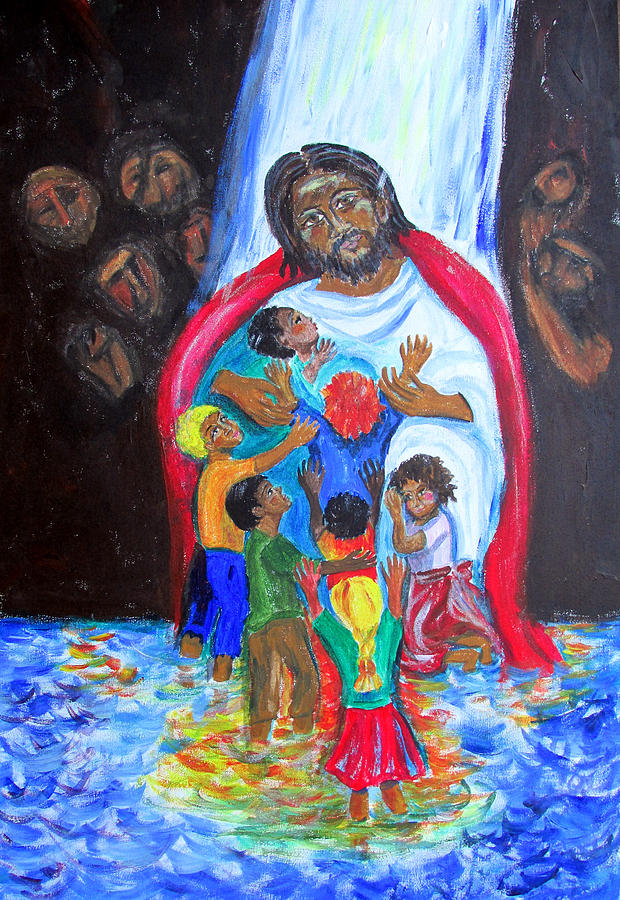
Jesus Loves the Children by Sarah Hornsby

At that time the disciples came to Jesus and asked, “Who is the greatest in the kingdom of heaven?”

Then he called a little child over to sit among the disciples, and said, “I assure you that if you don’t turn your lives around and become like this little child, you will definitely not enter the kingdom of heaven. Those who humble themselves like this little child will be the greatest in the kingdom of heaven. Whoever   one such child in my name welcomes me.

“As for whoever causes these little ones who believe in me to trip and fall into sin, it would be better for them to have a huge stone hung around their necks and be drowned in the bottom of the lake. How terrible it is for the world because of the things that cause people to trip and fall into sin! Such things have to happen, but how terrible it is for the person who causes those things to happen! (Common English Bible)

How would you answer the disciples’ question of who is the greatest in God’s kingdom?

Jesus answered the question by essentially stating that the least among us are the greatest. To be little is to be big. The kingdom hinges on being humble, gentle, meek, and lowly.

That definitely isn’t the way Western society looks at greatness – even the Western Church typically devalues the importance of such virtues and spiritual qualities.

In particular, many Americans takes pride in their can-do spirit. They seem always on the lookout for those who are assertive and can get things done efficiently and quickly. The tragedy of this is that, even though intentions may be noble, such a spirit often ends in causing others to stumble over their prideful beliefs of being hardworking and right.

Methinks Jesus and Horton the elephant would get along well together. In Dr. Seuss’s book, Horton Hears a Who, Horton exalted the littlest of persons whom others could neither see nor hear.

“A person’s a person no matter how small” said Horton to the people completely unconcerned for all the residents of Who Ville, living on a clover. They were unconcerned because the Who’s were invisible to them. 

Dr. Seuss chose to make Horton an elephant, a large creature able to hear with big ears and be attentive to the small. Largeness of heart comes from being attentive to the smallest ones among us – so small that the big people are unaware of them.

People who no one sees or notices, nonetheless matter to Jesus; and so, they should matter to us, too. 

Jesus often mingled with the little people of his time – children, women who had no rights, social misfits like lepers, the chronically ill, religious outsiders, tax collectors, and prostitutes. 

Our world is filled with similar people – angry adolescents, unwanted babies, forgotten old people, the mentally ill, moral failures, immigrants and refugees, and, if we have eyes to see and big ears to hear, lots of poor people who reside on the dark underbelly of society. They are around us, even if we fail to see or hear them.

The way to become great in the kingdom of God is to descend, not ascend, into greatness. The main enemy of any community is a desire to be prominent – it’s called “pride” and it will give us a terrible end if we hold onto it.

The disciples’ question is dripping with a desire for position and prestige. It’s a question meant to posture themselves into prominence and power. They want to know how to climb the ladder in God’s kingdom and be the important people.

I admire Christ’s grace for not throwing up his hands and going off on these guys: “What!? You’ve been with me how long and you ask me a stupid question like that?  Where have you been?  Have you learned nothing from me?” 

But instead, Jesus calmly called a child to him and used them as an example of his answer: Unless you become like this little child you will have no future at all with God. The way to have what you want is through humility.

In Jesus’ day children had no status or rights. Ancient culture was not kid oriented and there was no such thing as a youth culture. Children were, for the most part, viewed as potential adults – weak, small, and unable to contribute much of anything until they grew up. 

Christ’s disciples are to become like children, to become lowly; they are to give up their status and a desire to be important. They can only be big if they become small.

There’s another thing about the smallness of children that we ought to notice: Kids see what adults don’t. Whereas adults make distinctions between people on the basis of race, class, ethnicity, and gender, children see children and will play with just about anyone.

Only by getting on the same level as little people can we ever welcome Jesus; a person who is attentive to the lowly is attentive to Jesus. 

We are not to welcome people because they are great, wise, rich, powerful, good-looking, and just like you and me – but because they are noticed by Jesus. Christ stands for those we may tend to overlook.

The proud person who seeks prominence is forever looking for greener pastures, to do things that will impress others and help them advance up the ladder of success. In such a frame of mind, the proud person pays no attention to who they step on along the way. 

Christians, however, are to be different – giving socially insignificant people the time of day and treating them as important – because they are important to Jesus.

Here’s how Christ’s argument unfolds to the disciples:

  • Humility. Those who become like little children enter God’s kingdom, because it is only accessed through humility.
  • Attention. Those who pay attention and receive these little ones receive Jesus.
  • Rejection. Those who reject these little ones reject Jesus, and by their lack of loving them cause them to sin. 
  • Consequences. Leeching the poor and needy, ignoring the insignificant around us, and devaluing the littlest ones is damnable behavior, according to Jesus.

A person’s a person no matter how small. 

We need humility, to lower our sights in order to see and hear little people. No one is to be overlooked or to fall through the cracks under Christ’s rule and reign.

Loving Lord Jesus, you gave honor to the least, the forgotten, the overlooked, and the misunderstood and misjudged. You came to give first place to the last, those left behind and undervalued. You seek to provide a warm welcome to the lost, to the abandoned and the destitute.

Help us to be your ears to listen to their cries; your voice to speak love and acceptance; your feet to walk beside those in need; and your hands to clothe, feed and shelter them. Lord, in your mercy, hear our prayer. Amen.