Ash Wednesday (Matthew 6:16-34)

“When you fast, do not look somber as the hypocrites do, for they disfigure their faces to show others they are fasting. Truly I tell you, they have received their reward in full. But when you fast, put oil on your head and wash your face, so that it will not be obvious to others that you are fasting, but only to your Father, who is unseen; and your Father, who sees what is done in secret, will reward you.

“Do not store up for yourselves treasures on earth, where moths and vermin destroy, and where thieves break in and steal. But store up for yourselves treasures in heaven, where moths and vermin do not destroy, and where thieves do not break in and steal. For where your treasure is, there your heart will be also.

“The eye is the lamp of the body. If your eyes are healthy, your whole body will be full of light. But if your eyes are unhealthy, your whole body will be full of darkness. If then the light within you is darkness, how great is that darkness!

“No one can serve two masters. Either you will hate the one and love the other, or you will be devoted to the one and despise the other. You cannot serve both God and money.

“Therefore I tell you, do not worry about your life, what you will eat or drink; or about your body, what you will wear. Is not life more than food, and the body more than clothes? Look at the birds of the air; they do not sow or reap or store away in barns, and yet your heavenly Father feeds them. Are you not much more valuable than they? Can any one of you by worrying add a single hour to your life?

“And why do you worry about clothes? See how the flowers of the field grow. They do not labor or spin. Yet I tell you that not even Solomon in all his splendor was dressed like one of these. If that is how God clothes the grass of the field, which is here today and tomorrow is thrown into the fire, will he not much more clothe you—you of little faith? So do not worry, saying, ‘What shall we eat?’ or ‘What shall we drink?’ or ‘What shall we wear?’ For the pagans run after all these things, and your heavenly Father knows that you need them. 

But seek first his kingdom and his righteousness, and all these things will be given to you as well. Therefore do not worry about tomorrow, for tomorrow will worry about itself. Each day has enough trouble of its own. (New International Version)

Traditional Ash Wednesday services focus on the brevity of life and remind worshippers that they came from dust and will soon enough return back to the earth, dust once more. For our many of our parents in the faith, Lent was typically a sad season in which they gave up something in order to prepare themselves for eternal life.

The salvation promised and hoped for led them to look away from the joys of Spring and the beauties of the earth. Faithful Christians, in generations past, trained their eyes on heaven, forsaking time for eternity.

Yes, life is serious and risky business, and no one gets out alive. Yet is salvation really all about escaping this world of constant grief and death? Or is it seeing everlasting beauty in each passing moment?

It could be that you struggle with Ash Wednesday services and the season of Lent precisely because of its focus on giving up something, or because when you were a kid this time of year seemed like such a downer. Maybe your typical approach to Lent in the past has been a shoulder shrug and a response of “meh.”

So, therefore, I want us to get a different take on the meaning of Ash Wednesday and look at it from a different angle.

I will take away the ashes on their head, and I will give them a crown. I will take away their sadness, and I will give them the oil of happiness. I will take away their sorrow, and I will give them celebration clothes. 

Isaiah 61:3, ERV

The uncertainty of life can invite us to praise and wonder, to seize the moment—for this is the day the Lord has made and I will rejoice in it! All that I love and care for is mortal and fleeting, but mortality is the inspiration to celebration and love.

This is the sort of approach I saw in a dear friend who died fifteen years ago from a very long struggle with cancer. Bea always found ways to rejoice in her suffering, to be attentive to the working of God around her, and to bless those who needed God’s grace more than she did. More than once I found Bea, in one of her many hospital stays, out of the bed and in someone else’s room playing her dulcimer (she had once been a music teacher) and singing a hymn of praise to a fellow patient.

This Ash Wednesday, I’m not only fasting and giving up a few meals a week; I’m also letting go of everything that keeps me from rejoicing in the passing beauty of the earth.

Yes, we are dust, but we are real earthly sacred dust. Dust is good, after all, emerging from God’s intergalactic creativity. We are frail, but we are also part of a holy adventure reflecting God’s love over thousands of years.

Ash Wednesday is a time for us to pause, notice, wake up, and discover that God is in this place. This day invites us to take a much needed break and open up to the precarious yet beautiful world in which we live. So in this season of Lent, I plan on considering the lilies and the birds of the air.

In some Christian traditions, the imposition of ashes is accompanied by the words, “repent and believe the gospel.” And that I plan to do this year. I plan to turn around and be more present to the moment, appreciating God’s grandeur, and believing the good news—the embodied, everlasting, beautiful, wondrous, and gracious good news of walking with the Lord who is with me, surrounds me, and goes before me and after me.

Pastor and author, Jan Richardson, lost her husband to cancer several years ago during the season of Lent. She chose to cremate her husband so that his ashes might remind her and her family that there is beauty in the dust.  She wrote the following poem at her first Ash Wednesday without him:

Blessing the Dust

All those days
you felt like dust,
like dirt,
as if all you had to do
was turn your face
toward the wind
and be scattered
to the four corners

or swept away
by the smallest breath
as insubstantial—

did you not know
what the Holy One
can do with dust?

This is the day
we freely say
we are scorched.

This is the hour
we are marked
by what has made it
through the burning.

This is the moment
we ask for the blessing
that lives within
the ancient ashes,
that makes its home
inside the soil of
this sacred earth.

So let us be marked
not for sorrow.
And let us be marked
not for shame.
Let us be marked
not for false humility
or for thinking
we are less
than we are

but for claiming
what God can do
within the dust,
within the dirt,
within the stuff
of which the world
is made
and the stars that blaze
in our bones
and the galaxies that spiral
inside the smudge
we bear.

Amen.

Spiritual Dementia (Deuteronomy 30:1-9)

Now, once all these things happen to you, the blessing and the curse that I’m setting before you, you must call them to mind as you sit among the various nations where the Lord your God has driven you; and you must return to the Lord your God, obeying his voice, in line with all that I’m commanding you right now—you and your children—with all your mind and with all your being. 

Then the Lord your God will restore you as you were before and will have compassion on you, gathering you up from all the peoples where the Lord your God scattered you. Even if he has driven you to the far end of heaven, the Lord your God will gather you up from there; he will take you back from there. 

The Lord your God will bring you home to the land that your ancestors possessed; you will possess it again. And he will do good things for you and multiply you—making you more numerous even than your ancestors!

Then the Lord your God will circumcise your hearts and the hearts of your descendants so that you love the Lord your God with all your mind and with all your being in order that you may live. 

The Lord your God will put all these curses on your enemies and on those who hate you and chase you. But you will change and obey the Lord’s voice and do all his commandments that I’m commanding you right now. 

The Lord your God will help you succeed in everything you do—in your own fertility, your livestock’s offspring, and your land’s produce—everything will be great! Because the Lord will once again enjoy doing good things for you just as he enjoyed doing them for your ancestors. (Common English Bible)

The mind is a vast, glorious, and (un)explored territory. Although there is much we know about it, there’s even more we don’t know about the human mind.

The mind can be both a blessing and a curse. Anyone with depression, anxiety, or other mental disorders and diseases can tell you that, especially family members who have loved ones with dementia.

Dementia is a general term for a decline in mental ability severe enough to interfere with daily life. Professionally, I visit patients with dementia nearly every day. Personally, I watched my own mother’s faculties slowly erode and decline in the last few years of her life. In her final months, my Mom rarely remembered my name, only knew me once in a while, and never recalled the conversation we had thirty seconds ago. It was difficult to watch, this woman who once cared for me, needing to be cared for.

The biblical book of Deuteronomy is the retelling of Israel’s story as they were about to enter the Promised Land. It’s a book completely dedicated to memory care. If the people were to forget who they are, they would not know what they’re supposed to be doing. The Israelites strayed from the blessings into the curses of God’s covenant life because their collective mind slowly slipped into spiritual dementia.

The mind’s need to remember is not a new issue; it’s endemic to the human condition. The constant refrain of the author of Deuteronomy is to recall and to remember where the people came from, where they are going, and why. 

Moses reiterated the covenant and the law for the people before they entered the land. It was a fresh re-hashing, nothing really new, of what God had already communicated to them. God’s people were to remember that they were once slaves in Egypt and that God had delivered to be a people for his name. They were not to forget that they had provoked the Lord in the desert – with the result of an entire generation of people being lost because they had neglected and forgotten what God told them.

Memory issues continue into the Gospels. Jesus miraculously fed a great crowd of people not once, but twice. The second time, he called his disciples to remember what had happened the first time in order to understand the second. 

In the New Testament Epistles, Paul kept reminding the Jews in the churches that they should remember the ancient covenant, and called the Gentiles to remember that they were once estranged from that very same covenant. Both Jew and Gentile together needed to collectively remember the death of Christ that united them into a new covenant community. Like them, we are to “Remember Jesus Christ, raised from the dead, descended from David.” (2 Timothy 2:8)

Like the ancient Israelites, Christians are to remember who they are and what they are about: blood-bought people of God, belonging to Christ, and given a mission to make disciples and participate with God in the redemption of all creation through remembering the poor, seeking justice, and being peacemakers in the church and the world. 

Think about where you have fallen from, and then turn back and do as you did at first. (Revelation 2:5, CEV)

There’s a difference between the disease of dementia and the church’s spiritual dementia. Folks inflicted with dementia will not recover but only worsen, whereas the church can recover its collective memory by listening again to the ancient Word of God and being constantly refreshed with the promises and covenant of God.

  • Why do you and the church exist? 
  • How do God’s words inform and influence your identity? 
  • Does the mission and practice of your church intentionally remember the risen and ascended Christ? 
  • Are disciples being formed around collective remembering of God’s covenant and promises? 
  • Are ministries, spiritual practices, and policies being established based on Christ and his commission, or on something else? 

Let’s continually work through answers to those questions so that we are not cursed but blessed, and continually built up in the faith.

May the Lord bless you and keep you.
May the Lord show you his kindness
    and have mercy on you.
May the Lord watch over you
    and give you peace. Amen.

Let Go and Give (Isaiah 58:1-12)

“Shout it aloud, do not hold back.
    Raise your voice like a trumpet.
Declare to my people their rebellion
    and to the descendants of Jacob their sins.
For day after day they seek me out;
    they seem eager to know my ways,
as if they were a nation that does what is right
    and has not forsaken the commands of its God.
They ask me for just decisions
    and seem eager for God to come near them.
‘Why have we fasted,’ they say,
    ‘and you have not seen it?
Why have we humbled ourselves,
    and you have not noticed?’

“Yet on the day of your fasting, you do as you please
    and exploit all your workers.
Your fasting ends in quarreling and strife,
    and in striking each other with wicked fists.
You cannot fast as you do today
    and expect your voice to be heard on high.
Is this the kind of fast I have chosen,
    only a day for people to humble themselves?
Is it only for bowing one’s head like a reed
    and for lying in sackcloth and ashes?
Is that what you call a fast,
    a day acceptable to the Lord?

“Is not this the kind of fasting I have chosen:
to loose the chains of injustice
    and untie the cords of the yoke,
to set the oppressed free
    and break every yoke?
Is it not to share your food with the hungry
    and to provide the poor wanderer with shelter—
when you see the naked, to clothe them,
    and not to turn away from your own flesh and blood?
Then your light will break forth like the dawn,
    and your healing will quickly appear;
then your righteousness will go before you,
    and the glory of the Lord will be your rear guard.
Then you will call, and the Lord will answer;
    you will cry for help, and he will say: Here am I.

“If you do away with the yoke of oppression,
    with the pointing finger and malicious talk,
and if you spend yourselves in behalf of the hungry
    and satisfy the needs of the oppressed,
then your light will rise in the darkness,
    and your night will become like the noonday.
The Lord will guide you always;
    he will satisfy your needs in a sun-scorched land
    and will strengthen your frame.
You will be like a well-watered garden,
    like a spring whose waters never fail.
Your people will rebuild the ancient ruins
    and will raise up the age-old foundations;
you will be called Repairer of Broken Walls,
    Restorer of Streets with Dwellings. (New International Version)

Let Go of the Hypocrisy and Get Real

Isaiah’s prophecy came to a community in conflict. The root of the issue was a hypocritical gap between the people’s conduct and their worship. They wondered why God had not noticed their pious fasting – why their actions before the Lord had gone unseen. Isaiah made it clear that their practice of fasting and their rituals of worship were ineffective because it was all self-serving instead of serving others.

Let Go of the Food and Get Generous

True fasting does not abstain from food just to get noticed (by God and/or others) but has the aim of a generous spirit and a giving heart. Both abstinence and generosity are necessary in the practice of fasting. 

Fasting is a much neglected spiritual practice today, so we need to make sense of the reason to do without food for a set amount of time. Fasting ought to put us in touch with our vulnerability; it should remind us of our mortality and our frailties. That’s why fasting is so often associated with the upcoming season of Lent.

Through fasting we remember that if we are not fed, we will die. Standing before God hungry, we realize that we are dependent creatures in desperate need of the Lord. By fasting, we discern that we are poor, and called to be rich in a way the world does not understand.

We are empty, called to be filled with the fullness of God. We are physically hungry, called to taste the goodness that can be ours in Christ, as we get in touch with a hunger for God.

Fasting, however, does not end with abstinence from food; and it is not merely a private individual thing. The spiritual discipline of fasting is meant to open our eyes and our hearts to the truly needy among us and in the world.  We are to be open to both the spiritual needs of people, and their very real material needs.

“When you see people freezing outside in the frigidity of unbelief, without the warmth of faith, impoverished and homeless, lead them home to the church and clothe them with the work of incorruption, so that, wrapped in the mantle of Christ, they will not remain in the grave.”

St. Jerome (347-430, C.E.)

Isaiah also addresses the very real daily tangible needs of people for the basic necessities of life. The message is this: Fasting is to personally abstain from food in order to provide food for another. 

Let Go of the Ego and Get to Praying & Repenting

Just as abstinence from and provision for food are two sides of the same coin, so fasting and prayer are, as well. We are to stop eating in order to take that time to pray and to give. Letting go of a meal puts the food that would have been eaten into the pantry for the needy. Fasting from lunch at our jobs can be done, not just to get more work accomplished, but so that we might share both our food and our friendship with those in need.

The prophecy of Isaiah has intimate connections between worship, fasting, justice, and reconciliation. They are meant to be a seamless whole, indivisible, enjoying a close bond that makes for powerful and effective ministry. All of this enables us to get back in touch with the real meaning of repentance:

  • To repair a broken relationship with God or with another person
  • To grieve over the reality of a certain situation
  • To devote oneself to service
  • To experience new life and spiritual growth

Isaiah wanted people to repent of both their individual sins and their social sins. Truth be told, we must all deal openly and honestly with our own complicity in the sins of our world, our nation, our church, and our families. The worship that God desires is inescapably corporate as well as compellingly personal. To ensure that all people around us flourish as human beings is both an obligation and a necessity to our collective fulfillment as God’s people.

The result of true fasting is a repentance that produces the fruit of renewal and restoration. Fasting connects us to God, and then leads us to repair and rebuild what has been broken and torn down. 

Let Go of Your “Precious” and Get Committed to God and Others

We fast to practice repentance, attach ourselves to God, and become more generous toward others. In the Lord of the Rings movies, Smeagol was much too attached to the power of the ring; it was his “precious,” and he was willing to do anything not to lose it or let it go.

Yet, we must all decide that we are going to let that precious thing go, at least for a time, whatever it may be. Each year at this time, before Ash Wednesday and the season of Lent, I decide in what ways I will practice fasting. In past years, I have abstained from buying certain things or watching TV. This year, however, I am going to do what fasting really is: abstaining from food for a set time. 

For most of the history of the church, Christians were expected to observe regular fasts on Wednesdays and Fridays, every week, year round.  When the season of Lent came, the church was united in their commitment to use the forty days as a time of introspection, confession, and fasting in order to prepare for the miracle of forgiveness on Good Friday and its life-giving power on Easter. It was understood to be a time of confronting sin, purging bad desires, yearning for forgiveness, and developing godly habits of living.   

For me, I think the least I can do is fast two meals a week – one on Wednesday and one on Friday (if not the whole days) to not only be in solidarity with the faithful that have gone before us, but in order to let the season of Lent do what it is intended to do.

I encourage you to consider implementing some sort of regular fast through Lent, if for no other reason, to fulfill the spirit and intent of Isaiah’s message to us so that we all connect deeply with Christ in purposeful Christian living.

Merciful God and Father, we have erred and strayed from your ways like lost sheep. We have followed too much the devices and desires of our own hearts. We have offended against Your holy laws. We have left undone those things which we ought to have done; and we have done those things which we ought not to have done – leaving us bereft of good. O Lord, have mercy upon us and restore us according to your grace, through Jesus Christ our Savior and Lord. Amen.

The Ministry of Jesus (Matthew 4:12-23)

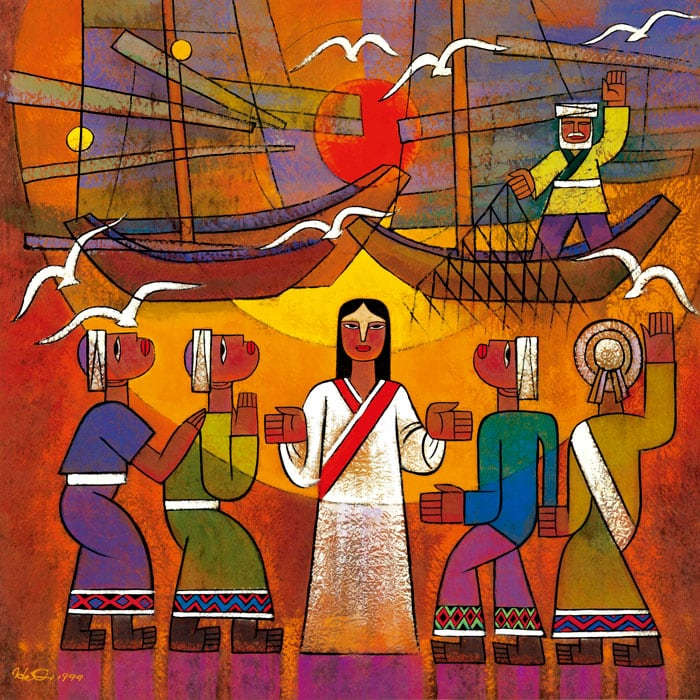
Jesus Calls His Disciples by He Qi

When Jesus heard that John had been put in prison, he withdrew to Galilee. Leaving Nazareth, he went and lived in Capernaum, which was by the lake in the area of Zebulun and Naphtali—to fulfill what was said through the prophet Isaiah:

“Land of Zebulun and land of Naphtali,
    the Way of the Sea, beyond the Jordan,
    Galilee of the Gentiles—
the people living in darkness
    have seen a great light;
on those living in the land of the shadow of death
    a light has dawned.”

From that time on Jesus began to preach, “Repent, for the kingdom of heaven has come near.”

As Jesus was walking beside the Sea of Galilee, he saw two brothers, Simon called Peter and his brother Andrew. They were casting a net into the lake, for they were fishermen. “Come, follow me,” Jesus said, “and I will send you out to fish for people.” At once they left their nets and followed him.

Going on from there, he saw two other brothers, James son of Zebedee and his brother John. They were in a boat with their father Zebedee, preparing their nets. Jesus called them, and immediately they left the boat and their father and followed him.

Jesus went throughout Galilee, teaching in their synagogues, proclaiming the good news of the kingdom, and healing every disease and sickness among the people. (New International Version)

What is “ministry”? 

For some, ministry is only about the souls of people; it is seeing as many people respond to the message of salvation in Christ as possible. 

For others, ministry is meeting the tangible needs of people because there is such a breadth and depth of human social and physical problems. 

And, for others, ministry is defined in terms of what takes place within the four walls of a church building, led by pastors and church leaders.

“Ministry takes place when divine resources meet human needs through loving channels to the glory of God.”

Warren Wiersbe

Problems, however, arise whenever we:

  • Focus on one dimension of ministry. Because, in reality, ministry is multidimensional.
  • Fulfill the outward, administrative demands of ministry – without going after the relational heart of what ministry entails. 
  • Forget about whole groups of people who are different than us. Ministry is for everyone, not some.

We need to look at the ministry of Jesus – what he did and why he did it. Christ’s purpose is to be our purpose: Minister to the total life of all people.

Jesus Preaching

Before there were newspapers, CNN, and 24 hour news cycles, ancient people heard what was happening from heralds or preachers who loudly announced in the streets the important news of the day.

Jesus had a ministry to both Jew and Gentile. Although his ministry was chiefly directed toward his fellow Jews, Christ went out of his way to engage Gentiles, as well, with a message of repentance.

Repentance is turning the whole person – body, soul, mind, will, and emotions – from sin and disobedience to God in obedience to the message of Christ. It involves humility, sorrow for sin, and a commitment to following Jesus.

To repent doesn’t mean to manage sin or clean up parts of my life; it’s a radical conversion from an old way of life to a new way of life. Repentance is not simply adding Jesus to our schedule but is a complete change of how we live.

Christianity is a life, not just an event. Following Jesus is a journey, a life-long process of inner transformation; a complete forsaking of anything that does not please God; and a desire to reorient my life around what’s important to God. 

To illustrate this in a contemporary context, I ask, “What does it mean to follow the Green Bay Packers football team?” A fan not only watches all the games from start to finish, but cheers loudly for the Packers; talks about the Packers with everyone, even strangers; and doesn’t cheer for the Chicago Bears! Fans are committed to their team.

The difference, however, between football and Christianity, is that followers of a team are fans, whereas followers of Jesus are not fans in the stands or watching the television. Instead, Christ followers are on the field of play as teammates with Jesus.

So, when it comes to repentance, we turn from being fans of Jesus to followers of Jesus, doing what he did and saying what he said. We are active participants in the kingdom of God – embracing and embodying a message of repentance to new life in Christ.

Jesus Calling

Jesus calling the first disciples illustrates the kingdom message: a radical break with the old life. Each disciple walked away from a good life and embraced of a new life following Jesus.

Some understanding of Jewish culture in the time of Jesus is helpful here. Central to the life of any Jew was the Torah, the Law. Around age 6, Jewish boys would begin to go to the synagogue for schooling in the Torah by the local rabbi. 

This first level of education was called Beth Sefer (“House of the Book”) and would last until about age 10. In those four years, the first five books of the Old Testament, the Pentateuch, were thoroughly memorized.

By age 10, some of the boys would distinguish themselves as good students and able to handle Torah. So, they would continue on in the second level of schooling called Beth Talmud (“House of Learning”). Those that did not continue with school would then learn the family trade and become an apprentice. Those that went on with school would then memorize the rest of the Old Testament.

At about age 14, only the best of the best were studying Torah. At the completion of their studies, they would apply to a well-known rabbi in order to become his disciple. The goal of this third level was to become just like the rabbi. This was called Beth Midrash (“House of Study”). The rabbi essentially interviews the teenager to find out if he has the stuff to become like the rabbi. 

If the rabbi believes the kid doesn’t have it in him, he tells him to go back to the family business. If, however, the rabbi grills the kid and finds he has what it takes, then he will say to him, “Come, follow me.” It was considered a great privilege and opportunity, and the teenager would leave everything to literally follow the rabbi everywhere he went.

Now, let’s return to Christ’s disciples. Jesus calls Andrew, Peter, James, and John. At the time, they were fishing because they were fishermen. That meant somewhere along the line they didn’t have what it took to further their education, or to follow a rabbi. 

Let’s, then, not miss the import and impact of Jesus saying to them, “Come, follow me!”  Jesus is expressing a belief that these men can become just like him. Well, of course you drop your nets and follow him! Jesus believes I can be like him! Jesus took a group of young men who couldn’t make the grade and used them to change human history. 

Jesus also says the same thing to you and me: I choose you. Come, follow me. 

Christ believed in us before we believed in him. Yes, Jesus believes you can do all the work of embodying the very words of God and becoming like him.

The attitude here is not, “Oh, geez, I have to go do ministry,” as if I were a teenager who was just asked to do the dishes. Rather, the attitude is of privilege and opportunity. If we fail to view ministry in this way, then we must come back to the message of repentance and have an attitude adjustment. People who follow Jesus do so because they get to, not because they have to.

Jesus Healing

            Envision yourself walking with Jesus and following him. You observe several things about his ministry of healing:

  • Jesus heals every problem. Christ has the power and authority to do so.
  • Jesus heals the whole person – not just the physical, or just the spiritual.
  • Jesus heals people whether they repent or not. Christ never made repentance a prerequisite for healing. He heals simply because he wants to.
  • Jesus heals to defeat the devil. Christ continually looks to reverse the hold that sin has on people.
  • Jesus chose to focus on healing the destitute, the poor, and the disadvantaged – rather than directing ministry to the higher classes and royalty to mediate his wishes to the people.

Who are the people – the least, the lonely, the lost – in need of healing in your family, neighborhood, and community?

  1. Those who are ill with various diseases
  2. Those suffering severe pain – of body, mind, emotion, and spirit
  3. The demon possessed or demonically influenced
  4. Prisoners and ex-convicts
  5. The working poor, and the elderly poor
  6. Those in the hospital with no one to visit them
  7. Those who grieve alone
  8. Those with addictions and behavioral issues
  9. Victims of verbal or physical abuse
  10. And many, many more….

Jesus had a ministry of both word and deed. To follow Christ is to become like him and pass on what we have learned to reliable people who will do the same.