A Prayer of Confession and Contrition (Nehemiah 9:16-25)

But they—our own ancestors—acted arrogantly.
They became stubborn and wouldn’t obey your commands.
They refused to listen.
They forgot the miracles you performed for them.
They became stubborn and appointed a leader
to take them back to slavery in Egypt.
But you are a forgiving God,
one who is compassionate, merciful, patient,
and always ready to forgive.
You never abandoned them,
even when they made a metal statue of a calf for themselves
and said, ‘This is your god who took you out of Egypt.’
They committed outrageous sins.
But because of your endless compassion,
you didn’t abandon them in the desert.
The column of smoke didn’t leave them during the day,
but it led them on their way.
The column of fire didn’t leave them during the night,
but it gave them light to see the way they should go.
You gave them your good Spirit to teach them.
You didn’t keep your manna to yourself.
You gave them water to quench their thirst.
You provided for them in the desert for 40 years,
and they had everything they needed.
Their clothes didn’t wear out, and their feet didn’t swell.

You gave kingdoms and nations to the Israelites
and assigned them their boundaries.
So they took possession of the land of Sihon,
the land of the king of Heshbon,
and the land of King Og of Bashan.
You made their children as numerous as the stars in the sky.
You brought them into the land you told their parents to enter and possess.
Their children took possession of the land.
You defeated for them the Canaanites, who lived in the land.
You handed the Canaanite kings and their people over to them
to do whatever they wanted with the Canaanites.
The Israelites captured fortified cities and a rich land.
They took possession of houses filled with all sorts of good things,
cisterns, vineyards, olive trees,
and plenty of fruit trees.
So they ate and were satisfied and grew fat.
They enjoyed the vast supply of good things you gave them. (God’s Word Translation)

The Jewish people had experienced the Babylonian Captivity. The walls of Jerusalem had been torn down, and the Temple was ransacked and destroyed.

Years later, the Persians overthrew the Babylonians, and many of the Jewish captives were allowed to return to Judea. One of the returning groups was led by Nehemiah, who was a cupbearer to the king.

Nehemiah engaged in an ambitious project of rebuilding Jerusalem’s wall and securing the city. It was a large undertaking. Yet, even more daunting was restoring the Jewish people’s worship of Yahweh, and following the Torah, God’s law.

Today’s Old Testament lesson takes place in the fifth century B.C.E. Nehemiah, along with the religious leader Ezra the scribe, organized a public assembly. The people listened to the Torah being read, and were fasting, confessing, and repenting of the ways they had neglected God’s law.

A group of Levites (the priests) stood up and said a long prayer of confession. Our verses for today are a part of that extended time of confession of sin and profession of faith. The people’s past history was very much a part of their present circumstances.

The Levities emphasized that it is God’s nature to be full of faithfulness and steadfast love. So, the Lord preserved the Israelites and rescued them out of Egyptian slavery through a series of miraculous wonders.

While their ancestors were out in a desert sojourn, anticipating entry into the Promised Land, God was faithful to provide for the Israelites both physical and spiritual food – Torah and manna.

And yet, despite the incredible rescue from Egypt, and miraculously escaping through the Red Sea, the people were rebellious. Their disobedience to God in the golden calf experience prevented that generation from entering into the promised rest. (Hebrews 3:16-19)

Every generation has its “sinners,” those who seem to have a bent toward selfish behavior, and refuse to see the needs of the entire group. They only serve God if it serves their own self-centered purposes. And they stubbornly refuse to bend to anyone’s wishes, including God’s.

Unfortunately, that sin of pride and arrogance gets passed down to the next generations. It’s not only, in some ways, taught; this sort of stubbornness also appears to have a genetic component, as well. Whenever our minds and hearts are rewired with injustice toward others and disobedience toward God, that wacky wiring gets passed down to the next generations.

It is quite likely that past trauma has a lot to do with skewed minds and hearts.

Epigenetics is a scientific field which investigates how environment influences our genes. Trauma does not alter our actual DNA sequence; but it does impact how that sequence is read and utilized in our body.

When an individual experiences trauma, their body may adapt by adjusting gene expression, and some of these changes can be passed on to their children. It’s like passing on genetic notes to our progeny – which means that these notes can be rewritten (and rewired) by our own life experiences and actions.

I am not a genetic scientist, yet this may be something akin to the divine warning about generational sin, arising from a generation’s trauma experience, after being enslaved and mistreated for 400 years in Egypt. In giving the Law to Moses, God then said:

“The Lord, the Lord, the compassionate and gracious God, slow to anger, abounding in love and faithfulness, maintaining love to thousands, and forgiving wickedness, rebellion and sin. Yet he does not leave the guilty unpunished; he punishes the children and their children for the sin of the parents to the third and fourth generation.” (Exodus 34:6-7, NIV)

Whether any of us knows anything about genetics and epigenetics, or not, there yet remains the need for a prayer of confession. It is necessary to acknowledge our own sins, as well as the sins of our ancestors.

In their prayer of confession, the Levites in Nehemiah’s time acknowledged and confessed their own guilt, and the guilt of their ancestors, of being the following:

  1. Obstinate. They stubbornly presumed God would be with them, then obstinately did whatever the heck they wanted.
  2. Stubborn. They were “stiff-necked” and refused to obey God when they didn’t want to.
  3. Forgetful. Not an accidental forgetting, but a purposeful neglect to remember what God had done for the people.
  4. Idolatrous. It was the people’s impatience with waiting for Moses on Mount Sinai that led to the golden calf idol disaster. Failing to accept God’s timetable will always lead to a bevy of bad behavior.
  5. Disobedient. The most sinister form of this is obeying halfway, and believing that you have completely done your duty for God, i.e. the sin of one person, Achan, affecting the entire community. (Joshua 7:1, 10-12, 20-26)
  6. Complaining. Murmuring and grumbling is the dissatisfying attitude and speech of ingrates. When directed at God, it is a failure of faith, replaced with a belief that God is mean and/or capricious.

Confession and repentance are the remedies to both individual and communal guilt. And that is exactly what Ezra and Nehemiah organized the post-exilic Israelites to do, publicly.

Not only did they offer a prayer of confession and repentance, but they also acknowledged and believed God’s faithfulness and mercy to forgive, renew, and restore.

Indeed, God’s grace is greater than all of our sin.

The Levites were not simply offering a mechanical liturgical formula for corporate confession. They were crying out with heartfelt confession to the God they believed was listening and would respond.

As the Levites led the people in confession and repentance, they pointed to the following attributes and activities of God which they put all of their trust in:

God forgives.

He made known his ways to Moses,
    his deeds to the people of Israel:
The Lord is compassionate and gracious,
    slow to anger, abounding in love.
He will not always accuse,
    nor will he harbor his anger forever;
he does not treat us as our sins deserve
    or repay us according to our iniquities.
For as high as the heavens are above the earth,
    so great is his love for those who fear him;
as far as the east is from the west,
    so far has he removed our transgressions from us. (Psalm 103:7-12, NIV)

God guides.

He guides me along the right paths
    for his name’s sake. (Psalm 23:3, NIV)

God provides.

He has caused his wonders to be remembered;
    the Lord is gracious and compassionate.
He provides food for those who fear him;
    he remembers his covenant forever. (Psalm 111:4-5, NIV)

God sustains.

I lie down and sleep;
    I wake again, because the Lord sustains me. (Psalm 3:5, NIV)

When all is said and done, the centrality of God is humanity’s ballast. As we orient all of life around the Lord, this is what makes all the difference in coming to grips with our past, present, and future.

May it be so, to the glory of God.

I Am Responsible and Accountable (Ezekiel 18:1-32)

The word of the Lord came to me: “What do you people mean by quoting this proverb about the land of Israel:

“‘The parents eat sour grapes,
    and the children’s teeth are set on edge’?

“As surely as I live, declares the Sovereign Lord, you will no longer quote this proverb in Israel. For everyone belongs to me, the parent as well as the child—both alike belong to me. The one who sins is the one who will die.

“Suppose there is a righteous man
    who does what is just and right.
He does not eat at the mountain shrines
    or look to the idols of Israel.
He does not defile his neighbor’s wife
    or have sexual relations with a woman during her period.
He does not oppress anyone,
    but returns what he took in pledge for a loan.
He does not commit robbery
    but gives his food to the hungry
    and provides clothing for the naked.
He does not lend to them at interest
    or take a profit from them.
He withholds his hand from doing wrong
    and judges fairly between two parties.
He follows my decrees
    and faithfully keeps my laws.
That man is righteous;
    he will surely live,
declares the Sovereign Lord.

“Suppose he has a violent son, who sheds blood or does any of these other things (though the father has done none of them):

“He eats at the mountain shrines.
He defiles his neighbor’s wife.
He oppresses the poor and needy.
He commits robbery.
He does not return what he took in pledge.
He looks to the idols.
He does detestable things.
He lends at interest and takes a profit.

Will such a man live? He will not! Because he has done all these detestable things, he is to be put to death; his blood will be on his own head.

“But suppose this son has a son who sees all the sins his father commits, and though he sees them, he does not do such things:

“He does not eat at the mountain shrines
    or look to the idols of Israel.
He does not defile his neighbor’s wife.
He does not oppress anyone
    or require a pledge for a loan.
He does not commit robbery
    but gives his food to the hungry
    and provides clothing for the naked.
He withholds his hand from mistreating the poor
    and takes no interest or profit from them.
He keeps my laws and follows my decrees.

He will not die for his father’s sin; he will surely live. But his father will die for his own sin, because he practiced extortion, robbed his brother and did what was wrong among his people.

“Yet you ask, ‘Why does the son not share the guilt of his father?’ Since the son has done what is just and right and has been careful to keep all my decrees, he will surely live. The one who sins is the one who will die. The child will not share the guilt of the parent, nor will the parent share the guilt of the child. The righteousness of the righteous will be credited to them, and the wickedness of the wicked will be charged against them.

“But if a wicked person turns away from all the sins they have committed and keeps all my decrees and does what is just and right, that person will surely live; they will not die. None of the offenses they have committed will be remembered against them. Because of the righteous things they have done, they will live. Do I take any pleasure in the death of the wicked? declares the Sovereign Lord. Rather, am I not pleased when they turn from their ways and live?

“But if a righteous person turns from their righteousness and commits sin and does the same detestable things the wicked person does, will they live? None of the righteous things that person has done will be remembered. Because of the unfaithfulness they are guilty of and because of the sins they have committed, they will die.

“Yet you say, ‘The way of the Lord is not just.’ Hear, you Israelites: Is my way unjust? Is it not your ways that are unjust? If a righteous person turns from their righteousness and commits sin, they will die for it; because of the sin they have committed they will die. But if a wicked person turns away from the wickedness they have committed and does what is just, and right, they will save their life. Because they consider all the offenses they have committed and turn away from them, that person will surely live; they will not die. Yet the Israelites say, ‘The way of the Lord is not just.’ Are my ways unjust, people of Israel? Is it not your ways that are unjust?

“Therefore, you Israelites, I will judge each of you according to your own ways, declares the Sovereign Lord. Repent! Turn away from all your offenses; then sin will not be your downfall. Rid yourselves of all the offenses you have committed, and get a new heart and a new spirit. Why will you die, people of Israel? For I take no pleasure in the death of anyone, declares the Sovereign Lord. Repent and live! (New International Version)

Every single one of us is accountable to one another for what we say and how we conduct ourselves. Above all, we are accountable to God for our motives, words, and actions in this life.

The flipside to stating that we are accountable, is saying that none of us are responsible for another person’s intentions, words, or actions.

Other people may influence us. We may be either participants in or victims of another’s actions. Some folks might take credit for something another person said or did. Yet, ultimately, we are responsible for our own life.

Whatever I think, say, or do is on me, period.

What’s more, one’s past actions do not replace our current actions. The prophet Ezekiel emphasized individual responsibility and accountability. All of the other Old Testament prophets addressed whole nations, and not individuals. They denounced the social, economic, and political systems and institutions, upholding communal ideals of justice.

Ezekiel communicated that children shall not be punished for their parent’s sins. Only the person who sins will face judgment.

A person ought only to pay for their own sins; punishment should not carry forward to future generations. The prophet also insisted that each individual person has the opportunity to change their behavior, and so, avoid their deserved penalty.

Every individual has the opportunity to change their personal ways of injustice or unrighteousness. For those who refuse, there is a and right and just Judge who knows how to dispense what is needed for each person – whether it is judgment to the arrogant, comfort to a victim, or justice for the underprivileged.

God cares that every person on earth receives what they need to thrive and flourish in this life. And to those who don’t give a wit about others, the Lord gives an opportunity to turn from arrogance and change.

Refusing to change, however, will end badly for the stubborn person.

The prophet Ezekiel calls on individuals to speak and act in ways that are helpful, not harmful. And whenever one harms another, that one must acknowledge the irresponsibility, because I am held accountable for what I say and do.

All words and actions come with consequences. It would do us a lot of good to consider how what we say and do (or fail to say and do) impacts the next generation of people. Everyone leaves a legacy of some sort – whether good or bad – so we need to be aware of how we live.

Each person must take up the mantle to do good, not evil; and to live righteously, not wickedly. Living selfishly with impunity leads to divine judgment. Yet, mercy is always there, if we seek to amend our ways.

Conversely, living righteously, and then resting on my laurels and living however I want, does not inoculate me from divine judgment.

You and I must live one day at a time, trusting God and seeking the welfare of others. And when I mess up, I am to keep a short account with God by admitting my fault and receiving grace.

We humans have quite enough responsibility in our lives without taking on the extra job of exacting judgment on another person. If we live a righteous life to begin with, then there is no need for a new heart and life.

Yet, if I need it, a new existence is there, through a change of direction which humility grants us.

Almighty God, help me to prioritize your values, and put my faith into action. Enable me to use the talents, resources, and time with which I have been blessed. Empower me to serve my community and my world. May I serve you always, and pray with a joyful spirit. Amen.

I Concede (Job 42:1-6, 10-17)

By Bible Art

Then Job answered the Lord:

“I know that you can do all things
    and that no purpose of yours can be thwarted.
‘Who is this that hides counsel without knowledge?’
Therefore I have uttered what I did not understand,
    things too wonderful for me that I did not know.
‘Hear, and I will speak;
    I will question you, and you declare to me.’
I had heard of you by the hearing of the ear,
    but now my eye sees you;
therefore I despise myself
    and repent in dust and ashes.”

…And the Lord restored the fortunes of Job when he had prayed for his friends, and the Lord gave Job twice as much as he had before. 

Then all his brothers and sisters came to him, and all who had known him before, and they ate bread with him in his house; they showed him sympathy and comforted him for all the evil that the Lord had brought upon him; and each of them gave him a piece of money and a gold ring. 

The Lord blessed the latter days of Job more than his beginning, and he had fourteen thousand sheep, six thousand camels, a thousand yoke of oxen, and a thousand donkeys. He also had seven sons and three daughters. He named the first Jemimah, the second Keziah, and the third Keren-happuch. In all the land there were no women so beautiful as Job’s daughters, and their father gave them an inheritance along with their brothers. 

After this Job lived one hundred and forty years and saw his children and his children’s children, four generations. And Job died, old and full of days. (New Revised Standard Version)

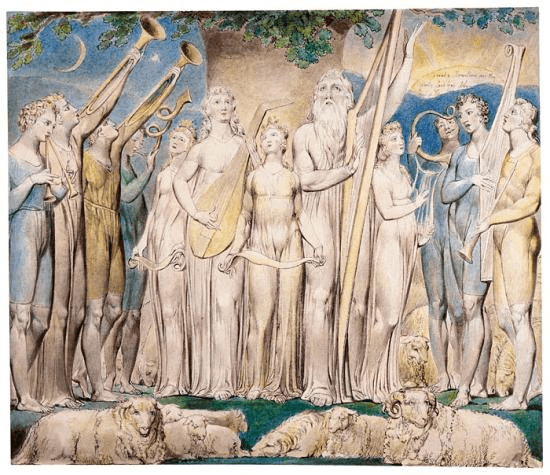
Job is restored, by William Blake (1757-1827)

Job was in awful suffering. He contended with God about it. Job’s friends contended with Job. In the end, God never gave a humanly suitable answer to the problem of suffering. Namely, because we cannot understand the answer, even if it is provided.

Indeed, the gap between God and humanity is quite pronounced. God is the Creator. We are creatures. Yet, God did vindicate Job.

That’s right God affirmed Job – and not Job’s companions. Even though Job did what many a believer in God today believes is wrong, perhaps even sacrilegious or sinful.

Job argued, confronted, grappled with, and even opposed God for the terrible troubles he faced in losing his family, his wealth, and his health. He fully engaged God.

Job’s friends, however, did no such thing. Instead, they argued, confronted, grappled with, and even opposed their friend Job. They fully avoided God.

In the end, Job conceded that he himself knows nothing. Yet, there is still the hint of complaint within him. This is good. Job did not stop engaging God. He remained faithful and devoted.

Let us never believe that faithfulness and devotion to God involves putting up a false front and nice polite piety. Prayer, in truth, is a hard wrestling with God, a struggling and working through all the difficulties of this unfair life.

God is not the least offended by our full, real, and raw engagement of him. But God is offended by avoiding such engagement altogether.

All of us, in reality, speak mostly in ignorance. We talk about things we don’t really understand. The only thing we can be 100% truthful about, however, is ourselves – about how we are really doing, feeling, experiencing, believing, struggling with, etc.

I myself am the true expert on me – and you, the expert on you. And this truth I can bring to God anytime, anywhere. The Book of Job affirms to me that this is the sort of devotion and sacrifice which the Lord is pleased with.

Job gained some knowledge and understanding through personally encountering God. The Lord God almighty, Creator of heaven and earth, actually spoke to Job in a direct revelation of the Divine presence.

This is an affirmation of Job’s integrity. But the godless, disintegrated, and fragmented person cannot see God or expect a personal audience with God.

Through all that Job had been through, he held to his integrity, and held onto God, both at the same time. In the end, he still did not understand why he had to go through such horrible suffering.

English translations of the Hebrew text don’t do it justice. There is always something lost in translation of any language to another. And it seems what is lost here is that Job was perhaps still protesting at the end. Yet, it comes across in English as Job despising and abhorring himself, as if he had done something very wrong.

“I despise myself,” misses the mark. Without getting into some deep grammatical Hebrew waters, I wonder if the phrase might better be rendered, “I protest.” What is meant to be conveyed is that Job still acknowledges what he originally held onto. Namely, that he has done nothing wrong, did not deserve what he went through, yet has never rejected God, nor lost faith in God.

Job did not need to repent of some secret sin, as his friends supposed. Job repenting does not mean because of sin; Job’s repentance was a change of position from mourner and complainer, to accepting the situation as it is, without answers.

So, this brings us back to the beginning of the book. God is God. There are celestial forces and operations in play we know nothing about. Humans are not God. Humans are never going to get most of what is happening in this world. And humans will inevitably experience hard and bad things – and not know why.

No answers given. No change of situation (yet). But Job changed. He changed his mind about how to live with what he was experiencing. He relinquished his complaint, and decided to keep living, even though he did not get answers.

Honestly, this response of Job is more consistent with my own experience of awful suffering, and more faithful to the text of Scripture. Much like Jacob wrestling with the angel, Job had to finally concede and relent, and continue on his life journey, come what may.

Following Job’s intercession for his friends, God restored Job to wealth and family. A significant piece of this restoration was Job’s wider community of friends and family who gathered around him, giving Job the consolation and comfort that the three “friends” in the book did not provide.

The community cared for Job, not through nice theological phrases, but with genuine fellowship. They shared together around the table, the community giving both a meal and contributing monetary gifts for Job’s needs.

The Book of Job ends, perhaps with as many, or more, questions than when it started. Answers, however, are not the point.

Rather, Job’s incredible and awful experience of suffering and redemption becomes an invitation for you and me to have a more expansive view of what a relationship with the living God truly looks like.

May God bless you with discomfort
At easy answers, half-truths, and superficial relationships,
So that you may live deep within your heart.

May God bless you with anger
At injustice, oppression and exploitation of people,
So that you may work for justice, freedom and peace.

May God bless you with tears
To shed for those who suffer pain, rejection, hunger, and war,
So that you may reach out your hand to comfort them
And turn their pain into joy.

And may God bless you with enough foolishness
To believe that you can make a difference in the world,
So that you can do what others claim cannot be done
To bring justice and kindness to all our children and the poor. Amen.

Be Honest (Job 42:7-9)

Job’s Sacrifice, by William Blake (1757-1827)

After the Lord had finished speaking to Job, he said to Eliphaz, “I am angry with you and your two friends, because you did not speak the truth about me, the way my servant Job did. Now take seven bulls and seven rams to Job and offer them as a sacrifice for yourselves. Job will pray for you, and I will answer his prayer and not disgrace you the way you deserve. You did not speak the truth about me as he did.”

Eliphaz, Bildad, and Zophar did what the Lord had told them to do, and the Lord answered Job’s prayer. (Good News Translation)

After all of Job’s terrible trouble in losing everything and everyone he cared about; after all of the longwinded speeches of his supposed friends; and after God’s breaking of silence through unanswerable questions; the epilogue of the story brings us God’s verdict concerning Job and his situation.

God finally dispenses his assessment, and renders his judgment. The Lord was not at all happy with Job’s companions; and was pleased with Job. Therefore, God made a decision against the companions, and for Job.

Four times in three verses, God refers to Job as “my servant,” but does not describe the friends as such. It is Job, and not Job’s friends, who spoke truth. Only Job spoke words consistent with reality.

At best, the friends spoke unhelpful words. At the worst, their words were hurtful and full of hubris. In retrospect, they probably should have at least kept their mouths shut. And ideally, they could have been true comforters, and consoled Job in his agony.

This gets at something which I believe we all need to get a firm hold upon: Not extending help, mercy, and consolation to those in dire straits, pisses-off God.

It irks God because it is a misrepresentation of God’s basic character, and distorts God’s true nature.

Being dishonest and pretending to be okay when one is not…

telling someone who is hurting to suck it up and confess their sin…

believing that the world operates according to good guys getting health and wealth, and bad guys getting sickness and poverty…

downright angers the holy and merciful God of the universe.

Job, unlike the Three Stooges he had as friends, affirmed what is right and true:

  • God is the Sovereign of the universe who dispenses both good and bad (Job 2:10)
  • God is the One who gives and who takes away (Job 1:21)
  • God is the Lord to whom we must bow in willing submission (Job 42:5-6)

In the dialogue with his friends, Job rightly insisted that God is sometimes an enemy, and that God’s inexplicable silence and absence is unjust and destructive.

I don’t want you to easily pass over what I just referred to, or to flip-out over it. In truth, God is both present and absent. And God’s absence hurts. Sometimes, it hurts like hell. We must affirm that God is sometimes silent. There are times when it feels like God is on vacation and is paying no attention.

I want you to get ahold of this important dimension to the spiritual life:

Human pretentions and posturing only present a false self to God and the world. That sort of behavior angers God. The Lord wants honest vulnerability.

Whereas Job’s friends insisted on maintaining theological respectability and an ordered theological system, Job essentially said, “To hell with all that!”

And Job was right.

Job contended with God. He cried, yelled, and exposed his innermost thoughts and feelings to God. Job was real. No phoniness existed with him. Yet, Job did not forsake God, curse God, or say there was no God.

The genuine spiritual life is always a tricky and risky combination of devotion and confrontation toward God.

Job presented his true self to God.

Job’s friends presented to God what they believed God wanted to see and hear.

There is a big difference between those two approaches.

God affirmed Job. God was against Job’s friends.

Maybe today it is necessary to rethink what you have always believed it is which gets God’s affirmation, and what raises God’s ire.

If we cannot be honest about what we are really thinking, and about how we are really doing, then we are hopeless people. In that state, no one can help us. And God is not pleased.

The final verdict of God is that only the prayers of one who speaks truth, like Job, will be effectively heard. Less honest prayers, like those of Job’s wife and friends, are foolish and ineffective.

One of the big overall messages of the Book of Job is this: For God’s sake, be honest!

My own culture is one of Midwest nice. That’s a nice way of saying that Midwesterners are mostly dishonest creatures. Every Midwesterner I know, understands being nice and polite to someone’s face, and then speaking gossip and slander to their back.

Ask any Midwestern American how they are doing, and they’ll tell you, “Just fine,” or “Great!” or “The sun is shining,” or some other deflection or blathering lie about how they are really doing. More than once, I have actually heard a depressed person with suicidal ideation tell another person that they are “doing fine today.”

That sort of claptrap gets us nowhere, especially with God. The Lord is okay with you and I telling him what we really think, even if we are extremely upset with God. God isn’t bothered by our anger, yelling, or messed-up thinking. But God is bothered by our pretending, our dishonesty, and our false presentations.

None of this means that we must wear our heart on our sleeve. In fact, I have found that persons who declare to me that they “tell it like it is,” are some of the most false people on the planet. It’s usually a sign that I’m not going to get from them how they are really feeling. It usually means they’re angry, and want to talk smack against someone, without ever examining themselves.

Don’t be a jerk. There are nice jerks, and obnoxious jerks, but in the end, they’re all just jerks. You and I really can speak honest words of truth, without being a jerk about it.

Job was honest, real, raw, hurt, angry, sad, lonely, and grieving out of his mind. And he was no jerk. And God affirmed him.

Personally, I’d rather have God’s affirmation than anyone else’s. How about you?

Almighty God, help us to speak and act truthfully in all situations. May we be honest with ourselves and with others, building trust and integrity in our relationships. Thank you for your example of truth and honesty. Help us to follow in your footsteps and to live with authenticity.

Guide us to be honest even when it is difficult, recognizing that honesty is the foundation of trust and respect. Help us to confront our own falsehoods and to seek the truth in all aspects of our lives. May we create environments where honesty is valued and encouraged, fostering open and transparent communication.

We pray for those who struggle with honesty, asking for your guidance and support in their journey towards truthfulness. Thank you for the clarity and peace that comes from living honestly. Help us to embrace and uphold this value every day. Amen.